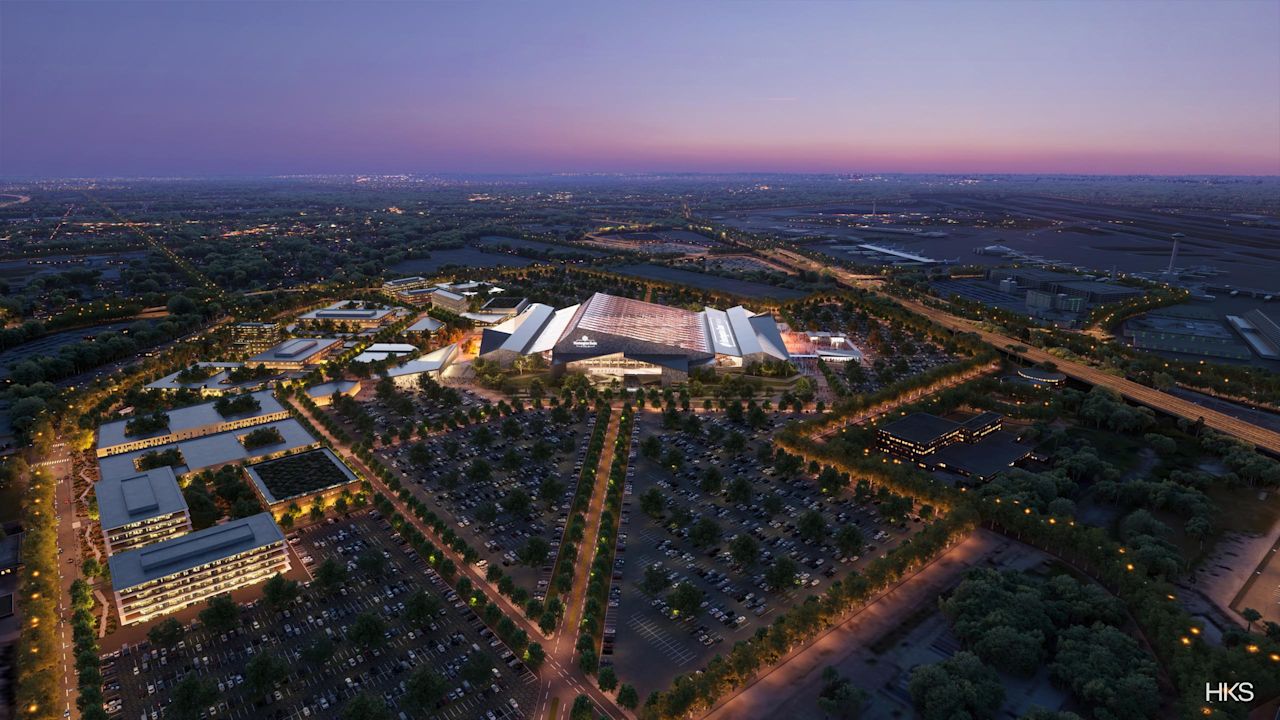
The Browns’ new $2.4 billion stadium and mixed-use destination will repurpose vacant industrial land in Brook Park near Cleveland Hopkins International Airport by 2029 (HKS, HSG). CLICK IMAGES TO ENLARGE THEM.
A clearer image for surrounding mixed-use development
A 68-page master planning document was unceremoniously released last week by the city of Brook Park and Haslam Sports Group (HSG). In it is the most detailed look yet at the key design standards and approach for developing the mixed-use district surrounding the Browns’ new stadium.
A master planning document is a set of guidelines that developers follow to execute a cohesive vision for large-scale projects such as this. It will typically include directions on streetscaping, circulation, building design, wayfinding and signage, retail and more.
This new document presents a more detailed picture of both the programming of the mixed-use district and the phasing. Until this point, HSG and international design firm HKS have only released conceptual renders of the planned $2.4 billion stadium district. It is important to note that this document only outlines design criteria for the mixed-use development surrounding the proposed stadium and not the stadium itself.
It was evident in differences between renders that designs were constantly in flux. Now, the master planning document focuses in on years of tweaks and adjustments to the site layout. And with a groundbreaking scheduled for March 2, the majority of the program elements appear to be in place.
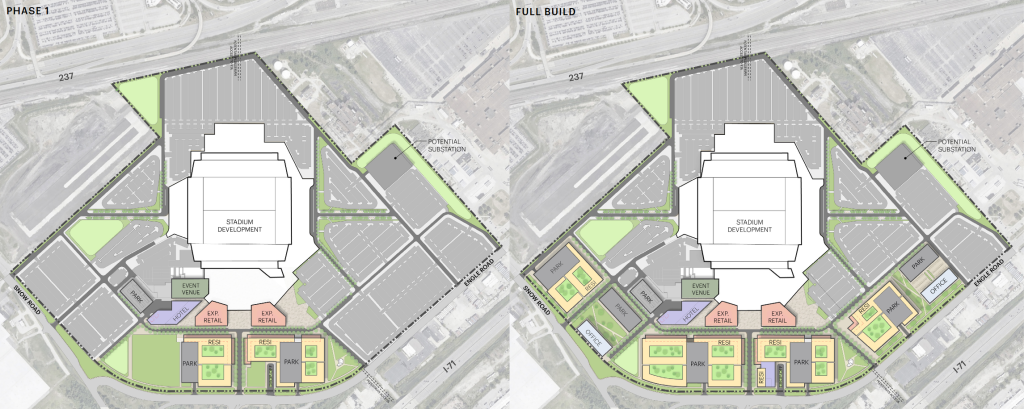
According to the master plan, Phase 1 (left) would be built with the stadium. That phase includes an event venue, hotel and the majority of retail offerings. The full build-out (right) adds additional residential buildings and office space (HKS, HSG).
The first and most telling piece of the master plan highlights the phasing for the mixed-use development. Phase 1 will construct the stadium itself as well as an undisclosed “event venue” and a 350-room hotel. The hotel brand and event space operator have not been named as of the writing of this article.
Sources had speculated that Cosm was a potential host for this venue space but instead chose to partner with Bedrock in downtown Cleveland across from Rocket Arena. Bedrock is spearheading their own multi-billion dollar investment there with the new Cavs-Cleveland Clinic training facility and riverfront redevelopment.
Also in Phase 1 of the Browns’ project, all of the planned residential buildings with ground floor retail will be built along either side of the main street leading up to the stadium entrance. The remaining space would be surface lots for game-day or event parking.
The sum of apartment buildings in Phase 1 will provide 624 units for roughly 900 residents. All residential buildings in the development will have dedicated parking garages centrally located along with interior courtyards for privacy from outside guests visiting the district.
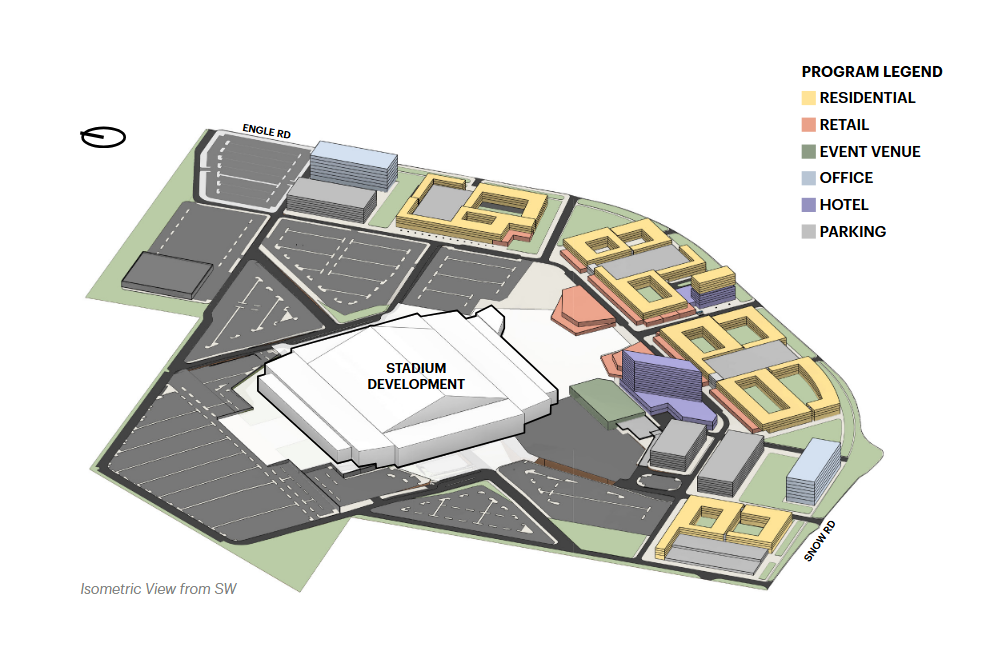
This 3D view of the full build-out highlights the various apartment buildings with ground-floor retail and mid-rise buildings with office and hotel spaces. (HKS, HSG).
In the full build-out, the remaining buildings will be constructed in place of some of the temporary surface parking from Phase 1. This includes two office buildings and an additional 964 apartments in several others, including a dual hotel-residential tower anchoring the main entrance. Included in this phase are several parks throughout the district.
In total, the development will provide 1,588 units for over 2,000 residents, 300,000 square feet of retail, an event venue, 350-room hotel, 500,000 square feet of office space and 5,667 stalls in six parking garages.
Concerns about securing $600 million in state-backed funding to support the Browns’ Brook Park development had led to speculation that the mixed-use district would be an afterthought in delivering the new stadium. But the master plan document suggests that while the stadium will certainly be the focal point, a significant portion of the surrounding area would be developed concurrently or closely behind the stadium in Phase 1. Whether funding is in place to complete the full build out has not yet been confirmed.
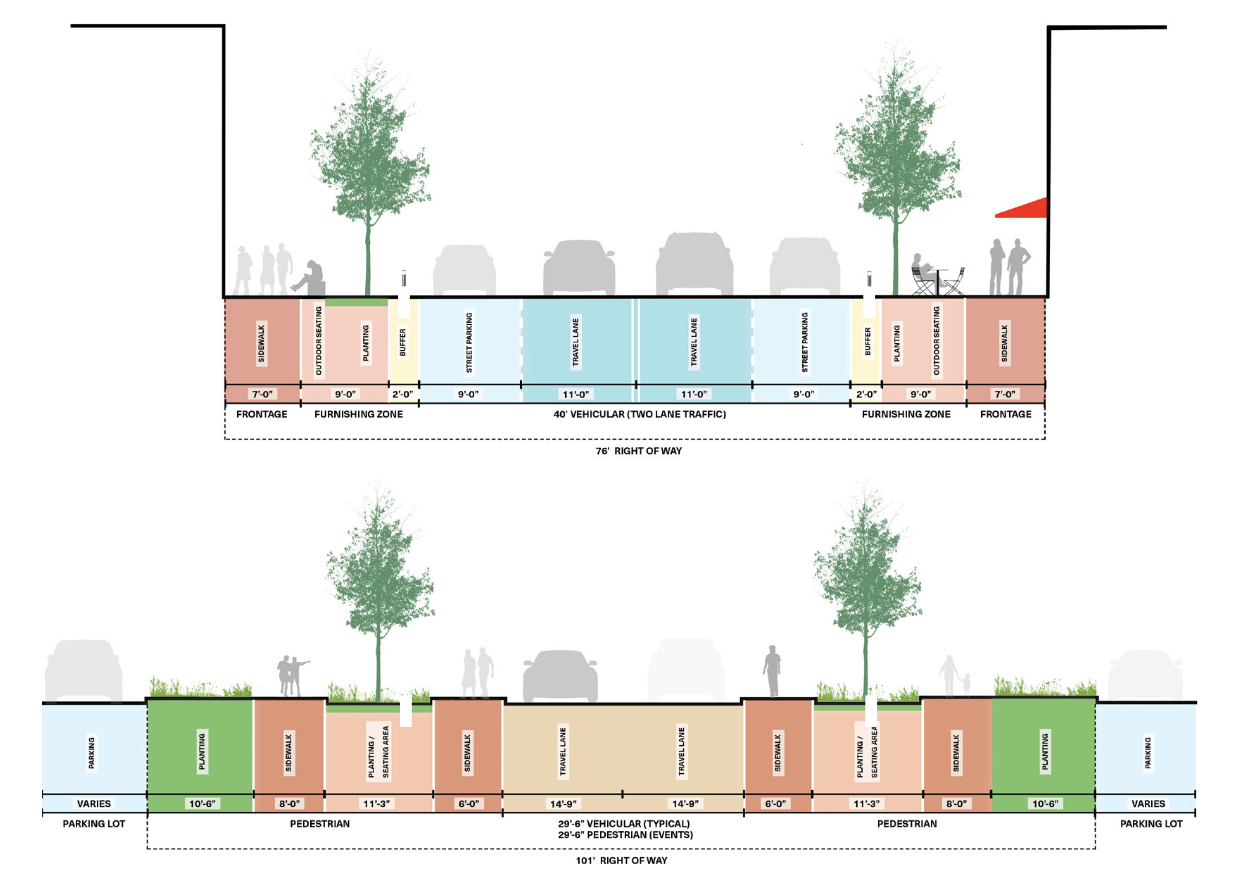
Cross sections of several streets were provided in the master plan. This comparison shows the proposed retail-lined roads versus ones surrounding the parking lots. (HKS, HSG).
Further outlined in the guidelines are streetscaping principles. Proposed for narrower, retail-oriented corridors are pedestrian and furnishing zones separated from roadways with buffers featuring native plantings and trees. For more open zones, wide sidewalks with plantings on either side would convey guests from surface parking lots to the more dense, retail-oriented programming.
The design guidelines for buildings envision a district with various styles of architecture that fit cohesively together. That could mean many things, but likely is a nod to crafting facades that complement the unique design of the stadium itself.
Buildings of at least 30 feet in height are a requirement, with distinct bases, middles and tops for the taller ones. From the ground level, retail is expected to be pedestrian-friendly and inviting, rather than sterile and closed off. Restaurants would include outdoor seating areas, for example.
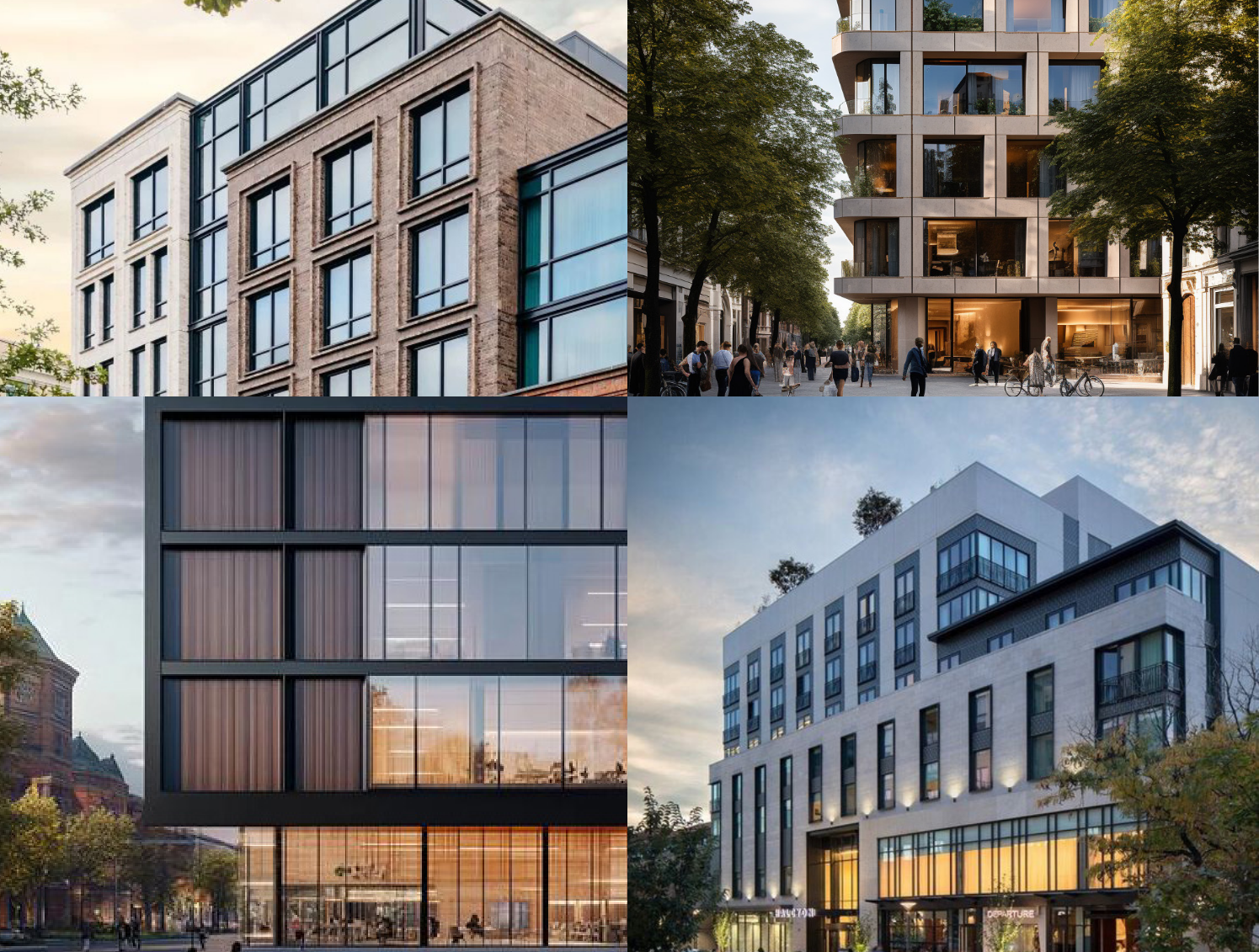
No renders of specific buildings are provided, but a “mood board” of various architectural styles gives an impression of the look HSG is trying to achieve within the new district (HKS, HSG).
Because HSG envisions a year-round district that can survive when football is not in season, retail and restaurants are expected to be a continuous draw and not something that only frequented on game day, much like other “lifestyle centers” around Cleveland today such as HSG’s District 46 under construction nearby in Berea.
When talking about materials, the master plan guides developers to use those that reflect the region, drawing inspiration from rich natural landscapes like woodlands and shores. Much like the stadium’s industrial-looking design, additional buildings would harken to Northeast Ohio’s industrial heritage with the use of brick and steel and appropriate accents.
Linear parks appear to be a key feature of this mixed-use district as well. The large footprints of residential buildings and parking lots are more conducive to narrower parks with benches, lighting and curated plantings rather than wide open spaces.
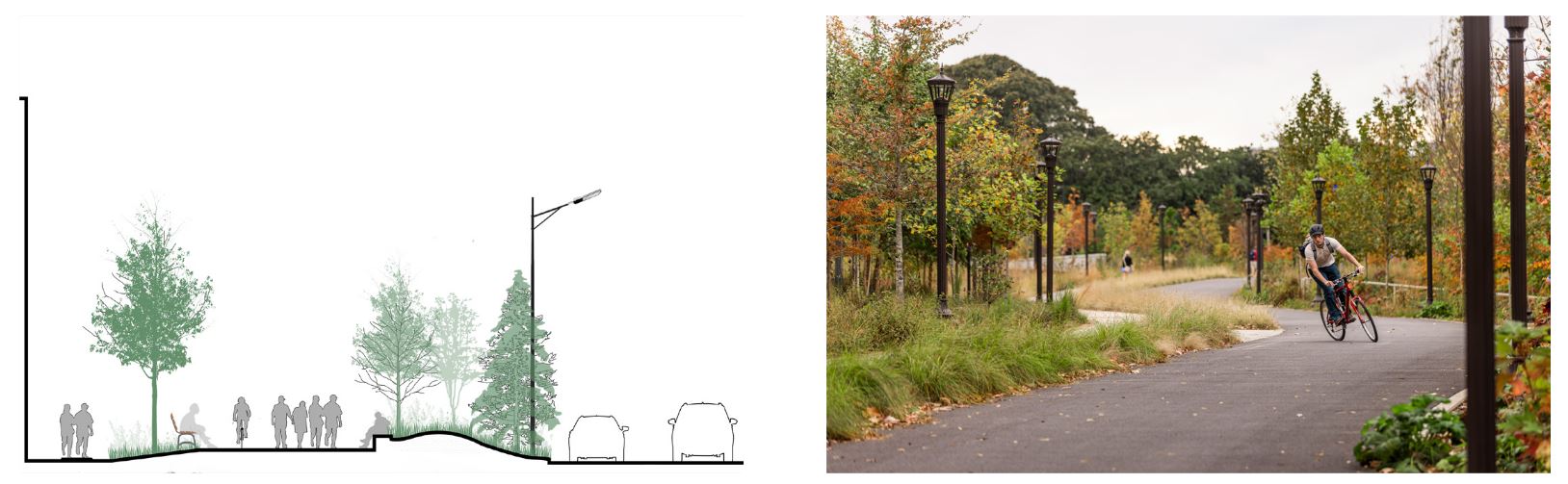
This typical section shows what some linear parks may look like surrounding the new stadium (HKS, HSG).
These parks would serve as communal open spaces on game-day while providing accessible paths, shade and play elements for residents and visitors alike year-round. The master plan shows how they would line a reconstructed Engle Road encircling the district and then weave their way inward towards the stadium.
Finally, expect various signage improvements, lighting and public art installations to draw visitors in to the site and then help them navigate it. Cohesive signage would assist in placemaking and promote a district-wide identity. No final designs were released as part of the document, but a clear direction towards modern pylons, interactables and storytelling geared towards the Browns franchise are preferred.
In terms of public transportation access, the master planning document hints at pedestrian access to a future Greater Cleveland Regional Transit Authority (GCRTA) Red Line light-rail station near the airport. Previous planning documents called out the station but now plans for a new station are no longer explicit.
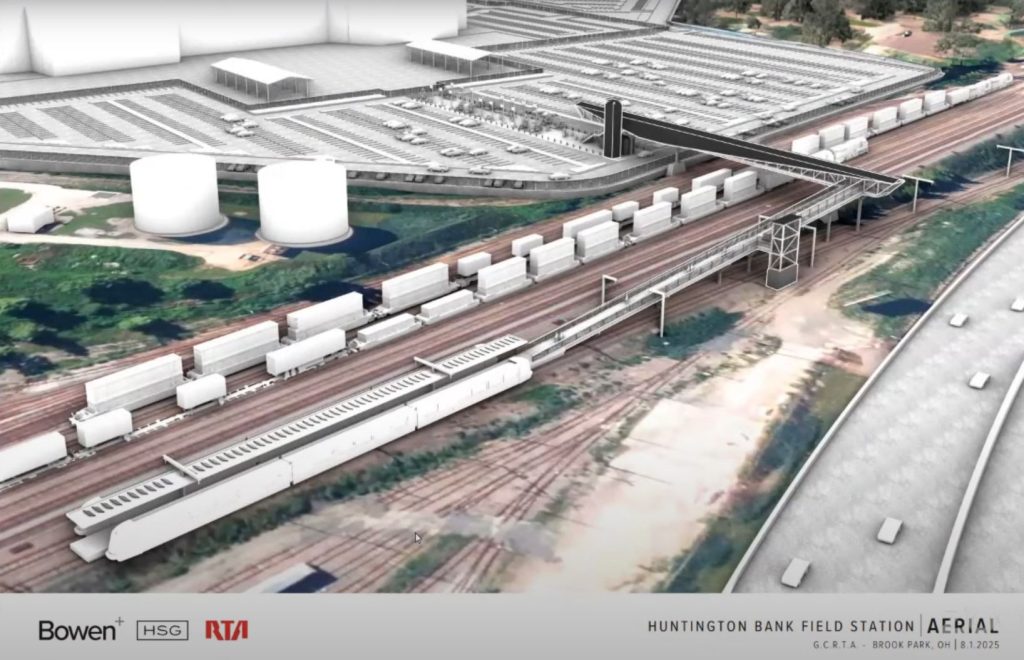
Renders of a proposed GCRTA Red Line station in between Airport and Brookpark stations was floated last year. The station, shown above, has no funding or concrete plans secured, but would provide direct access from public transit to the new stadium if pursued. GCRTA was not a part of the planning process according to leadership (Bowen, HSG).
HSG first floated renders for a new station last year as the current Brookpark station is just over a one-mile walk from the new stadium site. The new Huntington Bank Field is expected to have the least amount of parking of any new NFL stadium, and given that a large contingent of visitors currently use the Rapid to attend games downtown, developers are considering improved public transit access.
No funding has been secured for a new station at this time although GCRTA is aware of the concept and attended a recent public information session held by the city of Brook Park as an observer, according to GCRTA CEO India Birdsong Terry.
It may be a full year until substantial progress is visible on the Browns’ new stadium. Vertical construction on other buildings may not occur until the stadium itself rises out of the ground. In the meantime, continue to check back in with NEOtrans for additional news regarding future tenants and designs for this new mixed-use district.
END