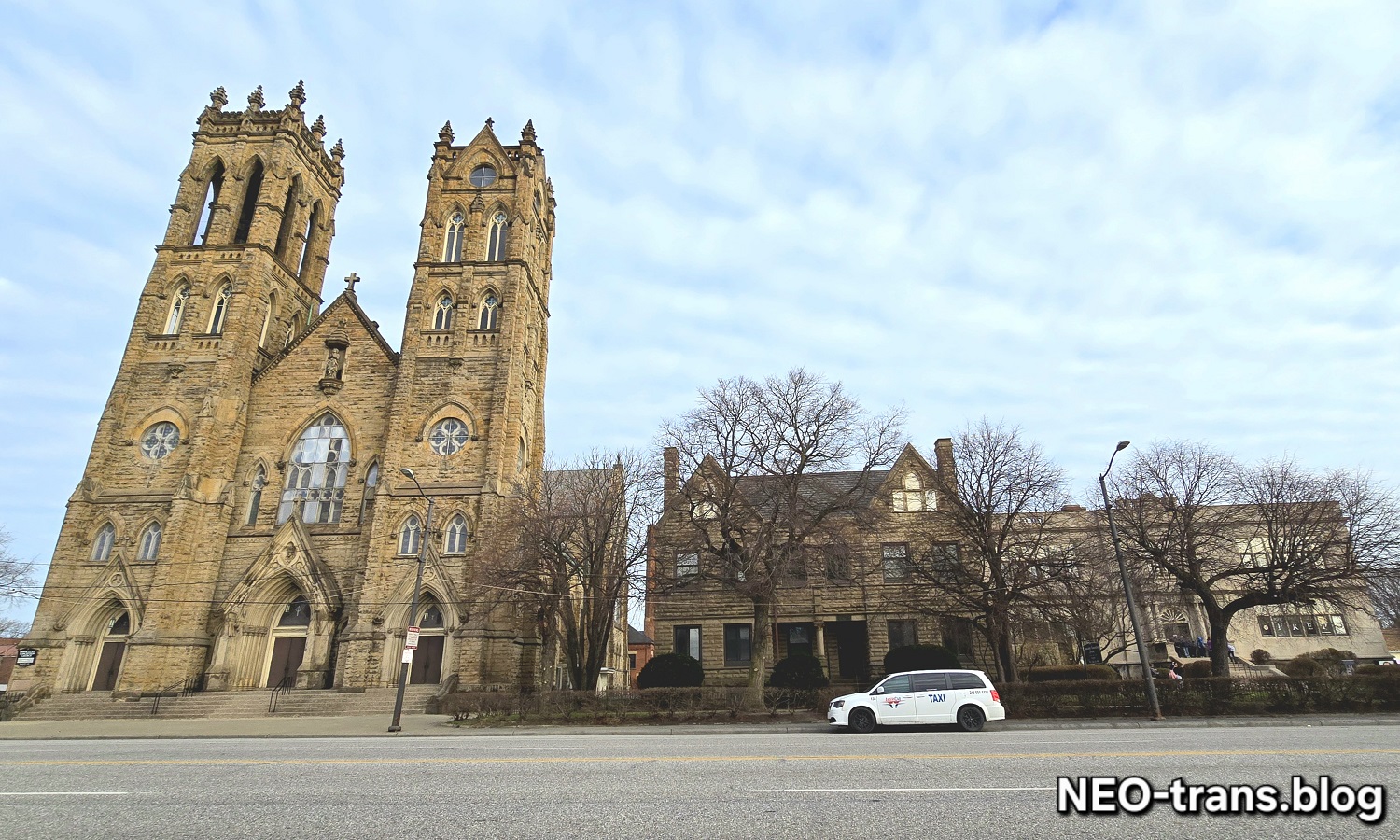
The Immaculate Conception Church, at left, has stood on Superior Avenue at East 41st Street for nearly 150 years. Its future is now uncertain. Its rectory is at center and school is at right (NEOtrans). CLICK IMAGES TO ENLARGE THEM.
Population outmigration, parish decline cited
Immaculate Conception Church, 4129 Superior Ave, opened its doors to a young, Irish immigrant-heavy parish in 1878 on Cleveland’s near-east side. But with later generations of its parish having fled to the suburbs over the ensuing decades, services at the early English Gothic structure are due to end May 24, 2026, possibly forever.
Cleveland Catholic Diocese Bishop Edward Malesic decreed on March 11 that the church would be closed by “extinctive union” with the nearby Parish of the Cathedral of St. John the Evangelist, 1007 Superior, downtown.
An extinctive union means that two parishes will be merged causing one of them to become extinct. The decree was published March 24 in parish bulletins and on their Web sites.
Diocese officials say the church structure, neighboring rectory and school will be maintained. But the cost of sustaining them for a declining parish was one of the reasons why the diocese chose to close them. All three structures are designated Cleveland landmarks, but none is on the National Register of Historic Places.
“While Immaculate Conception Parish is closing and merging its territory with the Cathedral of St. John the Evangelist, the diocese and the cathedral parish are preserving and supporting the buildings going forward,” the Cleveland Catholic Diocese said in a written statement sent to NEOtrans.
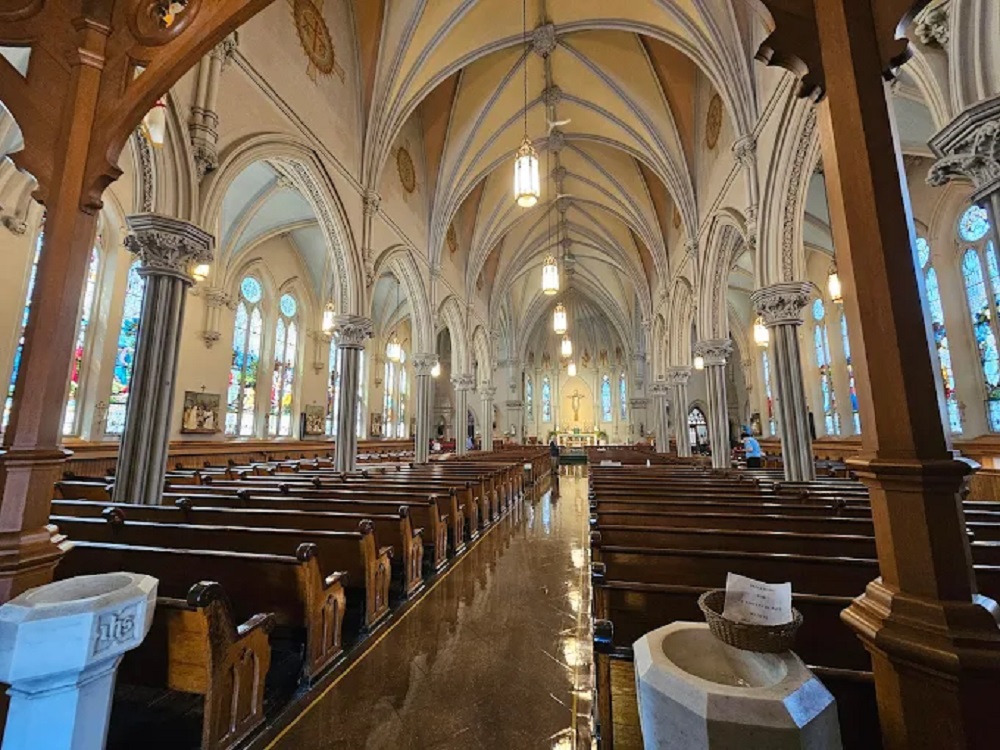
Interior of the Immaculate Conception Church in Cleveland’s Goodrich-Kirtland Park neighborhood (Phil Luketic photo, used with permission).
“While details are still being worked out, the church, school and rectory will be maintained for the benefit of the community, and they will continue to be vibrant places of worship and learning,” the statement concluded.
The original Immaculate Conception School is not threatened with closure. That diocese property was leased to Forrester Education which offers East Preparatory Academy, a kindergarten to eighth-grade charter school with approximately 240 students.
“We expect the relationship (with the school) to continue for the foreseeable future,” said Nancy Fishburn, executive director of communications at the Cleveland Catholic Diocese.
The church’s announced closure may be challenged before April 6 by “anyone legitimately aggrieved by it,” the decree noted. The challenger can petition Malesic to revoke, correct or improve his written decree.
“Immaculate Conception Parish has experienced a significant decline in Mass attendance and in the celebration of the sacraments and has limited resources,” Malesic said in his decree.
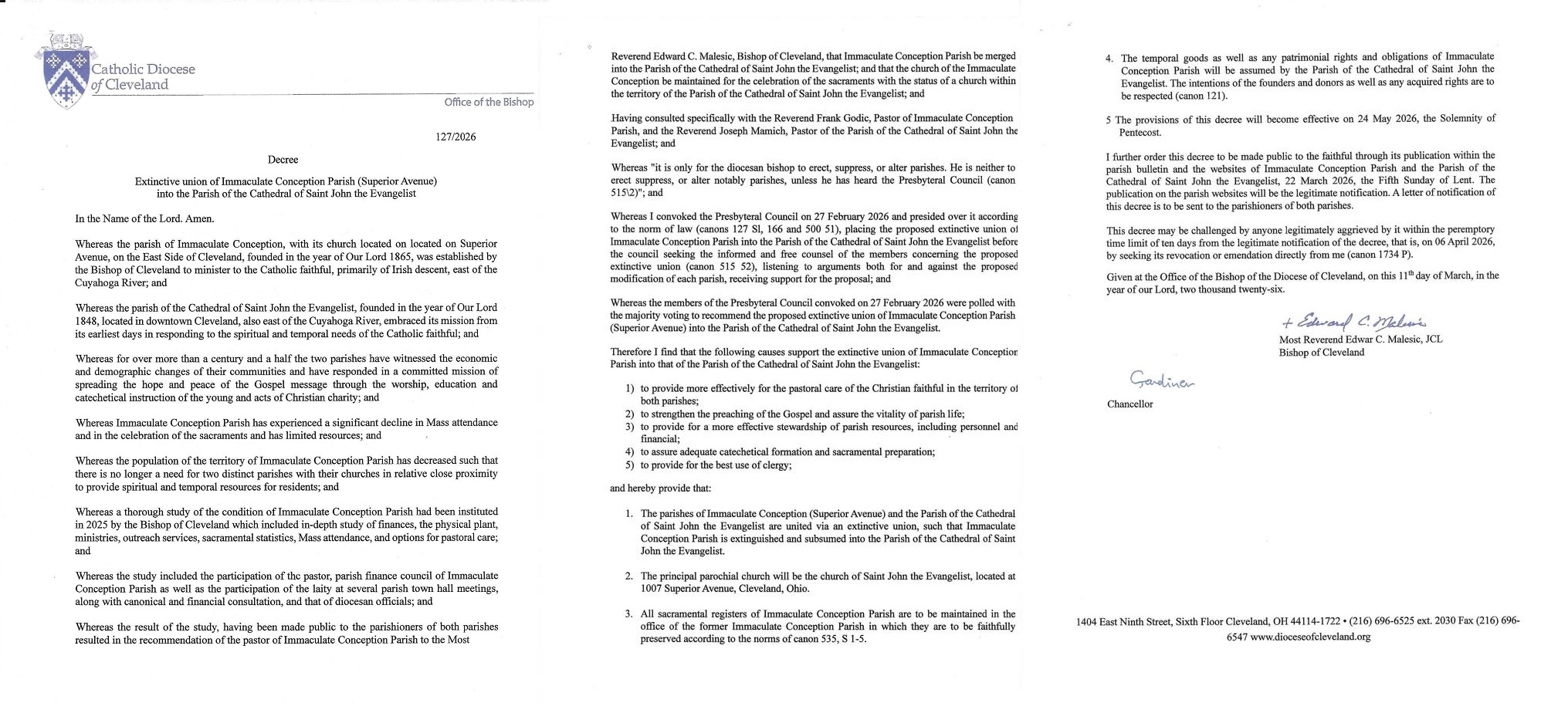
The three-page, March 11 decree by Bishop Edward Malesic to close the Church of Immaculate Conception by “extinctive union” with the Cathedral of St. John the Evangelist (Cleveland Catholic Diocese).
“The population of the territory of Immaculate Conception Parish has decreased such that there is no longer a need for two distinct parishes with their churches in relative close proximity to provide spiritual and temporal resources for residents,” he added. Temporal resources are the church’s material assets.
Kathleen Crowther, president of the Cleveland Restoration Society, said the church is a remarkable structure, is in very good condition and warrants attention from the society’s Sacred Landmarks Task Force which works with congregations to save and repurpose their unneeded properties.
“They have a pretty good approach at the diocese,” Crowther said. “The changes that have occurred in population and demographics are compelling. Not only have we in our community struggled with outmigration, we’ve faced declining church attendance, too. Together, it really hurts. They cannot survive on religious ceremonies once a week.”
Crowther said the cautionary tale sets just one block west — North Presbyterian Church, 4015 Superior. Due to a declining parish, the Gothic-style stone church closed in 2012 after 125 years. No new use has been found for the vacant building which has broken windows and vegetation starting to reclaim the structure.
Preservationist Steve McQuillin suggested the diocese and Catholic Charities move its downtown offices from The Chancery Building, 1027 Superior Ave., which it is renovating for $15 million. He said the downtown building is more marketable to private uses, be they offices or residential, than Immaculate Conception’s buildings.
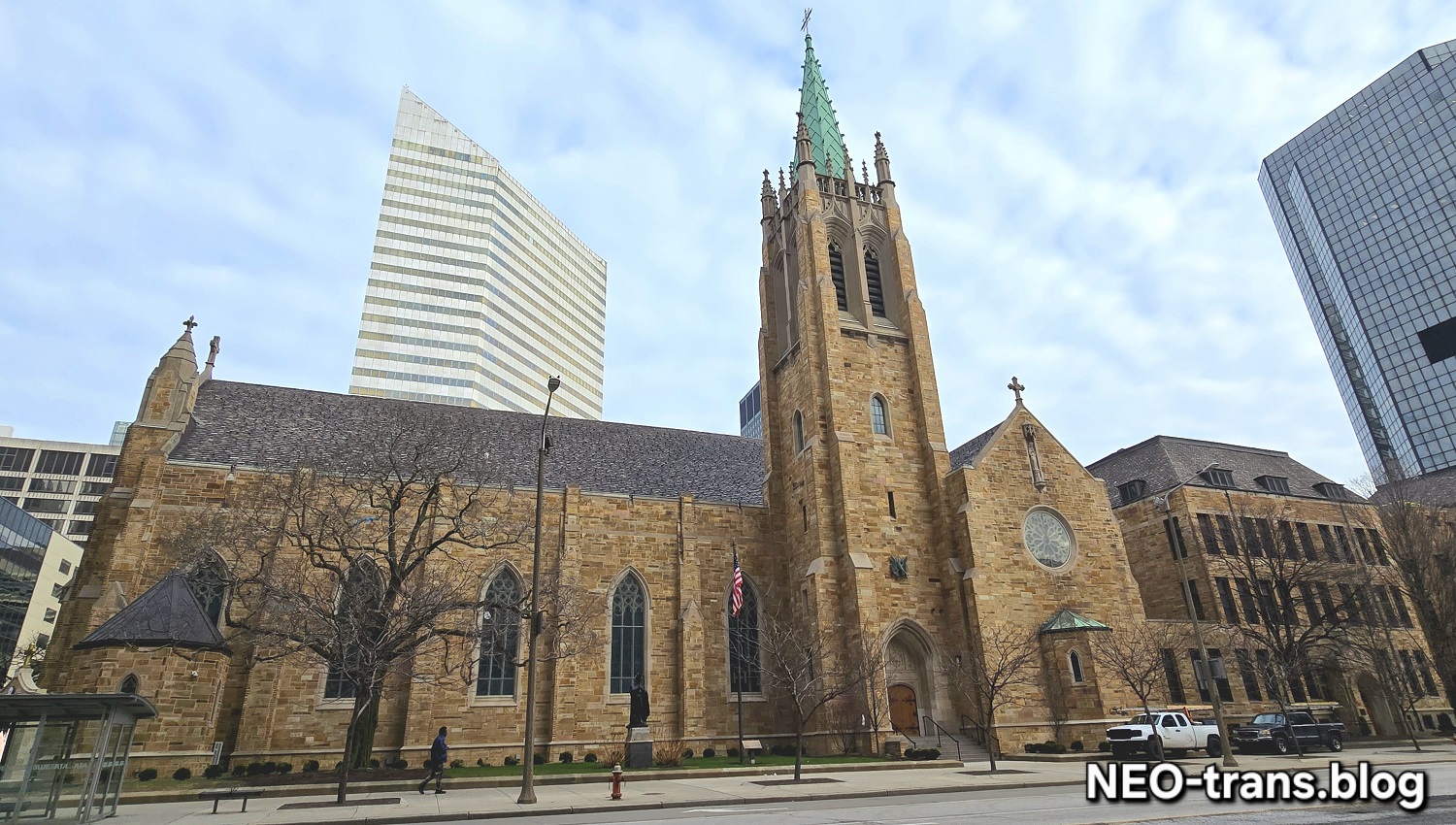
The Cathedral of St. John the Evangelist on Superior Avenue at East 9th Street in Downtown Cleveland. At far right is The Chancery which is being renovated by the Cleveland Catholic Diocese for its offices and those of Cleveland Catholic Charities (NEOtrans).
He lamented that no Cleveland church, unlike those in Chicago, Milwaukee or Buffalo, has been designated a basilica — a Catholic church granted special ecclesiastical privileges and a title by the Pope due to its historical, artistic or religious significance.
“Do our Catholic churches lack significance or is this a low priority in Cleveland?” McQuillin asked. “I’ve visited several basilicas in other cities and it’s great the way the public is invited to visit and experience their wonderful architecture. Perhaps this can be part of the discussion on the future of Immaculate Conception?”
The diocese said it followed Canon Law of the Roman Catholic Church in its decision-making. Malesic said he requested in 2025 a study of the condition of Immaculate Conception Parish. It included a study of finances, physical plant, ministries, outreach services, sacramental statistics, Mass attendance and options for pastoral care.
Under the canons, a bishop cannot erect, alter or suppress a parish without a vote of a Presbyteral Council — a group of priests chosen by the bishop and other local priests to advise the bishop in the management of a diocese.
Malesic convoked, or summoned the council for assembly on Feb. 27 and presided over the meeting. He said in his decree that a majority of the Presbyteral Council members in attendance were polled and voted to recommend the extinctive union.
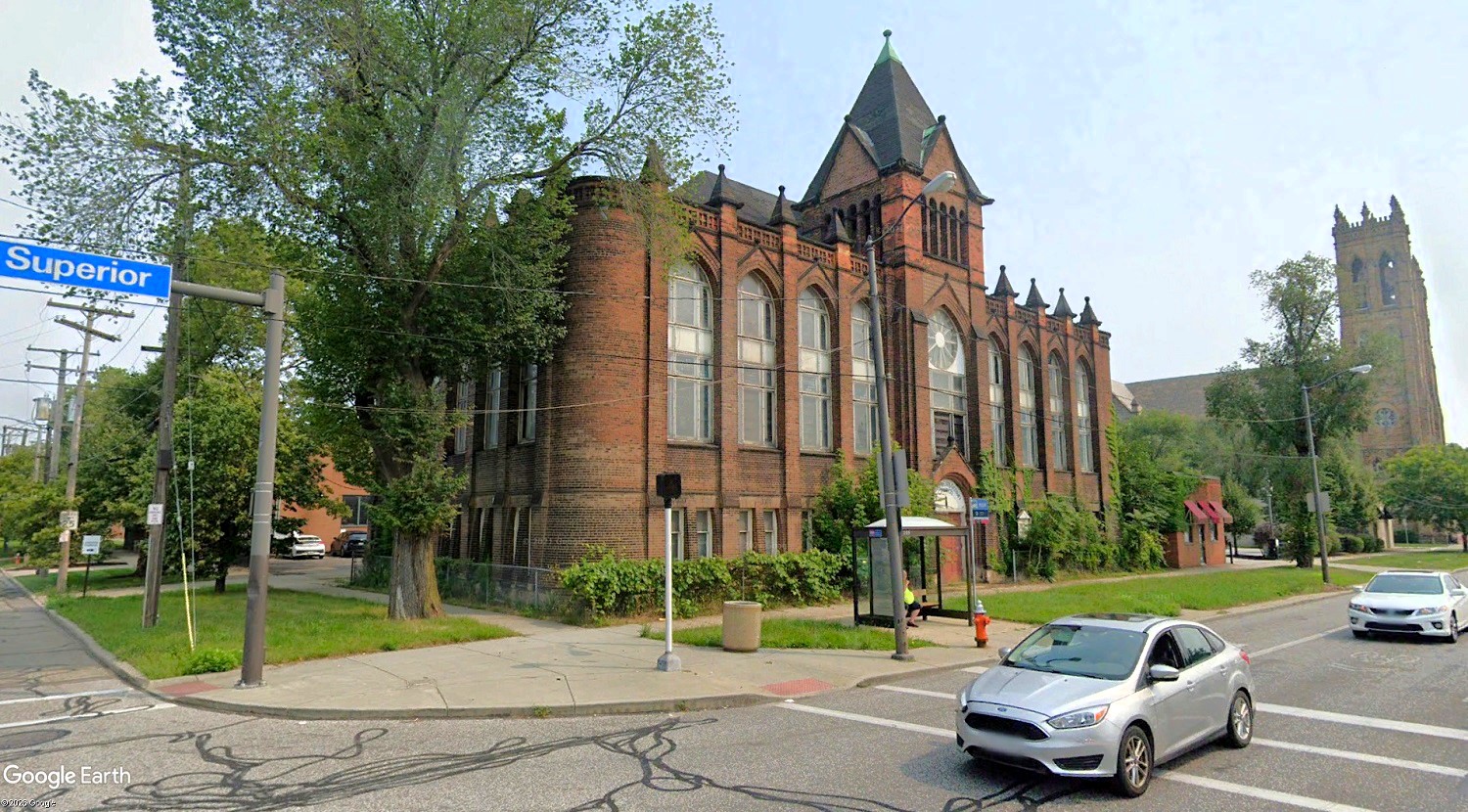
In Cleveland, there are lots of cautionary tales for historic churches. One of them, North Presbyterian Church, still stands just one block west of Immaculate Conception Church. Since this photo was taken five years ago, the vacant, 139-year-old North Presbyterian has decayed further (Google).
Ironically, Immaculate Conception Church had its physical origins on the property of Cathedral of St. John shortly after it was built in 1852, according to an article by Jim Lanese at the Center for Public History + Digital Humanities at Cleveland State University.
“In 1855, Bishop (Louis Amadeus) Rappe chartered a mission at Superior and Lyman (East 41st) Streets to become the Church of the Immaculate Conception,” Lyman wrote. “The first structure of the mission was the Church of the Nativity which originally stood at the site of the Cathedral of St. John.”
He noted that Immaculate Conception was built to serve the spiritual needs of Cleveland’s fast-growing Irish population. While most of the city’s Irish settled on the West Side, there was also a sizable east-side population as well. In fact, when the church’s cornerstone was laid on Aug. 17, 1873, 10,000 people gathered for the event.
The church structure, made of Berea sandstone, measured 169 by 91 feet, Lyman wrote. Two well-proportioned spires, the highest of which stood 275 feet above Superior, graced the front of the church with a third, smaller spire at its rear. None of the spires stood for long; they were all gone by 1910.
END