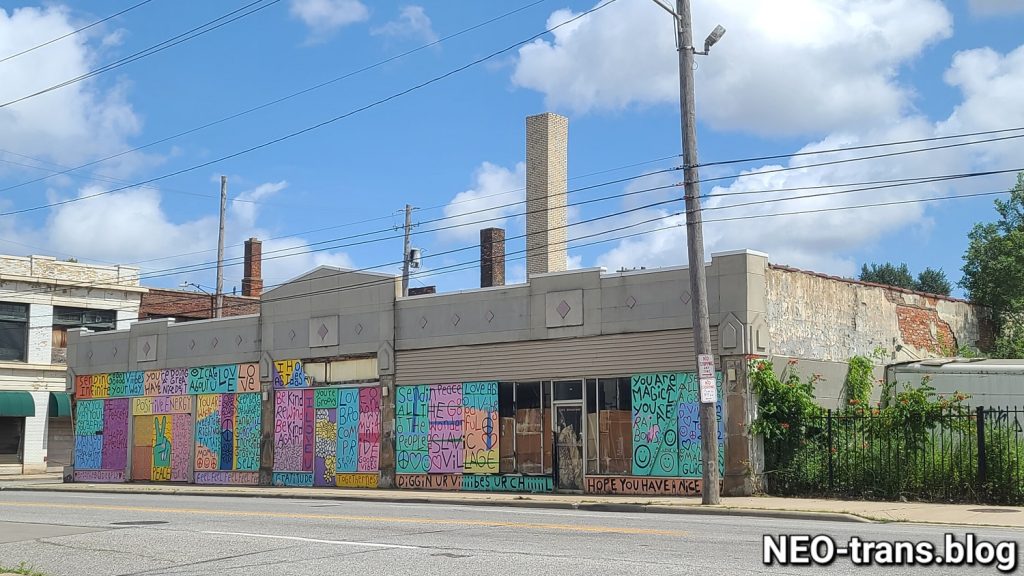
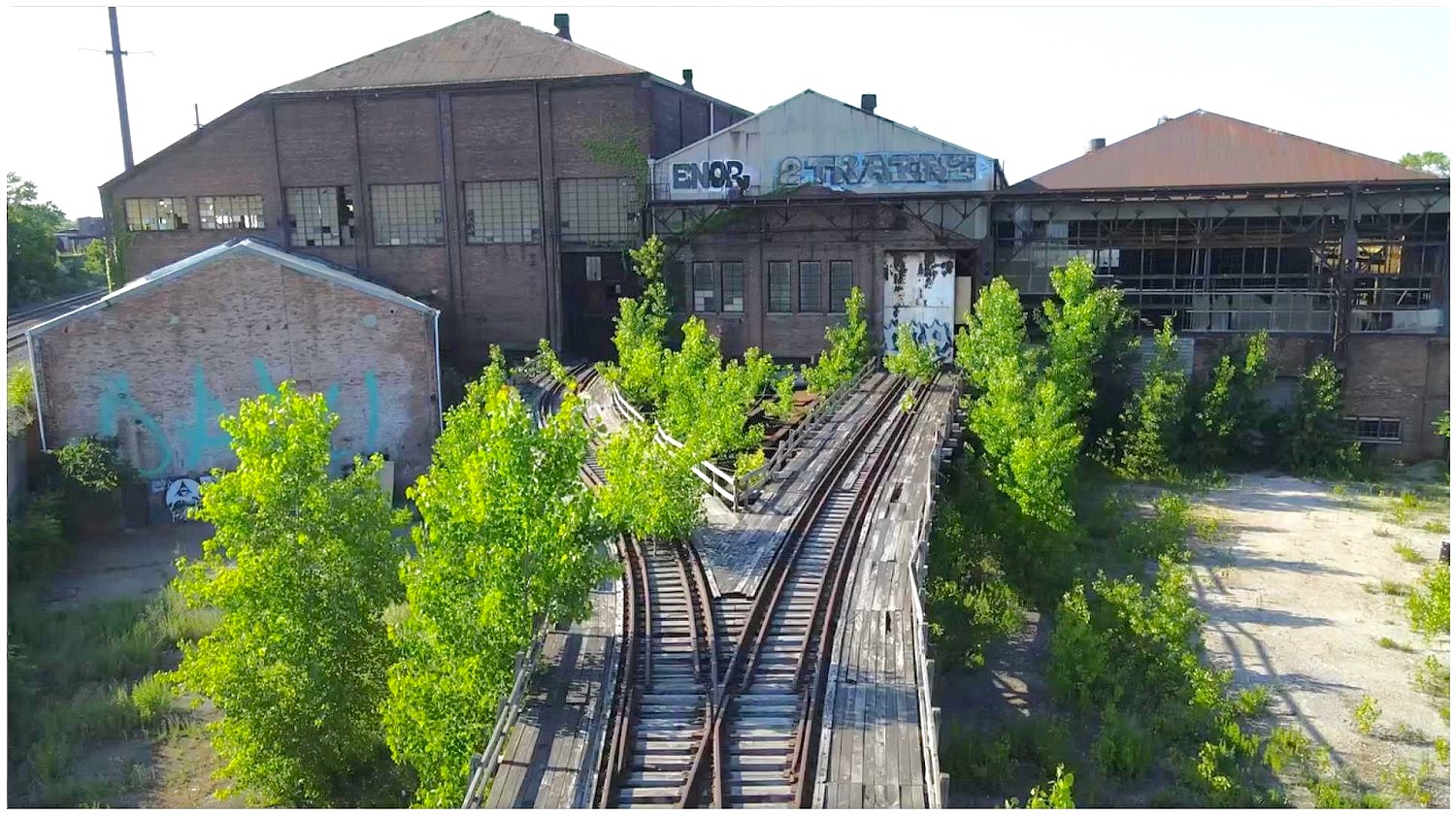
Before Mother Nature reclaims it, funding is being secured to reactivate the former Wellman-Seaver-Morgan factory on Cleveland’s East Side for a new commercial end user (Taco Slayer Aerial). CLICK IMAGES TO ENLARGE THEM.
Historic tax credits sought for historic use
A clearer picture is emerging of the planned redevelopment of the large, historic Wellman-Seaver-Morgan Engineering Co. manufacturing plant, 7000 Central Ave., where Cleveland’s Fairfax and Central neighborhoods meet.
The 183,000-square-foot factory, built in 1901, will be renovated and expanded for $25.7 million over three and a half years into a modern, 207,218-square-foot plant for a labor-intensive manufacturing or light-industrial end user, according to a public record provided this week to NEOtrans.
Renovating and expanding the factory will require about 150 construction jobs paying about $40 per hour and yielding 142 permanent, full-time jobs at the facility. The phased rehabilitation of the factory could begin almost immediately after the last piece of public financing — an Ohio Historic Preservation Tax Credit — is made available.
But there are still some things that aren’t being revealed publicly about the desired re-use of this 10-acre property — the first one acquired by the city’s new Site Readiness for Good Jobs Fund in 2024. The site readiness fund’s mission is to leverage Cleveland’s industrial past into a platform for economic opportunity.
Prior to a March 31 deadline, the site readiness fund submitted to the Ohio Department of Development an application for $2.56 million in state historic tax credits to help fund the commercial redevelopment project.
The State Historic Preservation Office is due to decide tax credit awards on or before June 30. NEOtrans submitted a public records request to the state for a copy of the application.
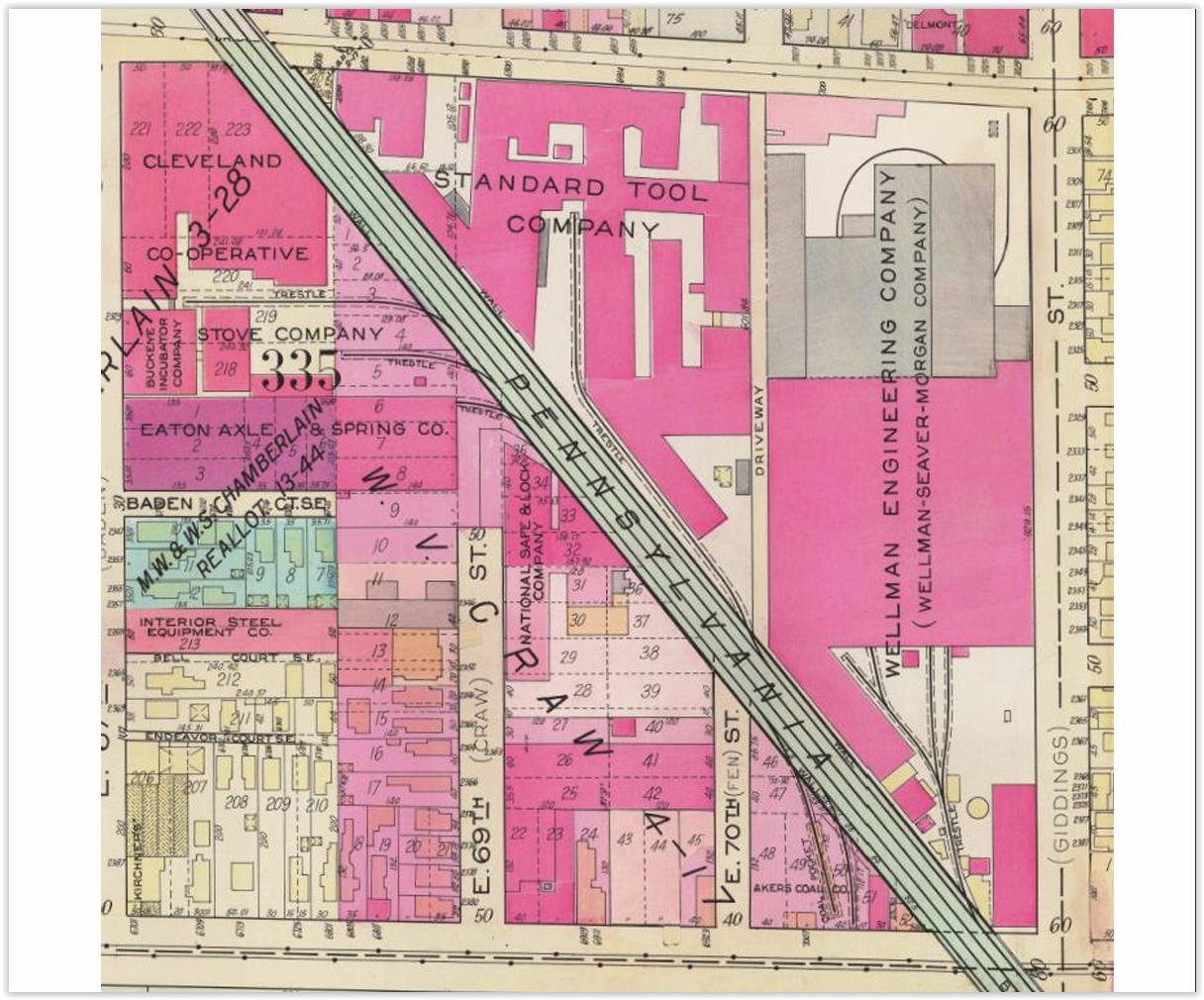
This property map from 1927, at the end of America’s Gilded Age and after 60 years of nearly continuous industrial growth in Cleveland, shows the Wellman-Seaver-Morgan factory site at right (Hopkins).
But the name of the potential end-user for the complex, three sources of private financing plus one public financing source, the identity of the chosen general construction contractor, along with some timelines were redacted from the site readiness fund’s application.
Also, none of the attachments to the application were supplied by the state. Those entire documents, including preliminary project designs and a pro forma, along with the redacted text in the application form, were considered to be trade secrets, protected by state law.
“All redactions are made pursuant to the Ohio Revised Code Section 149.43” which addresses the availability of public records for inspection and copying, said Mason Waldvogel, chief communications officer at the Ohio Department of Development.
Brad Whitehead, managing director at the site readiness fund, encouraged interested persons to focus on the importance of the building’s reactivation and the number of jobs it can produce, rather than the name of any end user or its intended use of the property.
“We want to bring this grand structure back to its former productive glory and the historic tax credits are crucial to that,” he told NEOtrans. “And I don’t want to jinx anything, but we’ve seen a lot of interest in this site so I am confident it can be a great source of jobs to the neighborhood if we can have it move-in ready.”
But not everything in the application was redacted. In fact, much could be learned about the proposed project and its potential use based on the information that was left was unobscured by government redactors and their digital black Sharpies.
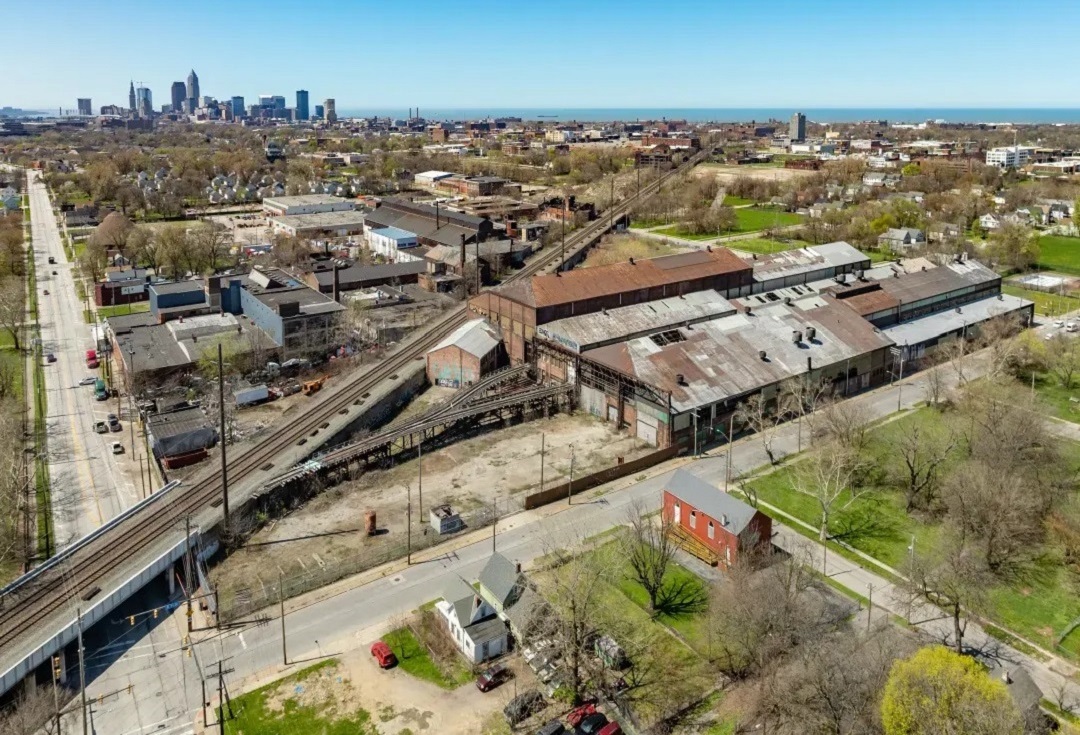
The former Wellman-Seaver-Morgan plant at Central Avenue, at left, and East 71st Street on the city’s near-East Side (Site Readiness For Good Jobs Fund).
Seeking state and federal historic tax credits for the property influences how the site, which was designated a Cleveland Landmark by City Council earlier this year, may be used post-rehabilitation.
A federal historic tax credit of $4.67 million was already committed along with $5.68 million in city, county, Cleveland Port Authority and state funds. The city is also supporting the project with a 10-year, 75-percent Enterprise Zone real property tax abatement with a value of a $1.9 million, the application said.
Guidance for the use of historic tax credits comes from the U.S. Department of the Interior. The intent of the rehabilitation is to meet the Department of the Interior’s first priority, which is to use the property as it was historically.
“The long open bays with three- to four-story-high ceilings will again be used for manufacturing purposes,” an unredacted part of the document noted.
“New offices and amenities spaces will be limited to the east bay and will be small and insignificant to the 200,000-plus square foot interior,” the document read. “The new offices will be constructed as a box within a box at 9-foot AFF (above finished floor) in smooth-painted gypsum.”
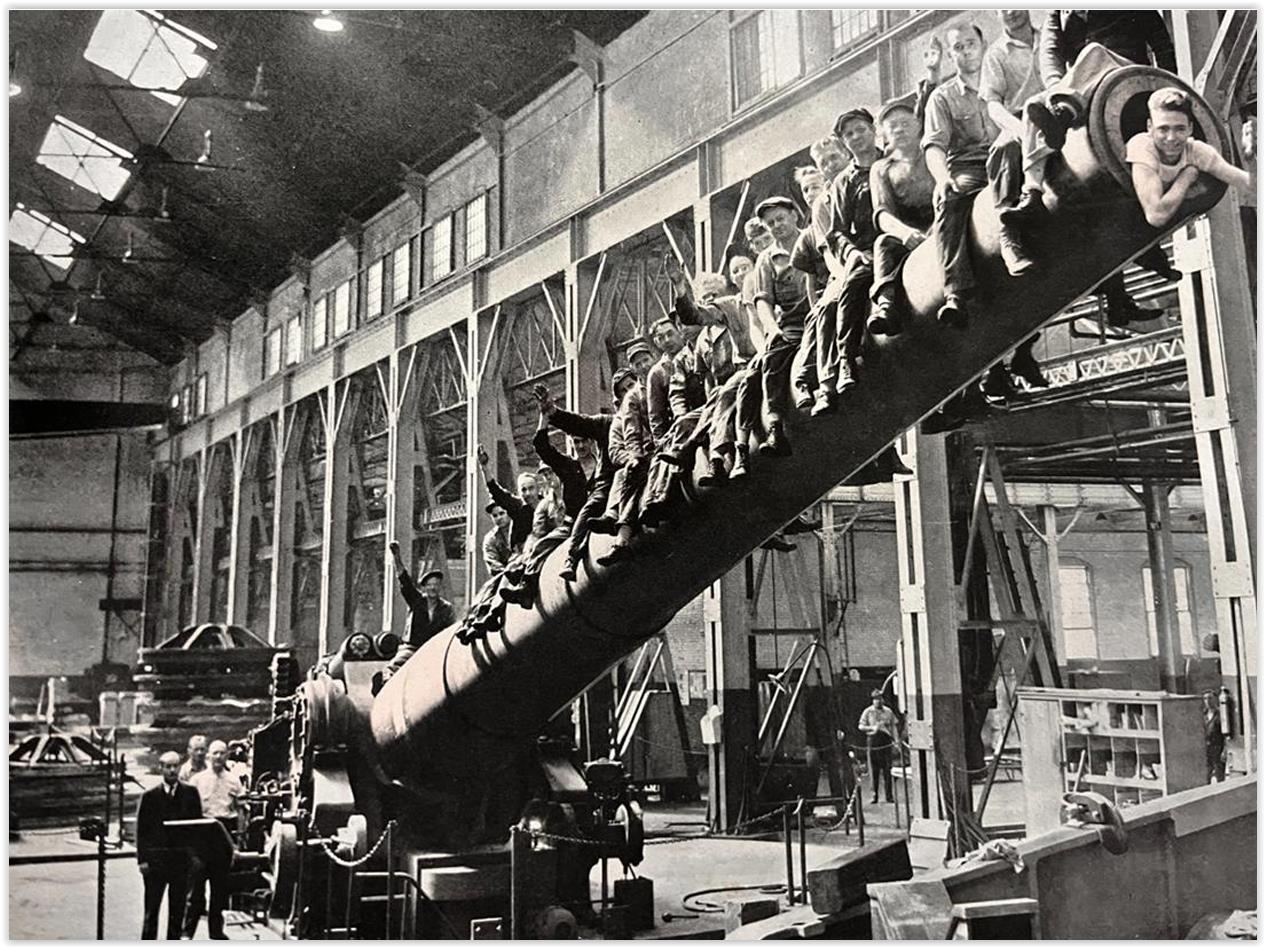
Wellman-Seaver-Morgan factory workers in World War Two pose with their latest creation — a battleship gun barrel that helped defeat fascism in Europe and Japan (Naylor-Wellman).
Gypsum drywall is used in both residential and commercial construction where fire codes require higher ratings. And for factory offices, it provides noise reduction to dampen loud machinery sounds for improved acoustics, according to modular building manufacturers.
NEOtrans asked Google AI what business use or activity can be inferred from a company needing 207,218 square feet and, after three years of operation, 142 workers.
The response was that, with a ratio of approximately 1,459 square feet per worker, this density suggests an operational mix requiring significant floor space for inventory, machinery, or product staging, but with enough personnel to suggest active, manual handling rather than highly automated storage.
The site readiness fund and its development team are finalizing construction documents. No construction work has begun on the rehabilitation of the property or its structures. A 2025 video tour of the factory by Taco Slayer Aerial is available on YouTube.
When an historical use isn’t being replicated as a result of historic tax credits, the next best thing is for the site to be given a new use that requires minimal change to distinctive materials, features, spaces and spatial relationships within its surviving structures.
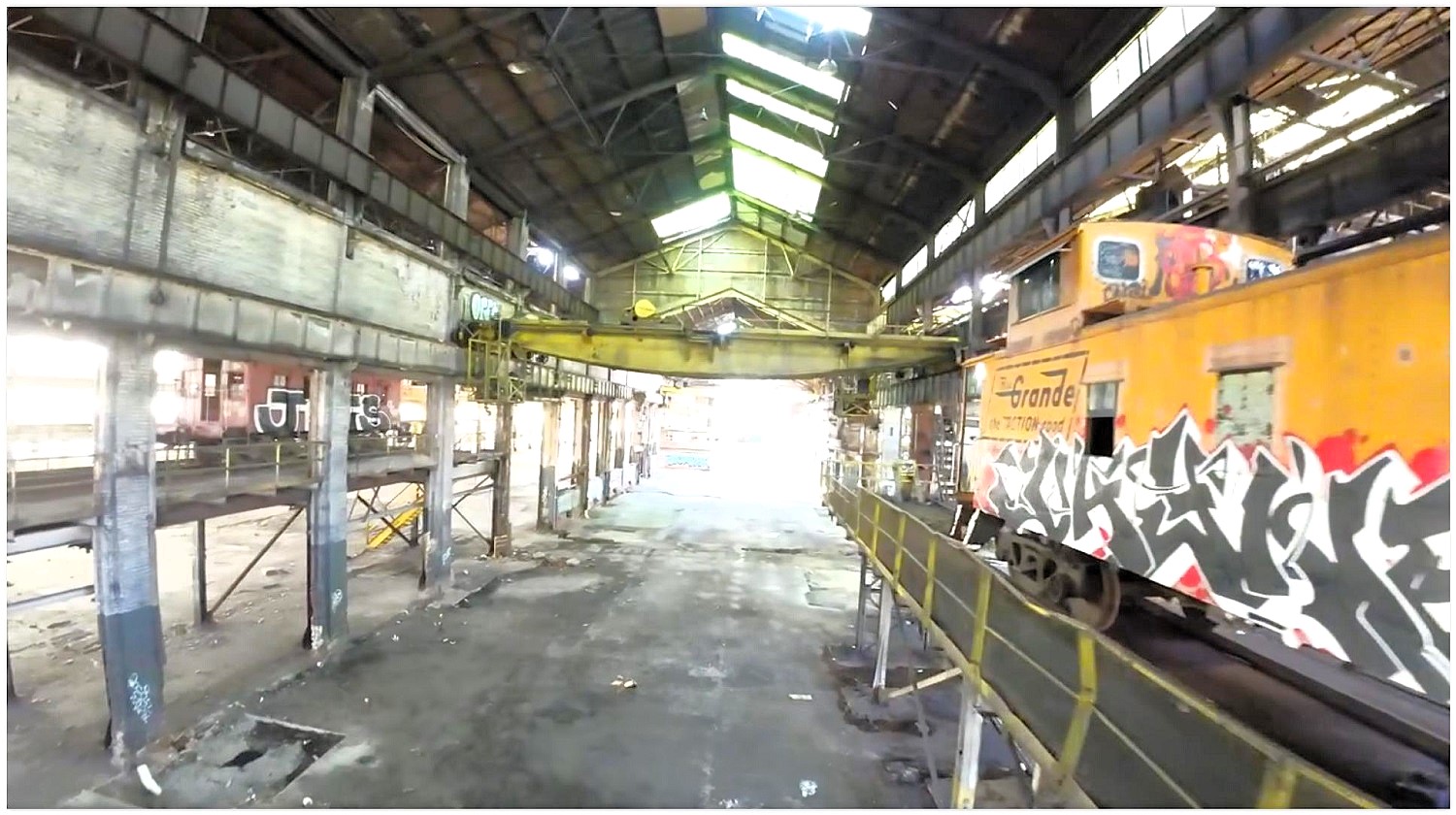
When the neighboring Pennsylvania Railroad line into Cleveland was elevated above the city’s busy streets in the early 1910s, the industrial sidings into the Wellman-Seaver-Morgan plant had to be elevated too. Two railroad cabooses parked inside the plant will be removed as part of the plant’s renovation, their destination unknown (Taco Slayer Aerial).
“The rehabilitation will replace deteriorated materials with contemporary compatible (materials) to bring the industrial building up to current code and energy efficiency,” the site readiness fund’s applicated noted.
“The interior open industrial complex will be maintained with historic steel members retained, repainted and totally visible throughout,” it continued. Two railroad cabooses parked on elevated tracks inside the factory will be removed.
The document said the building was full of steel furnaces that prevented the need for heating systems. Also, the building was constructed at a time when employee safety and comfort were not considered. The building will be required to meet present-day safety and environmental interior standards while being energy efficient.
The factory was built to construct steel beams, large machinery and equipment for building facilities and industry, including heavy-duty hoists, coal elevators, cranes and the famed Hulett ship unloaders. During World War Two, it made big armaments like battleship gun barrels. The factory closed in 1988.
But specialty railroad track-maker Cleveland Track Material Inc. began using the factory in 2007 and bought it two years later. Cleveland Track Material was later acquired by an affiliate of Caterpillar Inc. and relocated by 2017 to 6600 Bessemer Ave.
END