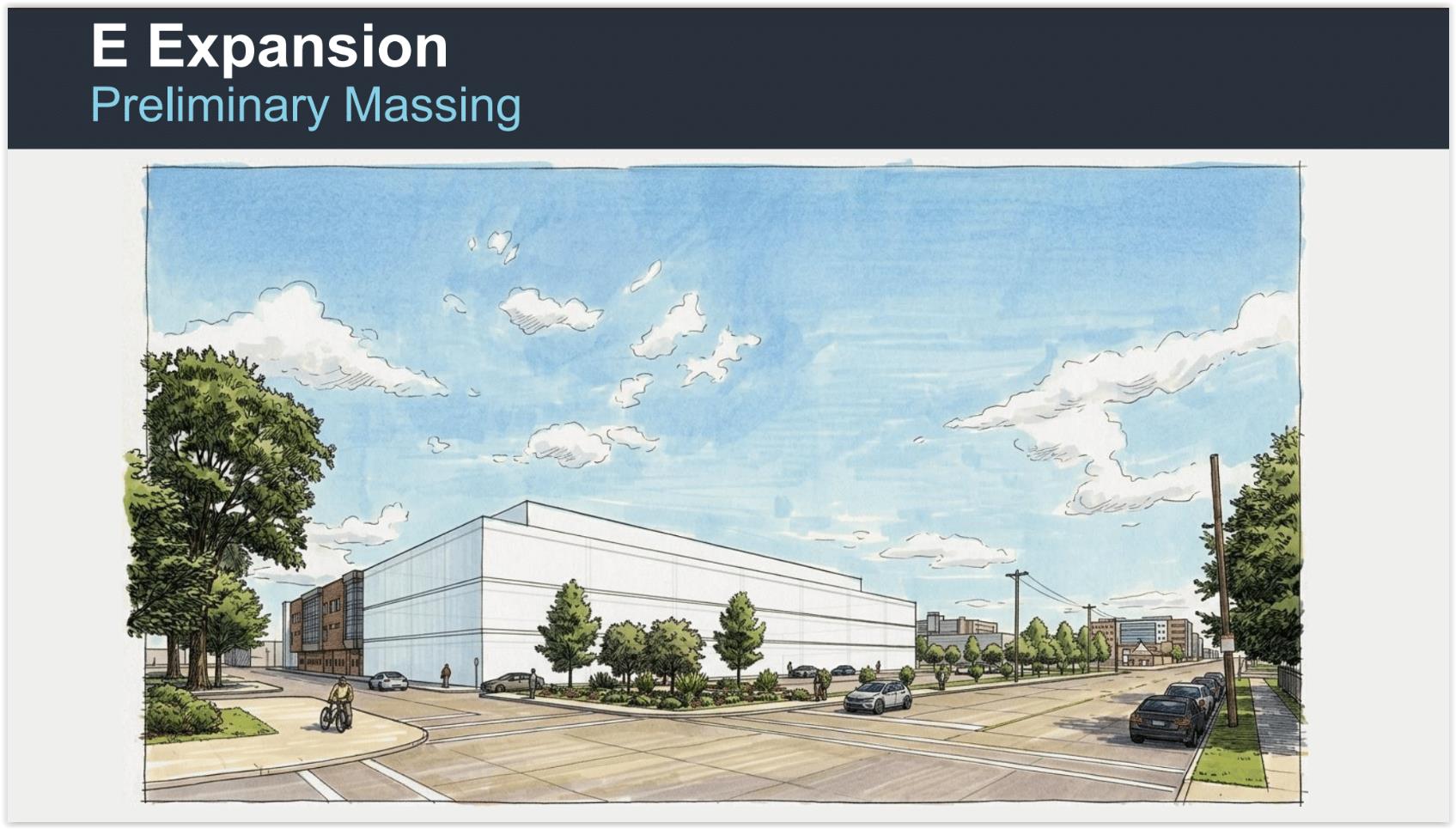
Seen from the corner of Cedar Avenue and East 93rd Street, this massing shows the scale, shape and location for Cleveland Clinic’s planned 120,000-square-foot expansion of the Maria & Sam Miller Emergency Services Building. If the City Planning Commission agrees with this concept, the details of the design will be filled in (Cleveland Clinic). CLICK IMAGES TO ENLARGE THEM.
Project is key to Level I trauma center
Cleveland Clinic and its facility planning consultants are seeking approval next week from the Cleveland Planning Commission for conceptual designs for its expanded Emergency Department, called Building E, 9105 Cedar Ave., in Cleveland’s Fairfax neighborhood.
Some may look at the “massing” designs, which intentionally lack texture and details, and wonder what the commission is being asked to approve. But the point of a massing is for the city to weigh in on the proposed scale, shape and placement of a structure on a site.
If the city agrees with those elements, the applicant then fills in the details for what’s called “schematic” and “final” approvals later. For right now, only conceptual plans are being considered by the Planning Commission.
The 120,000-square-foot expansion of the Clinic’s 1994-built, 228,000-square-foot Maria & Sam Miller Emergency Services Building is sought so the global health system can upgrade its trauma care and possibly secure a Level I trauma center designation from the American College of Surgeons.
Because of that, this project is also of a controversial nature. Some members of the community, not the least of which are two competing health systems, say Greater Cleveland cannot support a third Level I trauma center.
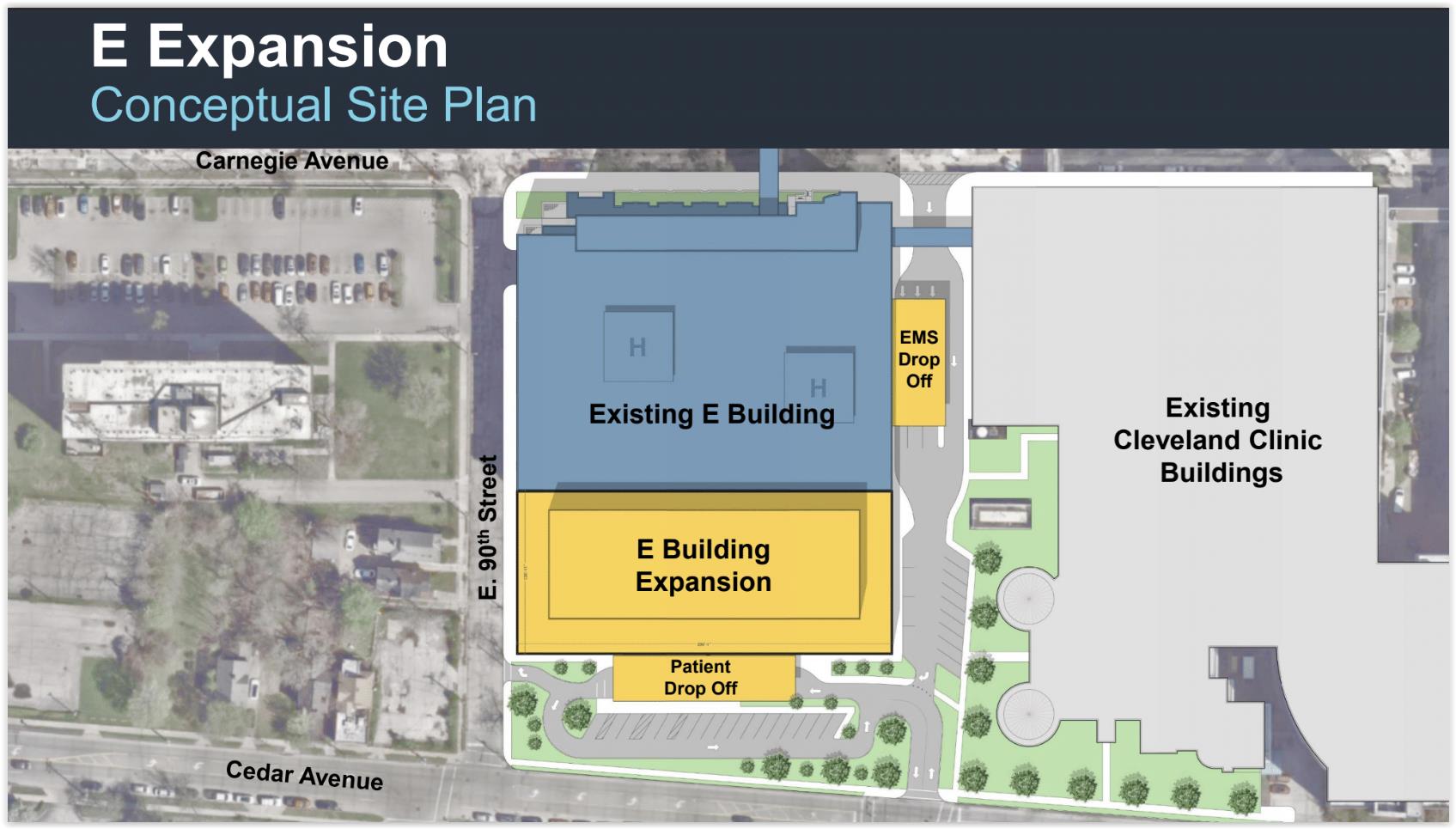
Site plan for the proposed Main Campus expansion of the Cleveland Clinic’s Maria & Sam Miller Emergency Services Building on Cedar Avenue (Cleveland Clinic).
Both the MetroHealth System and University Hospitals have opposed the Clinic’s proposal. They both offer Level I trauma centers at their main campuses. They say the Clinic’s plan, if realized, will weaken their health care systems.
But a prominent local organization disagrees. The Jack, Joseph and Morton Mandel Supporting Foundation in March awarded the Cleveland Clinic a $50 million grant to help it expand its emergency department.
Clinic officials say its current facilities will be upgraded and expanded to include more treatment spaces, trauma resuscitation rooms, specialized equipment and clinical support areas.
The expanded Emergency Department will be able to provide trauma surgery 24 hours a day, seven days a week. And it will offer advanced imaging, critical care and specialized teams for adults and children.
“The expansion will significantly enhance emergency, surgical, and critical care capabilities while improving patient flow, operational efficiency, and overall quality of care,” said the Clinic in its presentation to the Planning Commission. NEOtrans secured an advanced copy of the presentation.
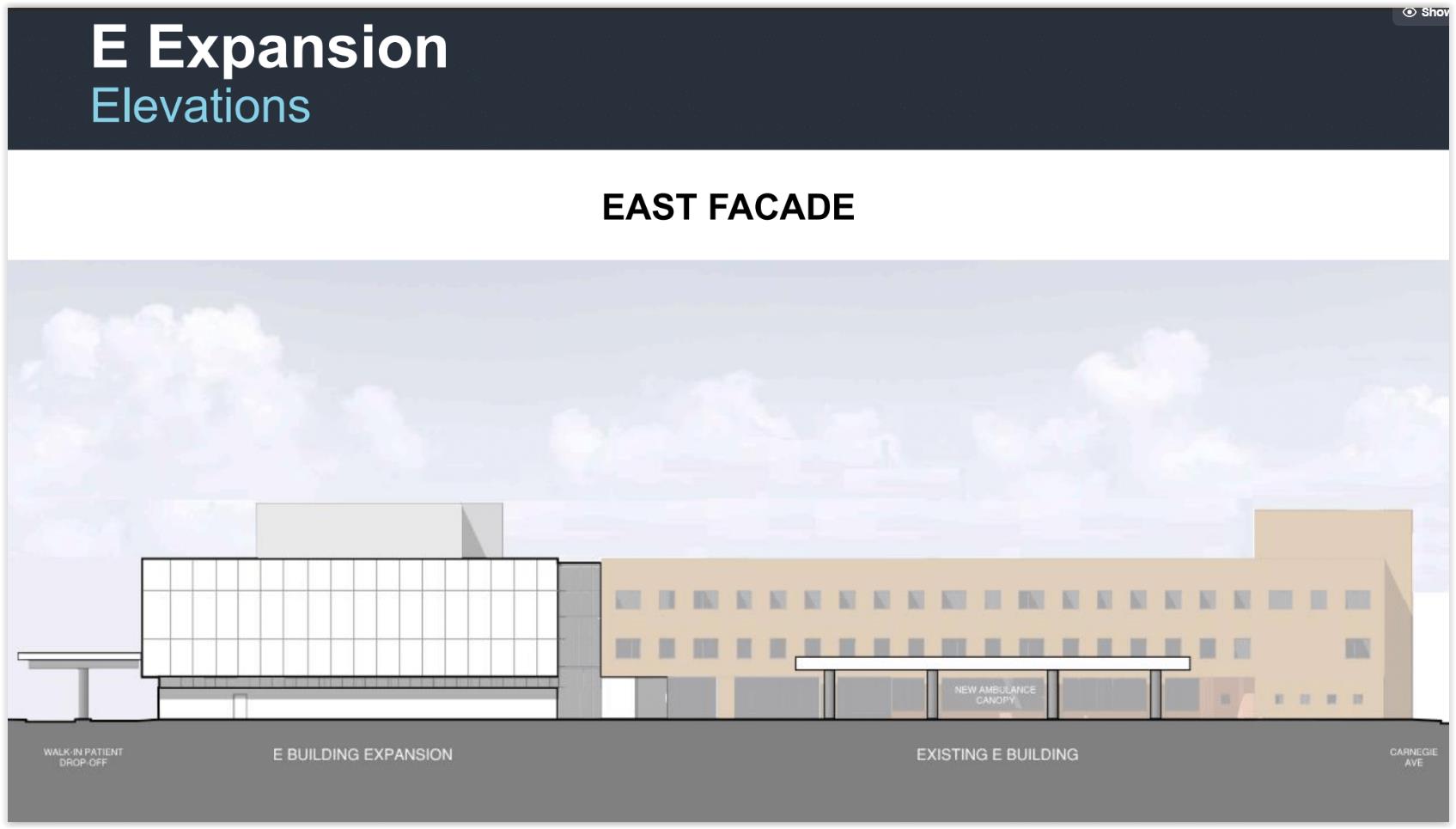
A side view along the vacated East 93rd Street showing the expansion at left of the 32-year-old emergency department at right including a new canopy over the drop-off location for emergency vehicles (Cleveland Clinic).
While the Clinic hasn’t revealed an projected cost for the emergency department expansion, the architectural/engineering firm BSA estimates that the average cost per square foot of constructing a trauma center is about $800.
That would put Cleveland Clinic’s emergency department expansion at about $96 million, although any renovations or other modifications to the existing building could push that total over $100 million.
The expansion is considered an integral part of the Clinic’s next round of development of its Main Campus. That expansion is reportedly going to be larger than the last which totaled nearly $2 billion and is just wrapping up now.
Plans for the emergency department expansion were to be submitted and reviewed by the commission at its June 5 meeting. But that review was postponed to the commission’s next scheduled meeting, June 26.
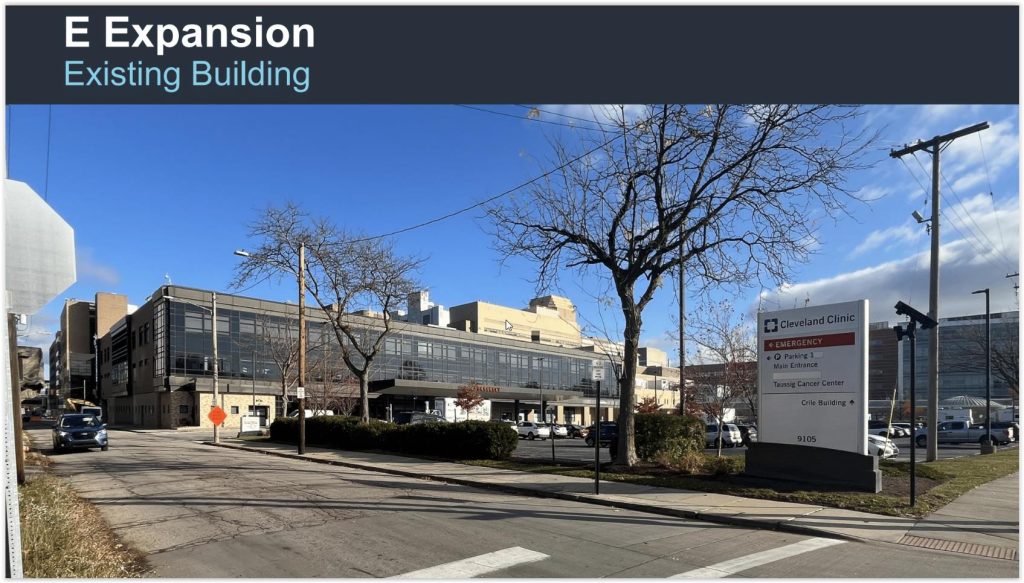
View of the existing emergency department from the corner of Cedar Avenue and East 90th Street. The proposed expansion will replace much of the parking lot in the foreground (Cleveland Clinic).
“My understanding is it was just a scheduling conflict,” said Andrea Pacetti, senior director of public & media relations at the Cleveland Clinic. “They’ll be back on the calendar at the end of the month.”
In addition to the construction of a three-story addition on the current site of the emergency department’s parking lot, the site will also gain improved patient drop-off areas for emergency and private vehicles.
“The new addition will increase the capacity and functionality of the Emergency Department through expanded trauma treatment spaces,
advanced diagnostic and support services, and improved circulation for patients, staff, and emergency responders,” the Clinic’s presentation added.
Because the existing facility will need to remain in operation during construction, Clinic officials said “special consideration will be given to phased construction planning and maintaining continuous operation of the existing Emergency Department and hospital services during all phases of implementation.”
END