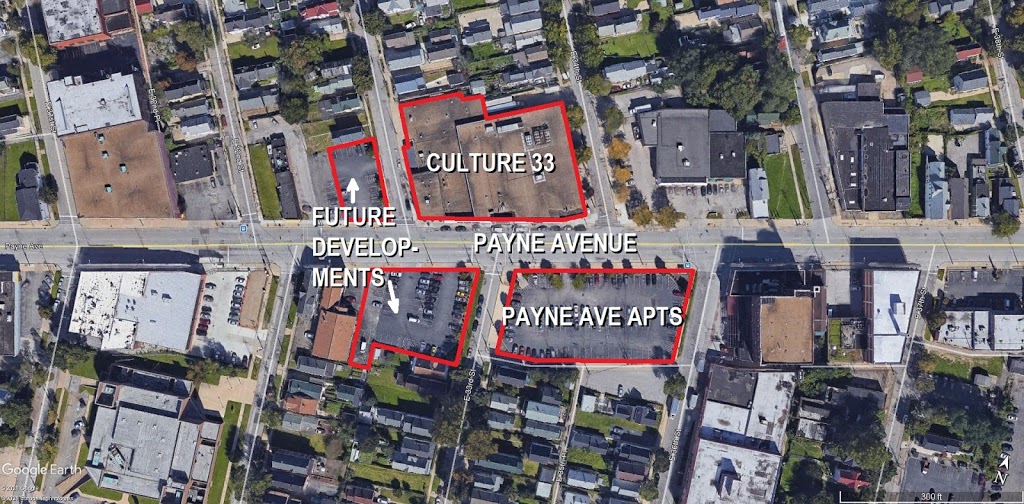
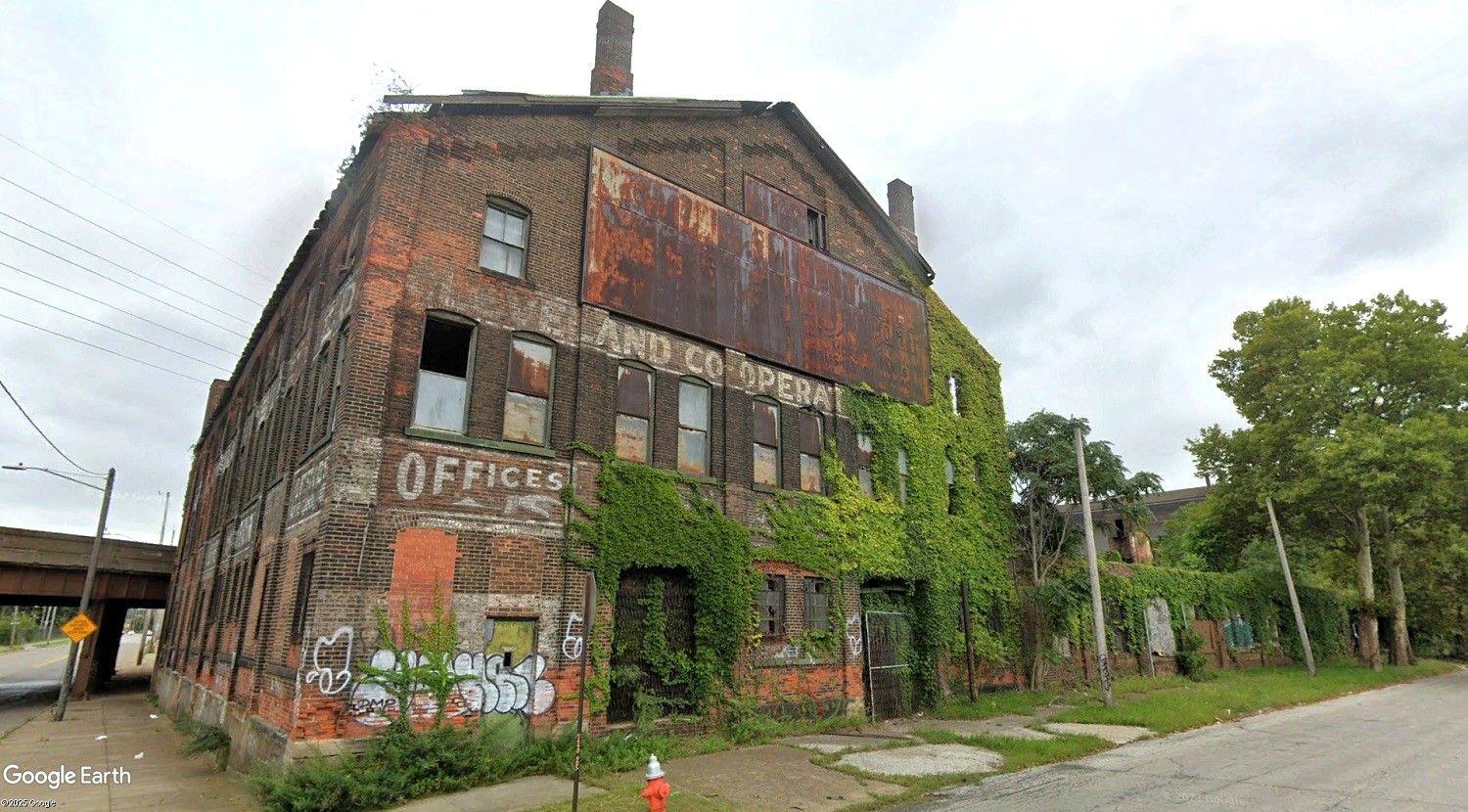
Cleveland and some of its inner-ring suburbs are filled with Brownfield sites. It has so many that the entire Ohio Brownfield Remediation Program could be used each year to clean up and help repurpose these sites left over from the Gilded Age when Cuyahoga County was an industrial giant (Google). CLICK IMAGES TO ENLARGE THEM.
Program intended to be merit-based
Cuyahoga County, once an industrial giant on a global scale, is trying to remake itself in America’s post-industrial economy. That remake is burdened by literally hundreds of properties awaiting environmental assessment and clean-up from more than a century of unregulated manufacturing.
Meanwhile, in Vinton County, a bucolic Appalachian setting, one must search to find towns of more than 1,000 population. With just 12,000 people, it is Ohio’s least-populous county. At least 80 percent of Vinton’s land is covered by forests, according to the U.S. Department of Agriculture and the ERSys Land Cover Report.
Yet, in the state’s fiscal year 2026, Cuyahoga County will get the same $1 million of Ohio Brownfield Remediation Program funds as Vinton County. So will each of Ohio’s 88 counties.
Ironically, the Ohio General Assembly renewed the program this past summer with a new charge. Instead of making the funds available on a first-come, first-served basis, it would be merit-based.
So how do the pristine, dew-dotted forests of Vinton County merit the same clean-up priority as the carcinogen-stained soils of Cuyahoga County after a Gilded Age of opportunistic industrialists?
“Projects will be evaluated on merit within each county,” said Mason Waldvogel, deputy chief of media relations at the Department of Development. “When the next application round opens, there will be over $100 million available without any set asides. At that time, projects will be evaluated on merit statewide.”
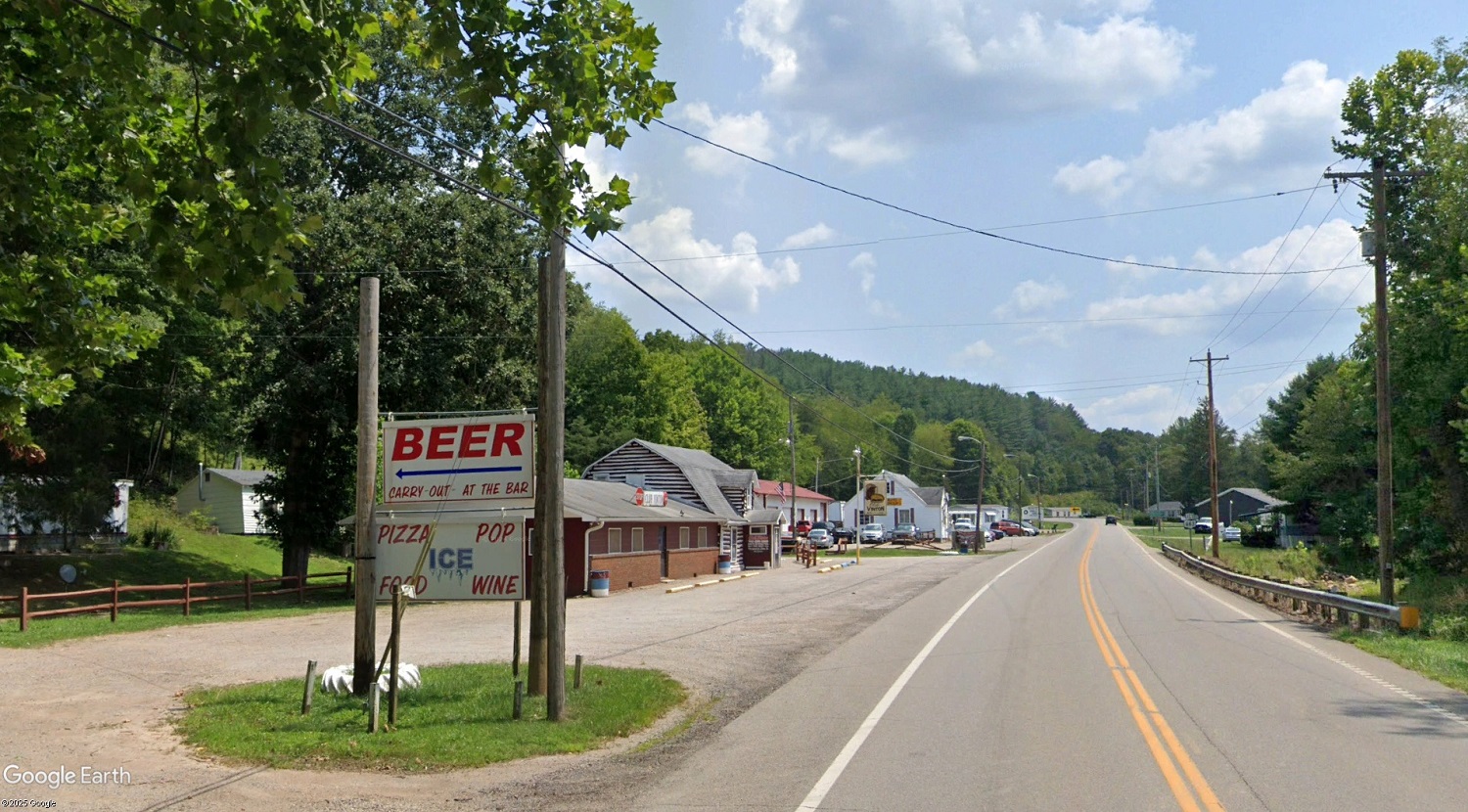
Aside from towns like Vinton County’s seat of McCarthur, population 1,743, this scene along U.S. Route 50 is about as developed as Ohio’s least-populous county gets. In fact, Vinton County has never applied for a Brownfield grant (Google).
“For FY 2026, $88 million will be available, with $1 million reserved for applicants in each of Ohioʼs 88 counties,” according to the new Brownfield guidelines. “If the $1 million county reserved funds are not obligated by June 30, 2026, these unclaimed funds will become available to eligible projects anywhere in the state in the FY 27 funding round.”
The Department of Development will begin accepting grant applications at 10 a.m. Nov. 12. Applications will close at 5 p.m. Dec. 5.
“In FY 2027, approximately $109 million will become available for eligible projects,” the guidance continued. “(The Department of) Development anticipates opening the FY 2027 statewide application in the spring of 2026 with awards anticipated after July 1, 2026.”
“All of Ohio’s communities deserve the chance to grow and prosper, but that can’t happen when contaminated properties stand in the way of progress,” said Ohio Gov. Mike DeWine in a written statement issued today.
The county-by-county Brownfield funding offered in this round pales to the awards Cuyahoga has received in the recent past. Just last December, $86 million was awarded statewide — slightly less than the current round. Despite that, Cuyahoga won nearly half — $40 million.
In fact, Cuyahoga County has typically won anywhere from one-fourth to one-half of all Brownfield funds since the current program began in 2021. In four years, nearly $717 million supported 681 projects in 86 counties. Before that, from 2002 to 2013, there was a similar program called the Clean Ohio Revitalization Fund.
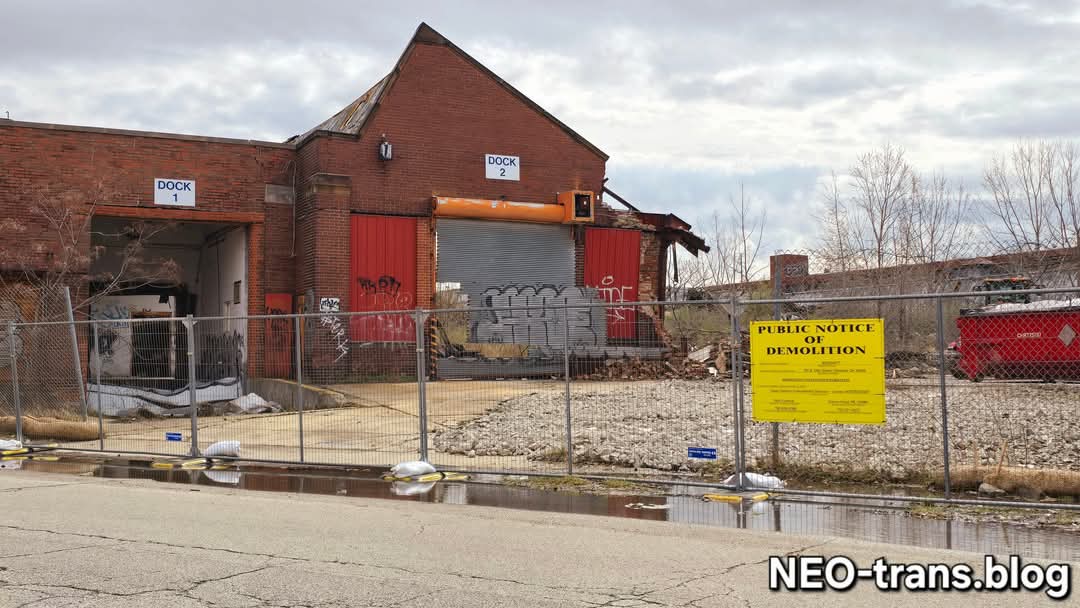
Thanks to $7.6 million in Ohio Brownfield funding, the National Acme plant in Cleveland was demolished and the site cleaned up for a total cost of $11 million. The site is now being assembled with others nearby and marketed to new commercial end users. Many more sites in Cuyahoga County are awaiting their turn at a future (NEOtrans).
Michael Sikora III, board president of the real estate development association NAIOP of Ohio, told NEOtrans that the Brownfield program is merit-based but the legislature wanted to give each county a shot at funding. If they don’t use it, they lose it to the counties who will.
Another change he noted from past practices involving the Brownfield program is that only county land banks could apply to the state for funds. If a developer needed Brownfield funds to clean up a site to build there, it had to go through the likes of the Cuyahoga Land Bank which has been proficient at securing state funds.
Now, the entities that are eligible to apply for Brownfield funds include a county, township, municipal corporation, port authority, conservancy district, park district or other similar park authority, county land reutilization corporation, or organization for profit, according to the new guidance.
Ending the first-come, first-served approach also ends the race out of the gate. In the past, when the application period opened at 10 a.m. on a certain day, all of the county land banks having applications would immediately submit them. Just one minute could make a difference of millions of dollars.
“If you applied at 10:01 you beat out a project that applied at 10:02,” said a Cuyahoga Land Bank staff person who declined to be identified. Despite that drawback, the staffer said the current approach is hardly merit-based.
“Not all of Ohio’s counties have $1 million worth of applications,” the staff person said. “When considered against the enormity of demand that Cuyahoga County has, some Ohio counties come up far short.”
END