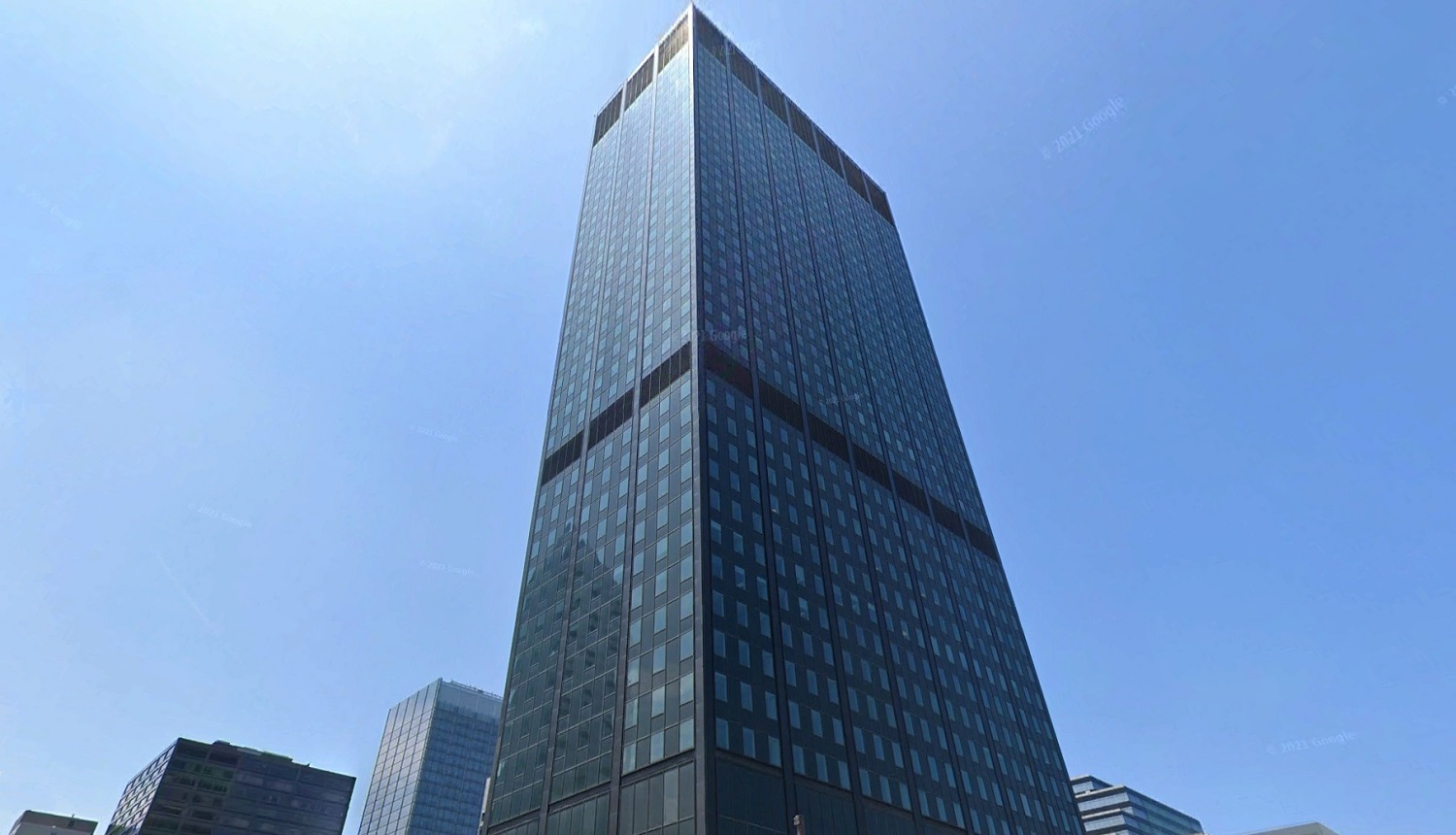
Once the second-tallest building in Downtown Cleveland, Erieview Tower is getting a makeover and a partial conversion to residential and hotel uses that will include a freshening up of its black and dark-green exterior (Google). CLICK IMAGES TO ENLARGE THEM.
Development team reveals reno details

With interior demolition work wrapping up, the Erieview Tower redevelopment team is now getting ready to update the building’s life safety infrastructure and convert the tower’s midsection to residential.
A construction permit application was submitted to the city yesterday for the proposed work which includes the residential conversion of 12 floors at the Erieview Tower office building, 1301 E. 9th St. This represents the first two phases of the 61-year-old tower’s revitalization led by Cleveland-based Kassouf Development.
The plans, submitted by architect Berardi + Partners LLC of Columbus and project manager TurnDev of Cleveland, show that floors 17-28 of the 40-story building will see a change of use from office to residential. Estimated cost of the planned work is just shy of $35 million, public records show.
At full buildout, the $218 million redevelopment project will feature 227 W-branded by Marriott luxury apartments, a 210-room W-branded luxury hotel, a 38th-floor fine-dining restaurant and bar, a 15,000-square-foot ballroom, spa, fitness center and lobby lounge.
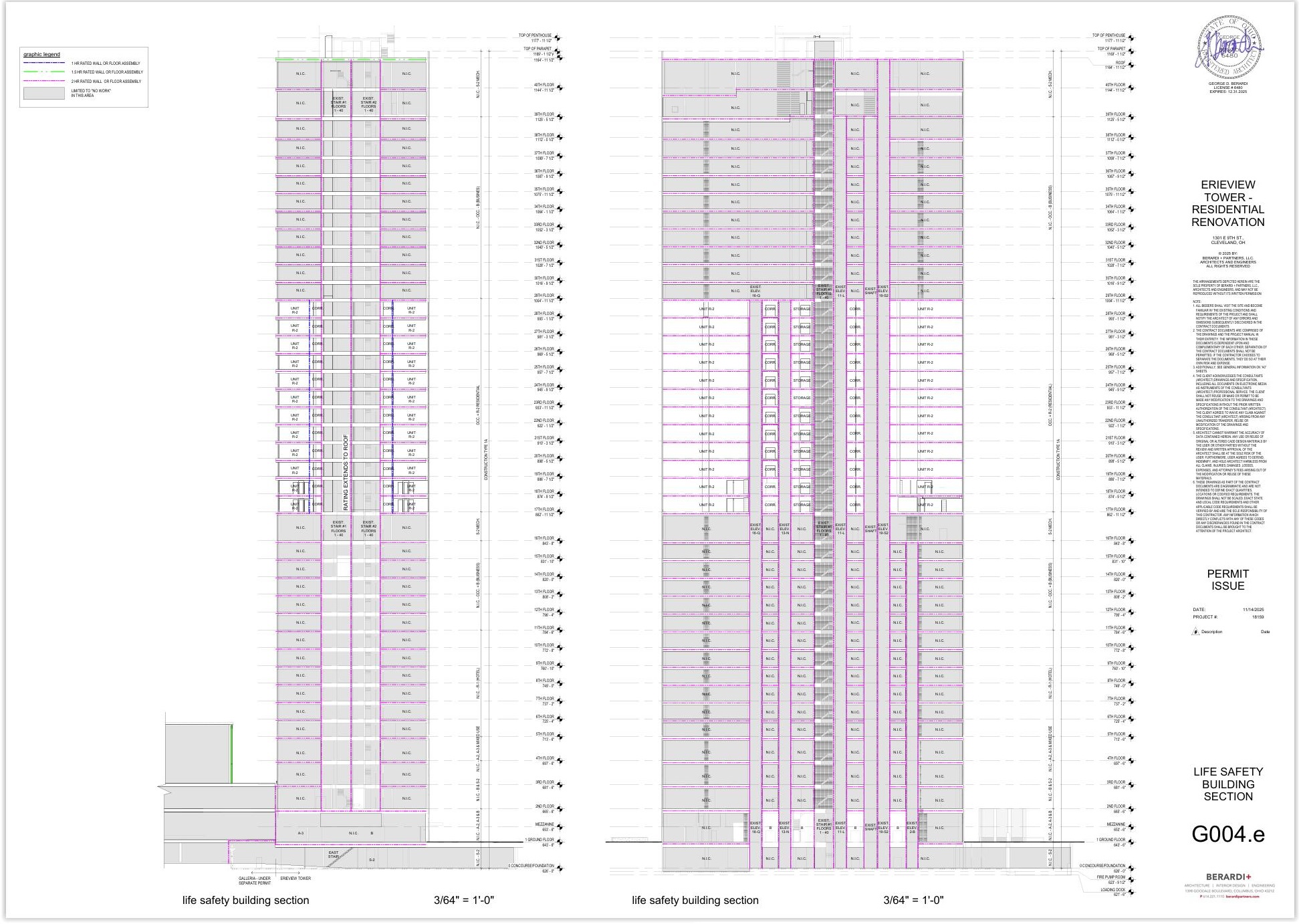
A cross-section of the Erieview Tower is shown here, with the highlighted 12 floors in the middle of the skyscraper to be converted to residential use. This was among many documents submitted to the City of Cleveland yesterday as part of the construction permit application (Berardi).
Residential offerings will consist of efficiencies/studios, one-bedroom units and two-bedroom suites. Although detailed information about rents were not yet available, the development team said they will be offered at market rates.
The 700,000-square-foot Erieview Tower will keep renovated office spaces across 12 floors, while retail, restaurant and other commercial spaces will be retained in the connected Galleria that was added in 1987. Plus, there are 200 residential and 311 nonresidential parking spaces below the Galleria and tower.
About $1.4 million in selective demolition work that’s wrapping up was done in recent months to floors 17-28 as well as to the ground floor. A second permit, awarded last month, authorized interior demolitions to floors four to 12; that work is projected to cost $775,000.
Conducting the demolition work is A&T EnviroMental of Bedford, according to an e-mail submitted Oct. 10 to the city’s Building Department by Mario Rini, senior project manager at TurnDev. The general contractor is Independence Construction of Brecksville.
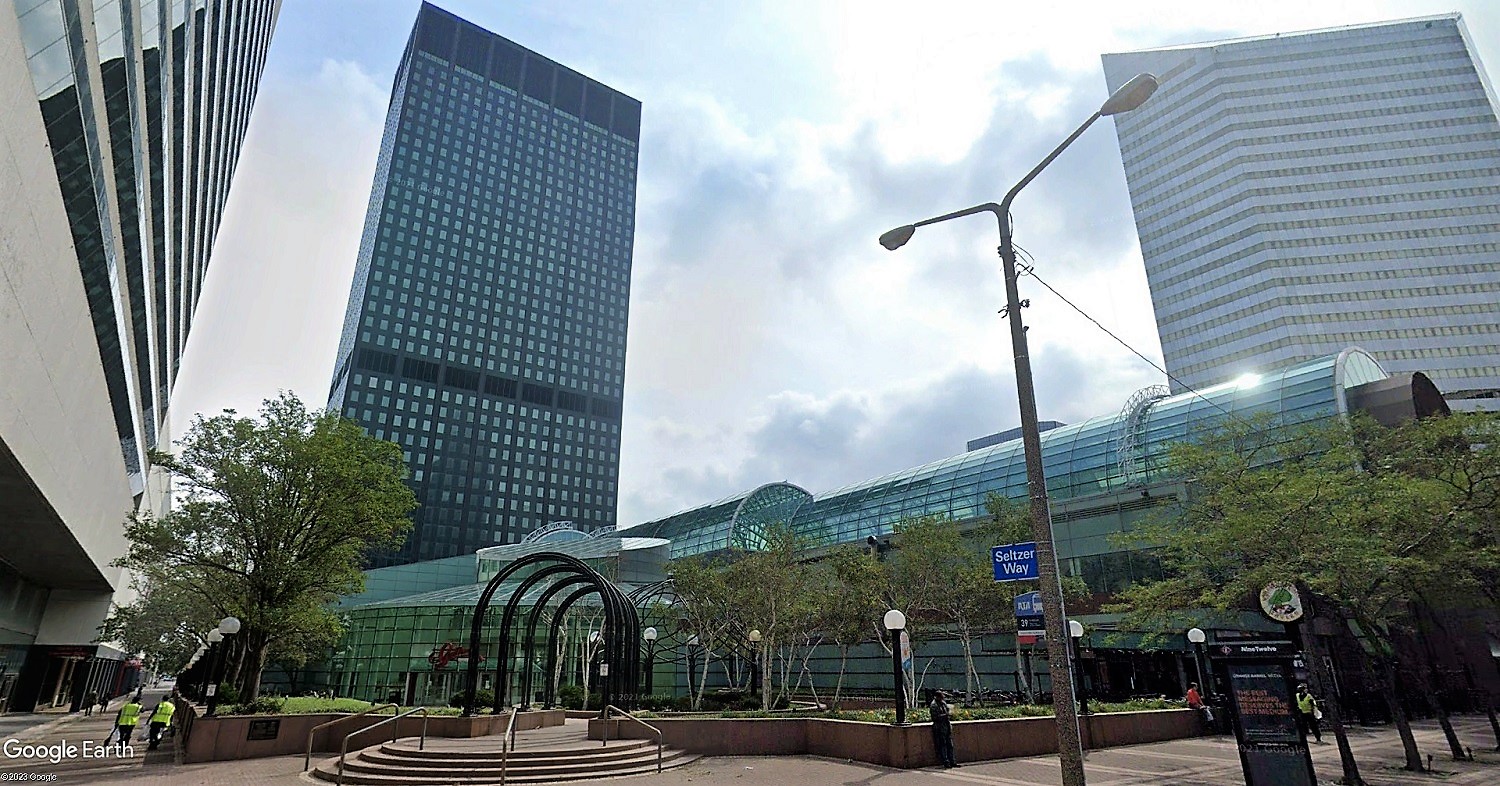
The Erieview Tower was joined in 1987 by the construction of the Galleria shopping center which has suffered from the loss of office tenants in the surrounding, aging office buildings. Some of the buildings were fully or partially converted to residential as Erieview will (Google).
“The building will undergo a change of use for occupancy to residential for floors 17-28,” wrote Derek Michaelis, project designer at Berardi, in submitting the permit application. “The project will maintain a business occupancy on all remaining floors. The Galleria will maintain is current use of mercantile and assembly.”
He said the residential renovation includes the rehabilitation of the tower’s exterior cladding, both the black granite pilasters and curtain wall system. Because the project received state and federal historic tax credits, the exterior cannot be changed from its original appearance.
Erieview Tower and Galleria are listed on the National Register of Historic Places. The surrounding district was also declared an historic district which allowed younger buildings nearby, such as The Bell Apartments, to tap historic tax credits for their redevelopment.
Floors 29-40 will remain unaltered at this time as they are partially occupied by office tenants. A new egress stair extension will be added between floors one and two, Michaelis wrote.
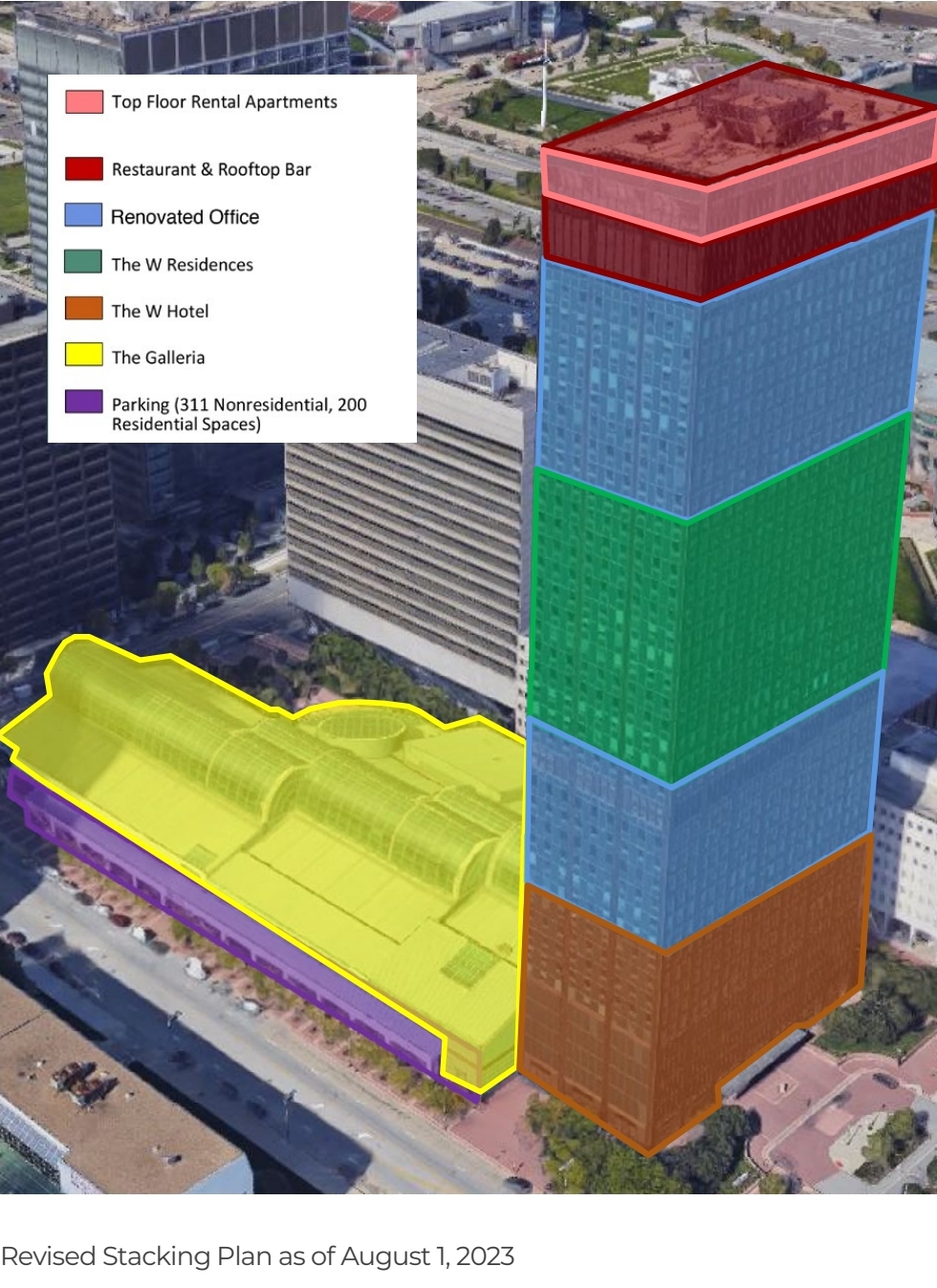
Proposed uses for Erieview Tower are shown here in a more complete and easy-to-understand presentation (Berardi).
The basement and concourse areas will continue to service the building utilities and provide access to the building’s life safety systems including a pump room. The floor will serve as the main entry for business and, ultimately, residential occupants of the tower.
Also to continue as before, the 16th floor will remain as the building’s mechanical floor, featuring many of the buildings utilities and electrical systems. When built, the 529-foot-tall Erieview Tower was Downtown Cleveland’s second-tallest building, trailing Terminal Tower. Now it is the city’s fifth-tallest.
Other parties in the development team include law firm Kohrman Jackson & Krantz, real estate firm Brown Gibbons Lang & Company, and accounting firm Novogradac & Company LLP, all of Cleveland, plus real estate program manager Turner & Townsend of Leeds, United Kingdom.
Financial partners in the project included Huntington National Bank, Midland States Bank, PPG, Cleveland-Cuyahoga County Port Authority, Peachtree PACE, and the Ohio Brownfield Remediation Program each of which provided development capital.
END