
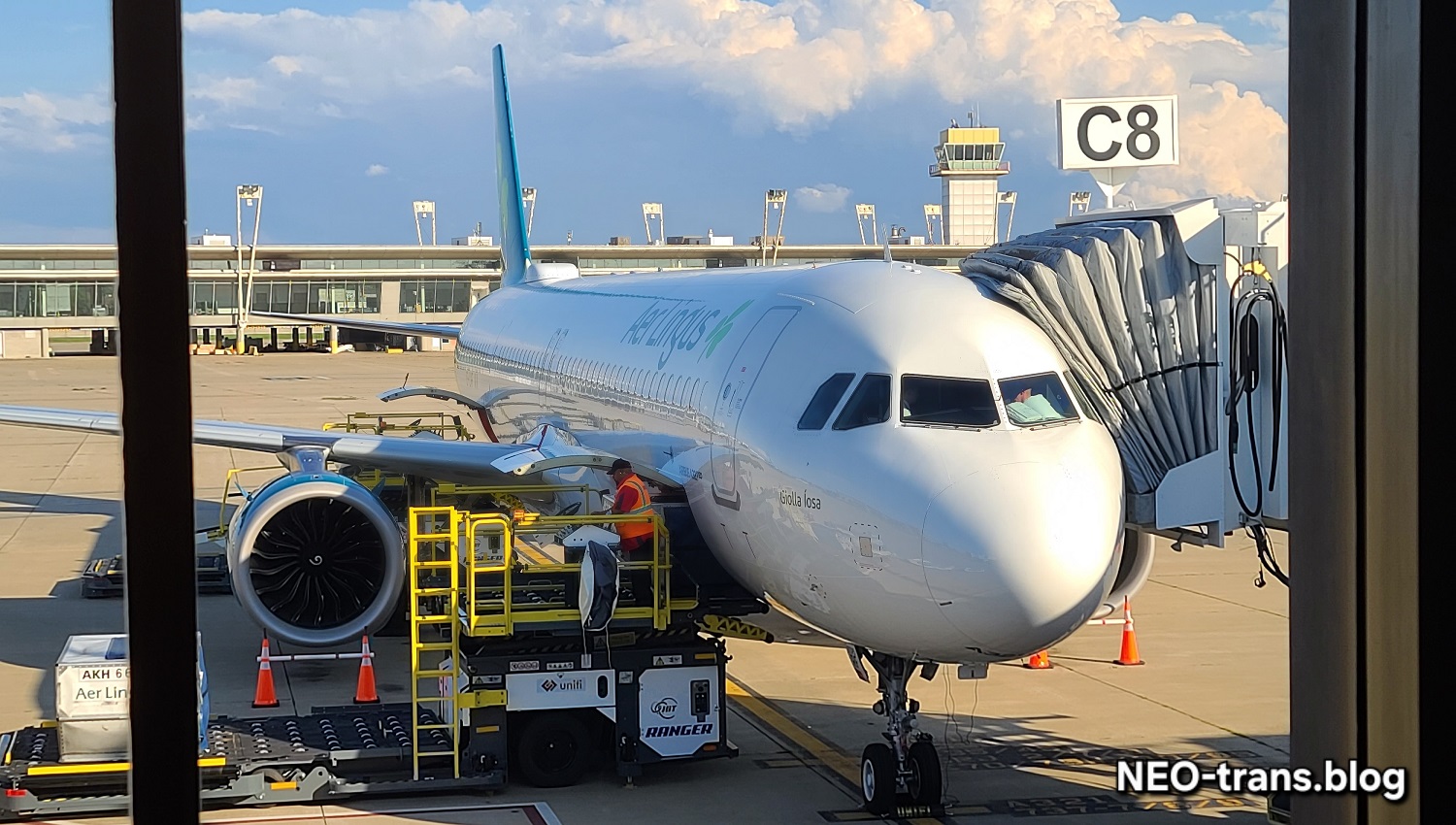
Cleveland Hopkins International Airport has the most international travelers of any non-hub or non-focus-city airport east of the Mississippi River. Yet this is Cleveland’s only nonstop transatlantic flight, a near-daily Aer Lingus round trip to Dublin, Ireland. In the background is Concourse D which, as of next year, will have been abandoned for as long as the 12 years it was in use (NEOtrans). CLICK IMAGES TO ENLARGE THEM.
Updated airport, new planes offer opportunity

Eleven years ago, United ended its hub operation at Cleveland Hopkins International Airport, leaving the 1999-built Terminal D vacant and relinquishing some of the airport’s remaining gates to expansion by low-fare airlines.
But an online aviation publication recently opined that Cleveland Hopkins was one of the nation’s five airports that are most likely to regain hub operations by a legacy airline. There are three such airlines — American, Delta and United.
Alexander Mitchell, a contributing editor at Simple Flying, wrote that Cleveland along with Cincinnati, Austin–Bergstrom, San Diego and Tampa were in the best position to gain or regain airline hubs. Mitchell’s business experience with commercial aviation began at Bridgewater Associates, the world’s largest hedge fund.
He said the three legacy air carriers are “locked in a battle” to be the largest and most financially successful airline in the country. A key piece of that pursuit is a careful selection of route networks and hubs.
“All three carriers are constantly evaluating their existing list of facilities, and they are exploring what new airports could be fit for a new hub,” Mitchell wrote.

United Airlines maintains a significant crew and maintenance base at Cleveland Hopkins International Airport, although not as significant as it once was. Thus, part of this city-owned facility off Cargo Road has been turned into offices for architects, engineers and contractors overseeing the $1.6 billion first phase of the airport’s modernization (Google).
He explained that United is in the best position to open, or in this case reopen, a hub in Cleveland. United had a hub at Cleveland from 1945-86 when it left for greener pastures at Washington-Dulles and Chicago-O’Hare.
That void was filled by Continental Airlines until it merged with United in 2011, only to be de-hubbed by United a second time in 2014. United cut its operations from 200 daily departures to 72, and abandoned the $80 million Concourse D opened in 1999.
Yet United continues to maintain a crew base for pilots and flight attendants here, along with a significant aircraft maintenance facility. Despite the growth of low-fare Frontier Airlines at Cleveland, United’s market share edges out Frontier’s as the city’s most popular airline.
“For many, saying United could soon open a hub in Cleveland is a no-brainer,” Mitchell said. “With budget airlines continuing to expand their offerings from the airport, United may be forced to open a hub soon to compete with airlines like Frontier.”
Of great interest to the airlines is Cleveland’s $1.6 billion first-phase, five-step program of improvements to Hopkins International Airport over the next seven years. It’s Hopkins’ first major reconstruction and modernization program since the 1970s.

The front door to Cleveland Hopkins International Airport could look like this as early as 2032 when the main terminal at right is due to open. At left is a new ground transportation center with 6,000 parking spaces, shuttle bus boarding areas and a new train station below (Corgan).
In 2024, Hopkins saw 10 million travelers — the most since 2008 when it was a hub for Continental Airlines. Nowadays, most travelers aren’t changing flights here, but parking cars, checking bags and going through security. That has put increased demands on the aging, cramped land-side terminal.
Cleveland Mayor Justin Bibb has said the airport needs to evolve to meet the needs of today’s travelers while paving the way for the future of aviation in Northeast Ohio. Future growth isn’t likely without Hopkins’ Terminal Modernization Development Program (TMDP).
But local officials are mum on the prospects of what that growth could look like, whether it can hold the promise of an airline hub or at least what’s called a focus city. A focus city, dubbed a “mini-hub,” is where an airline significantly boosts flights and operations to build network density.
“We appreciate United as Cleveland’s largest airline carrier and are always interested in supporting growth of their flights and operations in the region,” said Baiju Shah, president and CEO of the Greater Cleveland Partnership, the region’s chamber of commerce.
But he deferred NEOtrans’ questions on the specifics of potential growth to Cleveland Port Control Director Bryant Francis who oversees Hopkins and Burke Lakefront Airport which are both owned and managed by the City of Cleveland.
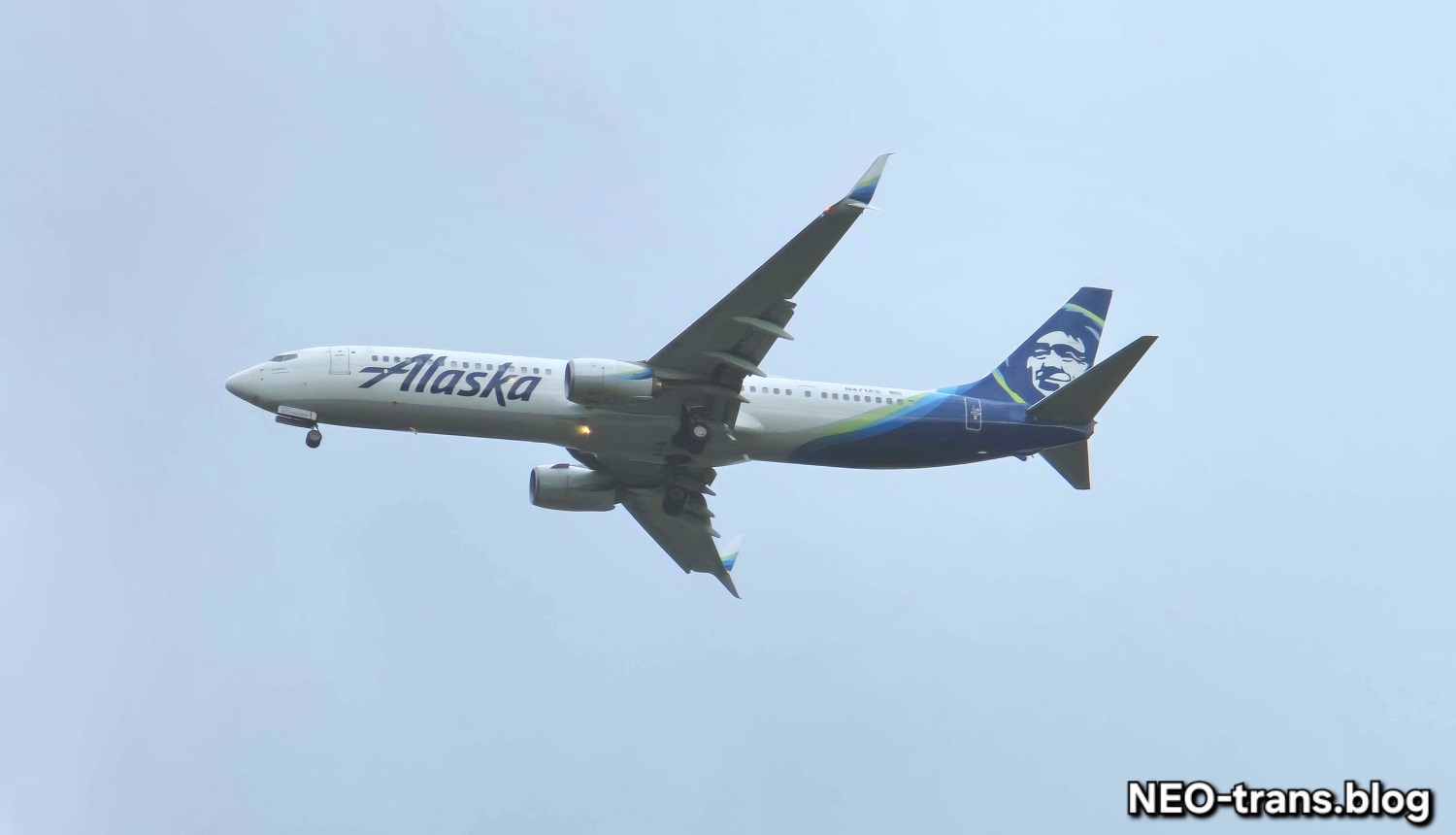
One of Cleveland’s longest-distance routes westward is this flight to/from Alaskan Airlines’ Seattle hub which offers connections to Alaska, Hawaii, Japan and South Korea (NEOtrans).
Neither Francis or a United Airlines spokesperson responded to NEOtrans’ inquiries prior to publication of this article.
“The feedback of our airline representatives has been central to our (TMDP) planning process, and their ideas surrounding our future are greatly valued,” said Francis in a written statement issued earlier this year.
Another development that could come into play is the introduction of Airbus’ new A321XLR, or extended long range jet. Not only can it fly further than any other single-aisle plane on the market, it also burns 30 percent less fuel per seat than comparable single-aisle aircraft like the two-decade-old Boeing 757.
Single-aisle planes are well-suited to smaller airports and markets like Cleveland. Fuel-efficient aircraft can also make marginal routes profitable. And from Cleveland, the A321XLR puts all of Europe from Warsaw, Poland westward within range of each other.
“The XLR, once it replaces older 757s, should allow airlines to bypass major hubs on either side of the Atlantic and open new, nonstop, transatlantic routes to smaller cities,” wrote transport and aviation reporter Edward Russell in a recent CNN article.
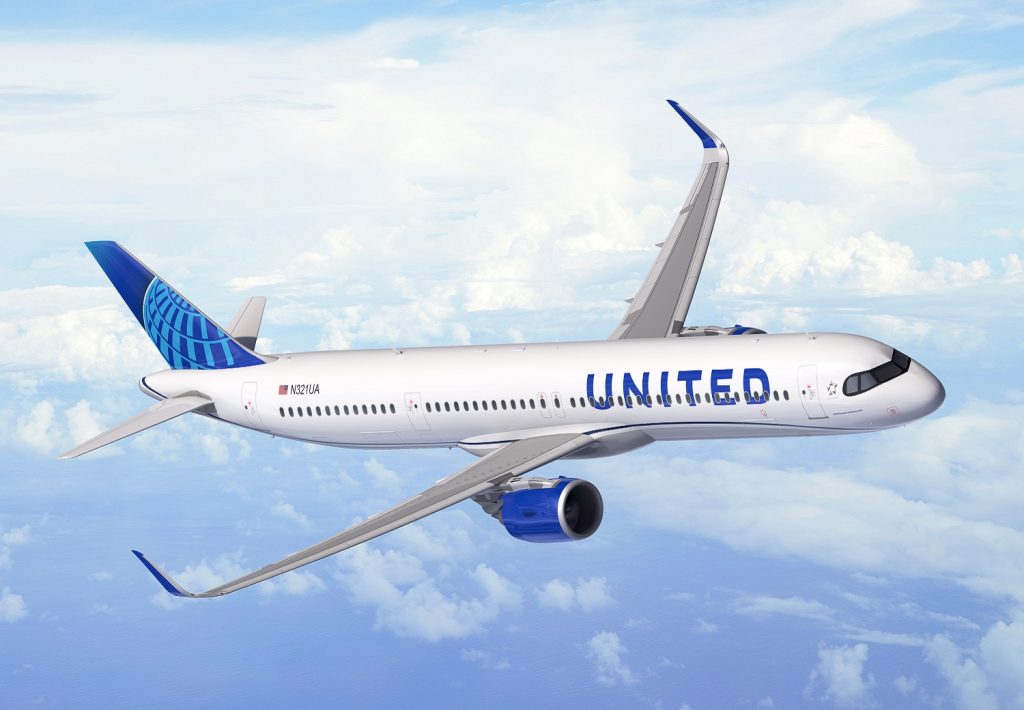
United Airlines has ordered 50 A321XLR planes to expand its destinations for transcontinental flights starting in mid-2026. So far, Cleveland has not been named as a potential beneficiary, but the new aircraft offers that opportunity according to aviation industry observers (Courtesy of Airbus).
While United CEO Scott Kirby said the airline is looking at serving up to a dozen smaller cities in Eastern Europe and North Africa from its Newark and Dulles hubs, the reverse is also possible.
Cleveland and other non-hub North American cities could become destinations from European hubs like London Heathrow, Amsterdam Schiphol, or Frankfurt Main.
According to global aviation analytics firm Cirium, Cleveland Hopkins has the most international traffic of any non-hub or non-focus-city airport east of the Mississippi River.
Cleveland Hopkins’ 1,605 daily international passengers last year exceeded that of its peer cities, namely Indianapolis (1,521), Pittsburgh (1,457), Cincinnati (1,390) or Columbus (1,292), Cirium reported.
END