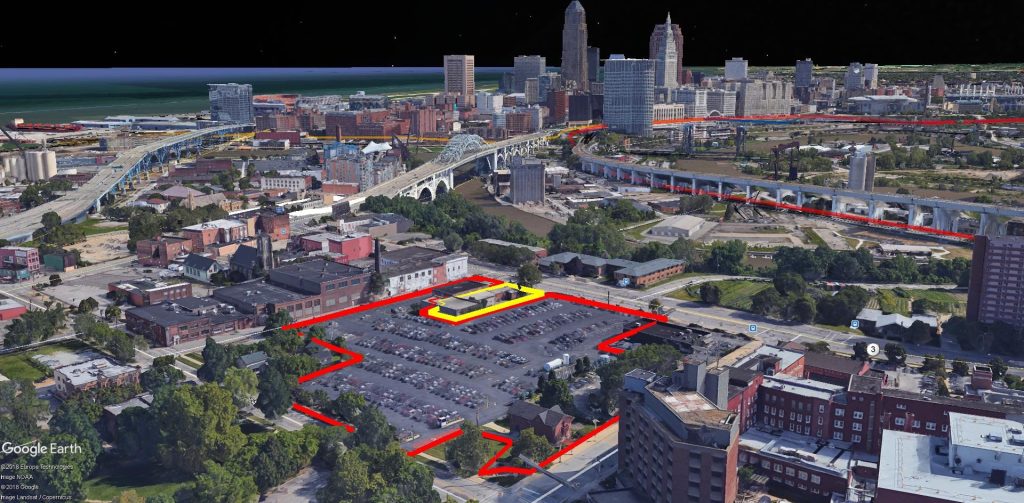
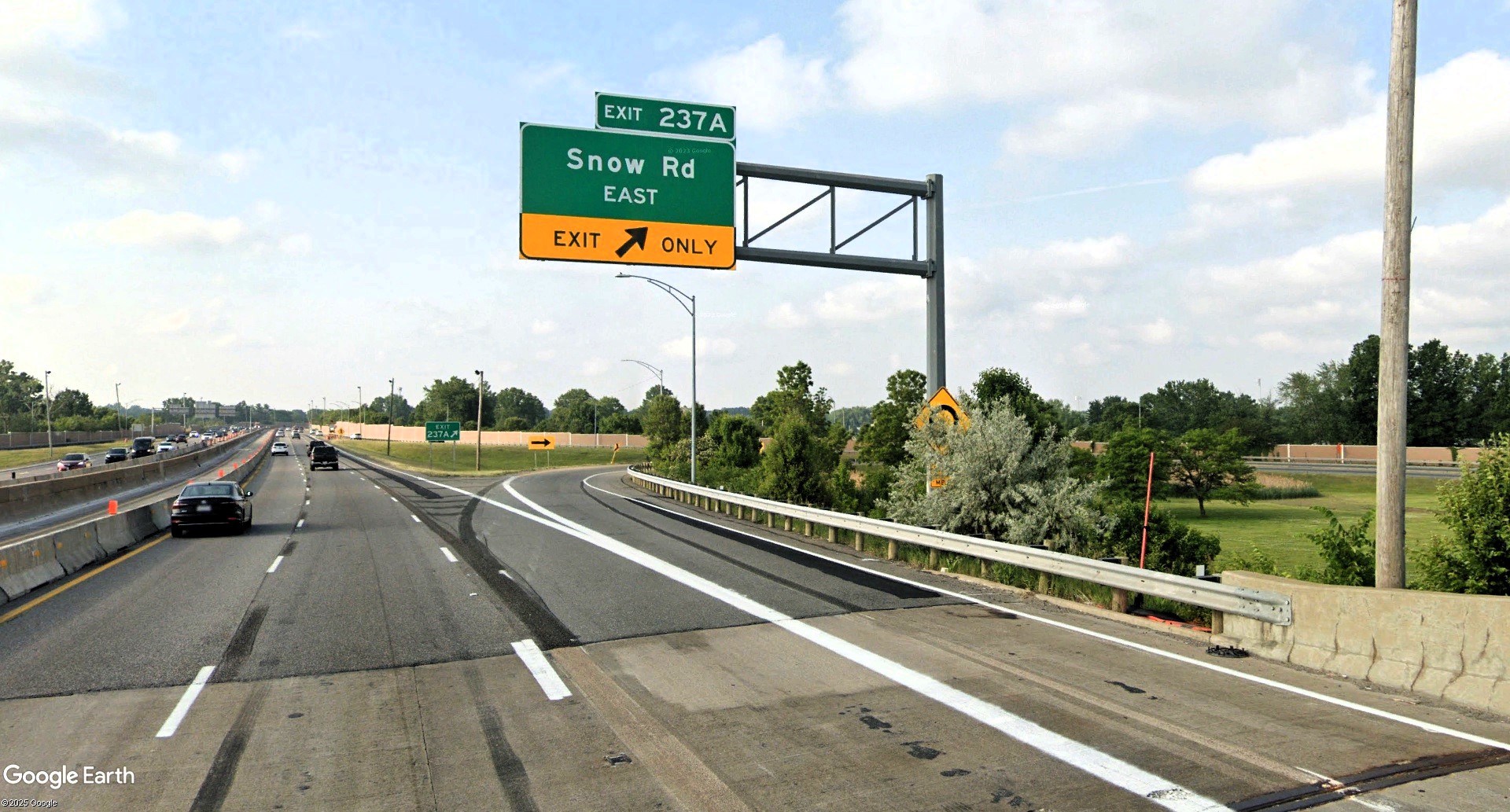
Major changes are proposed to the Interstate 71-Snow Road interchange in suburban Brook Park to handle traffic to and from the Haslam Sports Group’s planned enclosed stadium nearby (Google). CLICK IMAGES TO ENLARGE THEM.
Info on traffic, travel impacts to be shared

The Northeast Ohio Areawide Coordinating Agency (NOACA) and the City of Brook Park, will host a public meeting next month to provide residents, businesses, visitors and other stakeholders with an opportunity to learn more about and engage in an open discussion on regional transportation and traffic pattern considerations associated with the new enclosed stadium in Brook Park.
The public meeting is scheduled to be held from 6-8 p.m. Wednesday, Jan, 14, 2026, at the Brook Park Elementary School Auditorium, 17001 Holland Rd., in the city of Brook Park, according to a press statement issued by NOACA today.
The meeting will explore how people flooding into this area to visit the proposed 67,000-seat stadium could affect the surrounding area. The stadium is sought by the Haslam Sports Group, owners of the Cleveland Browns football team, for the team’s home games and other large-scale events.
The attendance for those games and events will affect local and regional roadways, neighborhood and business access, transit service, pedestrian and bicycle connectivity, safety, and overall mobility throughout the region, as well as game-day and event-related travel.
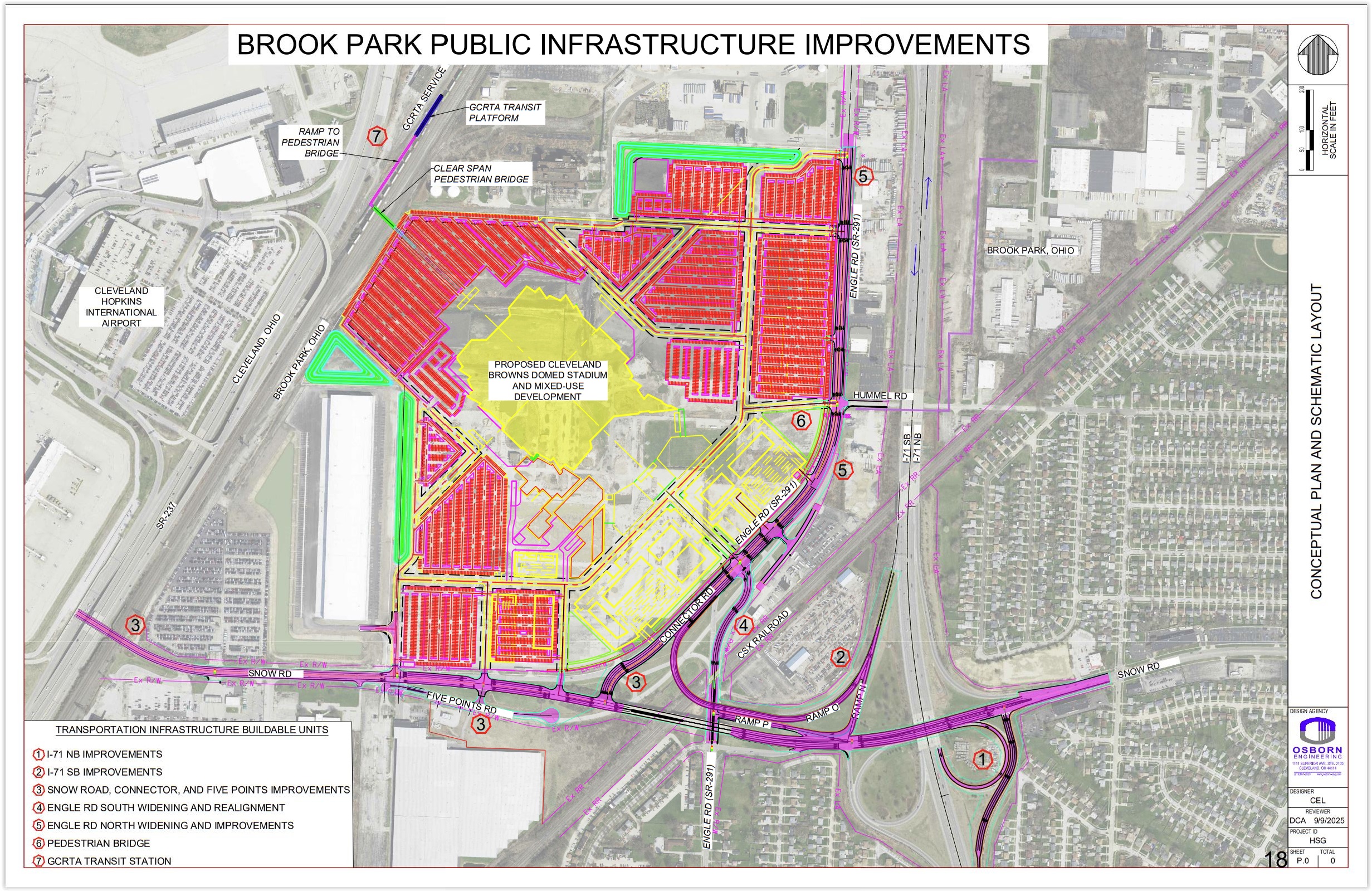
These are the infrastructure improvements proposed to improve access to the new, enclosed stadium in suburban Brook Park and ease traffic for neighborhoods seen at right and to Cleveland Hopkins International Airport at left (Osborn).
Seven infrastructure projects totaling more than $122 million are being considered to support public access to the new $2.4 billion Huntington Bank Field stadium. Public input will help decision makers decide which of these, or possibly others, may be submitted for state and federal funding to improve road and transit access in the stadium area.
As the region’s metropolitan planning organization, NOACA works with local governments and partners to evaluate transportation impacts and coordinate planning for major development proposals and allocate federal funds to infrastructure projects in Cuyahoga, Geauga, Lake, Lorain and Medina counties.
This public meeting is designed to encourage meaningful two-way dialogue, allowing interested parties to ask questions, gain perspectives, and engage directly with planning partners as transportation needs and infrastructure opportunities are discussed.
Community participation is essential to transportation planning. This meeting will provide a forum for constructive conversation and idea-sharing, helping to inform how transportation considerations are studied and reflected in future planning and decision-making.
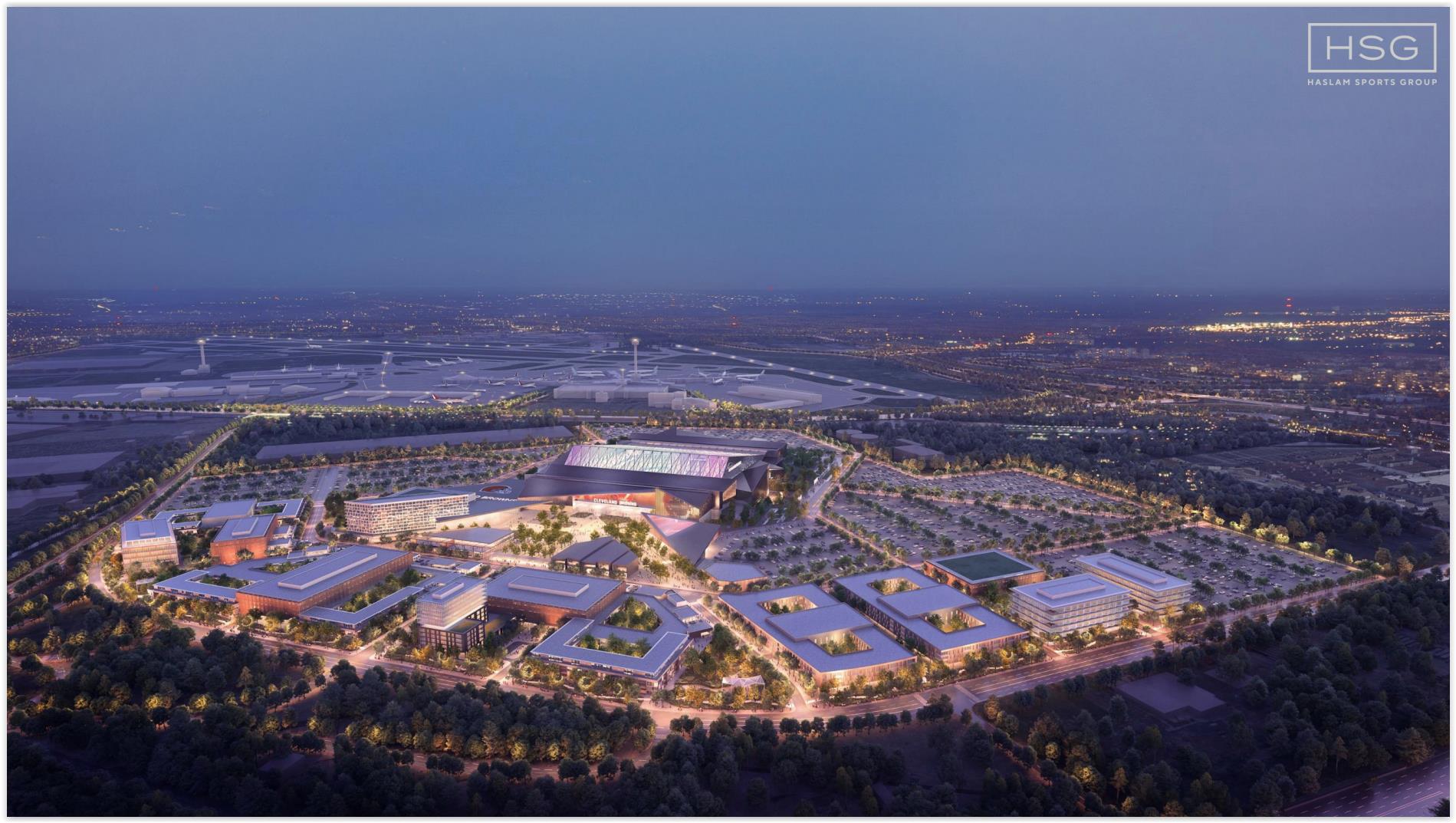
The new Huntington Bank Field and proposed supportive development in Brook Park is seen in this view looking west from above Interstate 71 (HKS).
A key issue to be addressed is where off-site stadium parking will be located. More than 12,000 parking spaces will be provided on immediately surrounding the new stadium on 180 acres, west of Henry Ford Boulevard and north of Snow Road.
The new stadium is proposed to see construction start in 2026 and be completed as early as the summer of 2029. But the Cleveland Browns could continue to play their home games for up to two more years at the current stadium in Downtown Cleveland if there are any construction delays.
But the on-site parking will be insufficient to handle peak attendance at the stadium. It is anticipated that thousands of off-site parking spaces will be provided northeast of the stadium site along Engle Road, West 164th Street, and Brookpark Road, on both sides of Interstate 71.
The location of parking will have a major impact on game-day traffic and affect people passing through going to Hopkins International Airport, or to surrounding neighborhoods. So studies are being conducted to determine how where the worst traffic will be and how to address it.
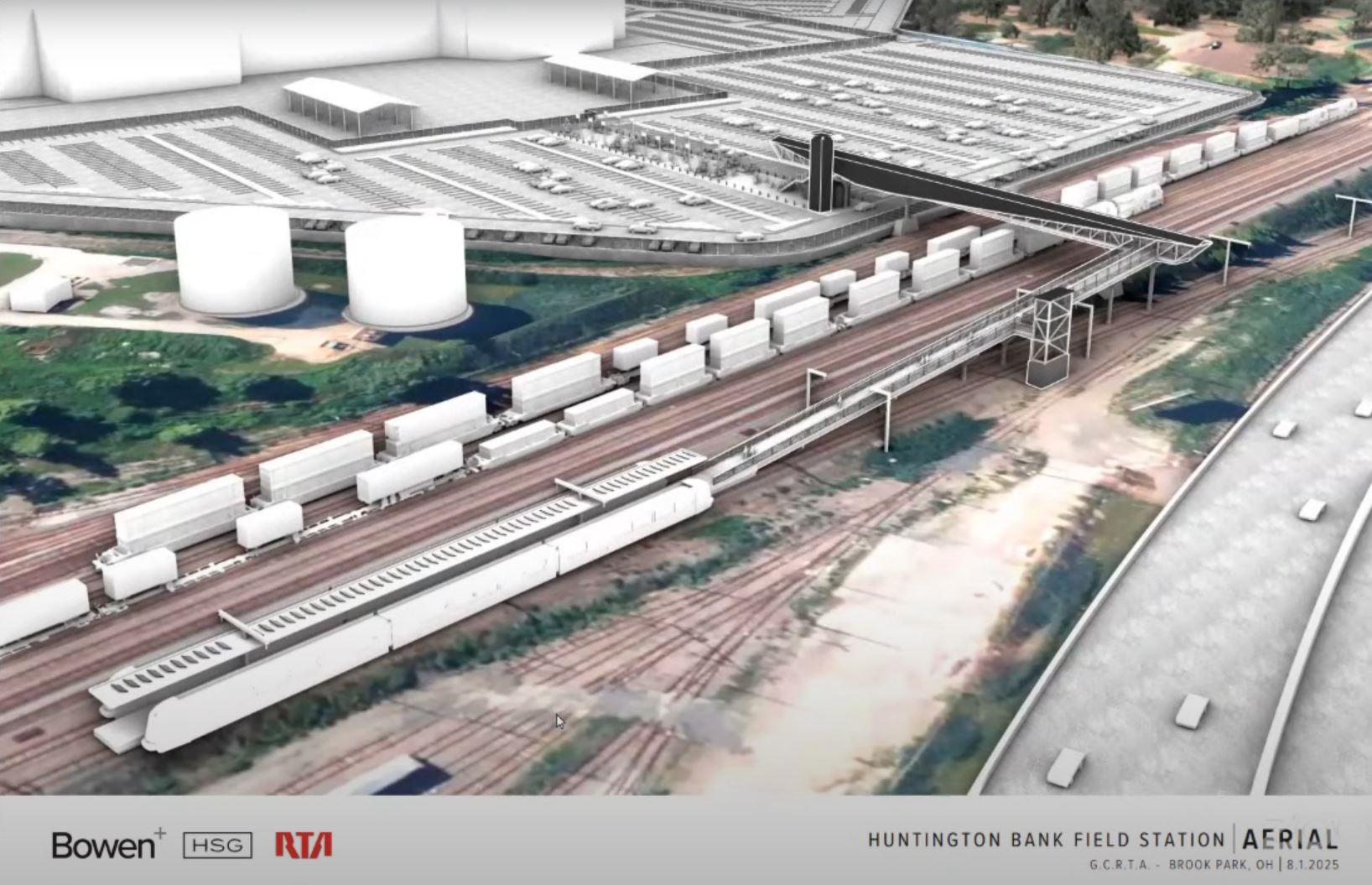
A new train station was proposed by the Haslam Sports Group to ease parking and traffic issues at the new Brook Park stadium, seen at upper left. The Berea Freeway is at lower right (Bowen).
“(This) is recommended in order to understand the impacts to traffic in the surrounding area,” a NOACA staff summary said. The lack of parking has prompted the Cleveland Browns owners, the Haslam Sports Group, to recommend the largest addition to the scope of transportation infrastructure planning.
A new $40 million rapid transit train station is proposed on the Red Line that links Hopkins Airport with Downtown Cleveland and the rest of the Greater Cleveland Regional Transit Authority’s (GCRTA) rail and bus system.
The new station is proposed to be located outside of the Red Line’s subway tunnel portal that leads to the rail station below the airport’s main passenger terminal. It requires moving the Red Line’s tracks to insert a boarding platform between them, building a pedestrian bridge over the busy Norfolk Southern railroad mainline and adding a ramp, stairs and elevator to that bridge.
The proposed Red Line station for the stadium is not in GCRTA’s plans, as any capital or operating funding for it would take away from already tight transit funding for the rest of the existing system. It is not yet clear where the funding would come from for this new station.
END