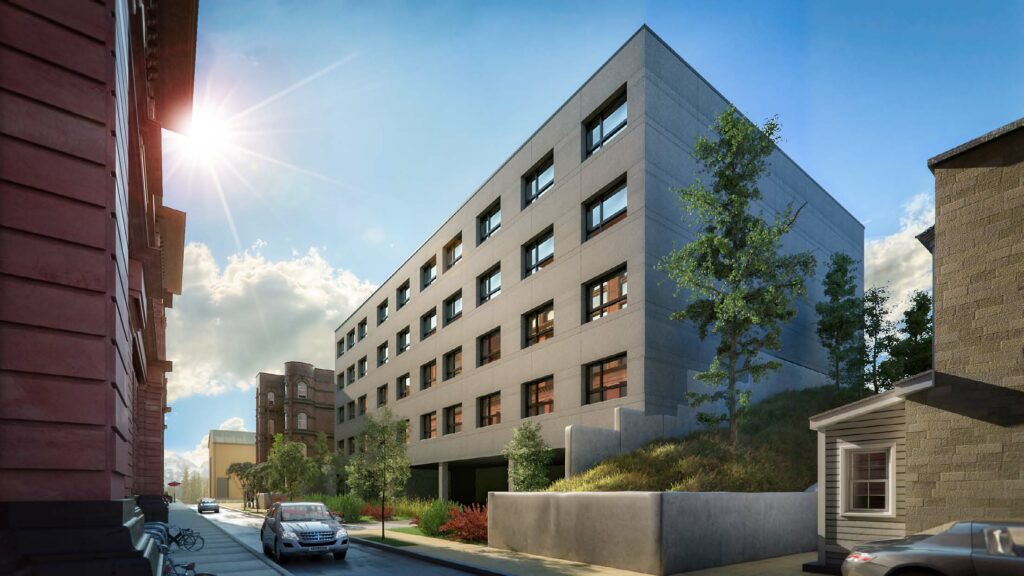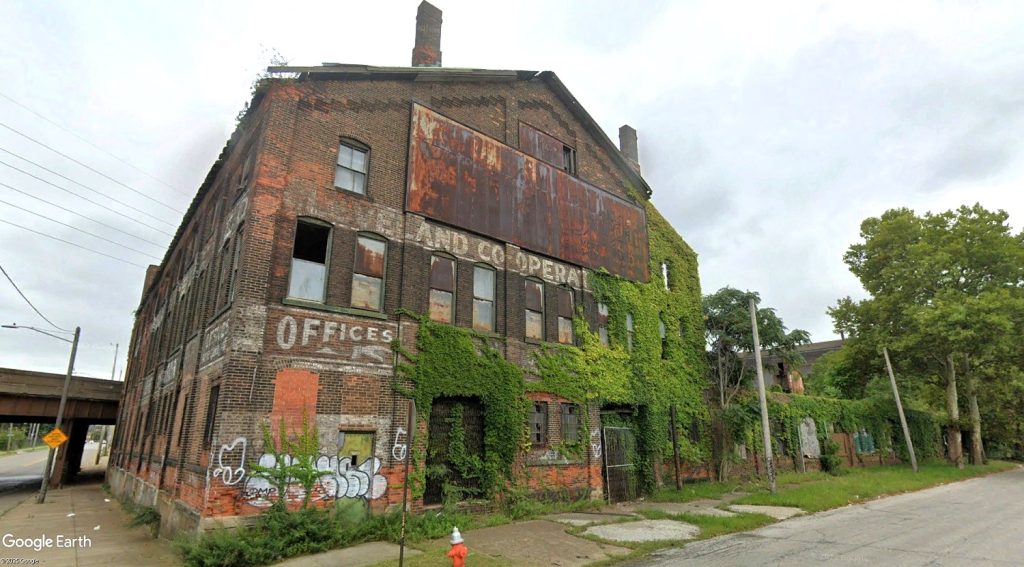
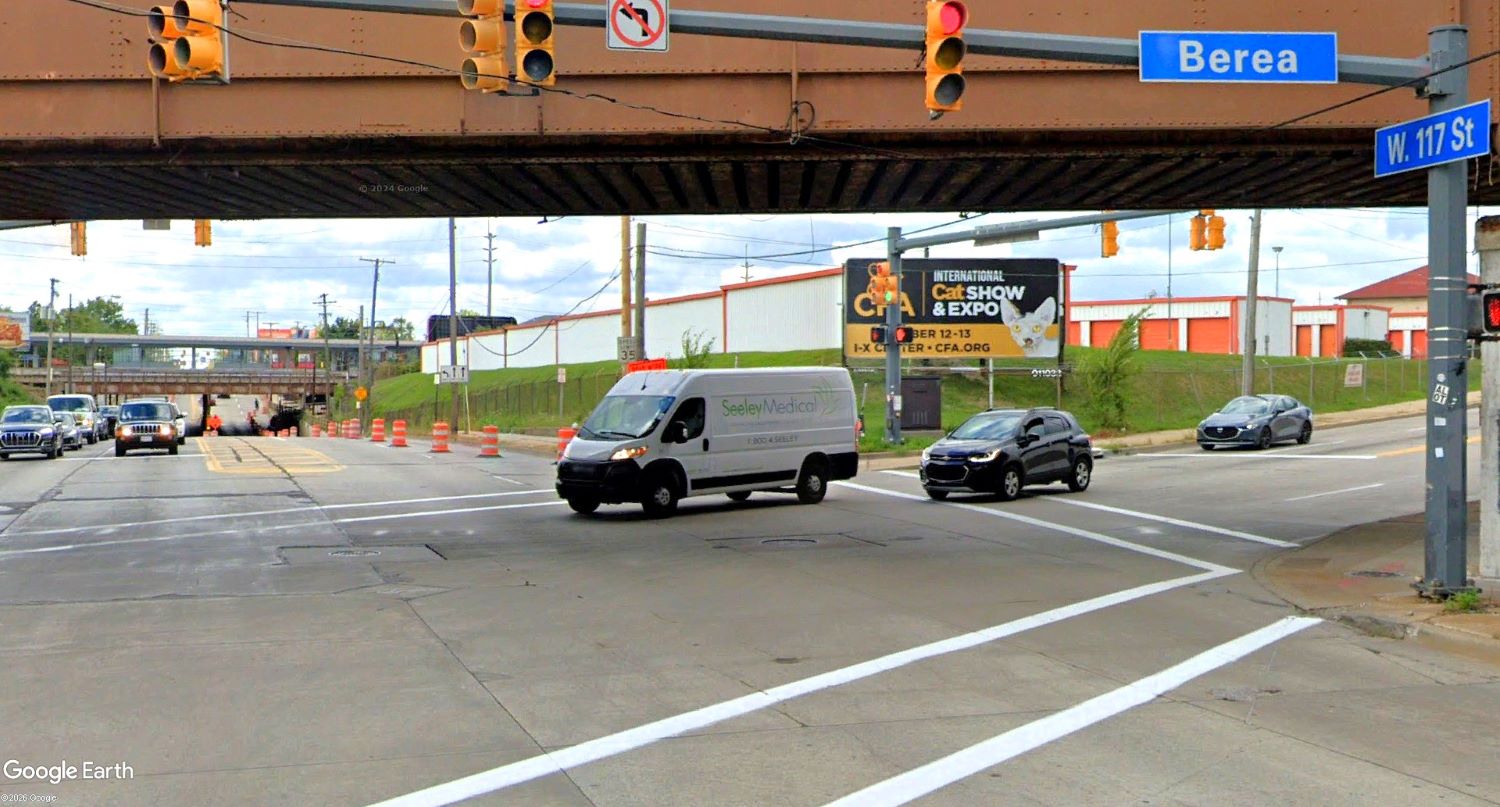
At the northeast corner of West 117th Street and Berea Road, and next to the Red Line train station in the background, is a self-storage property that’s being acquired by a national self-storage company. So it’s likely to remain a storage facility despite past efforts to redevelop it with transit-supportive housing and mixed uses (Google). CLICK IMAGES TO ENLARGE THEM.
But may remain as self-storage units
ARTICLE UPDATED JAN. 27, 2026 WITH PAGODA QUOTES
A Michigan-based self-storage company that has been expanding its property holdings in Ohio is adding another. This time it’s a property that’s been courted for decades by developers and planners as a potential site for Transit Oriented Development (TOD).
At the northeast corner of West 117th Street and Berea Road, where Cleveland meets Lakewood, is Helm Storage, 11600 Berea Rd. It is next to the West 117th-Madison Rapid transit station on the Red Line rail service that links Cleveland Hopkins International Airport, Downtown Cleveland and University Circle.
But considering the buyer and its history, the 3.55-acre property probably isn’t going to be redeveloped any time soon with transit-supportive land uses — housing, retail, community services — unless someone makes them an offer ASAP. Those uses could generate ridership for the rail transit line operated by the Greater Cleveland Regional Transit Authority (GCRTA).
The Red Line could certainly use the ridership, especially after the pandemic reduced commuting to downtown office jobs. This line in 2024 had the second-lowest ridership among heavy-rail systems in the country, according to the American Public Transportation Association. Only the newly built Honolulu Skyline was lower.
A certificate of disclosure was filed last week with the Cleveland Building Department which shows that the property is being sold by Lakeview Investment Group LLC of Cleveland to National Storage Management Co. of Farmington Hills, MI, in suburban Detroit. Terms of the pending sale were not disclosed.
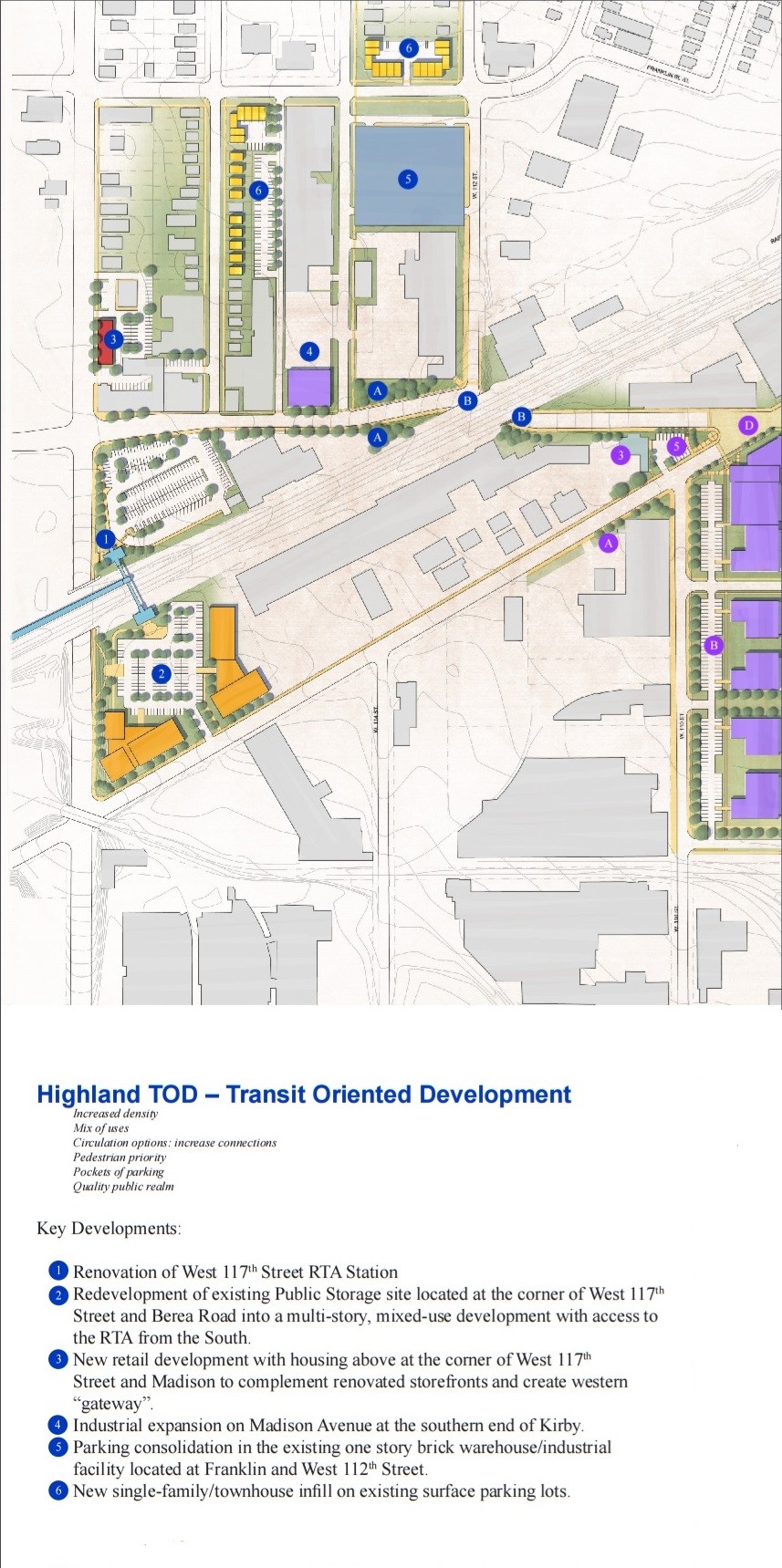
About 15 years ago, a land use plan by local community development corporations for the area around the West 117th-Madison train station proposed mixed-use development such as residential over commercial at the site of Helm Storage to provide more community benefits (City Planning Commission).
“We haven’t been approached by anyone” about alternative uses for the site, said Michael Pagoda, director of acquisitions at National Storage Management. He said the deal is closing today but is open to offers and ideas.
“We’re about to do substantial capex work (at this site),” Pagoda said in a phone interview. “Now is the right time for the city or whomever to reach out to us. Once we put in all this work in a year we wouldn’t be interested in selling. Now would be the time to have that conversation.”
E-mails sent to Rose Zitiello, executive director of the Westown Community Development Corp., seeking more information were not responded to prior to publication of this article.
Robert Fleig, GCRTA’s public information officer, told NEOtrans that the transit authority was not aware of the pending transaction and has not had any contact with the buyer. GCRTA has been showing greater interest in promoting TOD near its rail and bus rapid transit stations.
GCRTA also is investing $450 million in local, state and federal funds to replace its aging railcar fleet — the oldest trains owned by any transit authority in the nation. The first new trains will begin arriving this June from the manufacturer Siemens Mobility and are expected to enter service on the Red Line as early as July 2027.
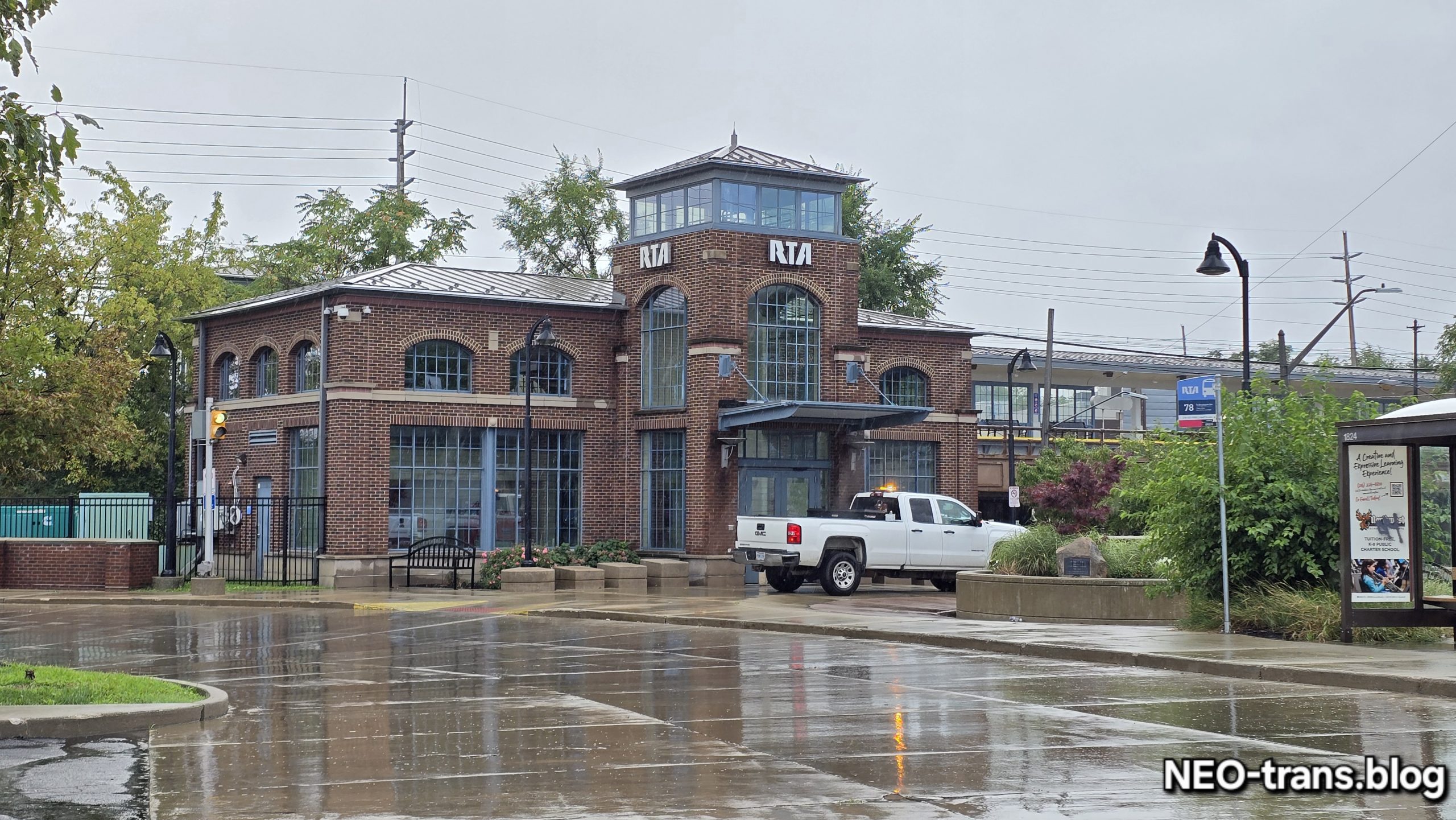
The Greater Cleveland Regional Transit Authority’s West 117th-Madison Red Line train station, seen here from the north side of the tracks. The self-storage property is on the south side of the tracks but is connected by a newly refurbished walkway under the tracks along West 117th Street (NEOtrans).
Helm Storage is the second self-storage facility on Berea that was acquired by National Storage Management. In 2019, the company acquired a property at 12600 Berea in Lakewood under the name Springhill Storage NSC LLC and repurposed its decades-old buildings with modern, climate-controlled storage units.
The 4.8-acre Springhill Storage property has about 95,600 square feet of structures and was appraised at $3,163,800 in 2024 by Cuyahoga County for tax purposes. Helm Storage’s 3.55-acre site has about 44,700 square feet of structures.
In November, parcels for the Helm Storage property and the neighboring Nippon Paint Automotive Americas Inc. plant were replatted and a 0.3-acre sliver of land between the two businesses was combined with the Helm Storage property.
Two decades ago, land use masterplans for the West 117th corridor showed the Helm Storage property repurposed with a dense, mixed-use development to take advantage of the access to rail transit.
Also, big box retailers were developing the stretch of West 117th south of the station to Interstate 90 in the early 2000s. Built was a Home Depot, a Giant Eagle grocery store, and a Target department store. The latter is undergoing a modernization.
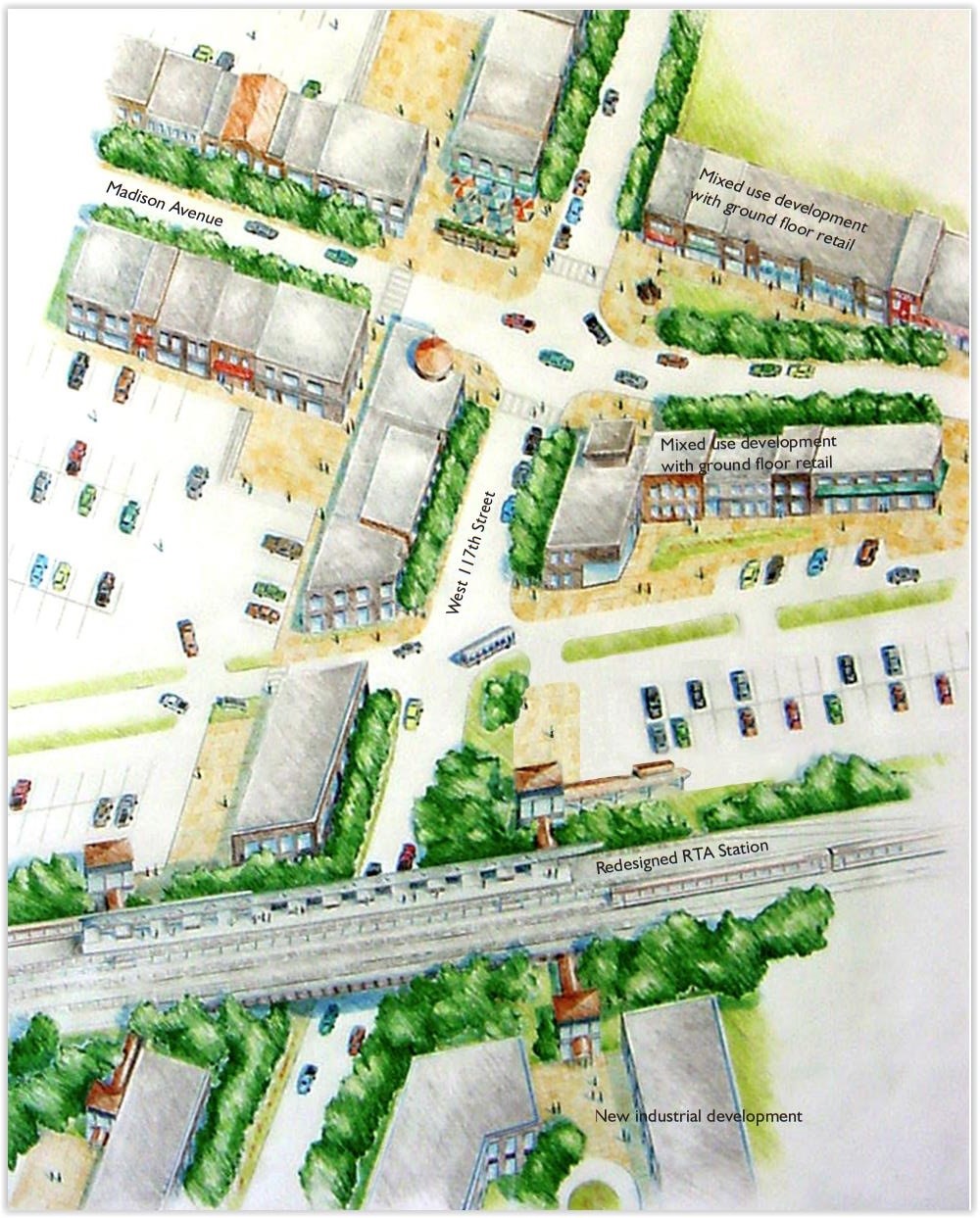
In 1999, Kent State University’s Urban Design Collaborative proposed a major revision of the land uses around the West 117th-Madison train station. It included industrial-commercial redevelopment of the Helm Storage whose jobs would be easily accessible to transit (UDC).
When she was executive director of Cudell Improvement Inc. about 15 years ago, Anita Brindza said that the then-owner of the Helm Storage property, Thomas Kilbane, received many inquiries from potential buyers wanting to redevelop it with residential or mixed uses.
Kilbane reportedly declined all offers because the self-storage business offered good cash flow with few expenses and none of the offers were lucrative enough to get him to walk away from it, Brindza said. He bought the property in 1985, according to Cuyahoga County records.
But when Kilbane died at the age of 80 in 2021, the survivorship deed to the property transferred to his wife Valerie, the public records show. She sold the property to Lakeview Investment Group for $2.3 million in November 2022. That’s $647,887 per acre.
“He was one of the first to start the self storage business craze in Cleveland and the US in the early 90’s,” his obituary noted. Thomas Kilbane, who lived in Westlake and Florida, also founded Kilbane Plumbing and Heating Inc.
For comparison, A Place For Us Housing LLC in 2015 paid $325,000 for 1.3 acres on the other side of the GCRTA station at 11610 Madison Ave., or $250,000 per acre. On that site, Cleveland-based NRP Group built a four-story, 55-unit senior apartment complex whose construction was subsidized by tax credits to make it financially doable.
END