The largest structures on Cleveland Clinic’s Main Campus aren’t medical buildings. They’re parking garages and two more are planned to see construction start this year (NEOtrans). CLICK IMAGES TO ENLARGE THEM.
Construction on both could start this year
The largest single structure built by the Cleveland Clinic isn’t a medical building like the new, 1-million-square-foot Neurological Institute on Carnegie Avenue. Instead, it’s the 1.56-million-square-foot parking garage immediately west of it. And there will be another garage of similar size added just west of that.
Construction on that big parking deck, located on the former Cleveland Playhouse property, 8500 Euclid, could start at the end of this year. But even sooner, another garage could see construction start this spring.
According to Cleveland City Council President Blaine Griffin and construction industry sources, that garage will be smaller and built on a Clinic-owned lot at the northeast corner of East 105th Street and Carnegie Avenue.
The scale of that garage is publicly less well known but unless two small Clinic buildings on Carnegie are razed, it appears as if it will have a footprint roughly equal to that of the W.O. Walker Center garage, 10524 Euclid Ave., in this same block.
That garage has only 466 parking spaces on its three levels. The new garage on East 105th will likely be much larger, however. Because of their weight, cost and soil conditions, Clinic parking garages have not exceeded 10 levels.
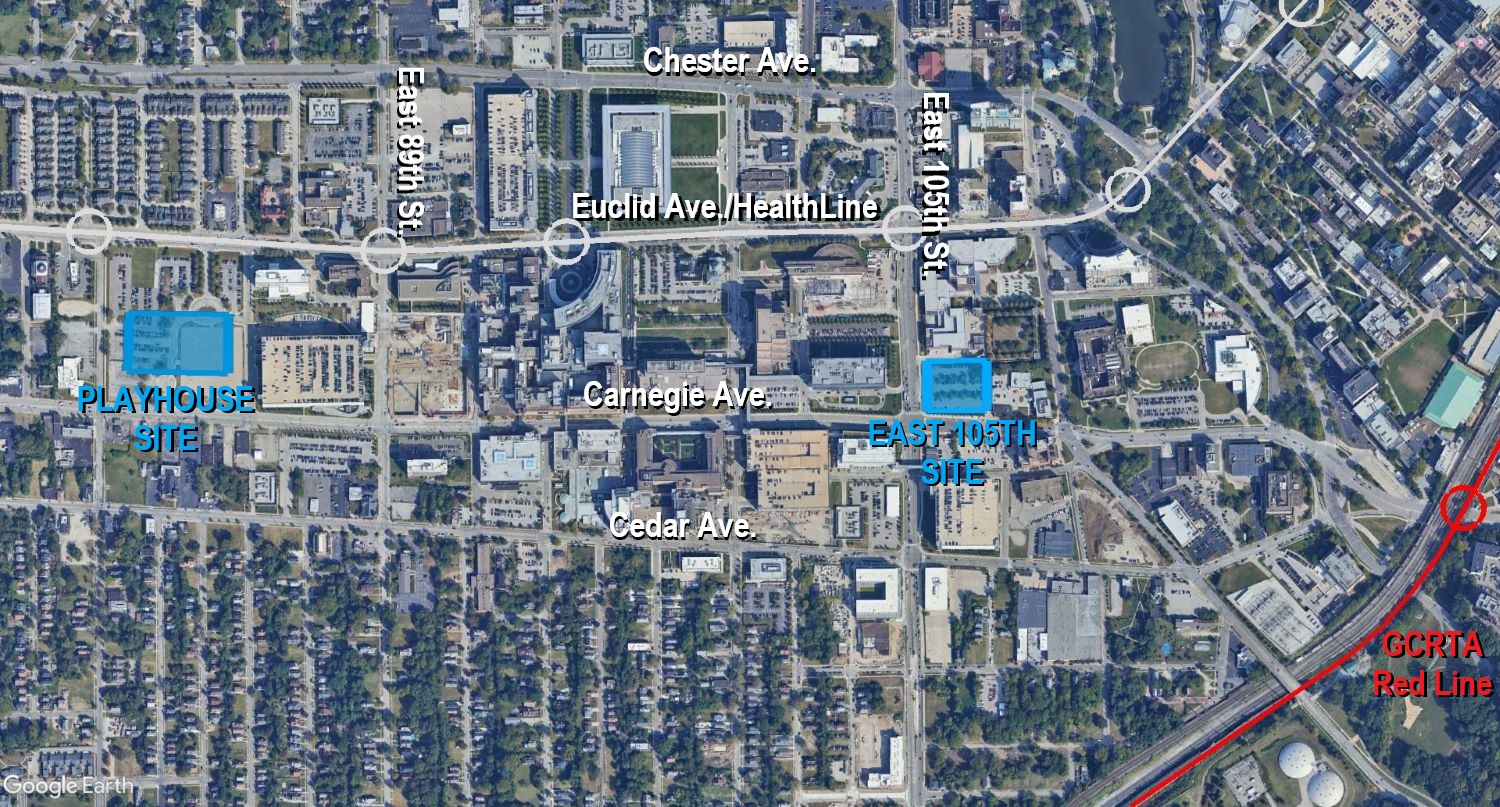
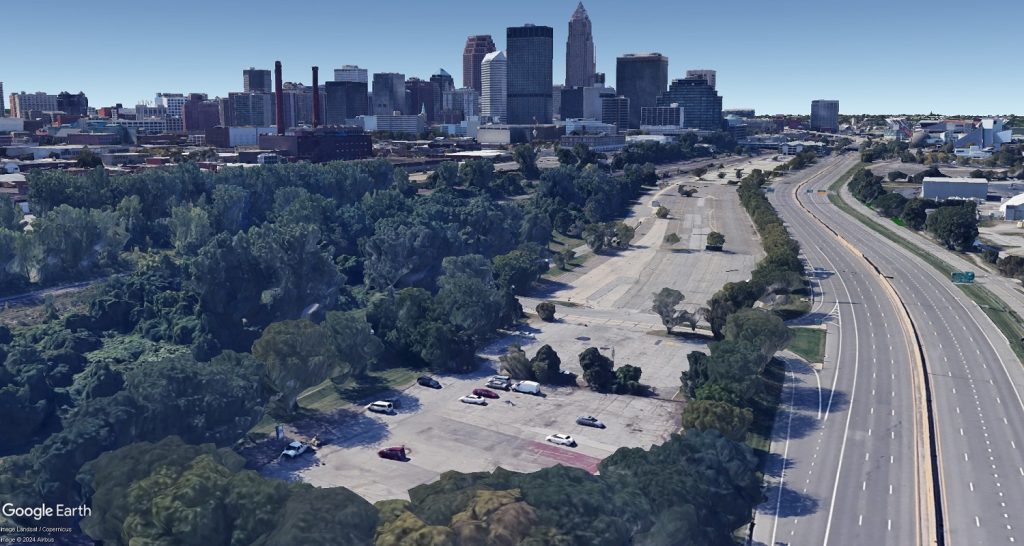
Locations of the two new parking garages on the Cleveland Clinic’s Main Campus. The Playhouse site is at 8500 Euclid Ave. and the East 105th site is at the northeast corner of East 105th Street and Carnegie Avenue (Google).
A nearby garage at East 105th and Cedar Avenue is nine levels, measures 915,000 square feet and has 3,000 parking spaces. It was built in 2015 for $38.5 million.
The East 89th garage, which the Playhouse-site garage may equal in size, accommodates 4,000 cars. It includes a 227,000-square-foot underground service center for the Clinic and a 12,000-square-foot office building to house the Clinic’s IT Department.
Cleveland Clinic officials said they have nothing new at this time to add to NEOtrans’ prior reports on these proposed parking garages.
“We are currently evaluating options and have not made any final decisions regarding this project,” said Angela Smith, senior director of corporate communications at the Cleveland Clinic in 2024 when news of the Clinic hiring an engineering firm for the garages became known to NEOtrans.
“Given the growth of our campus, we need additional parking for our patients and caregivers,” she said.
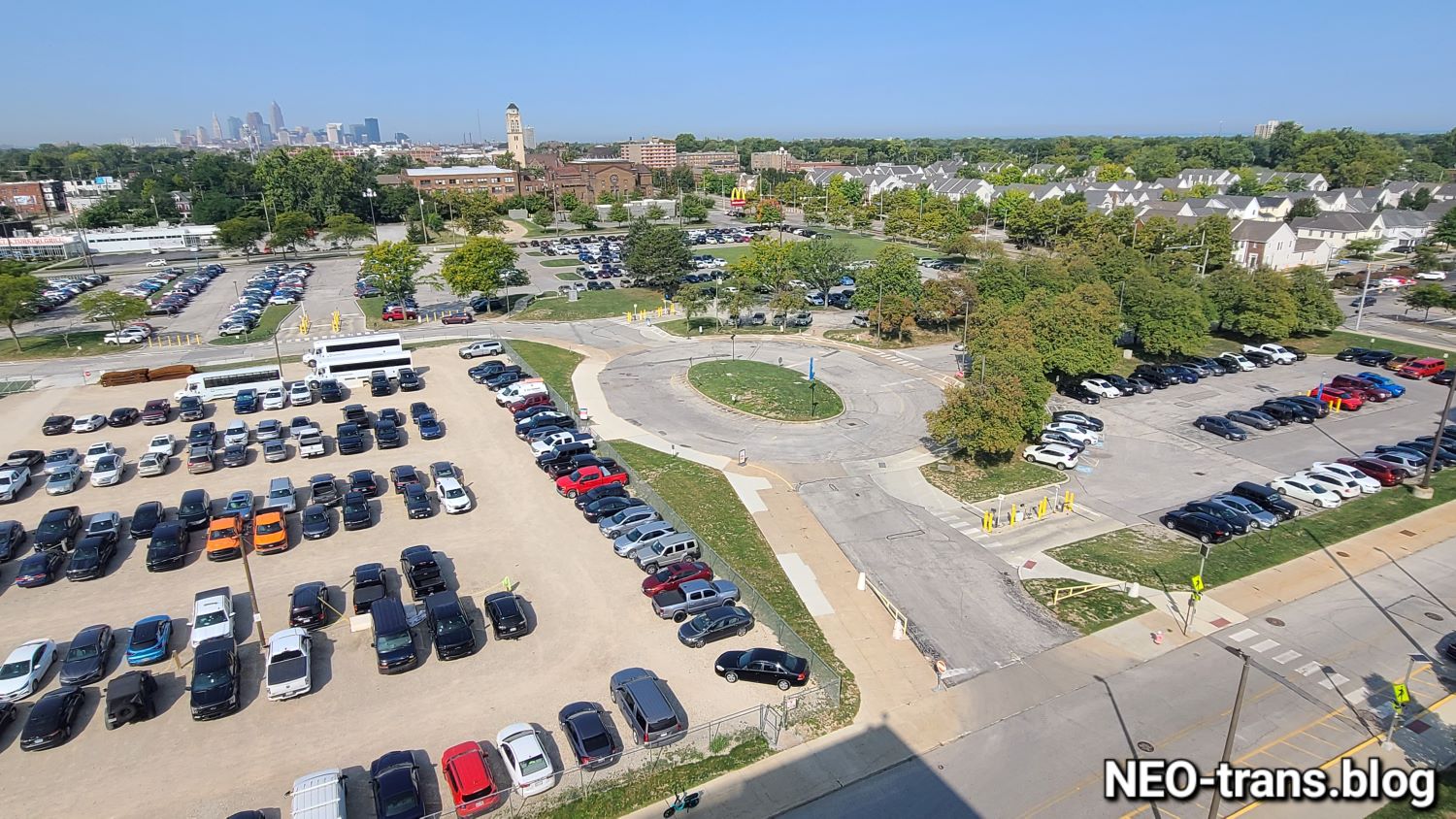
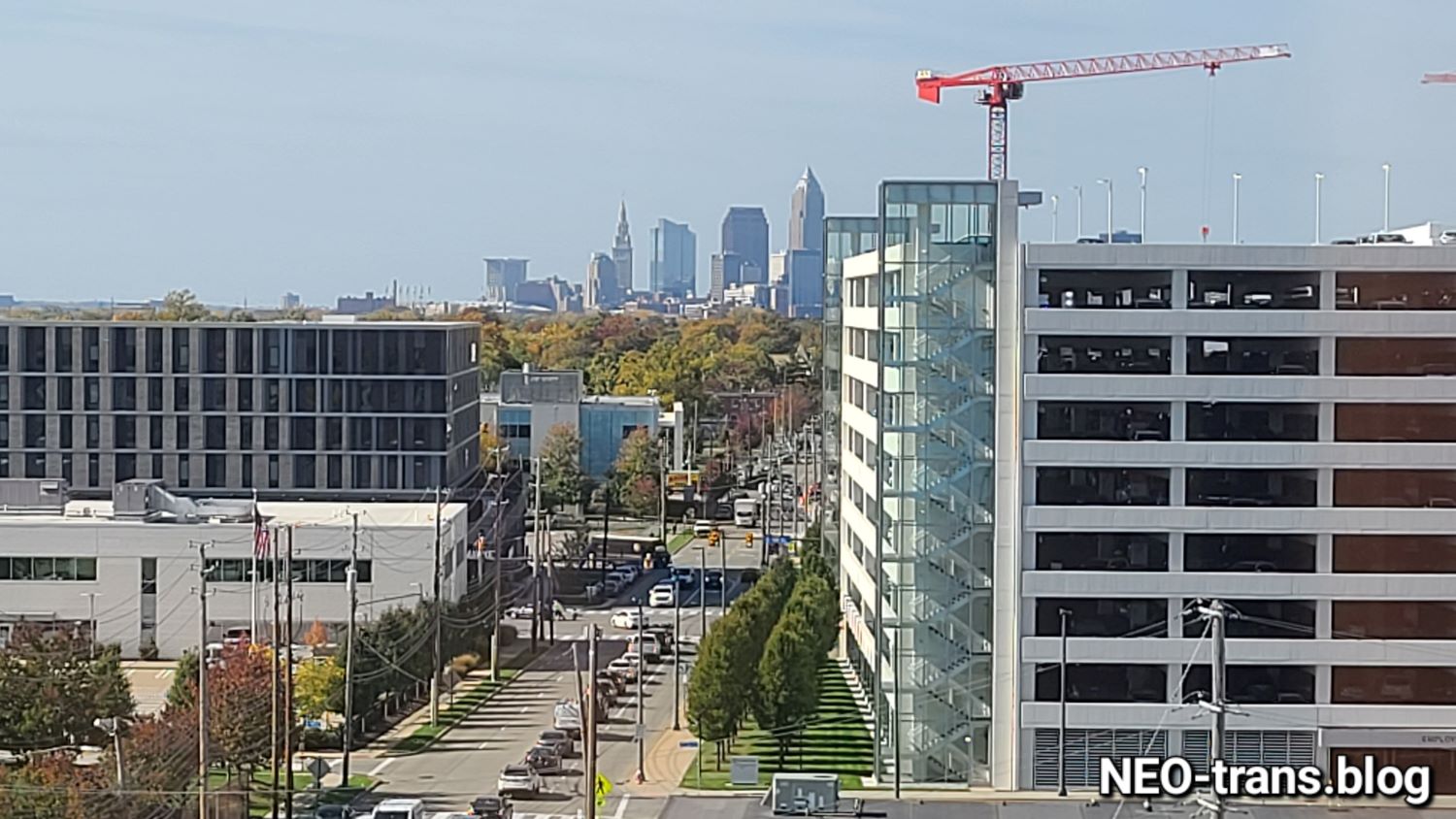
The former Cleveland Playhouse site is 11 acres. It is seen from the top of the Cleveland Clinic’s East 89th parking garage which is similar in scale to what will reportedly be built on the Playhouse site (NEOtrans).
But Griffin, who represents Ward 6, said he and residents in the Fairfax neighborhood want to know more about it, specifically how it will affect traffic and on-street parking. Morning traffic already backs up from East 105th onto Opportunity Corridor Boulevard.
He said it’s gotten so bad that commuters are bypassing East 105th in favor of neighborhood streets like East 79th and East 93rd streets, causing traffic to back up there as well. The new parking garages will only support more driving and more traffic.
And despite laws and posted signs restricting daytime parking on neighborhood streets to two hours, Cleveland police continually have to divert resources to ticket and tow offenders, many of whom are Clinic employees and visitors seeking free parking.
“These are persistent concerns for the community,” Griffin said. “If it’s something that adds to the traffic and the bottlenecks and congestion, then that’s something we’ll have to take a look at.”
Transit advocates said that increasing Cleveland’s car-dependency is not an effective way of reducing traffic congestion, pollution, sedentary lifestyles or the demand for huge parking garages that the Clinic and its customers will be obliged to sustain and maintain for decades.
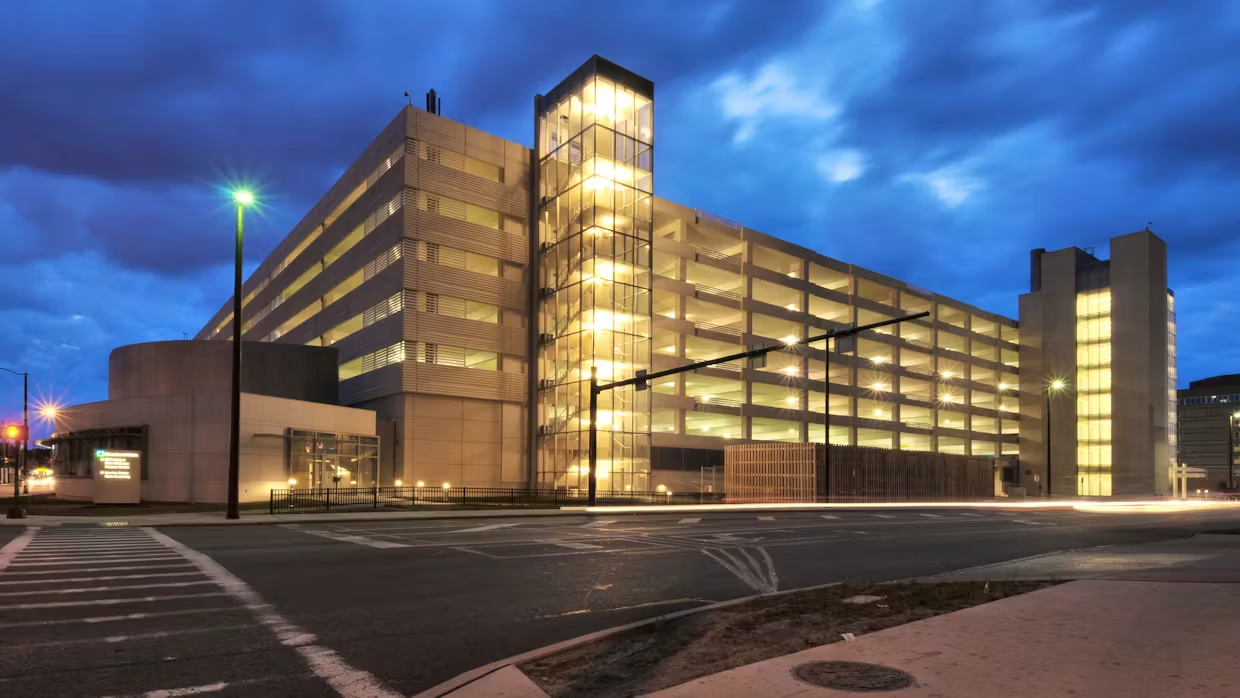
The largest structure Cleveland Clinic has built is this one — the East 89th Street parking garage that was built in 2008 (Independence).
“It would only take a 1.25-mile branch extension of the Red Line to connect the Cleveland Clinic to Cleveland’s established Rapid Transit system,” said Brian Schriver, northeast chapter director of the nonprofit advocacy group All Aboard Ohio. “Imagine having a one-seat rail ride directly from the Clinic to Ohio City, the airport, or anywhere else on the rail system.”
He said that, instead of spending up to $100 million on a parking garage, the Clinic could dedicate that investment towards a rail extension that would be transformative for the region.
“When my wife graduated from nursing school a few years ago, she didn’t even consider Cleveland Clinic Main Campus jobs,” Schriver said. “It is too hard to get there, the traffic in that area is miserable, and parking is expensive. One more garage doesn’t change that. But a proper rail connection gives employees, patients, and visitors a safe, comfortable, and affordable way to get to the area.”
As a bonus, he said this light rail line could connect the new Med School building at the Cleveland Clinic to Case Western Reserve University’s (CWRU) main campus. Alternatively a circulator bus to/from the Red Line or park-n-ride buses from the suburbs could be considered.
“It would be great to have alternative transportation options that would decrease the need for the hospitals and CWRU to spend money on parking garages, while also decreasing vehicle-related expenses for their employees,” Schriver added.
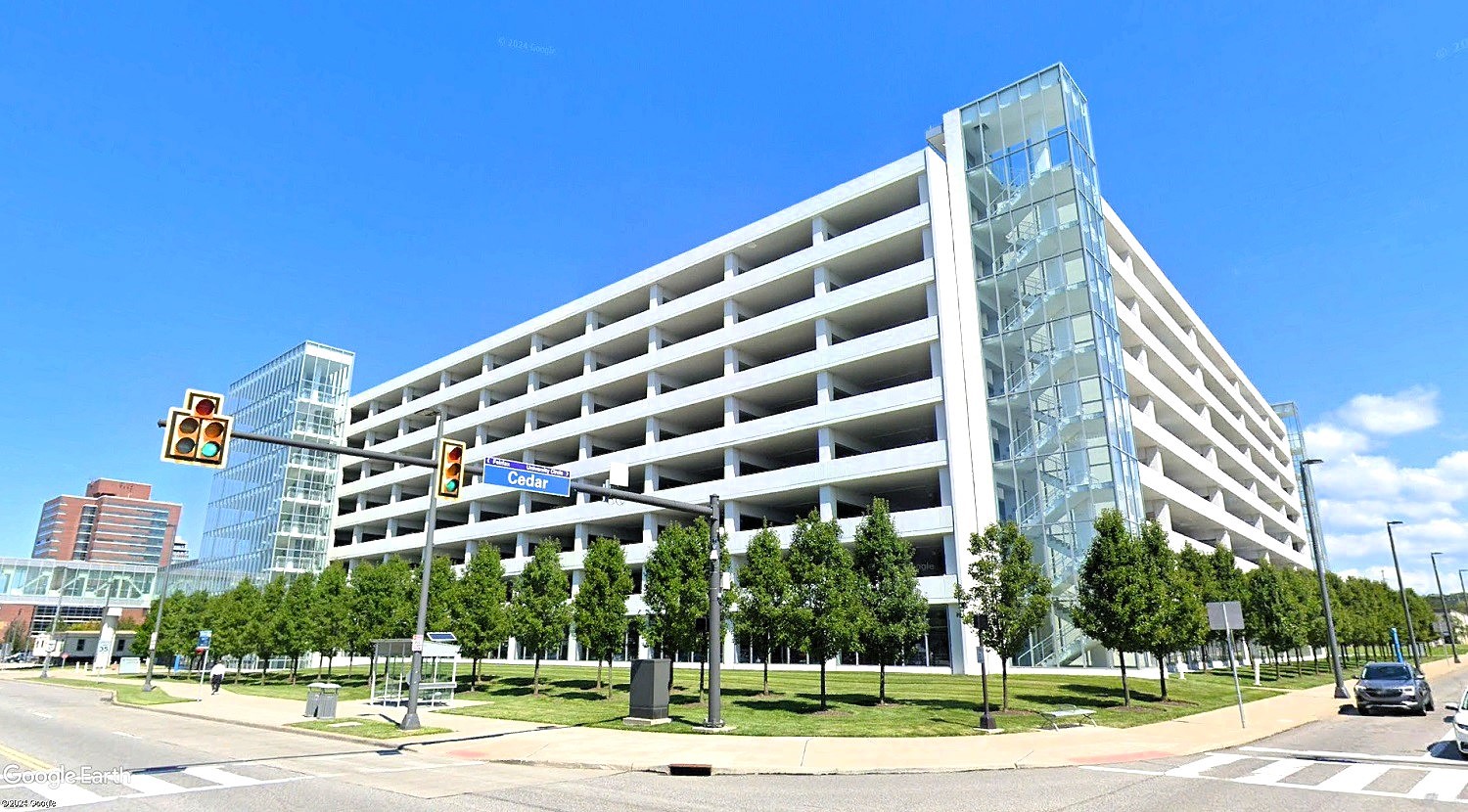
The East 105th-Cedar parking garage that was built in 2015 and accommodates 3,000 parked cars (Google).
A Ward 6 community meeting will be held at 6 p.m. Tuesday at Fairhill Partners, 12200 Fairhill Rd., to discuss at least one piece of a masterplan guiding Cleveland Clinic’s Main Campus.
That piece is a proposed Level 1 trauma center at the the Maria & Sam Miller Emergency Services Building whose entrance is at 9105 Cedar Ave. The parking garages may also be discussed at that meeting, Griffin said.
Last week in his State of the Clinic speech, Cleveland Clinic CEO and President Tom Mihaljevic reported on the health system’s growth including the next phases of expansion at the Main Campus. That includes the new Neurological Institute which is due to open to its first patients in January 2027.
“As we prepare the next iteration of the Main Campus master plan, we are committed to increasing our capacity to care for the critically ill, which includes pursuing a Level 1 trauma center for adults and children,” Mihaljevic said.
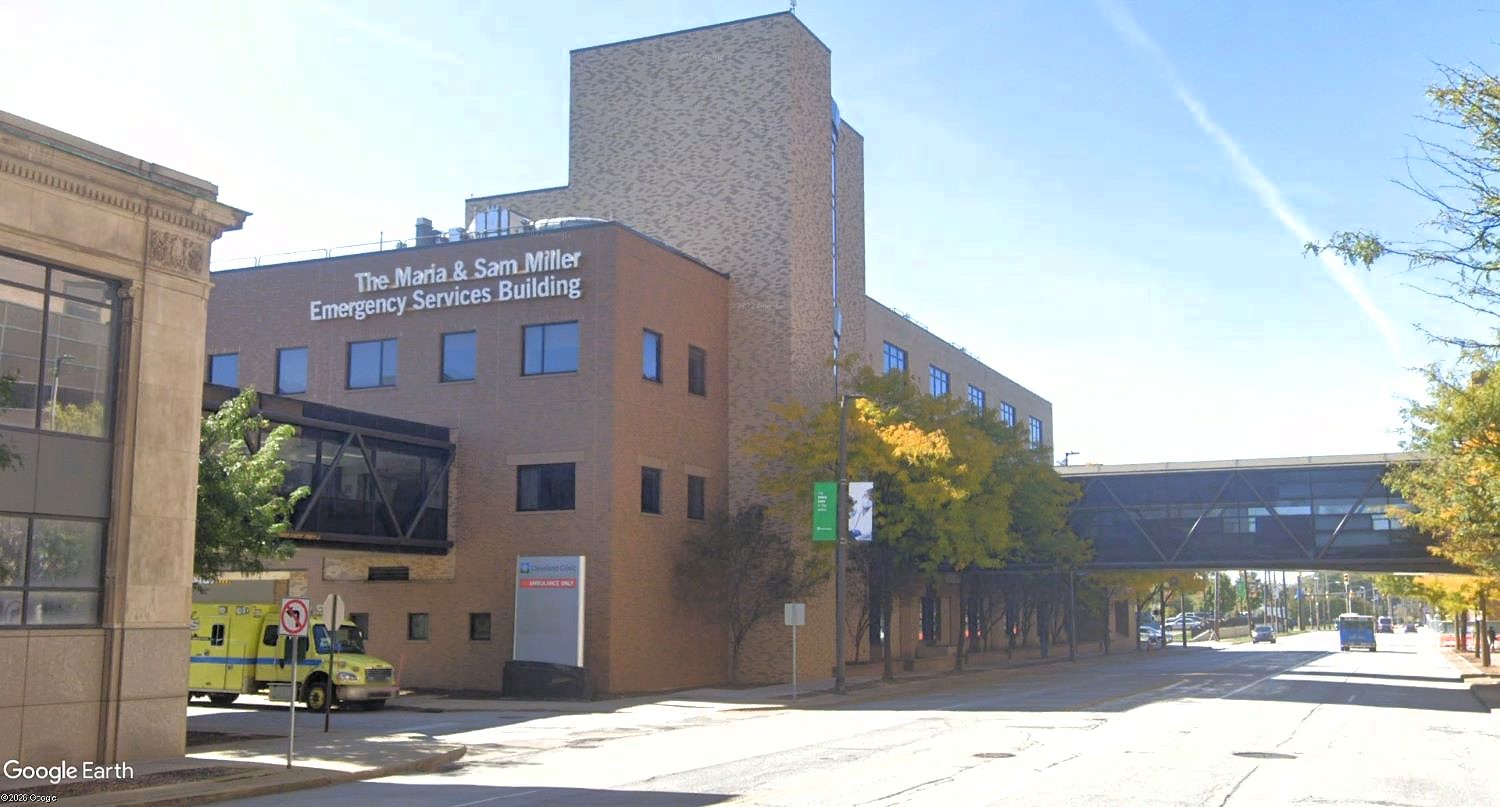
Looking west on Carnegie Avenue, the Cleveland Clinic’s Main Campus Emergency Department is at left with the new Neurological Institute at right, beyond the pedestrian bridge (Google).
MetroHealth System President and CEO Christine Alexander-Rager is critical of the Clinic’s plan to seek a Level 1 rating for its trauma care.
“Dr. Mihaljevic today repeated Cleveland Clinic’s intent to open a Level I trauma center, describing it as a next step in the Clinic’s campus master plan,” she said.
“But he still did not explain why this expansion is needed in a city that already has two high-quality Level I trauma centers, nor did he describe what, if any, input the Clinic received from first responders or community stakeholders in formulating its plan,” Alexander-Rager added.
“Any expansion that risks harming patient outcomes and driving up costs for Northeast Ohio families must be based on clear community need, not checking a box on a master plan,” she concluded.
END