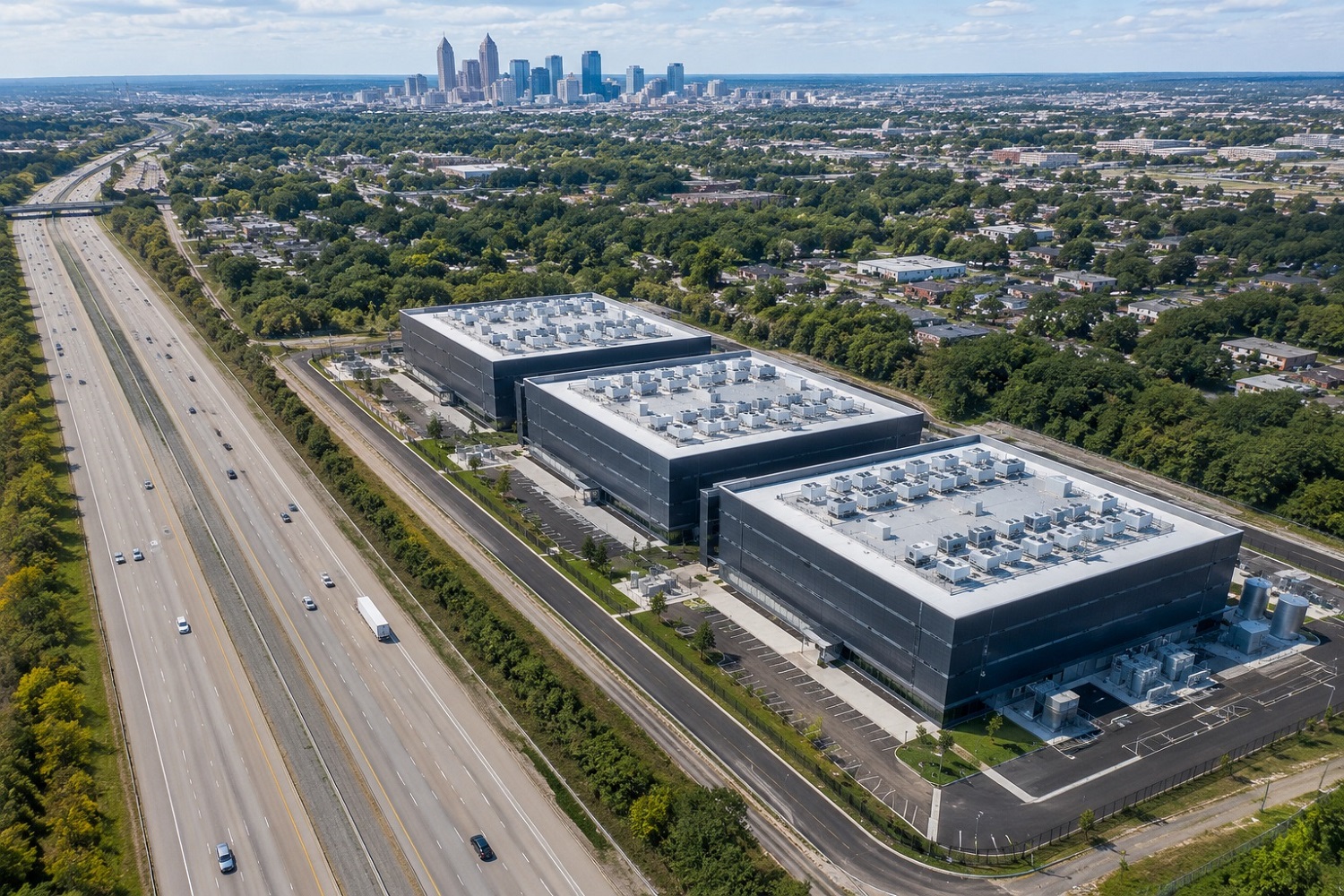
This is an image of a three-building data center totaling about 300,000 square feet next to an interstate highway. It is set in a city neighborhood south of a major downtown area. The image was created, ironically, using artificial intelligence hosted at multiple, massive data centers (ChatGPT). CLICK IMAGES TO ENLARGE THEM.
Data center sought before ban arrives
A 150-megawatt, $1.6 billion data center planned for Cleveland’s Slavic Village is in a race to get its plans approved before City Council can pass a moratorium on building more data centers in Cleveland, according to sources familiar with the project.
Those plans were submitted to the city’s Building Department on May 5; NEOtrans broke the story about the project yesterday morning. Cleveland City Council could have passed its moratorium as early as May 25 if it wasn’t Memorial Day. Instead it may have to wait until the following week, June 1.
But the company seeking to develop the hyperscale data center, Westlake-based Lakeland Equity Group, told NEOtrans today that its plans address community concerns about water and electrical power usage. A 150-MW data center has the power needs equal to that of a small city, or more than 100,000 homes.
Lakeland Equity said it intends to invest heavily in enhancing the electrical power grid and its proposed technology requires far less water for cooling. The project is planned on a 35-acre site currently owned by the Morabito Enterprises trucking firm, at 3560 E. 55th St.
Of the $1.6 billion project cost, $1 billion is for construction of the actual data center and the infrastructure to support it. The remaining $600 million is soft costs such as land acquisition, design fees, permits, insurance plus furniture, fixtures and equipment, the company said. In dollar terms, it would be one of the largest private investments in Cleveland history.
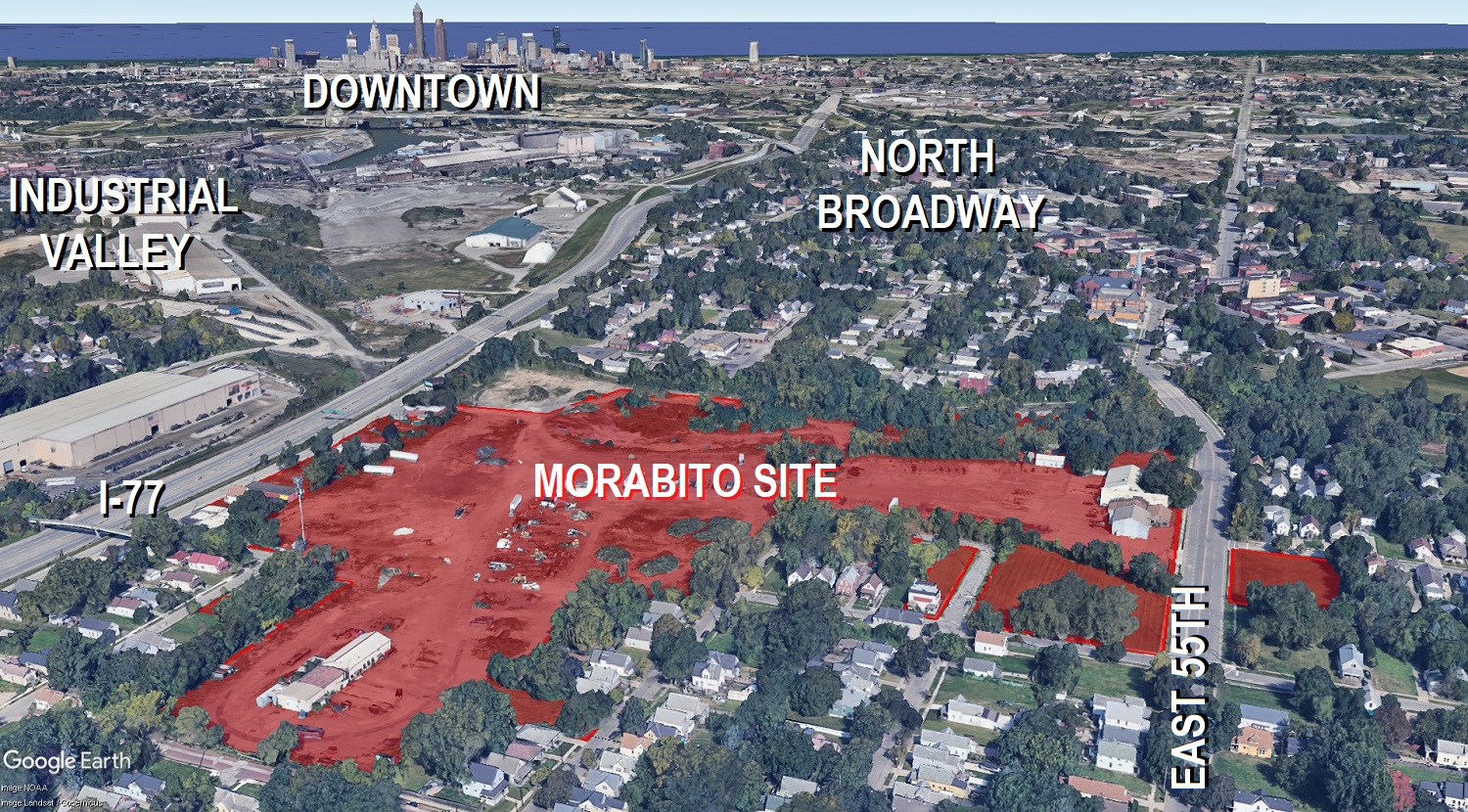
The actual birdseye view of the proposed data center site, set between Interstate 77 to the left and East 55th Street to the right, just south of the North Broadway commercial district of Slavic Village (Google).
“After a significant capital outlay to build out the utility infrastructure, the facility will be fed primarily by grid power,” the company said in an e-mailed statement. “For cooling, the architecture uses closed-loop technology that recirculates water without the need for a constant feed, dropping water consumption by 80–90 percent compared to older systems.”
Other questions posed by NEOtrans to the developer — such as who are the other partners and financiers of the project, if any plans or renderings are publicly available, and who the end-users/customers of the data center would be — were not answered.
“Several of your questions refer to proprietary discussions or information that is either preliminary or inappropriate to disclose at this time,” the company said.
“Modern facilities like the one we propose produce no smoke, no fumes and no truck traffic,” the company added. “They do not foul the neighborhood’s air, do not wear down city streets, and do not disrupt the life around them.”
Lakeland Equity forecasts 1,500-2,000 temporary construction jobs would result, with construction work continuing for roughly 30 to 42 months. Permanent on-site positions, high-skill, high-wage roles in critical facilities operations, engineering and security are forecasted between 65-115 jobs.

A stylized graphic showing the interior of a data center, created ironically by artificial intelligence hosted on Microsoft Azure’s cloud infrastructure distributed across multiple, massive, global data centers operated by Microsoft (ChatGPT).
“These are estimates,” the developer explained. “We are fine-tuning some design elements on the current package and should have them available shortly.”
The plans submitted to the city describe a trio of two-story data center buildings totaling 300,000 square feet. Lakeland Equity Group has an option to buy the Morabito property if its plans are approved by the city.
And it remains to be seen which level of planning approval would be sufficient for the project to be grandfathered in before the city’s proposed moratorium takes effect.
The Morabito site is currently zoned for semi-industry where structures as tall as 115 feet are permitted. The maximum gross floor area of buildings that can be built there is 762,300 square feet. It appears that it could be legal to build the as-proposed data center on that site without any variances.
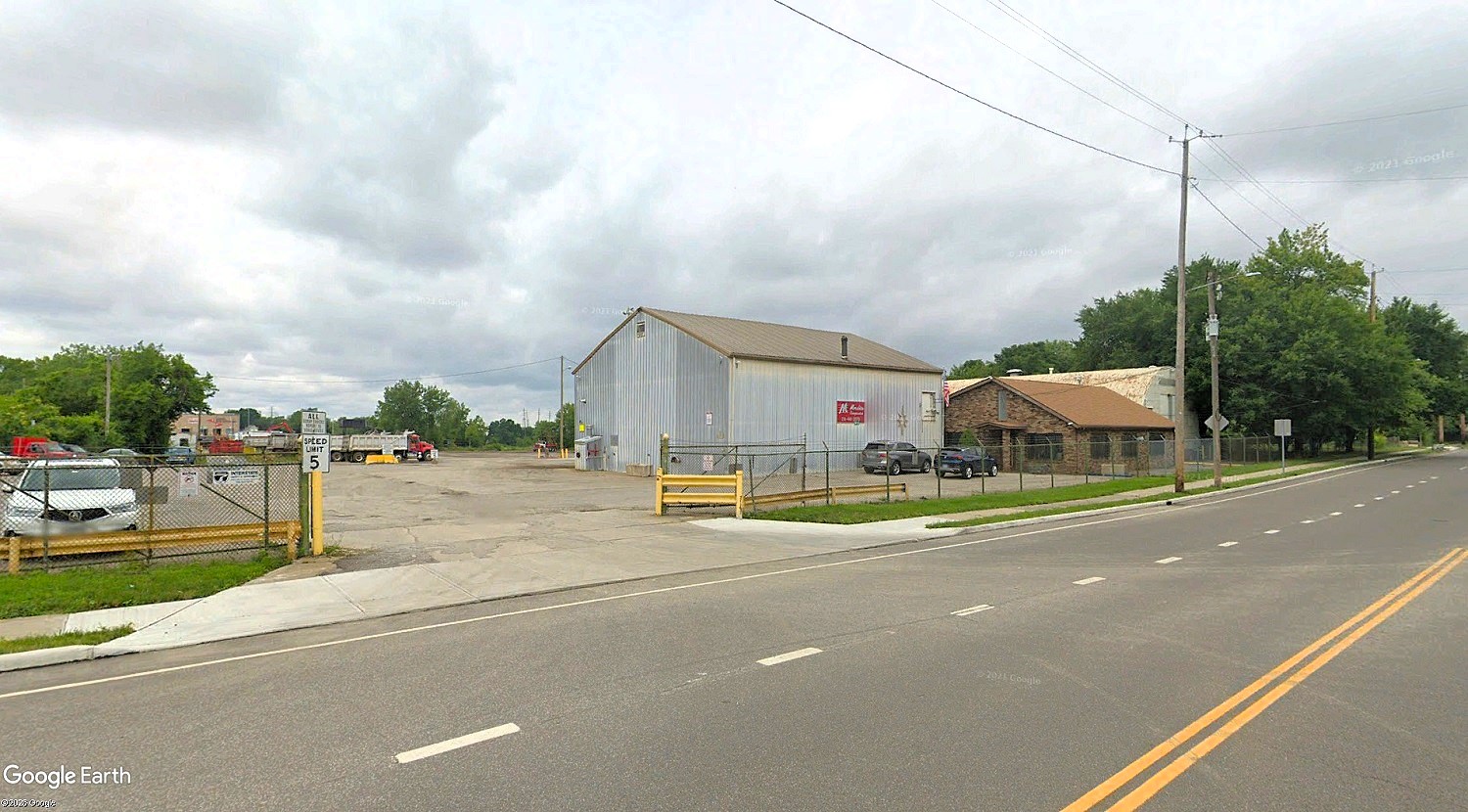
The main entrance to the Morabito site on lonely East 55th Street where Lakeland Equity Group plans to build a $1.6 billion hyperscale data center (Google).
So the question is, does city’s approval of a project here occur when the Building Department puts it stamp of acceptance on the plans after a zoning review that could take days or, at most, a couple of weeks? Or does approval constitute the issuance of a building permit, which could take months?
A City Hall source said that is question they are grappling with. The source also said Mayor Justin Bibb’s administration is opposed to the planned data center. In fact, this week, Bibb issued a statement on Instagram expressing his support for City Council’s proposed moratorium.
“We are doing the work right now to make sure we have strong policies and real safe guards in place to protect our environment and address rising utility costs,” Bibb said.
Ward 15 Councilman Charles Slife, author of the data center moratorium, said he was concerned about the proposed Slavic Village data center merely based on the fact that they are trying to get it approved under the city’s current zoning laws before they might change.
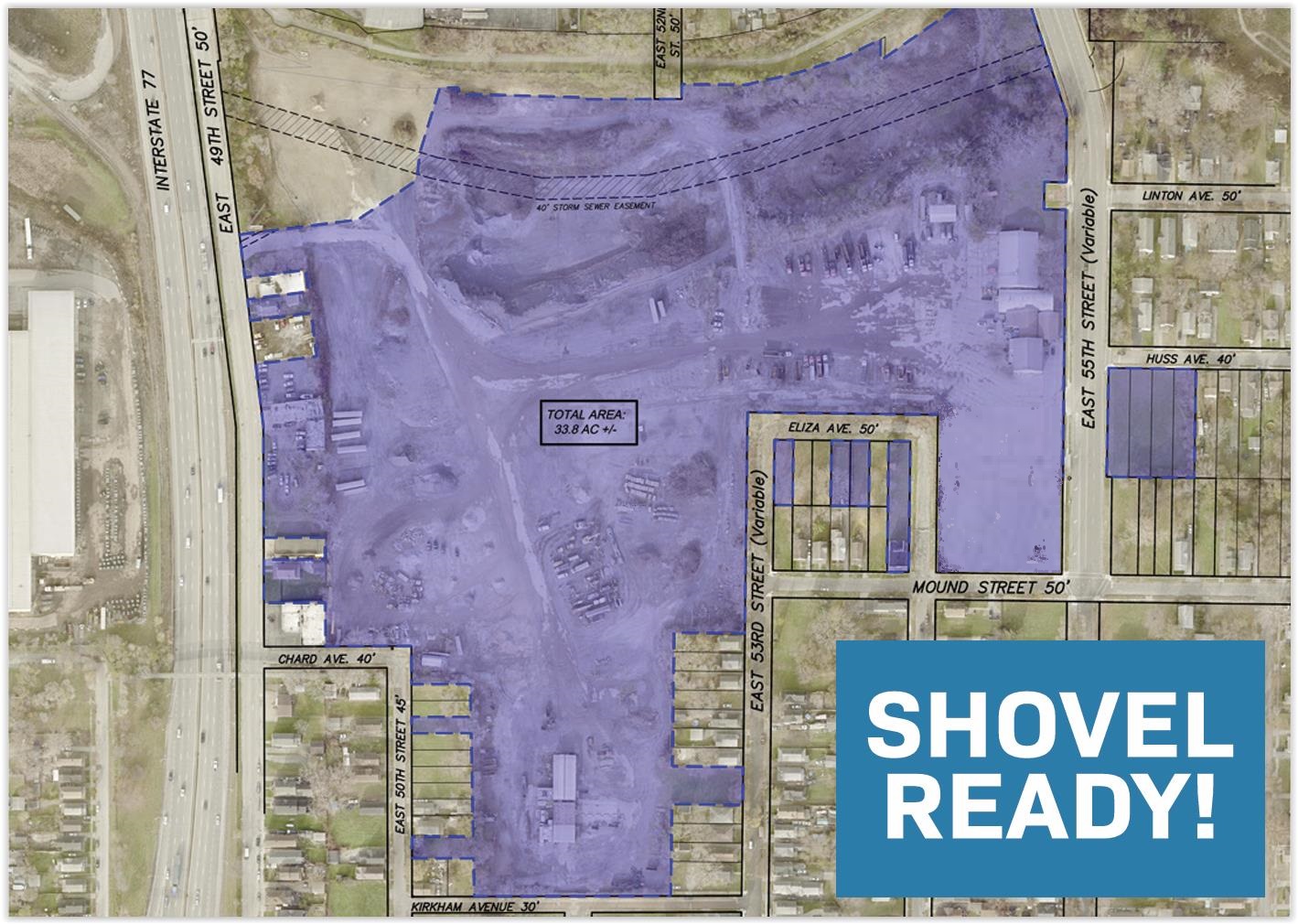
This graphic shows the entire Morabito Enterprises site including the newly acquired former Mound School site at the corner of Mount and East 55th streets (Morabito).
“I remain skeptical,” Slife said in a phone interview. “If I were a resident of that immediate area (in Slavic Village), I would have a lot questions. It would seem that (for the developer) their expedited timeline to get the project approved wouldn’t give me assurances that my questions would be taken into account.”
NEOtrans reached out to Ward 3 Councilwoman Deborah Gray earlier this week as the Morabito site is in her ward. She has not responded prior to publication of this article.
Slife said he sought the moratorium because, as he dug into the city’s existing zoning codes, it doesn’t differentiate between a small data services company and a multi-million-square-foot facility. He said the city needs to pause the addition of new data centers while it takes a hard look at its zoning code.
“I think we’re not able to offer guidance to our community on how to manage data centers — how big they should be and where they are appropriate and where they are not,” Slife said. “Under the new form-based code, which we’re rezoning more of the city, a data center could be treated as an office use.”
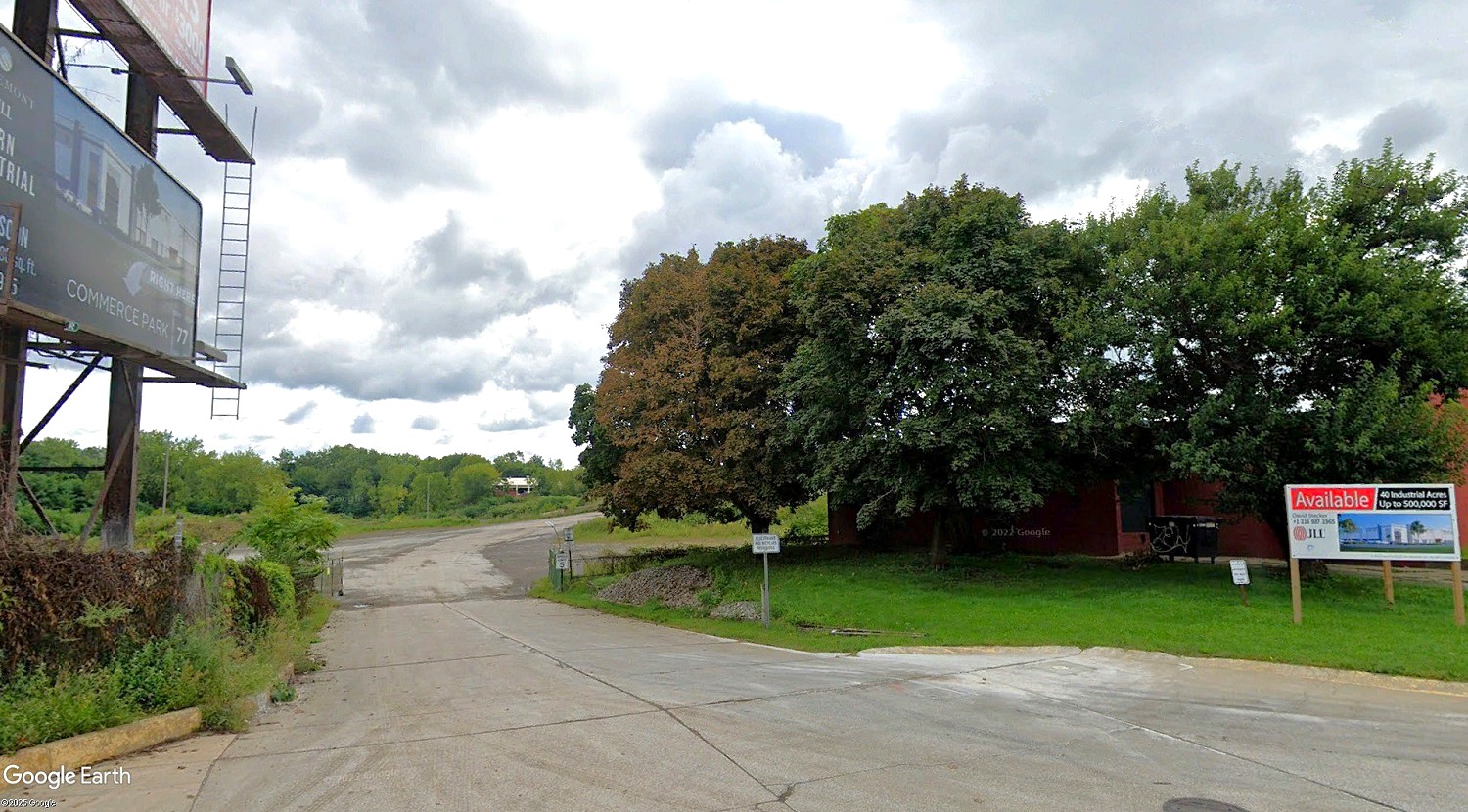
A driveway entrance from East 49th Street to the Morabito site, across Interstate 77 from the Steel Warehouse (Google).
Just last month, NEOtrans reported on the expansion of the H5 Data Center, currently the city’s largest. That growth is wiping out a row of storefronts and forcing out small businesses along St. Clair Avenue on the eastern fringe of Downtown Cleveland.
In Cleveland and worldwide, up to 50 percent of jobs in some sectors could be replaced by artificial intelligence hosted at data centers. In it application to the city, Lakeland Equity said its project would “deliver secure, resilient digital infrastructure with advanced power, cooling, and fiber connectivity, supporting cloud, AI, and enterprise workloads.”
“Data centers may be counterproductive for creating jobs,” Slife continued. “Income tax revenues represent two-thirds of the city’s budget. Those are revenues the City of Cleveland relies on to support city services.”
“This is not to say that data centers couldn’t be part of Cleveland’s future,” he said. “But right now there’s an overly eager industry coming into our community looking for economic development where the costs would stay in our community and the benefits would leave it.”
END