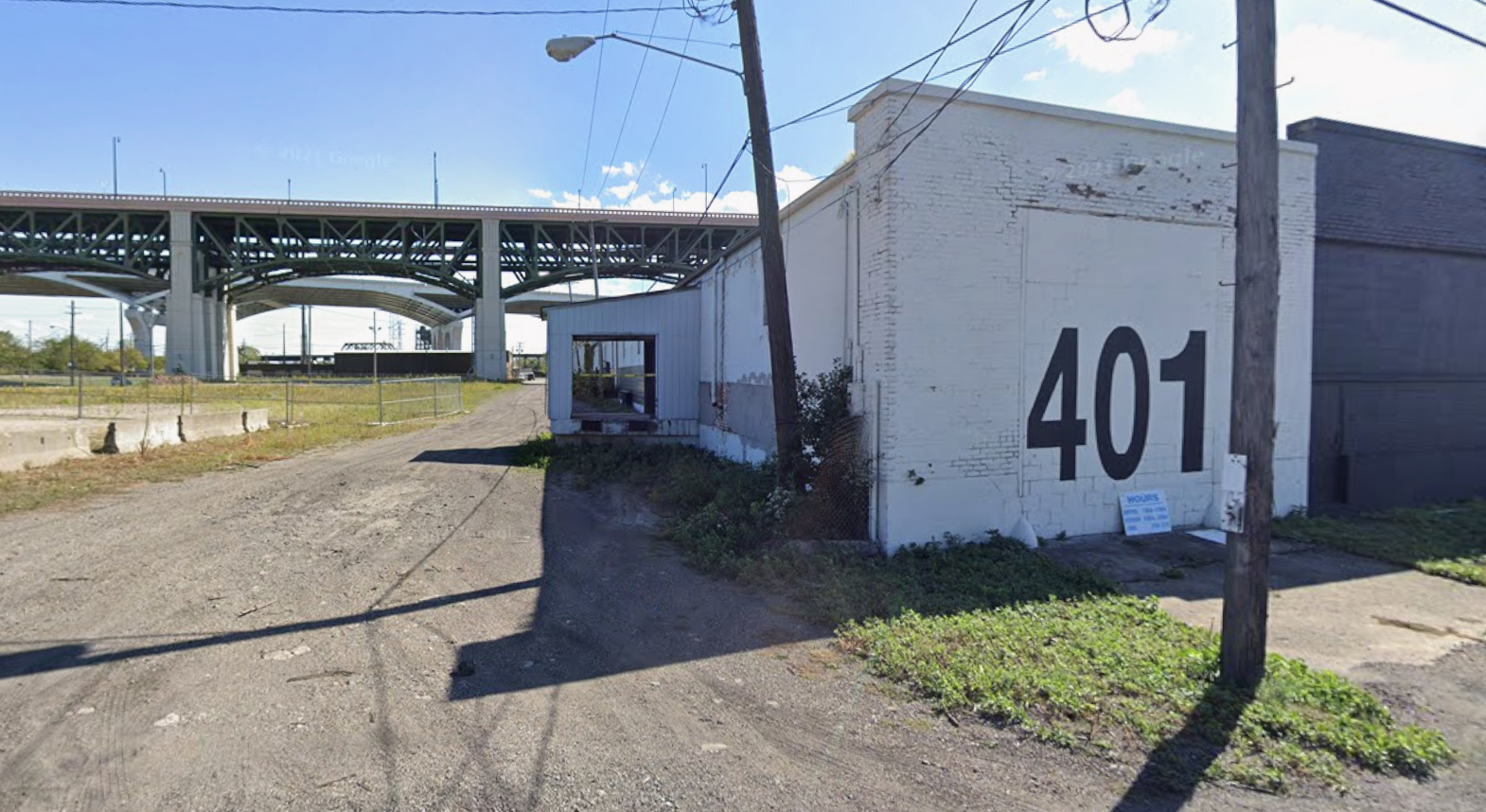
The Hope Memorial Bridge — home to the Guardians of Traffic pylons — overlooks the site of the future Riverfront Amphitheater and the existing warehouse at 401 Stones Levee Rd. in the Flats (Google). CLICK IMAGES TO ENLARGE THEM.
Music venue’s economic benefits revealed
Developers from Bedrock Cleveland and Rock Entertainment Group (REG) on Friday received approval from the City of Cleveland Planning Commission (CPC) to demolish a warehouse at 401 Stones Levee Rd. in the Flats. The demolition clears the way for the group behind billions in riverfront development to proceed with the next phase of revitalization and activation.
When combined with the vacant parcel already owned by Bedrock at the southern corner of Stones Levee and West 3rd Street, the 4.5-acre lot will serve as the home of a new $45+ million music and entertainment venue, currently referred to as the “Cleveland Amphitheater.”
With a capacity of 6,200, the amphitheater will be operated by music promoter Live Nation. The company — which operates the 1,200-seat House of Blues in Downtown Cleveland and 20,000-seat Blossom Music Center in Cuyahoga Falls — currently doesn’t have a Cleveland-area venue in the 5,000-seat capacity range.
That’s one reason why Bedrock is working with Live Nation to push for a venue of this size to anchor their riverfront projects; to book previously-elusive headliners to Cleveland’s music scene and increase activity.
The other is likely that a previously-reported “Rock and Roll Land” venue topped by a hotel tower was supposedly shelved earlier on in the planning stages. Sources say that a new EDITION Hotel tower is still potentially in the works for future phases of riverfront development.
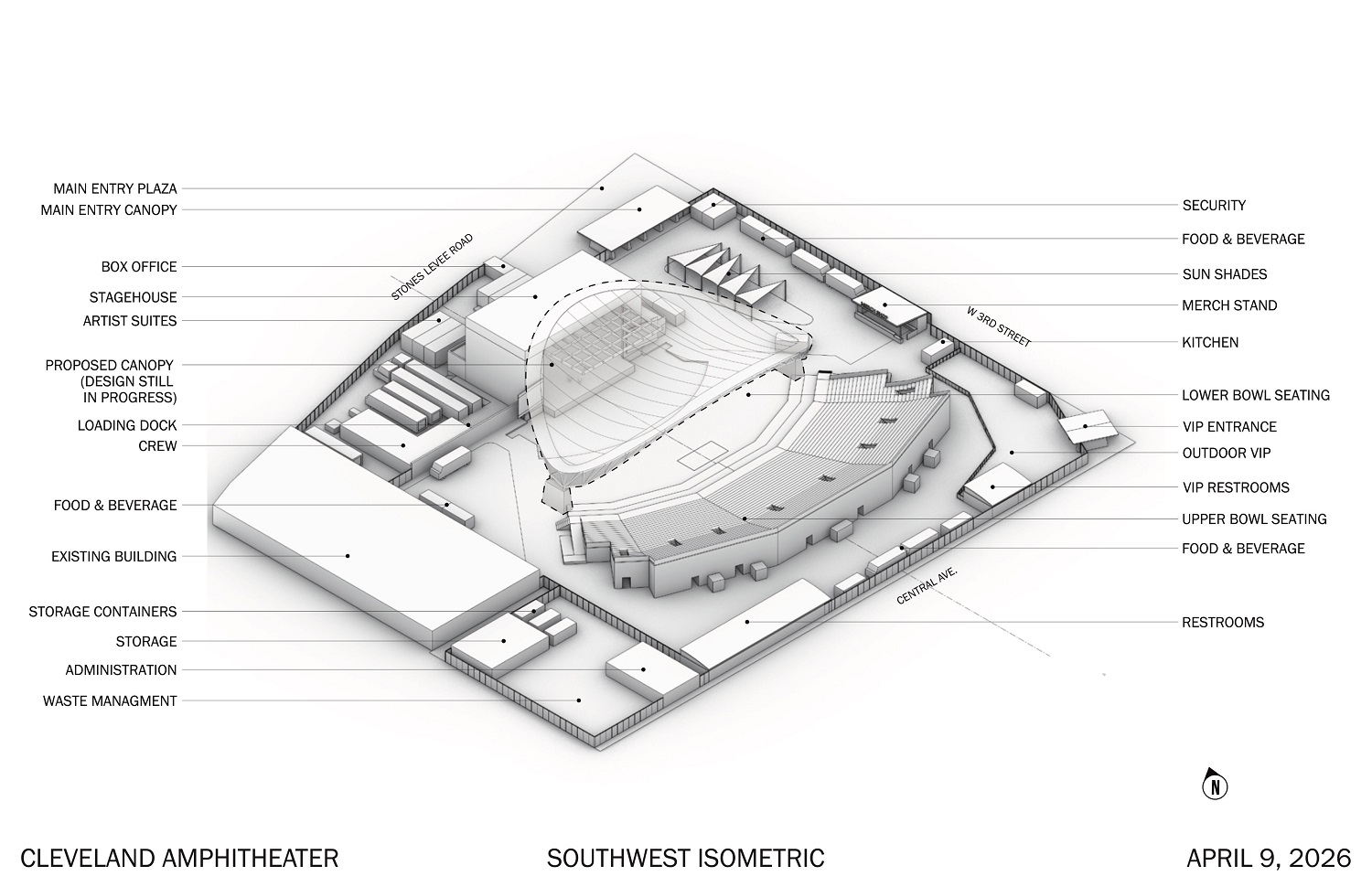
A conceptual plan for the proposed $45+ million riverfront amphitheater (Bedrock).
In the meantime, the new amphitheater will sit directly across from the new Cleveland Cavaliers training facility and Global Peak Performance Center operated by the Cleveland Clinic. That building, whose exterior construction is mostly complete, will open in 2027.
That new facility represents the first piece of a major riverfront redevelopment including a new riverwalk, bike lanes and a reconstruction of the Eagle Avenue ramp and bridge that will reconnect the Flats to Ontario Street where Progressive Field and Rocket Arena reside.
West 3rd, which will reportedly serve as the main access road to the new venue, is also expected to get significant lighting, signage and bike lane upgrades as a result of the project.
Initial plans for Cleveland Amphitheater were revealed in April to the CPC, where it received conceptual approval to proceed to the next stage of development. The only known information on the venue up to this point were preliminary “massings”, or basic images showing the scale of the stage, seating and ticketing/concessions.
At the time, commissioners were not shown what the amphitheater’s proposed “canopy” would look like and that information is still forthcoming. The main focus was to lock in the orientation and study how West 3rd traffic and circulation would affect a relatively-vacant portion of the Flats intended to be pedestrian-friendly.
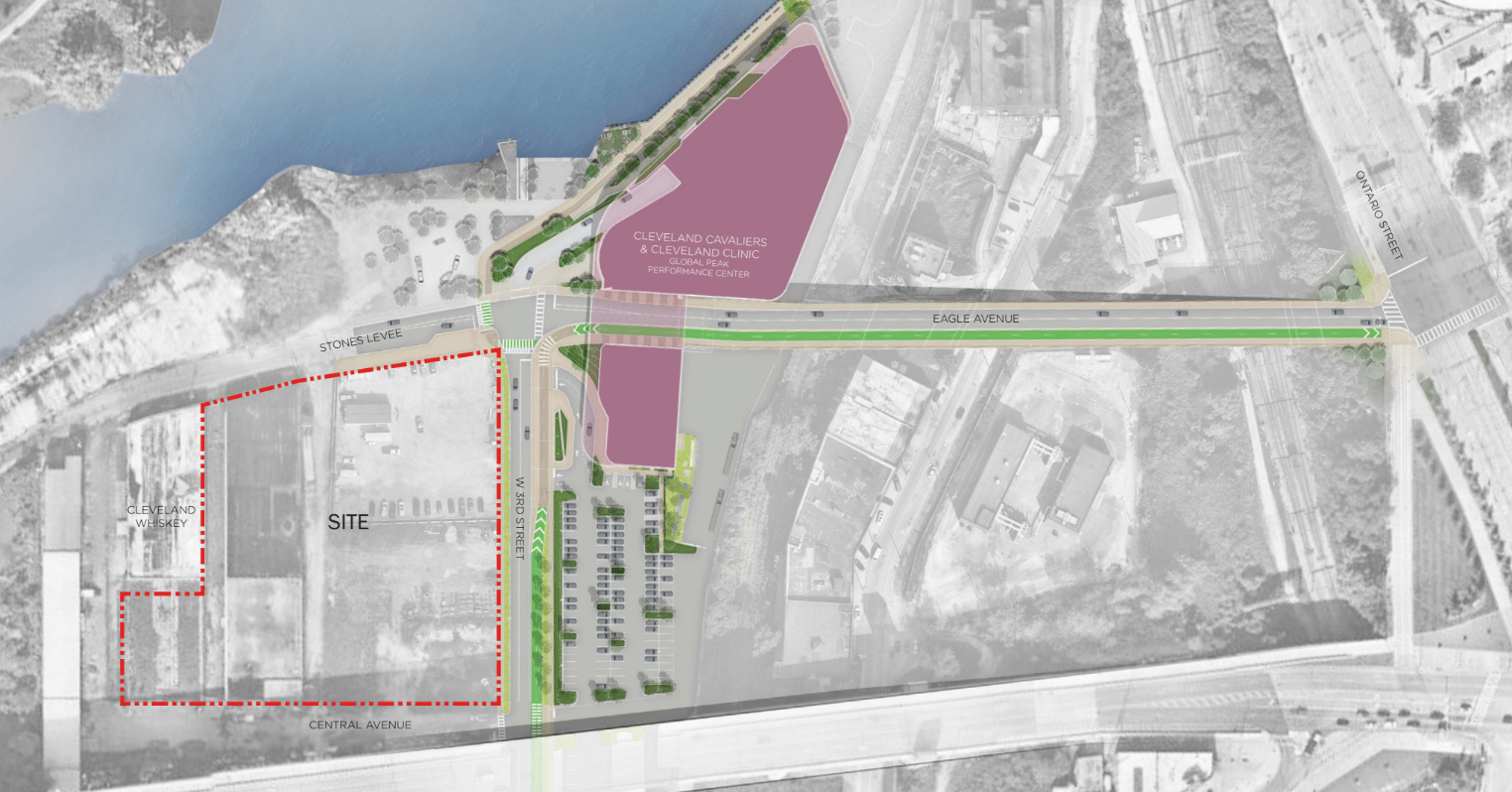
This site location map shows the building proposed to be demolished in context of the new Cleveland Clinic Global Peak Performance Center currently under construction and it’s relation to Ontario St and the new amphitheater. (Bedrock)
Now, developers are seeking the demolition in order to proceed with site preparation in anticipation of the amphitheater’s construction. Without it, the weeds will continue to grow around a lightly-used warehouse on the riverfront. No new amphitheater renderings were presented on Friday.
Neighboring the to-be-demolished building is Cleveland Whiskey, a distillery that renovated the 1911-built headquarters of the Consolidated Fruit Auction Company into a modernized production facility and tasting room at 601 Stones Levee.
Now, a report that a revitalized Cleveland Brewery will be moving from Cleveland’s Collinwood neighborhood into space at the facility bodes well for the vitality of this burgeoning neighborhood.
Additional information about the economics of the new venue were revealed to the commission as well, as they were asked to approve tax-increment financing (TIF) legislation for the construction of the amphitheater.
The amphitheater takes advantage of the Shore-to-Core-to-Shore TIF district implemented by Mayor Justin Bibb and the City of Cleveland to capture increases in land value resulting from the billions in new investment proposed for downtown Cleveland and its two waterfronts.
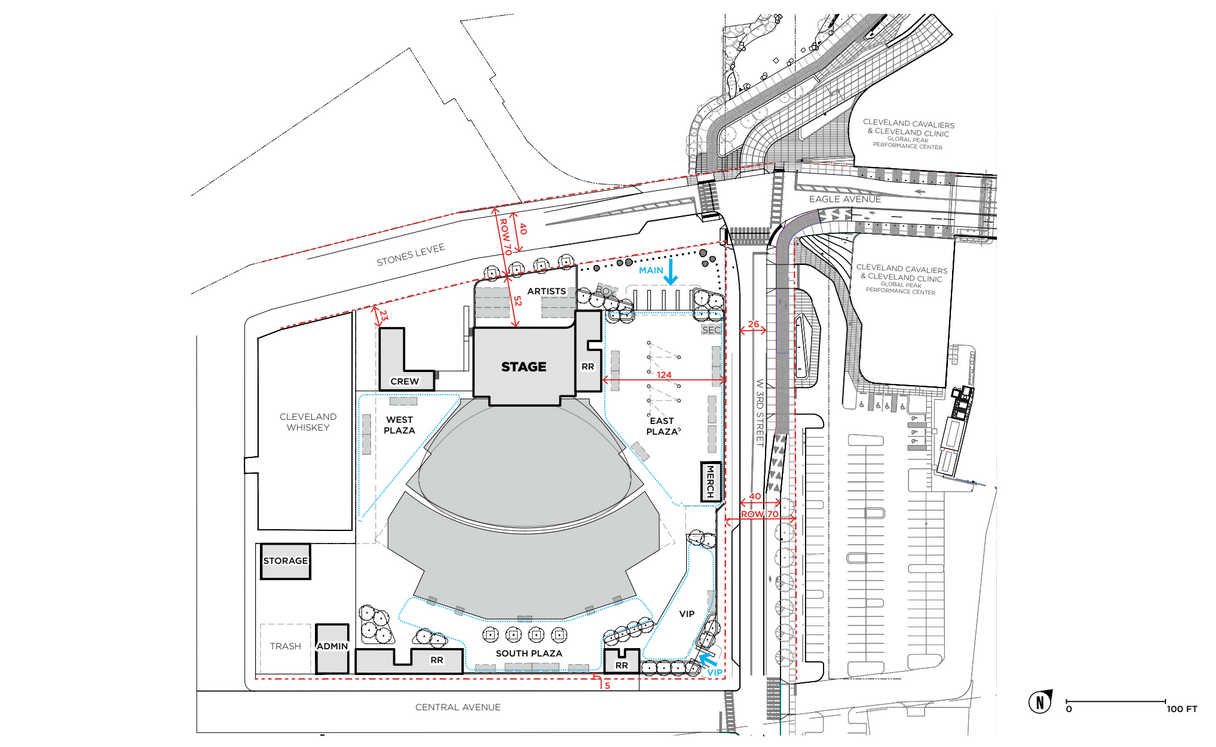
Cleveland Amphitheater will sit nestled next to Cleveland Whiskey’s distillery operation, directly across Stones Levee on the riverfront (Bedrock).
While TIF districts are common in cities around the country, Cleveland is currently playing catch up in capturing increases in land value throughout the city as momentum grows.
Notably, the TIF proposed for the amphitheater and other Bedrock projects in Cleveland is a non-school TIF, meaning that any new school taxes captured from the increase in land value do not get diverted away from the Cleveland Metropolitan School District (CMSD).
In fact, developers asserted that CMSD would receive an additional $16 million in new tax dollars over the 30-year TIF generated from the amphitheater project.
This, on top of the 60 new full-time jobs the venue will employ with a $3.1 million payroll and $2.3 million in new income tax for the city. In total, the project is expected to generate over $18 million in new tax revenue for the city.
According to Nora Romanoff, vice president of business development for Bedrock, the existing warehouse tenant has vacated the space which was used as a storage pick up/drop off facility for pallets for glass beads used in building materials. They’ve since found another location for this operation.

These site photos taken in Fall 2025 show the exterior conditions of the building proposed to be demolished (Bedrock).
The Downtown/Flats Design Review Advisory Committee (DFDRAC) recommended approval for demolition with the condition that Bedrock works with Habitat for Humanity to save or repurpose any materials salvaged from the warehouse, which Romanoff noted was in decent condition.
They also noted that the 110-year-old warehouse has no historical significance and did not contribute in any meaningful way to the district’s industrial character. NEOtrans broke the story in January that Bedrock was acquiring this site, possibly for a new amphitheater.
City planning staff also agreed with the DFDRAC’s comments and supported the demolition. Ultimately, the demolition was approved by the commission 5-1 with member Denise McCray Scott the lone vote against; her reason for opposing was not provided.
Next up, Bedrock will return to CPC for schematic approval where they will likely present updated and more detailed designs from architectural firm DLR Group for the Cleveland Amphitheater and how it ties into the rest of the rapidly-growing waterfront.
END