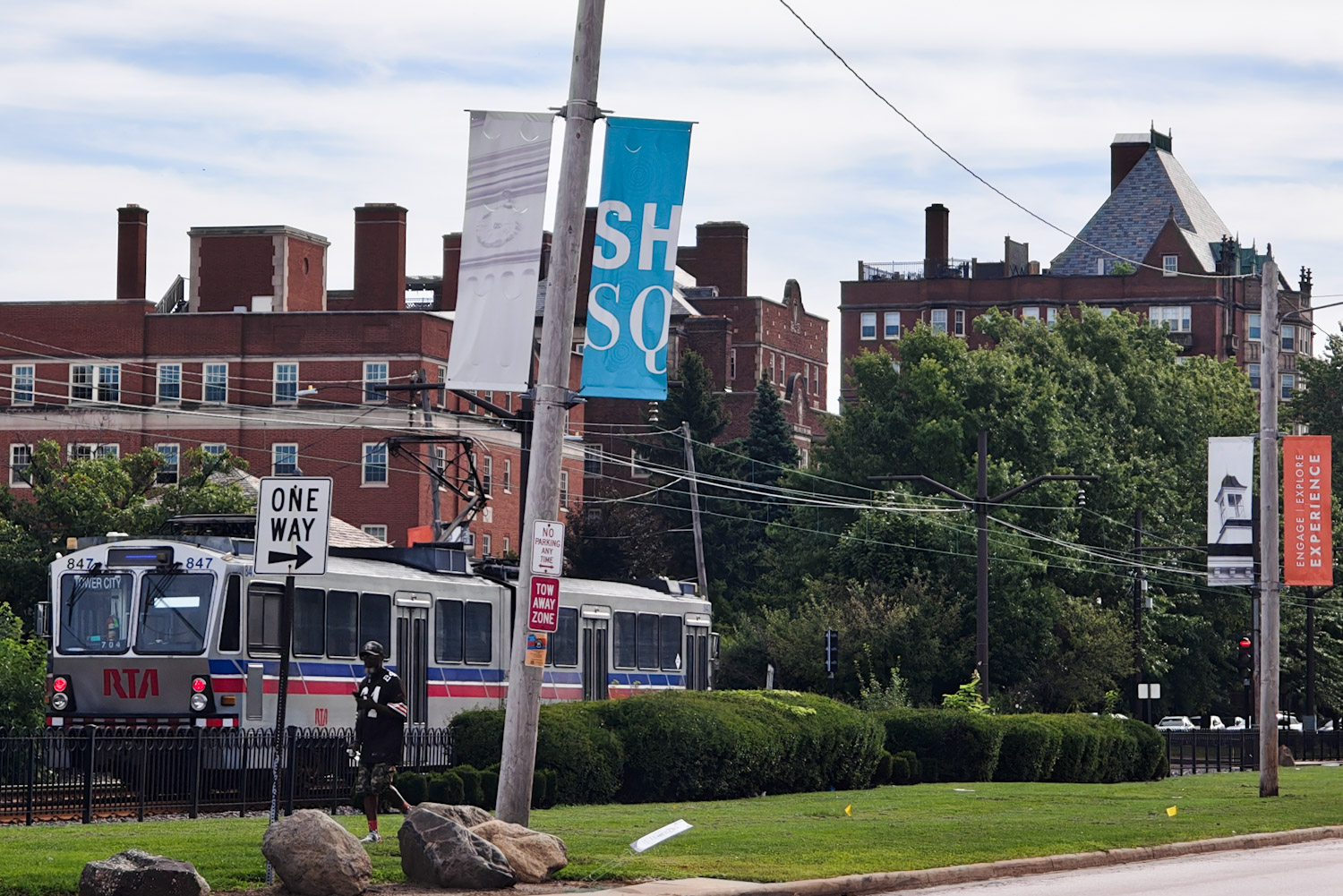
Many visitors arrive to Cleveland’s Shaker Square on transit vehicles, such as this GCRTA Blue Line train which originated at Tower City in Downtown Cleveland (Harrison Whittaker). CLICK IMAGES TO ENLARGE THEM.
Form-Based Code changes revealed for Buckeye-Shaker neighborhood
It’s no secret that Cleveland’s complicated and restrictive zoning code stifles new construction, hinders neighborhood walkability, and renders countless existing buildings noncompliant. Yet it remains to be seen how well its emerging Form-Based Code can resolve these issues.
Shaker Square, built in 1927 as the first planned shopping center in Ohio, predates the city’s original 1929 zoning code. That helps explain why many of the apartments, houses, and mixed-use buildings that make up the surrounding neighborhood would be illegal to construct today.
For instance, the city typically requires a minimum lot size of 4,800 square feet to construct a single-family home. Some properties around Shaker Square contain fewer than 4,000 square feet — remaining buildable only because the lots were created before the current code was established.
Zoning issues are not limited to older buildings: new developments routinely require variances, or special exceptions to the rules, because of outdated regulations that contradict contemporary preferences for mixed-use, walkable neighborhoods.
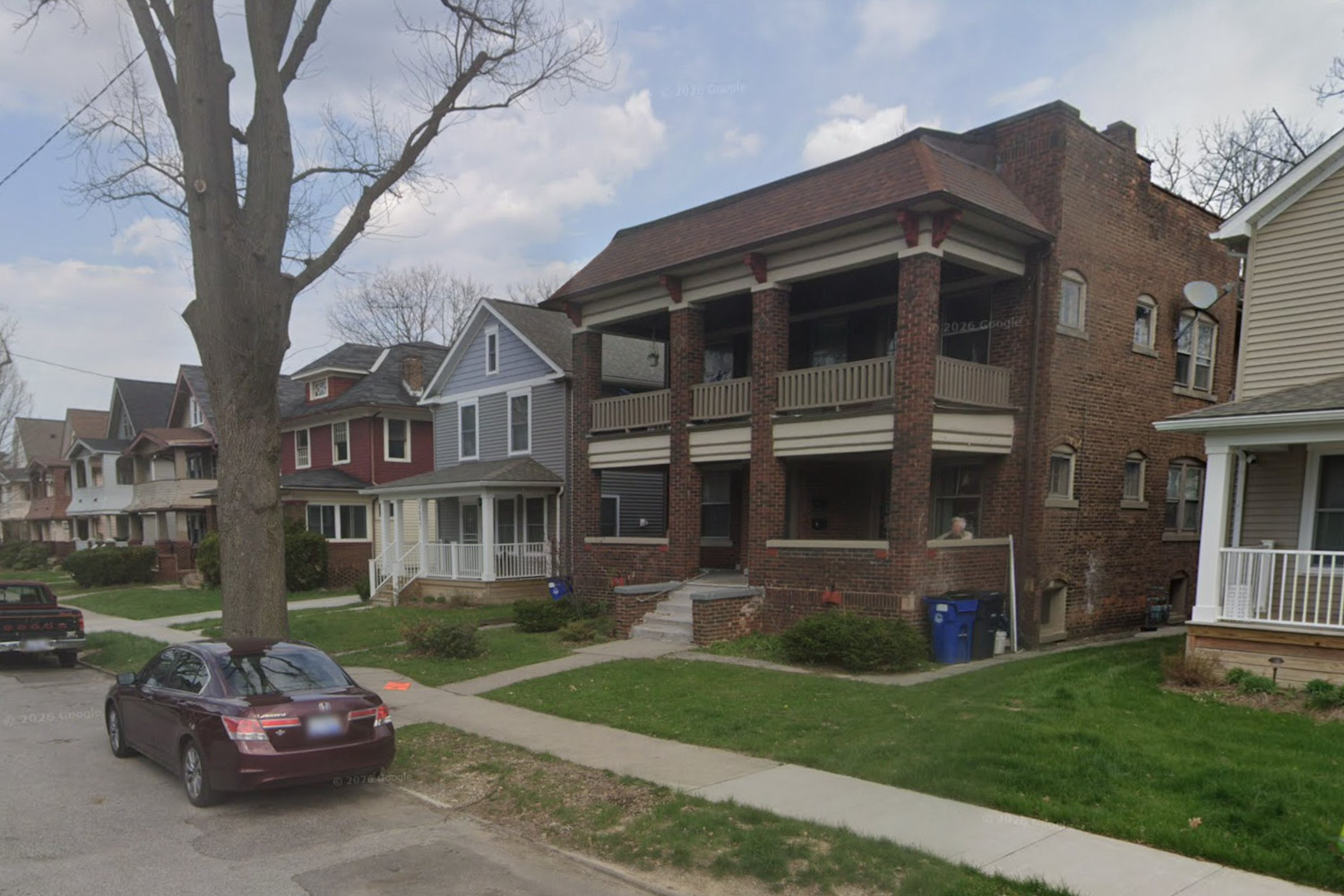
On East 128th Street, this 1920-built fourplex is an example of a structure which would be illegal to build today. While proposed zoning changes for this street would not permit fourplexes, smaller multi-family uses would be allowed (Google).
American land use regulations have deep roots in Greater Cleveland: so-called “Euclidean” (or single-use) zoning codes reference a landmark 1926 Supreme Court case involving a property in suburban Euclid.
While zoning was created as a tool to keep polluting industries and other nuisances out of residential neighborhoods, it has a long history of being weaponized to increase home prices, establish reliance on cars, and even enforce racial segregation.
The Form-Based Code works to modernize the rules by moving away from (but not eliminating) single-use zoning districts, instead prioritizing the scale and placement of buildings in relation to their neighborhood context. By clarifying expectations for new developments, the city also hopes to simplify and speed up the approvals process.
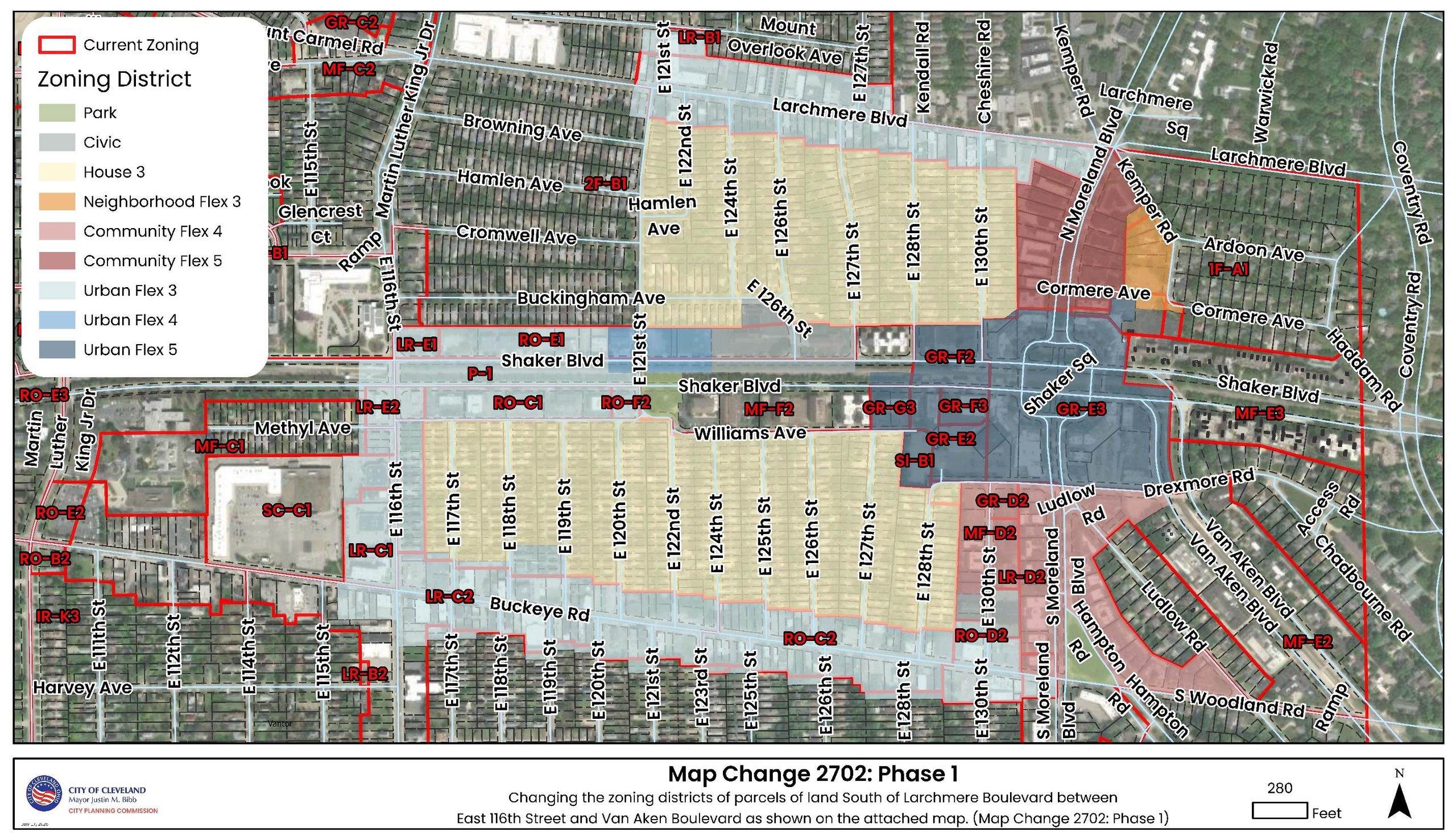
This map outlines new zoning districts proposed for much of the Buckeye-Shaker neighborhood. Notably, several parcels at the center of the image are excluded due to the lack of a zone which permits mid- to high-rise apartment blocks (City of Cleveland).
The new code defines four scales which reflect the increasing intensity of permitted uses:
- House-scale districts, the most restrictive, permit single-family homes as well as duplexes, triplexes, and sometimes fourplexes, limited to 2.5 stories;
- Neighborhood-scale districts also allow for townhouses and small apartments, limited to 2.5 or 3 stories;
- Community-scale districts additionally permit larger apartment complexes, limited to 3, 4, or 5 stories;
- Urban Flex districts are designed for traditional mixed-use buildings with residential uses over ground-level retail, limited to 3, 4, or 5 stories.
At Friday’s City Planning Commission meeting, proposed zoning changes were unveiled for a section of the Buckeye-Shaker neighborhood between Larchmere Boulevard and Buckeye Road. Form-Based Code pilot districts are already active in Hough/St. Clair-Superior, Detroit-Shoreway, the Opportunity Coordinator, and the New Economy neighborhood/Innovation Square.
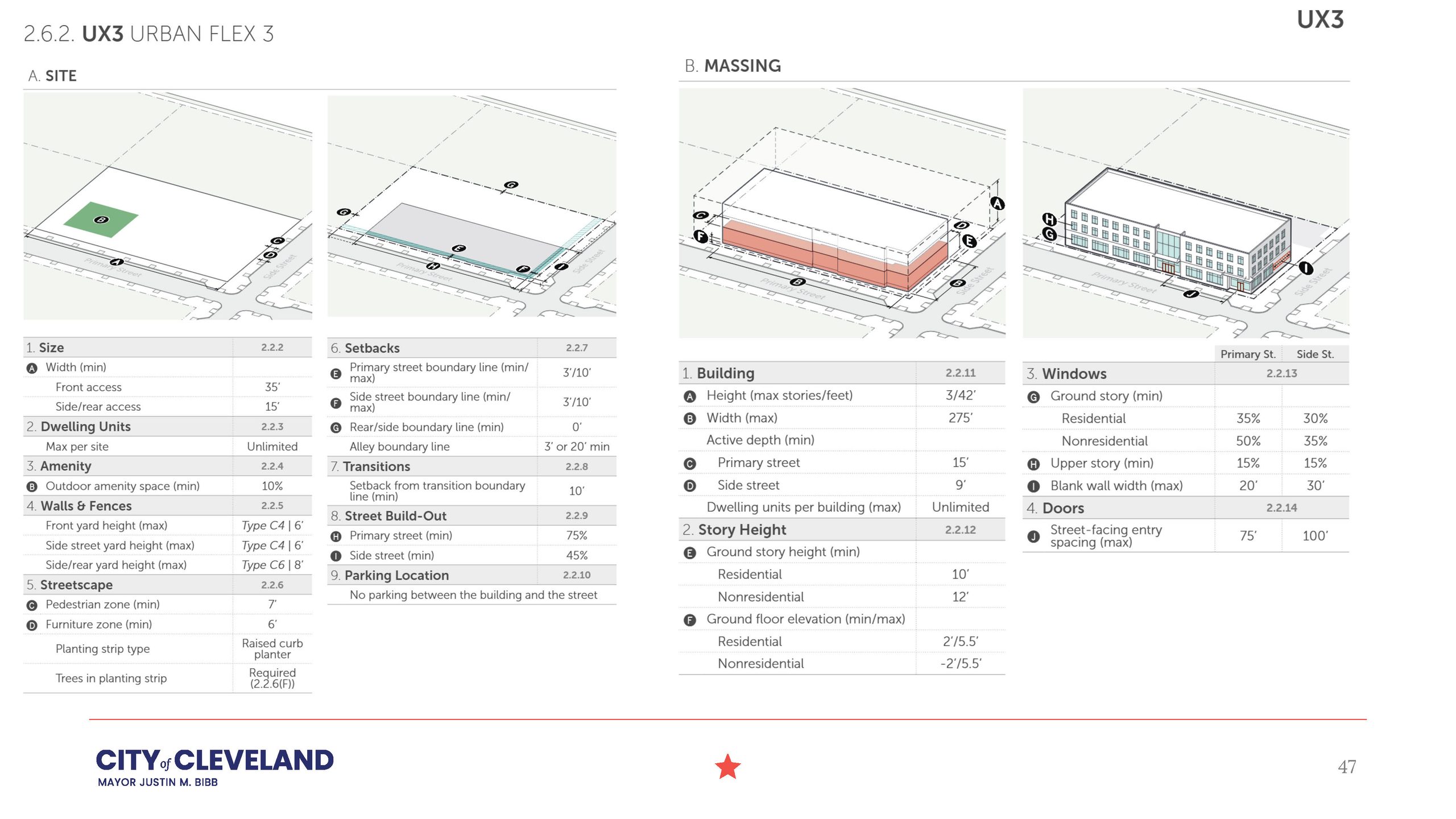
The Urban Flex 3 zoning district, proposed for parcels along sections of Larchmere and Shaker boulevards as well as Buckeye Road, is illustrated above. The district allows for mixed-use buildings limited to three stories in height (City of Cleveland).
Most Two-Family (2F) zones would become House 3 districts, which neither permit fourplexes nor any type of commercial use. Along North and South Moreland boulevards, Community Flex 4 and 5 districts would allow apartment buildings less than four or five stories in height, respectively.
Along sections of East 116th Street, Buckeye Road, plus Larchmere and Shaker boulevards, Urban Flex 3, 4, and 5 districts would permit mixed-use buildings of up to three, four, or five stories. Special districts are also proposed for parks and civic institutions.
A small district at the south end of Kemper Road, including a surface parking lot currently targeted for development, would be zoned as Neighborhood Flex 3. “Flex” versions of Neighborhood and Community districts permit low-intensity, neighborhood-serving commercial uses and public amenities.
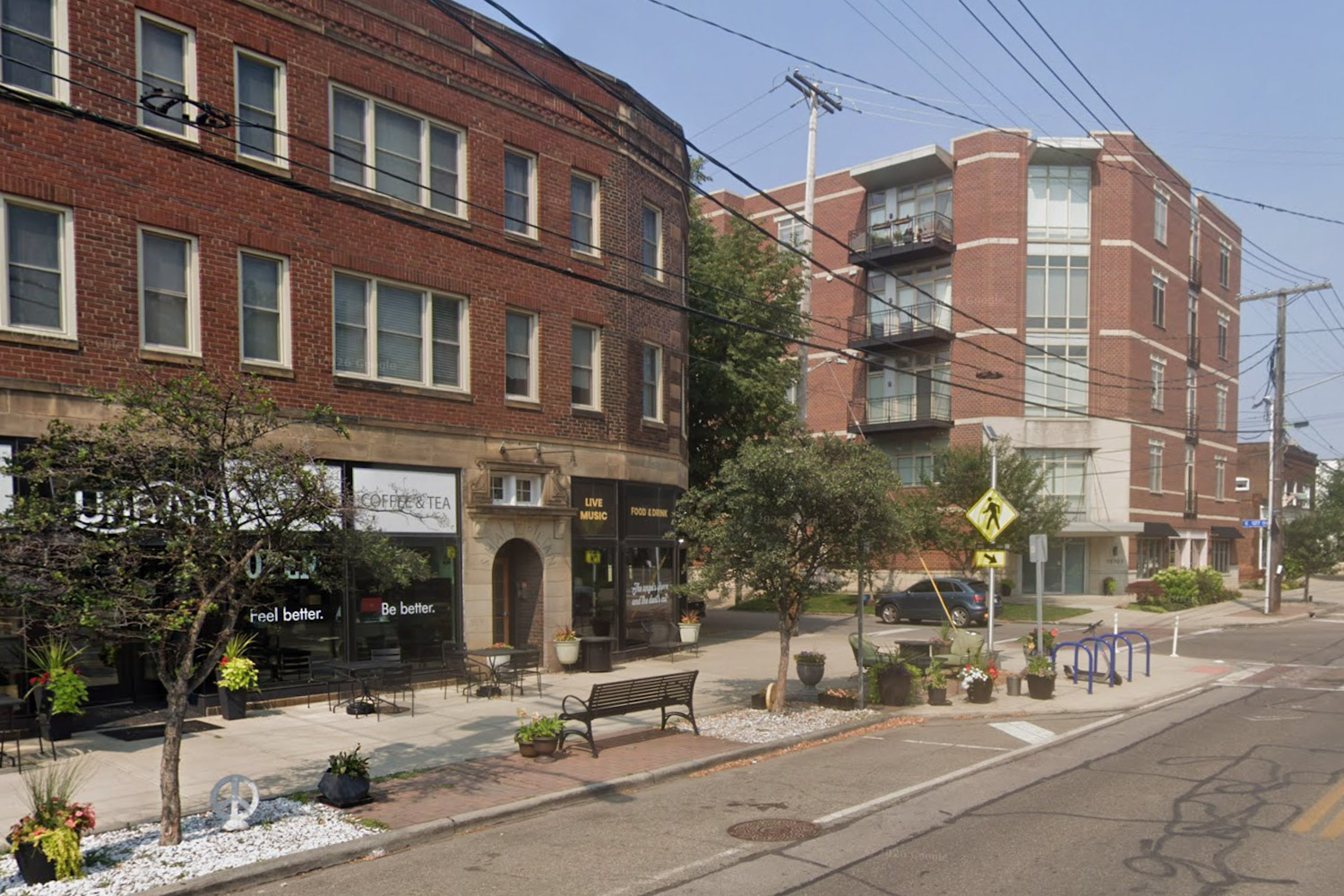
The five-story apartment building at right would not be allowed under the proposed Urban Flex 3 zoning, which limits structures to three stories in height (Google).
While critics may frame the Form-Based Code as a deregulatory move, it is far more restrictive than current regulations in a number of ways. Today, many design standards are only enforced within Design Review districts, which comprise about 17 percent of the city. The Form-Based Code would implement design guidelines citywide.
The new rules are also significantly more restrictive when it comes to height limits. While Planning Commission has expressed a desire to avoid creating non-conforming uses, proposed maximum heights on Larchmere and Shaker boulevards are shorter than several of their tallest buildings.
City planners acknowledge that the Form-Based Code is still a work in progress, with the proposed zoning change considered a “phase one” due to the lack of an appropriate district for a cluster of mid- to high-rise apartment blocks on Shaker Boulevard. Some of those properties are set to retain their existing zoning until the Form-Based Code can be revised.
The City Planning Zoning team will join the Ward 6 Community Meeting at 6-8 p.m. Oct. 13 to discuss the Form-Based Code. The meeting will be held at Fairhill Partners, 12200 Fairhill Rd.
END