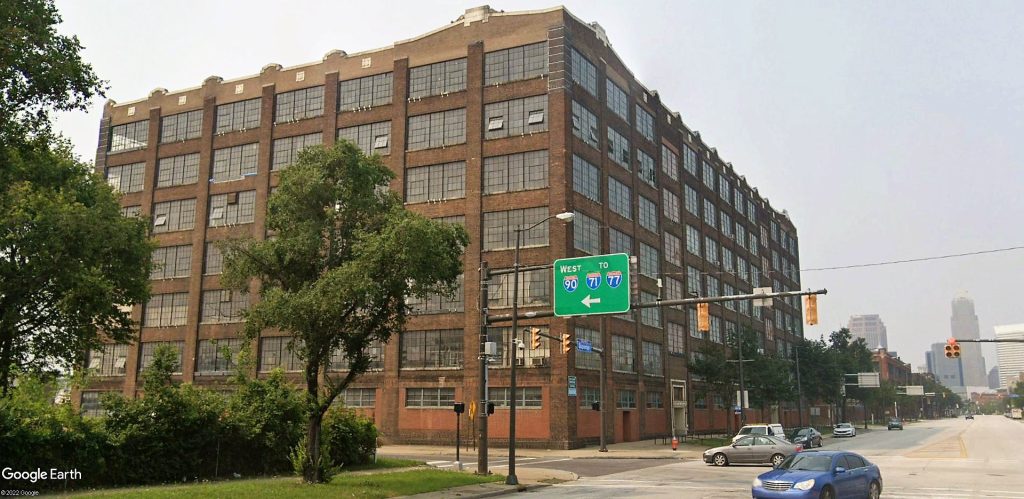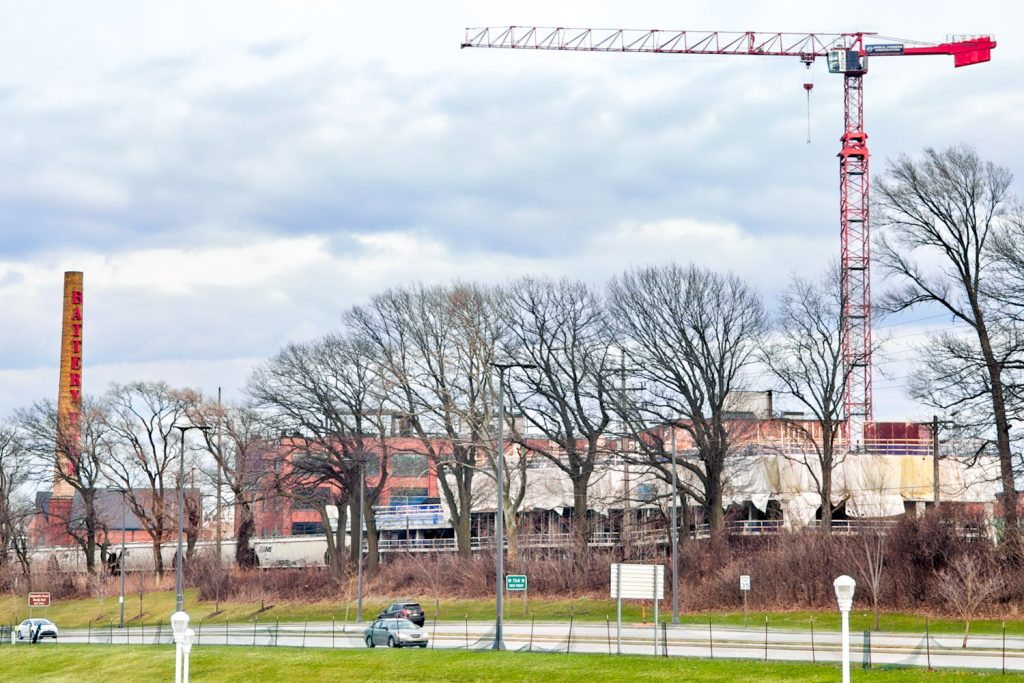

One of the most vibrant and, thus, congested enclaves in Cleveland is the Ohio City Market District. West 25th Street through this area hosts cars, trucks, bikes, dozens of on-street parking spaces, and two bus routes that carry more than 1 million riders each. Figuring out to reduce transit travel time through this gauntlet is the goal of a pending $50 million project (Google). CLICK IMAGES TO ENLARGE THEM.
Market District bus lane a hot topic
As plans for enhancing the Greater Cleveland Regional Transit Authority’s (GCRTA) MetroHealth Line Bus Rapid Transit (BRT) advance, a pinch point in those plans has become the subject of debate.
A community open house is scheduled to be held at 6-7:30 p.m. tomorrow (Aug. 13) at the Urban Community School, 4909 Lorain Ave., to get public input on the project. This will be the third open house with the fourth and final one to be held next summer, shortly before two years of construction is due to begin.
The MetroHealth Line BRT is planned to enhance roughly 4 miles of the West 25th Street corridor from the Detroit-Superior Bridge south to Downtown Old Brooklyn where several bus routes fan out in several directions.
The goal of the $50.5 million project is to not only improve the streetscape and transit waiting environments bus to also speed up the buses, primarily Route 51/51A, sponsored by the MetroHealth Medical Center — the largest employer along the route.

Location of the MetroHealth Line Bus Rapid Transit project and infrastructure investments (GCRTA)
That bus route carried just over 1 million passengers last year, according to GCRTA. Also serving part of the MetroHealth Line is Route 53 but it bypasses the most congested parts, in La Villa Hispana and in Ohio City, by taking Interstate 71 to/from Downtown Cleveland.
Another 1-million passenger route, the No. 22 on Lorain, uses a short portion of West 25th — the section north of the congested Market District. It is that section that is a major source of traffic slowdowns and debate on how to reduce transit travel times.
One option is to provide two dedicated multimodal, curbside lanes for buses and bikes, one in each direction, plus two lanes for cars and trucks and no on-street parking, according to range of options developed by GCRTA consultants.
Another is to provide a single, bidirectional bus lane for use by buses with opposing buses yielding to the two through lanes of car traffic. The fourth lane would be for on-street parking.

Conceptual ideas for reducing travel times of buses and their riders on West 25th Street through the Market District in Ohio City (GCRTA).
Currently there are two lanes for all through traffic — cars, buses, trucks and bicycles — plus two more for on-street parking on West 25th for up to 70 cars between Chatham and Bridge avenues.
Owners of restaurants, bars, shops and other businesses in the Market District said they don’t want to give up those spaces for customers. The parked cars also provide a buffer between pedestrian traffic on the sidewalks and the busy street, they noted.
But speeding up the buses is key to securing about $28.4 million in federal funding for the project. Another $12 million is anticipated from the Ohio Department of Transportation. GCRTA will pay the remainder, or approximately $10.1 million, the transit agency reported.
Faster, more efficient bus service is crucial to attract ridership and demonstrate the benefits of the project to justify federal investment. GCRTA officials say their vision for the MetroHealth Line BRT is to improve service frequency, accessibility, enhanced regional connections, better pedestrian safety and reduced corridor congestion.

Sidewalk views of West 25th Street past the West Side Market, existing at top, with two dedicated BRT lanes at lower left, and a bi-directional BRT lane at lower right (GCRTA)
To do that, GCRTA plans curbside bus stations, ADA-compliant station access, lane configuration adjustments, traffic signal phasing and timings, plus Transit Signal Priority (TSP) operation for buses.
Strategically placed district parking lots and possibly even garages for dense commercial and mixed-use districts could be the solution and has been the subject of interest of several community development corporations along the BRT corridor.
The project is also intended to coordinate with existing pedestrian and bicycle connections. And, of course, economic development is a hoped-for outcome of this project.
Multiple developments are planned along the West 25th corridor, and the upcoming transit investment is a big draw for at least some of them. Seaton Woods President Ben Beckman said the MetroHealth Line BRT is a big draw for his multiple developments in the Barber-Vega-Queen (BVQ) District.
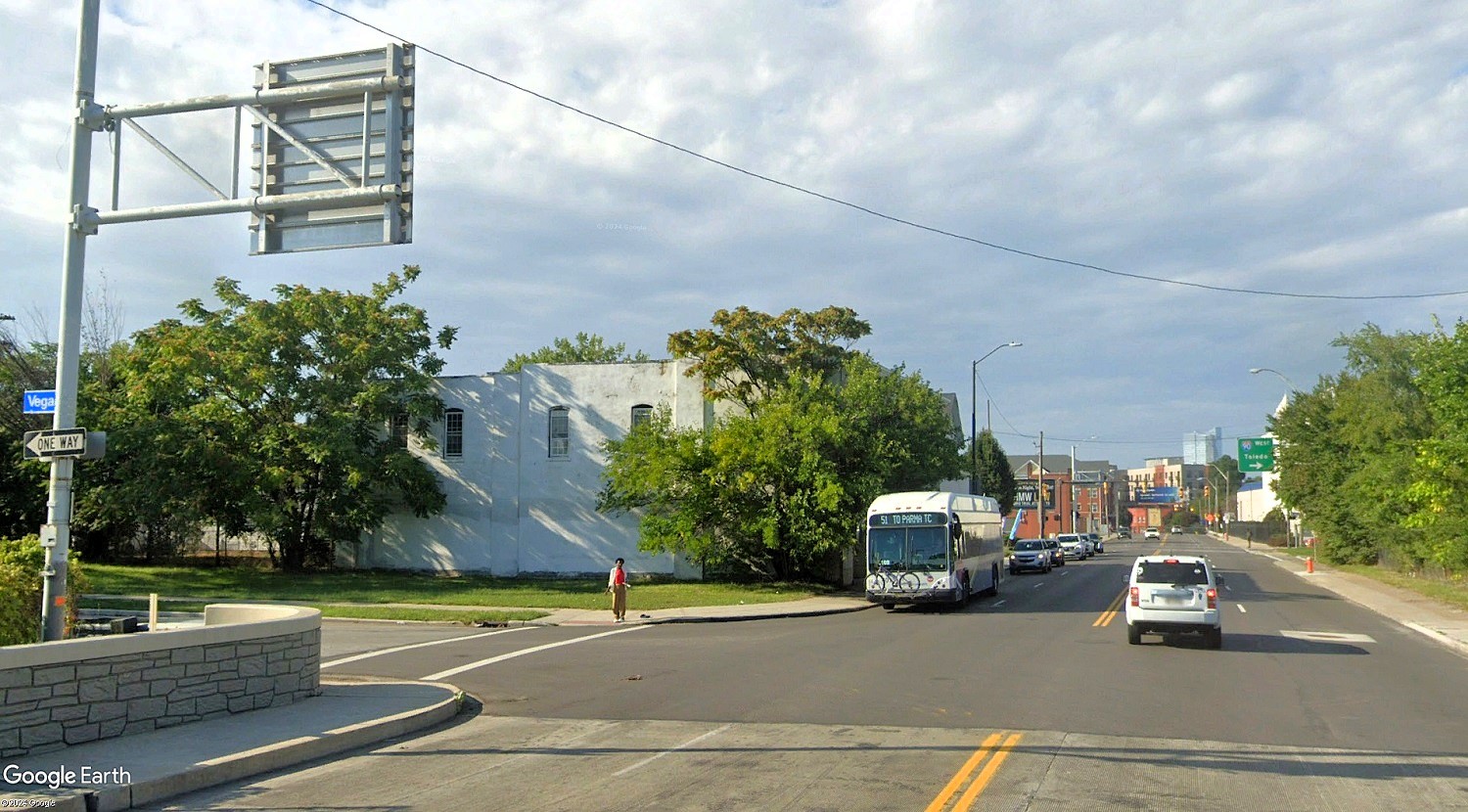
Some sections of the West 25th Street corridor have lost its urban fabric since the 1960s, including this section just north of Interstate 90 called the Barber-Vega-Queen District. But developer interest in this area is on the upswing, and the planned transit investment is a big reason why (Google).
Also in the BVQ District, the first phase of the 200-unit Hub 27 development led by Pivotal Housing Partners is due to start construction later this year. So might the Marriott Tribute Portfolio boutique hotel in Ohio City which is planned with just nine off-street parking spaces.
Another neighborhood investment pursued with the MetroHealth Line in mind is the Memphis-Pearl mixed-use development. The chance of gaining the BRT transit corridor is causing developer interest to expand south along West 25th, beyond the usual hot spots.
“This will be the first significant project south of our hot market neighborhoods in Ohio City and Tremont that is really focusing its design on transit-oriented development,” said Ward 13 Councilman Kris Harsh.
“So we’ve been in great communication with county planning, the RTA and city planning to make sure that the building is designed and focuses its residents on using that as an asset and a resource,” he said.
END