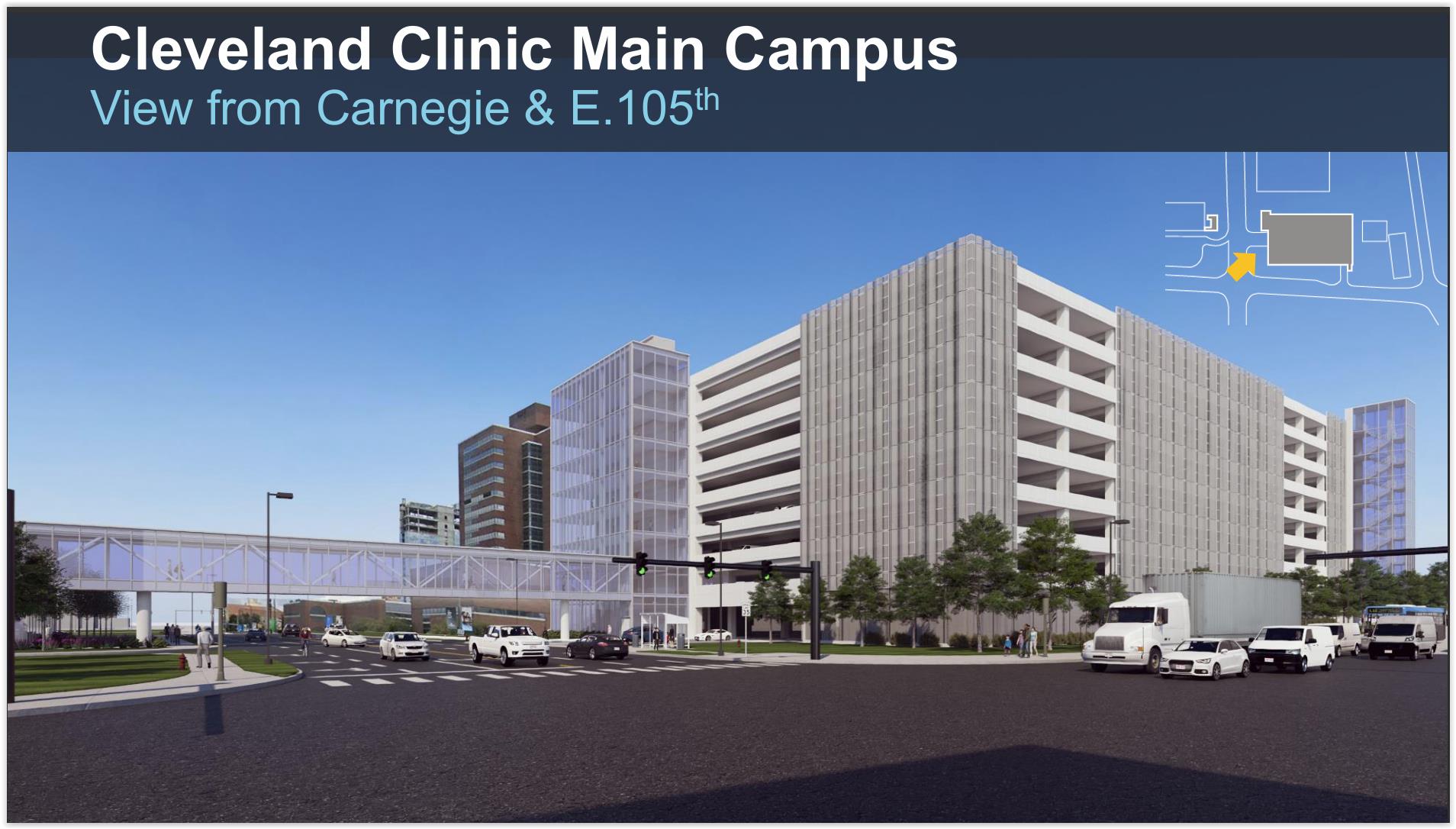
Rendering of the Cleveland Clinic’s “East Garage” proposed at the northeast corner of Carnegie Avenue and East 105th Street. A skywalk pedestrian bridge over East 105th is planned. The Clinic is planning two big garages at its Main Campus that straddles the University Circle and Fairfax neighborhoods of Cleveland. The East Garage will be sought first (Cleveland Clinic). CLICK IMAGES TO ENLARGE THEM.
Garage designs get first public airing
As Cleveland Clinic officials presented their plans for two new parking garages to neighborhood residents at a recent Ward 6 meeting, there also was an acknowledgement that the Clinic would have to take a broader view toward its transportation needs at the Main Campus.
More details about the two garages were provided at the Feb. 10 meeting, including some conceptual renderings and site plans that outlined the Clinic’s approach toward the placement and design of the garages. NEOtrans broke the story two weeks ago that the Clinic would seek these two garages this year.
While the garages would not be the largest decks at its Main Campus, the additional car traffic they would attract to already overburdened streets in Cleveland’s University Circle and Fairfax neighborhoods received some resident pushback.
As noted two weeks ago, the East Garage would be sought first, with construction starting possibly this spring at the northeast corner of East 105th Street and Carnegie Avenue. The West Garage would be built starting at the end of this year on Carnegie at East 86th Street, on a portion of the site of the former Cleveland Playhouse.
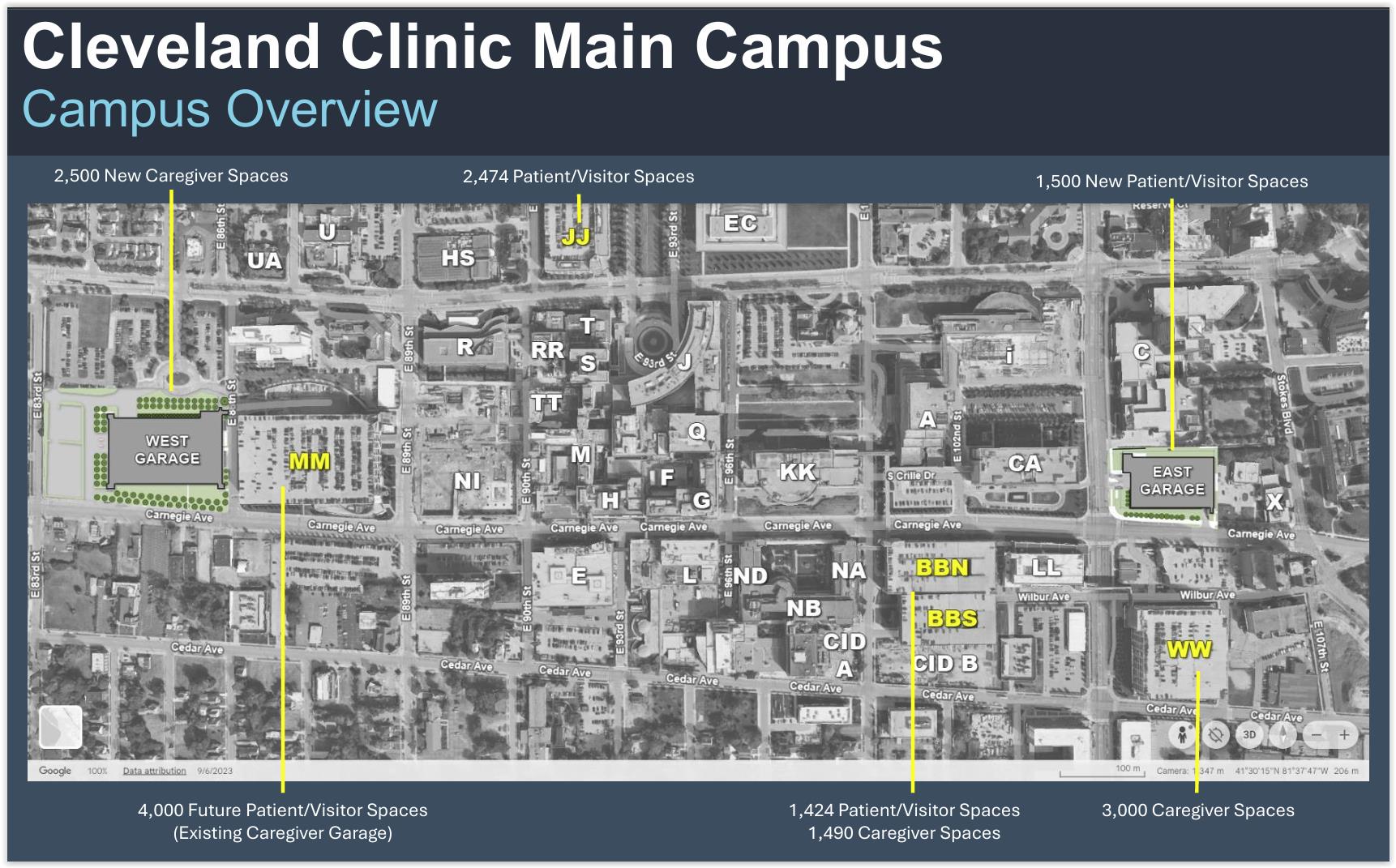
Locations of the proposed West Garage and East Garage plus other parking structures and their capacities at the Cleveland Clinic’s Main Campus (Cleveland Clinic).
The East Garage is proposed to be nine levels tall and accommodate about 1,500 cars for patients and visitors. It is also proposed to have a skywalk pedestrian bridge over East 105th to an elevator/stairwell on the west side of the street, plus a walkway to the Taussig Cancer Center. Both garages would replace existing surface parking lots.
The West Garage will be larger, but not as large as first reported. It will be about eight levels tall but have spaces for about 2,500 cars for Clinic employees, called “caregivers.” It, too, will have a skybridge, across East 86th to the East 89th MM garage, the Clinic’s largest structure at 1.56 million square feet.
Of the comments provided by some of the 70 people who attended the meeting hosted by Ward 6 Councilman and City Council President Blaine Griffin, most expressed concern about how the additional traffic would be accommodated. Several said that the garages will make a bad situation worse.
Although it is not yet five years old, the 3.2-mile, $330 million Opportunity Corridor Boulevard linking the Interstate highway system to University Circle is frequently jammed with traffic. In the mornings, many commuters bypass back-ups on Opportunity Corridor via East 79th and 93rd streets. Some park illegally in residential areas.
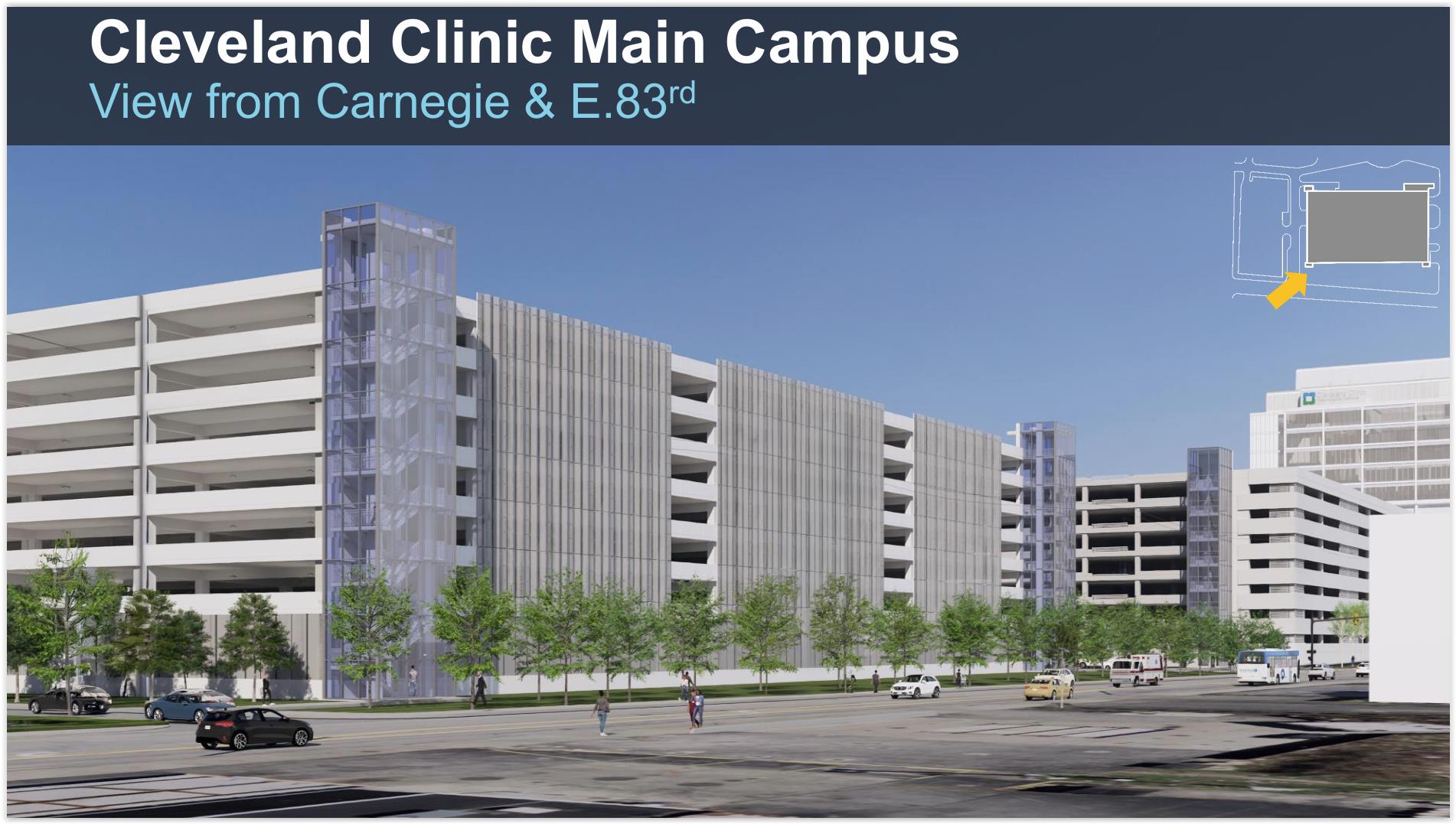
A conceptual rendering of the West Garage, to be located on Carnegie Avenue at East 86th Street, just west of the Clinic’s largest structure on its Main Campus. The East 89th Garage is seen just beyond with the new Neurological Institute at far right (Cleveland Clinic). CLICK IMAGES TO ENLARGE THEM.
Griffin said most Clinic-related parking on neighborhood streets is from their employees and causes tension with residents. He urged the Clinic to have conversations with local community development organizations University Circle Inc. (UCI) and Fairfax Renaissance Development Corp. on traffic issues, routings and parking.
Afternoons offer challenges, too. Parents who pick up students at John Hay High School, 2075 Stokes Blvd., and Cleveland School of the Arts, 2064 Stearns Rd., said they already have to contend with what they call “the Cleveland Clinic rush hour” which they say lasts from 2 to 6 p.m.
Others said their kids walk to school from and to nearby Greater Cleveland Regional Transit Authority (GCRTA) bus and train stops and expressed concern about their safety while crossing wide, busy streets.
Clinic officials said the new garages would help with the parking constraints and the garages will be designed so that cars entering the garages will queue inside so that traffic doesn’t back up out onto the streets.
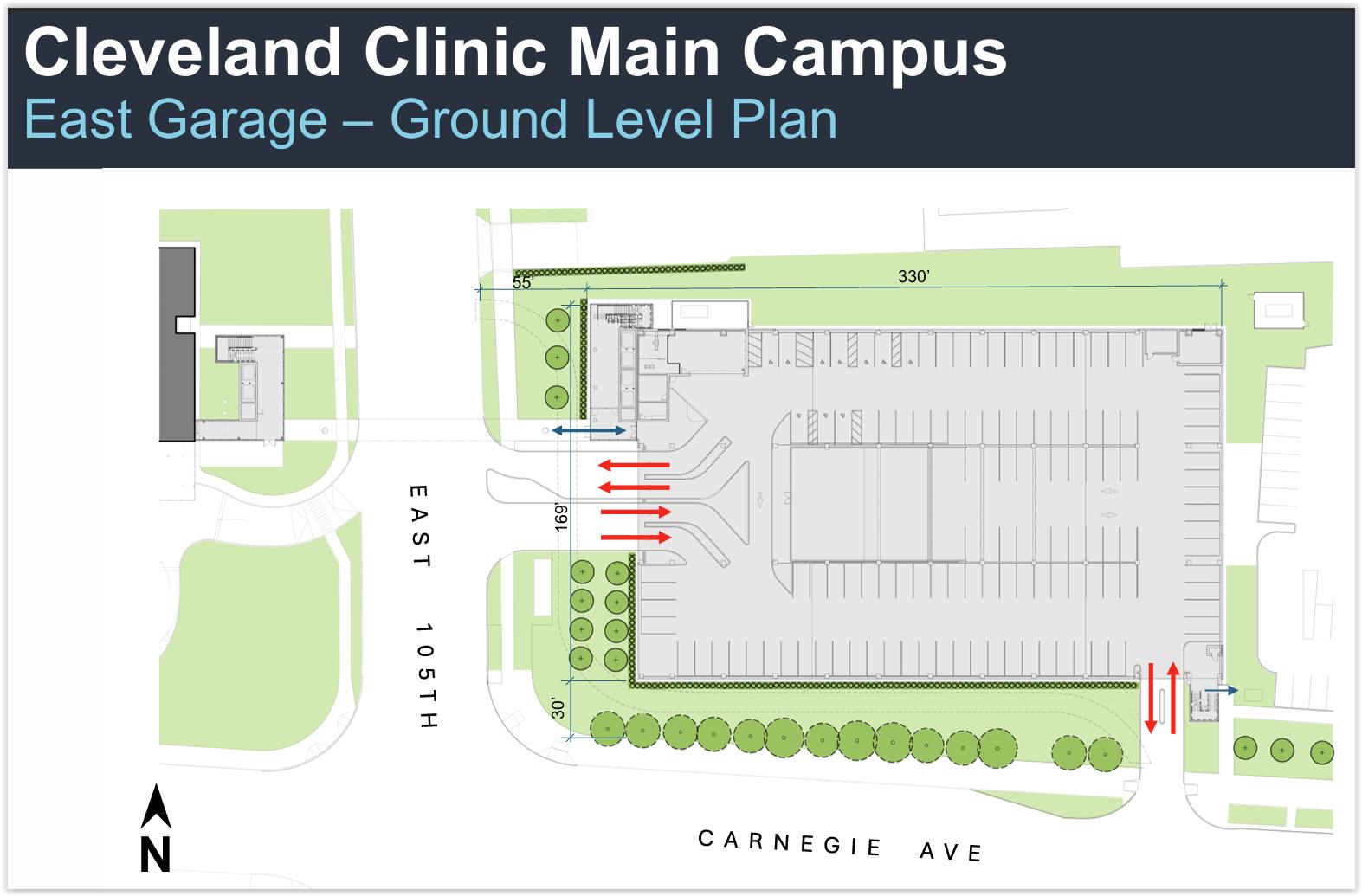
For the East Garage, this ground-level site plan shows the locations where visitors/patients will drive into and out of the garage. It also shows on the other side of East 105th Street where the skyway pedestrian bridge will land and be connected to the ground by an elevator/stairwell structure (Cleveland Clinic).
Jorge “Pat” Rios, the Clinic’s vice president of buildings and design, said the global health care system recently conducted a transportation study of the Main Campus using data from the taxpayer-supported Northeast Ohio Areawide Coordinating Agency (NOACA). He declined to share the results of that study, saying its findings were proprietary.
Rios said at the Ward meeting that the Clinic’s transportation needs and the growing pains associated with them presented “an opportunity for the Clinic to engage in a traffic management plan with the city, NOACA, GCRTA, UCI and Fairfax Renaissance.”
GCRTA board members and staff have noted that the University Circle area is one of the fastest-growing communities in its service area yet its transit services have not grown to match it. Instead, GCRTA is facing a budget crunch and may cut services by the end of this year.
Transit advocates have urged the Clinic to fund transit service expansions instead of parking garages, such as a building a branch of the rail transit Red Line. They argued it would take advantage of GCRTA’s new railcars that are due to enter service next year and be able to operate on any of the transit authority’s three rail lines.
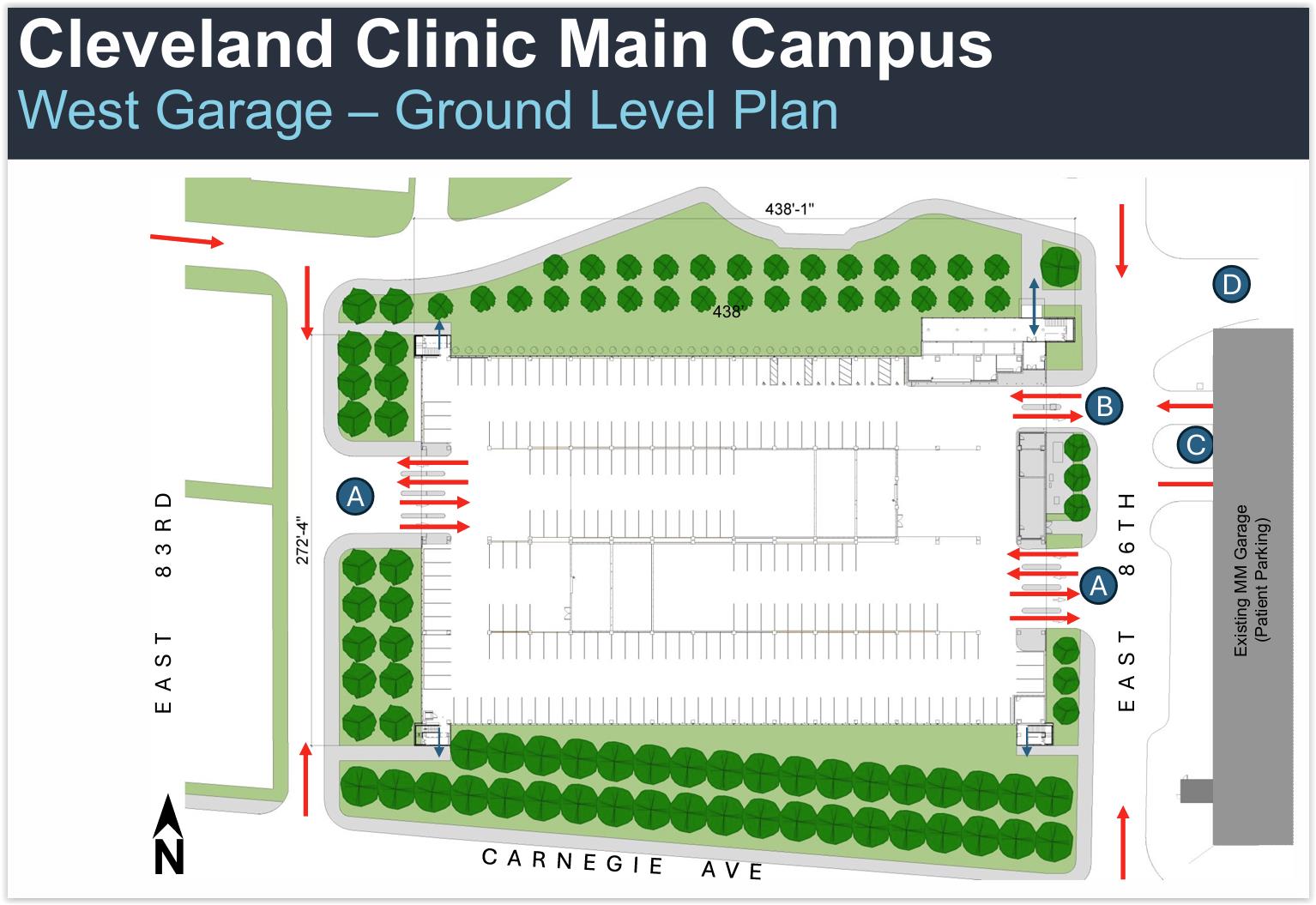
Ground-level site plan for the West Garage which is planned on the southeast corner of the former Cleveland Playhouse site, leaving room on the rest of the 11-acre property for the queuing of cars and future development (Cleveland Clinic).
Clinic officials cautioned that the garages’ designs aren’t yet set. Additional design refinements will be made during the city’s design-review process which could start in the coming weeks, said David Berlekamp, the Clinic’s director of its Healthcare Design Studio.
“We’re looking at architectural screening options for the rest of the garage possibly using metal paneling like what is on The Artisan” apartment tower garage on Chester Avenue at Stokes Boulevard, Berlekamp explained.
The garages will have security cameras but not monitored exclusively on-site. Views from garage security cameras will be visible to Cleveland Clinic’s police at an off-site monitoring station.
Both garages are to be set back from sidewalks behind grassy strips and fronted by trees. The Clinic will seek to plant mature trees to provide more screening. But neither garage will have an active street frontage, such as offering retail, restaurant or other commercial spaces along the sidewalks.
END