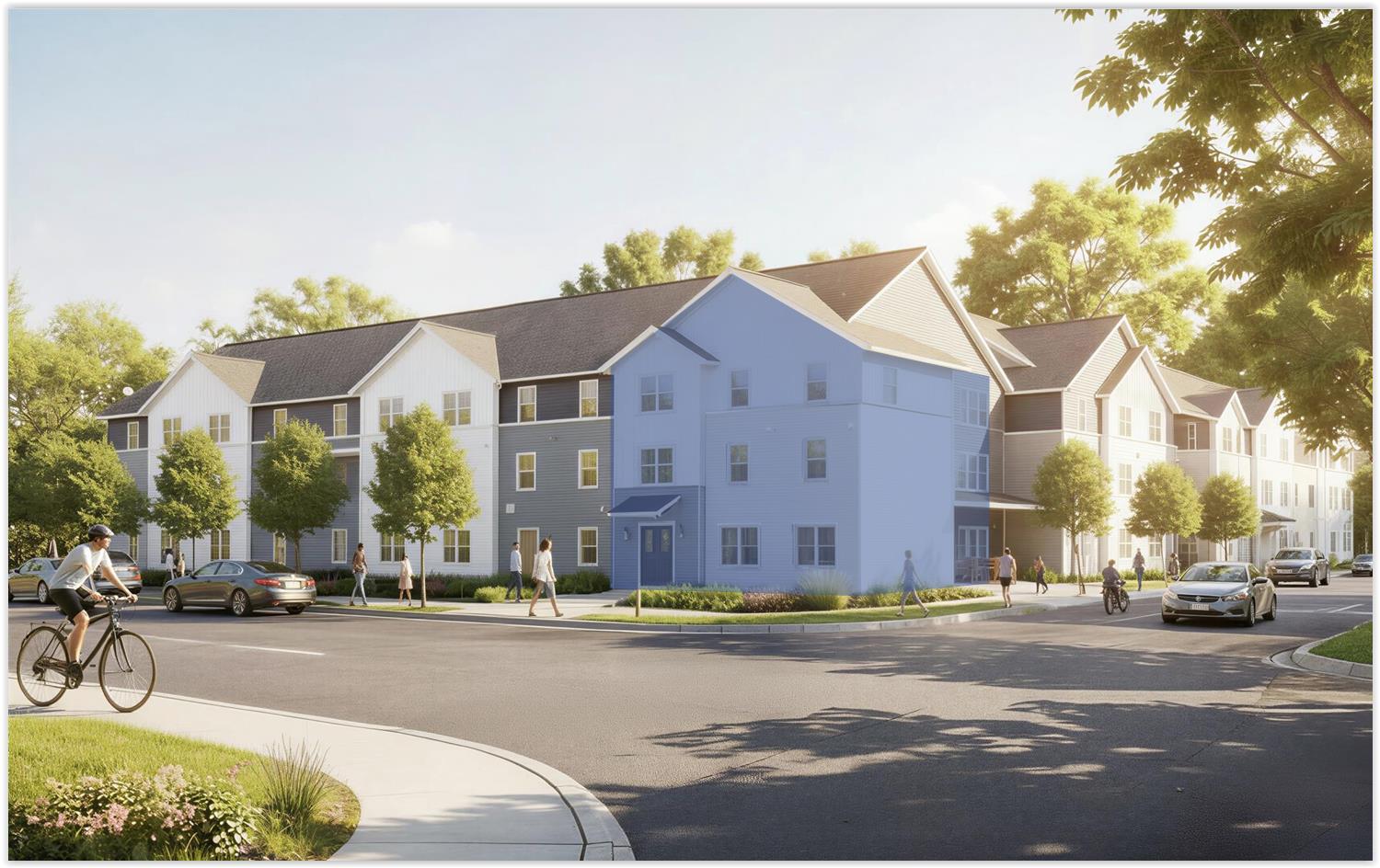
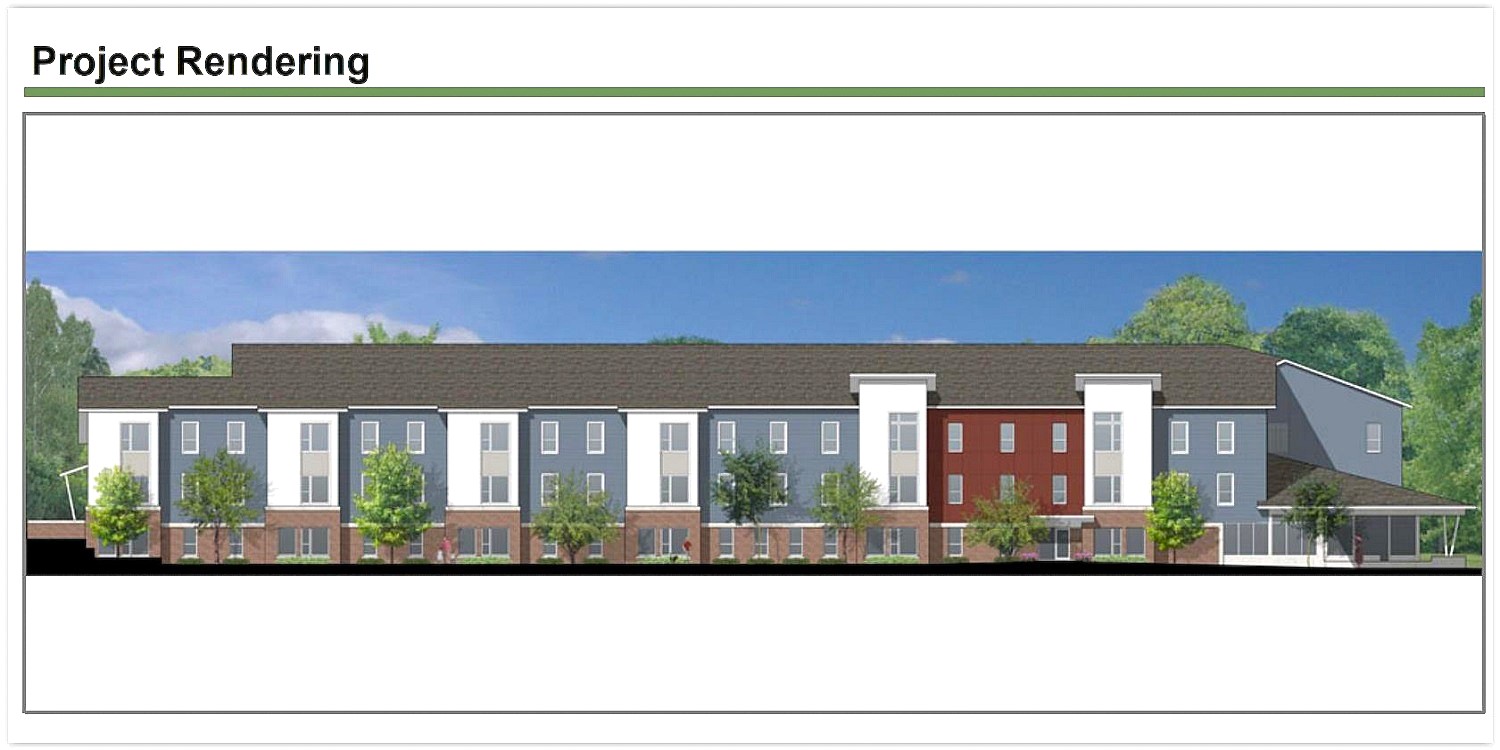
The design of Ironwood Flats was inspired by neighboring, historic houses in Cleveland’s Slavic Village with gables and different colored sections to break up the massing of the building (RDL). CLICK IMAGES TO ENLARGE THEM.
Senior housing sought in Slavic Village
Despite Cleveland City Planning Commission calling the design for a proposed affordable senior housing development in Slavic Village as unoriginal and its location isolated from community amenities, it urged that the project be approved in an expedited manner.
The commission’s reason for panning the project is that the its location and design are influenced by cost and regulatory constraints placed on this and similar projects by state policymakers, notably those at the Ohio Housing Finance Agency (OHFA), said commission members and the housing developer.
While Cleveland officials may wish to try to influence improvements to those policies in future years, the need exists now to build more affordable housing wherever it can be done in the city.
That’s why Ironwood Flats, 3051 E. 63rd St., not only won unanimous approval by the commission on Friday. It also got nudged forward to skip a step in the design review process and go straight to final approval the next time it appears before the commission.
Ironwood Flats is proposed by Wallick Development LLC of New Albany, OH as a 62-unit, three-story, 68,250-square-foot, income-restricted apartment complex for residents aged 55 years and older. A surface lot behind the building will have 56 parking spaces with eight of those for ADA persons.
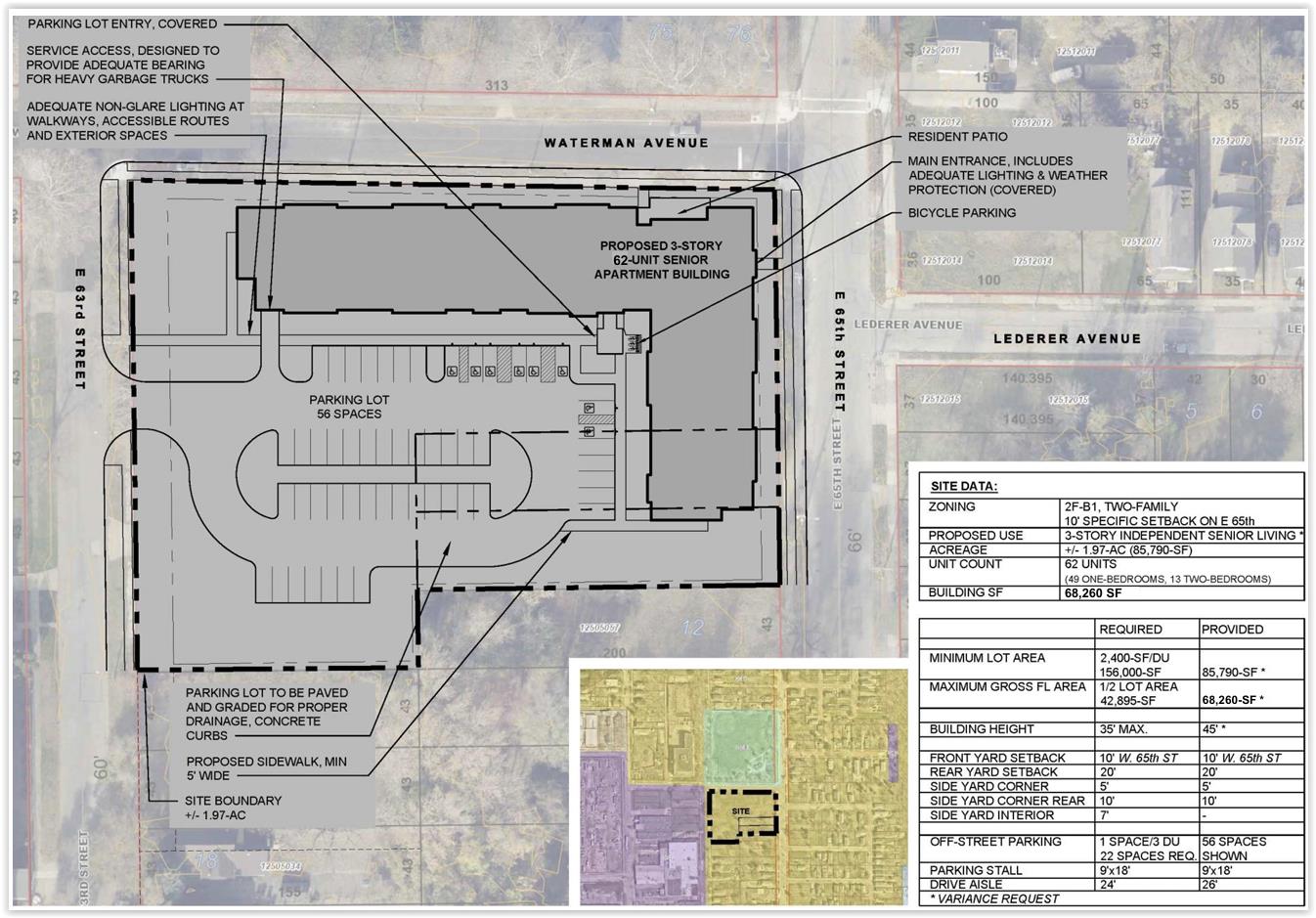
Proposed site plan for the Ironwood Flats with north at the top of the image. Also at the top of the image is the southern edge of Hyacinth Park (RDL).
While its construction cost is estimated at $14 million, the overall development costs for Ironwood Flats, previously called Waterman Avenue Senior Housing, will be much higher, totaling about $20 million, according to Wallick’s filing with the city.
The proposed development will be financed with equity from the sale of 9-percent Low Income Housing Tax Credits (LIHTC) from OHFA, a housing development bridge loan from OHFA, a conventional mortgage and construction bridge loan and a deferred developer fee.
“It’s a pretty competitive site, we feel like, or we wouldn’t be actively pursuing it,” said James McCune, Wallick’s vice president of development. The site is in the Hyacinth enclave, named after the former St. Hyacinth Church, since renamed Elizabeth Baptist Church.
Of the 62 units, eight will be rent- and income-restricted to senior households earning up to 30 percent of the area’s median income (AMI), 45 will be restricted to those earning up 60 percent AMI and nine units will be at 80 percent AMI.
The site, a 2-acre vacant lot, is owned by the nonprofit community development organization Slavic Village Development. It is across Waterman Ave. from Hyacinth Park and the Hyacinth Lofts. The site was home to Meyer Dairy Products from 1927-79.
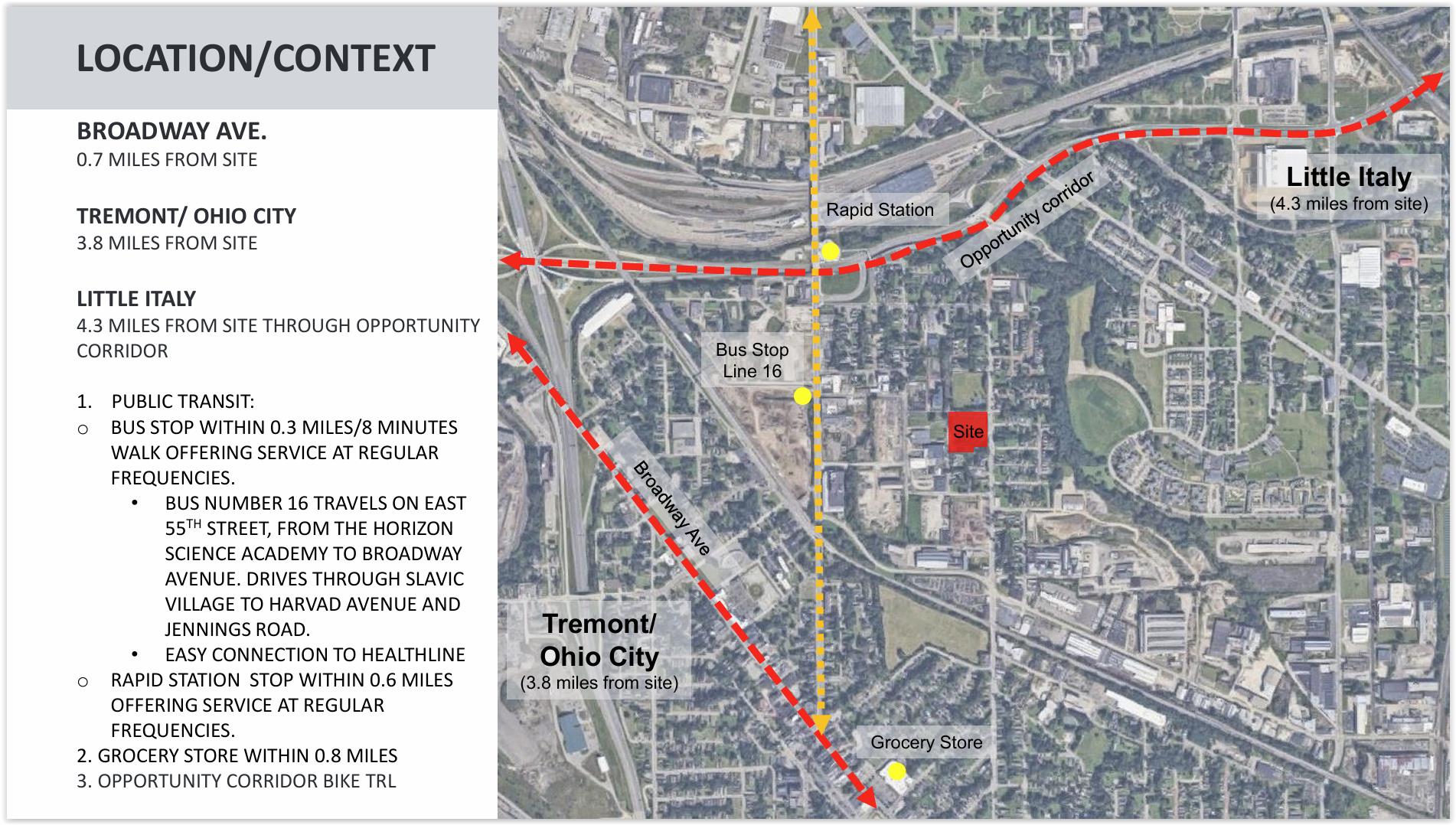
A number of amenities are within a short drive of the Ironwood Flats but are a long walk, especially for some persons aged 55 years and older. Many low-income seniors in Cleveland are without a car (RDL).
But there are no stores or other amenities within a short walk. In fact, the nearest bus stop, on East 55th Street, is 1,500 feet away. And that was another concern for commission members.
“Affordable housing is meant to be transitional,” said Planning Commission Vice Chair August Fluker who stood in Friday for the absent Chair Erika Anthony. “An unintended circumstance is that we warehouse people. We need to look at amenities. We need to do more.”
“It is frustrating to me that a lot of the qualifications for these types of dollars from the state, I think, concentrate poor people or lower-income people in neighborhoods that lack amenities,” said commission member and Ward 15 Councilman Charles Slife.
“And that’s not a criticism of the project or the developer,” Slife continued. “It is frustrating to me to your point that we kind of warehouse people. I think that that is a policy decision well above city government that we have to contend with.”
Fluker also said that OHFA-funded residential developments are beginning to all look alike — much like federal HUD-funded housing from the 1960s-80s.
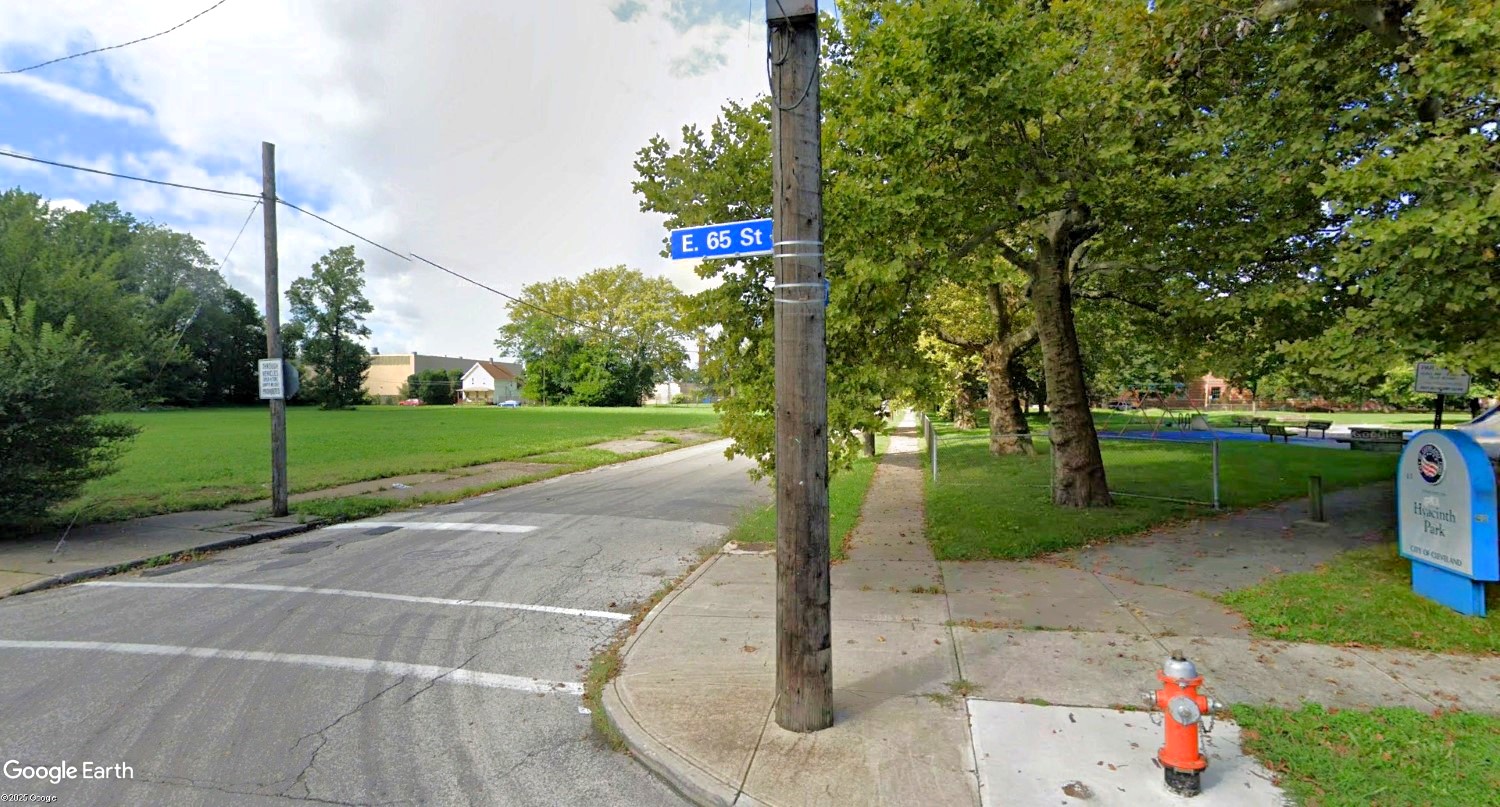
At left is the development site for Ironwood Flats, across Waterman Avenue from Hyacinth Park (Google).
“You could go to any city and point to a building and say ‘that’s a HUD 202 building’,” he added. “What I’m getting concerned about is a formulaic approach to how these buildings look. If history has already taught us anything, they’re all starting to look the same.”
McCune said that those concerns were all fair points. But he said the project is being funded by the state because the rents are capped so they go with a formulaic approach because it reduces costs and meets state regulations.
“I do agree with you that we are getting to a point where some of these projects are like a rinse and repeat,” McCune told the commission. “Largely in part that has to do with OHFA’s design and architectural standards that are fairly rigid. Obviously we’re cost-constrained. Our resources are capped. So we, as a developer, do have to be mindful of cost and things like that.”
As for affordable housing developments ending up in less-amenity-rich neighborhoods, thus concentrating poverty, he urged the planning commission, the City of Cleveland and others to provide input to OHFA when they issue their next draft project policy guidelines.
As for the design, Beachwood-based architect RDL’s Project Manager Winston Hung said the building’s corner is oriented toward Waterman and West 65th Street where there will be a multi-purpose room and living room near the corner, next to a 400-square-foot, half-covered outdoor patio space.
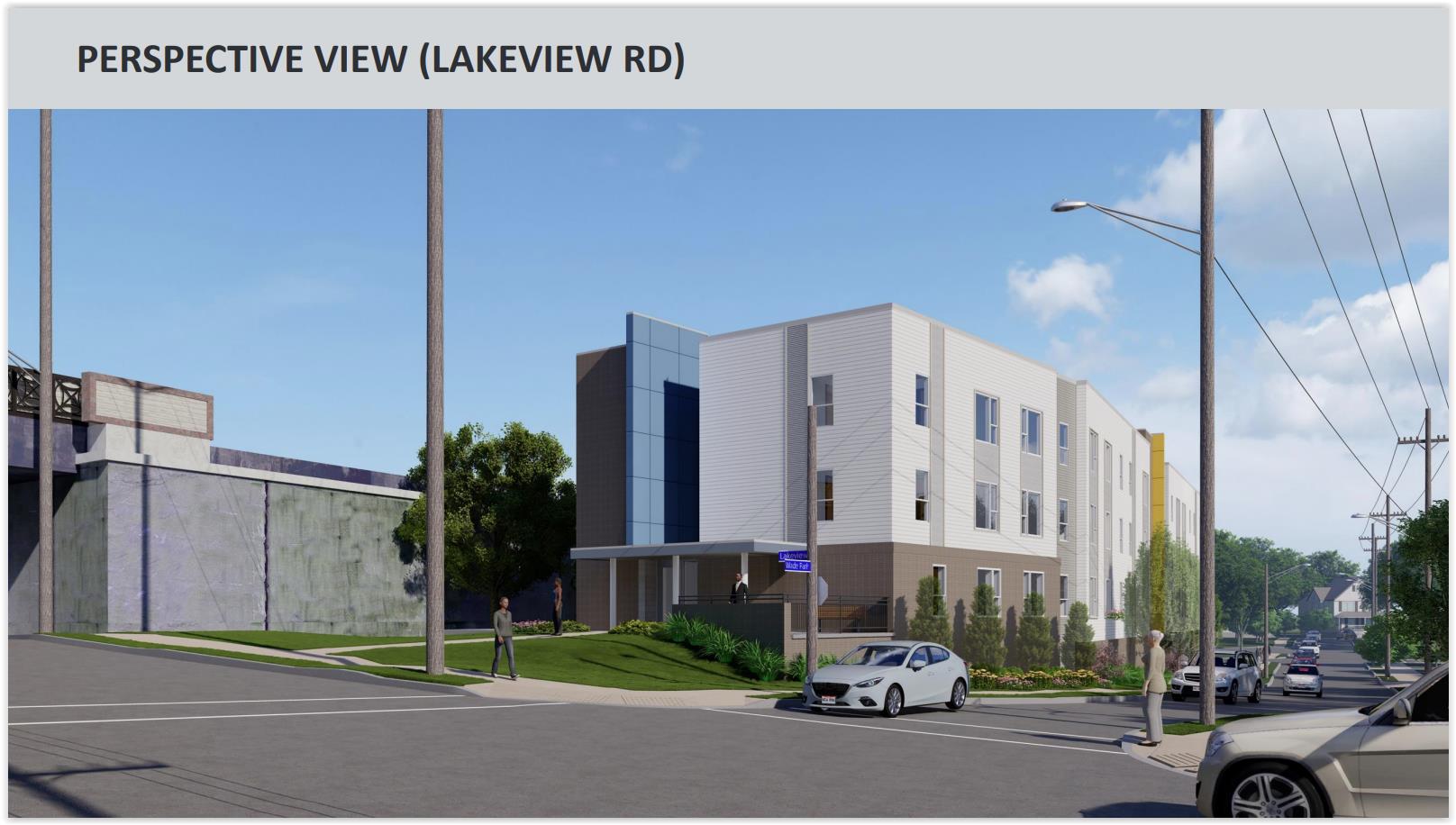
Another project by Wallick Development is Wade Park Station which could see construction start this summer at the corner of Wade Park Avenue and, in the foreground, Lakeview Road (RDL).
A lobby and on-site leasing office is planned near the door to the parking lot at the junction of the two building wings. In total the building will have 2,475 square feet of common space to support 49 one-bedroom units and 13 two-bedroom units.
“We understand that three stories with 62 units is going to be a big building,” Hung said. “So we took inspiration from some of the single-family homes in the neighborhood in terms of the scale of it and incorporated some of the design details into the building mass to help break up that mass with the use of gables to push and pull on the façade.”
Hung also used different colors in the façade to break up the massing of the building. The development will keep the mature trees along the streets and as many trees on the lot as possible.
Wallick is developing another project in Cleveland — Wade Park Station, 12308 Wade Park Ave., located where Cleveland’s University Circle and Glenville neighborhoods meet East Cleveland.
“That was financed last year,” McCune said. “That will hopefully begin construction this summer. We’re excited about that one.”
Wallick’s Depot Lofts at 30th on Train Avenue near West 30th Street in Cleveland’s Clark-Fulton neighborhood was to be a refugee housing development but faced headwinds and was withdrawn (RDL).
“It’s exciting to have a new developer in town, so welcome,” said City Planning Director Calley Mersmann. “We’re excited about your continued interest here and working with you on that.”
However, another project sought by Wallick, a 60-unit refugee housing development called Depot Lofts at 30th appears to have been withdrawn as it was facing headwinds.
Depot Lofts at 30th, was proposed to be located at 3119 Train Ave. near West 30th Street. The site is located in Cleveland’s Barber-Vega-Queen (BVQ) District, a west-side enclave in the Clark-Fulton neighborhood.
Next to it, Pivotal Development of West Chester, OH has begun site preparations in the BVQ District for a 53-unit affordable housing project called Hub 27, 2500 W. 27th St., at the north end of the Clark-Fulton neighborhood.
But plans for two other buildings sought for Hub 27 apparently were scrapped as OHFA funding applications for them were withdrawn. The 3.7 acres of land, owned by Opportune Development LLC, on which they were proposed now is listed for sale.
END