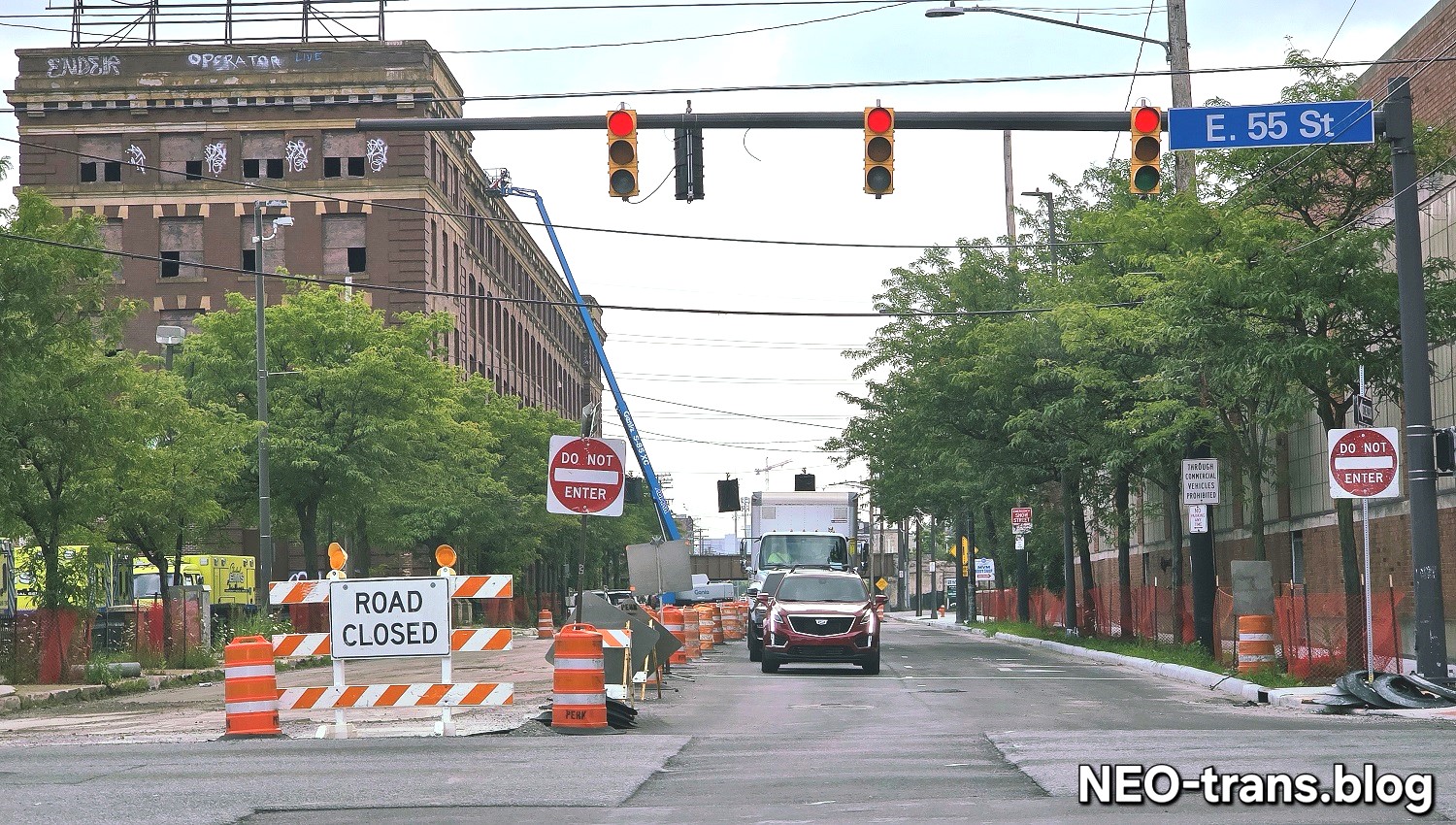
Lots of construction, from infrastructure to the redevelopment of abandoned industries, are evident in this view looking east on Carnegie Avenue from East 55th Street. But more is needed on Cleveland’s near-East Side to return abandoned properties back to productive use (NEOtrans). CLICK IMAGES TO ENLARGE THEM.
TIF district, form-based zoning sought
An expanded tax base is a result of economic development. On that score, Cleveland’s near-East Side doesn’t produce much in the way of tax revenue while its old infrastructure, city services and social programs are in need of lots of resources. So the city is going to do something to equalize that imbalance.
City Council is considering implementing two tools to repair a targeted area between Downtown and University Circle — a neighborhood-based tax-increment financing (TIF) district and the expansion of form-based code zoning.
The effort is in response to many decades of redlining by investors to stay away from neighborhoods like Hough, Central and St. Clair-Superior. It hastened the decline of those areas until they lost nearly 90 percent of their populations which bottomed out in the late 1900s but have been slowly inching up since.
Today, these areas are littered with vacant lots that are mostly owned by the city and sit in its land bank. There, the population of land bank lots unfortunately is very high. So to reverse the effects of redlining, the city is drawing a green line around that area to declare it’s open for new investment. It’s based on a model that began downtown.
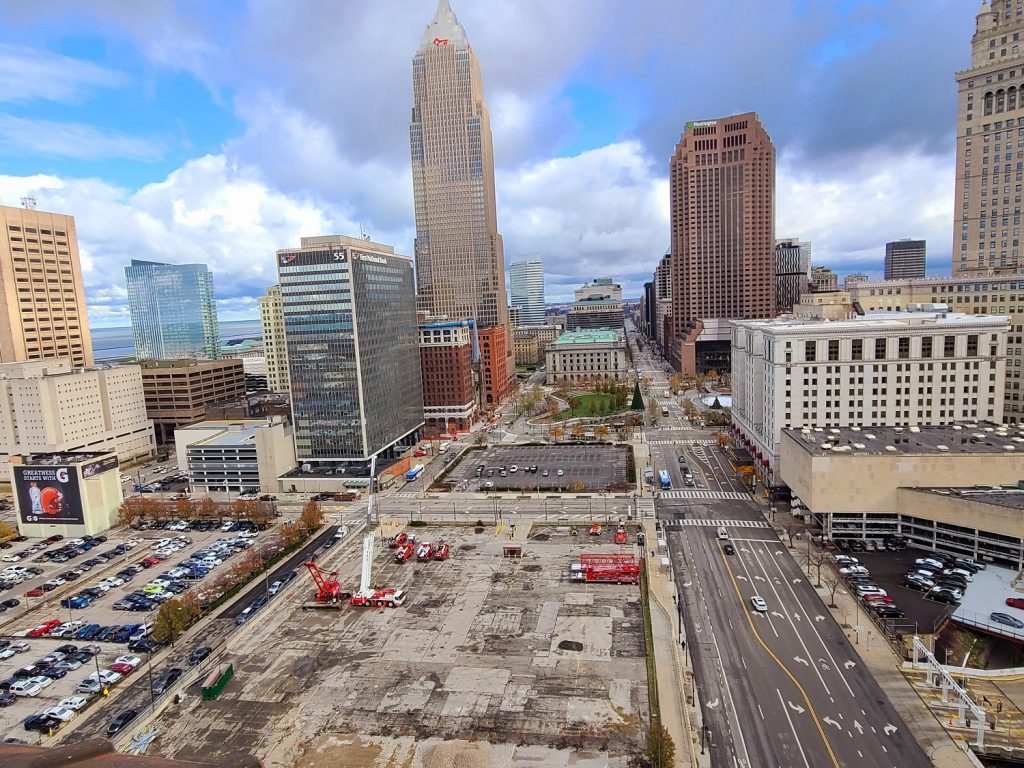
Mayor Justin Bibb’s administration has implemented its Shore-to-Core-to-Shore TIF that will generate anywhere from $3.5 billion to $7.2 billion over the next three decades for downtown infrastructure, demolitions, site clean-up, new parks, and other public investments that attract and support private investment.
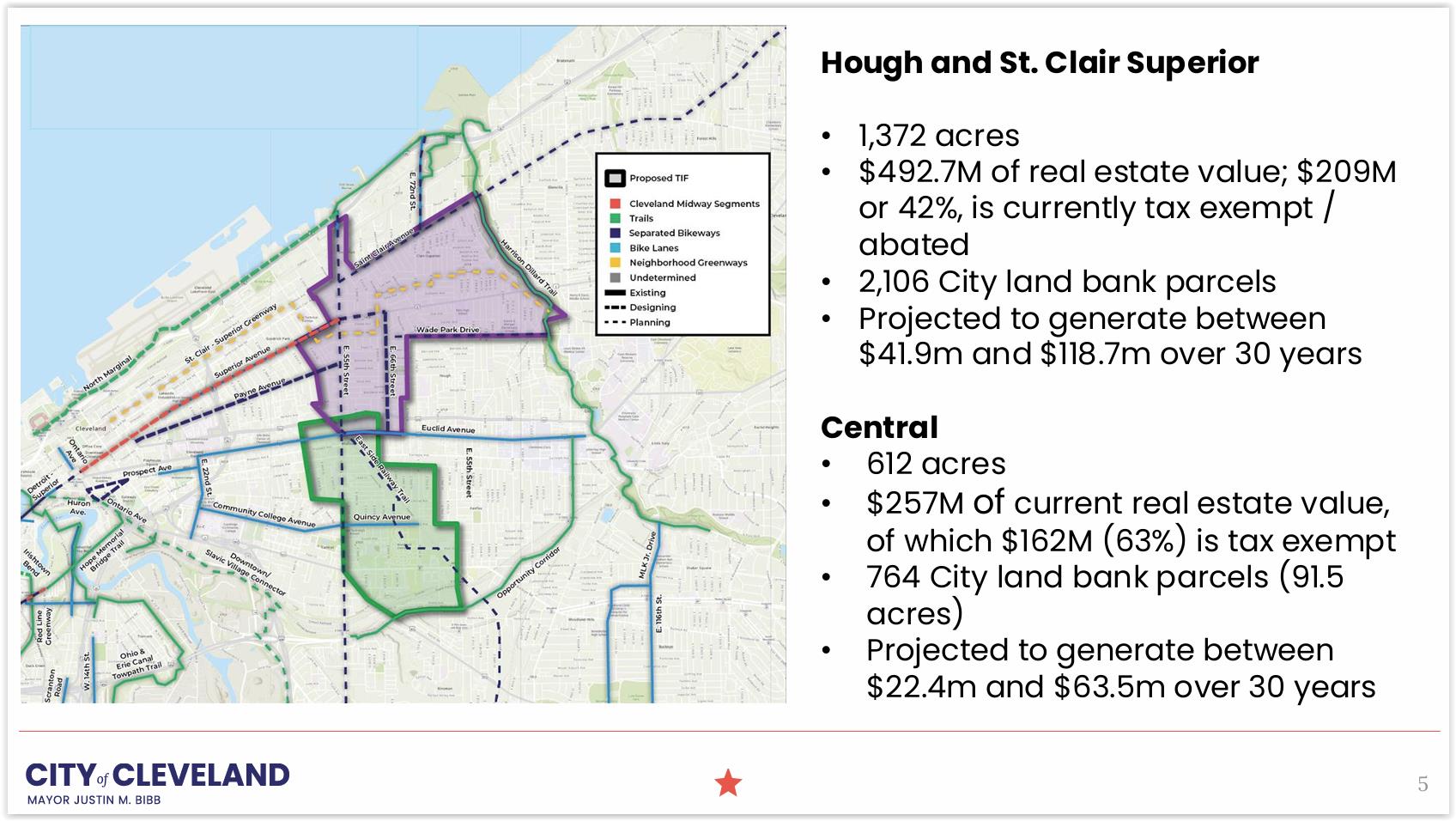
Two tax-increment financing districts are shown in this presentation to cover the near east side of Cleveland with them overlapping in the Midtown area of Euclid Avenue and East 55th Street which is envisioned to be restored as a dense node of housing and commercial activity (City of Cleveland).
Although Cleveland has many TIFs to support individual developments, the Shore-to-Core-to-Shore is Cleveland’s first TIF district. By comparison, Cincinnati has 35 TIF districts and Columbus has 31, said Tom McNair, the city’s chief of integrated development.
A TIF captures taxes from new values resulting from a public investment like a new road, streetscape, park, water and sewer lines and site preparation so it can go back to support that public investment, he told the City Planning Commission on Friday. And if it works here, more TIF districts can be implemented in more neighborhoods.
“We spent a great deal of time as an administration looking around the city and figuring out, if we are to use a tool like this for our neighborhoods, what is the right place to start?” McNair said. “What is the place that has the right conditions to be able to move this forward?”
The selected area of Hough, Central and St. Clair-Superior represents only 4 percent of the city’s land area. But it has a disproportionate share of land-bank lots and produces less than a 4 percent share of the city’s tax revenue. Yet it needs significant investment to support its repopulation.
“Those (land bank) properties have no tax value to them whatsoever,” McNair said in laying out the administration’s proposal. “This area is actually generating very little revenue for the City of Cleveland.”
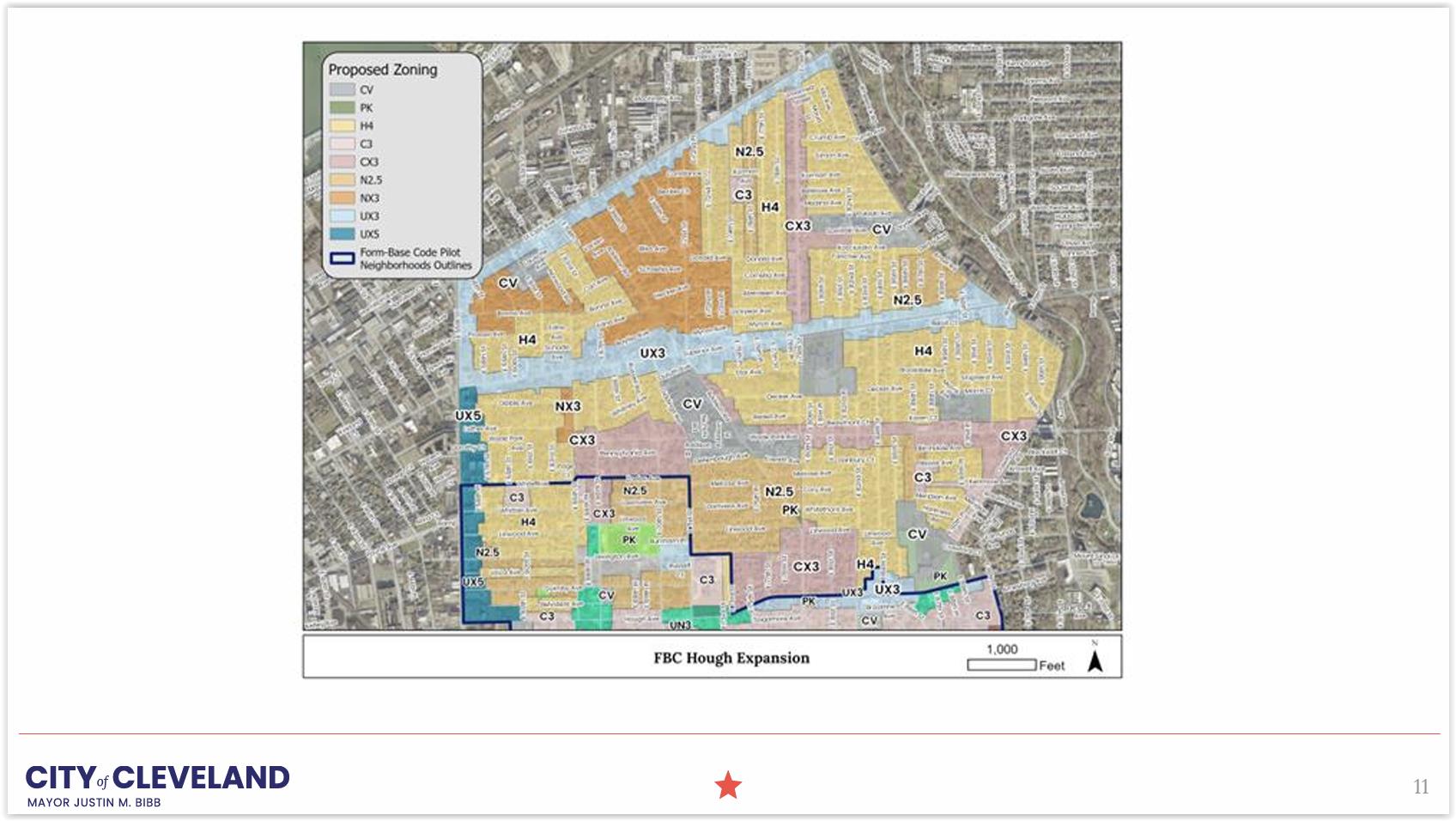
The proposed expansion of the Hough form-based code zoning pilot into the propsed tax-increment financing district (City of Cleveland).
“If we think about historical redlining, you look at the decades of disinvestment on the city’s East Side,” he asked, “How do we bring a tool that can actually reinvigorate the city’s east side? How can we start putting this land back to productive use?”
The East Side TIF is conservatively estimated to generate revenue of between $64 million and $182 million over 30 years. That wide range is dependent on the type of investment and growth that could result over a long period of time.
For example, if the public investments resulted in the construction of 15 new homes per year in the first five years, could it be increased to 30 homes per year over the next five years? If the growth increased at just 1 percent per year, it could generate the $64 million estimate over 30 years, McNair explained.
Commission members said they wanted clarity from the administration on whom would be the beneficiaries of these public investments — would they be the existing residents or new residents? Or could it be both?
“This isn’t just about building infrastructure that attracts residents who want to move in,” McNair said. “We’re talking about building infrastructure that improves the quality of life of the people that are here today. If you solve that problem, you start to make places attractive for others who want to join in.”
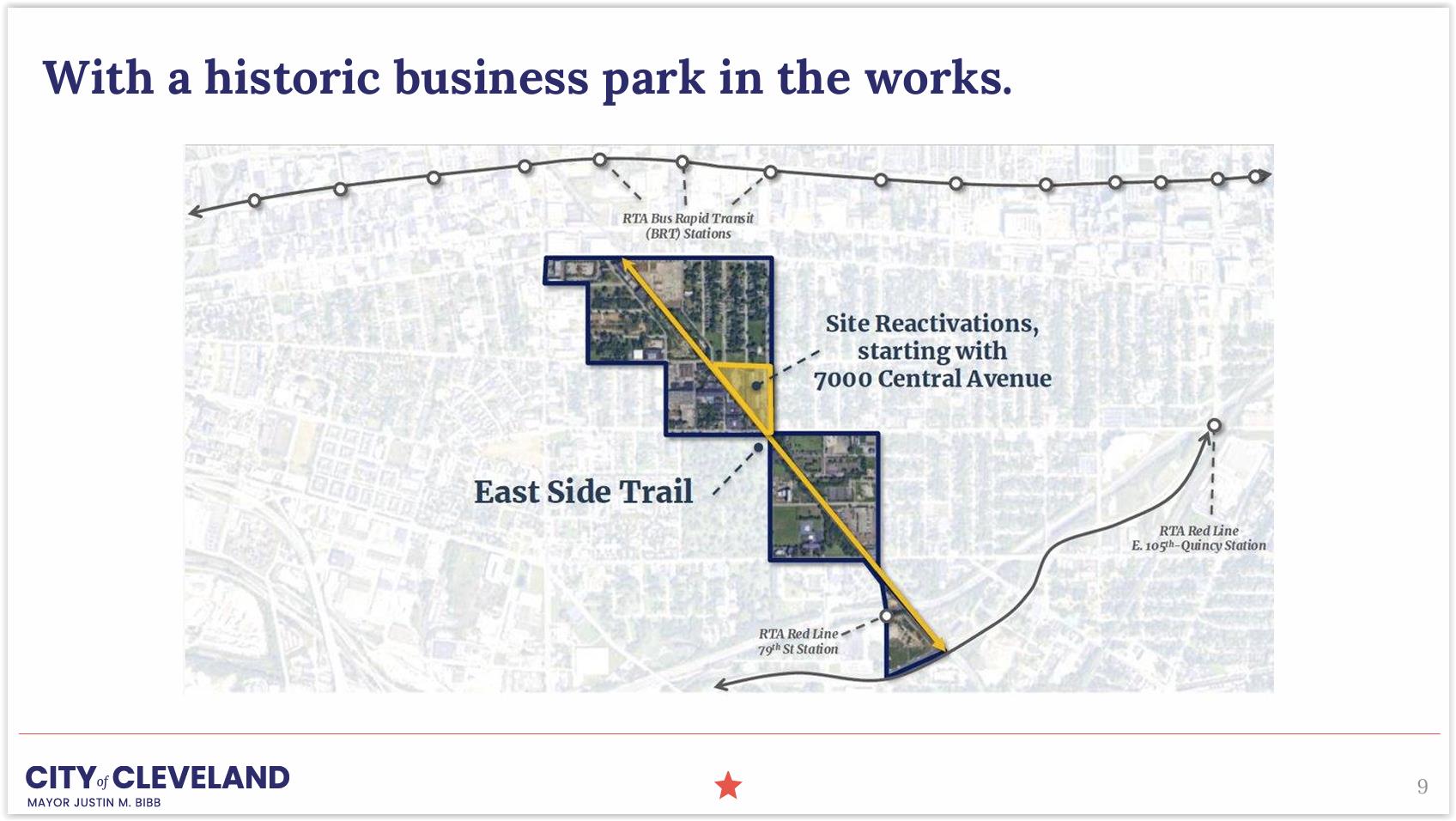
Along the elevated Norfolk Southern railroad line that cuts diagonally across the city’s near-East Side would be more than an all-purpose trail. Dozens of acres of shovel-ready land for new industries and other employers are sought to address a high rate of poverty in nearby neighborhoods (City of Cleveland).
While the administration has no specific projects that would result from the TIF, they are intended to spin-off from developments already emerging like those in Midtown or at Gordon Park or a new business campus along the elevated Norfolk Southern railroad. The campus’ first tenant is a new manufacturer at 7000 Central Ave.
“When I first started with the city three years ago, we had one site in the entirety of the city of Cleveland that was 10-plus acres and shovel-ready” for new industrial development, McNair said. But the city, the Cuyahoga Land Bank and the new Site Readiness for Good Jobs Fund have been busily assembling properties.
“They’ve been doing a substantial amount of work around that Norfolk Southern line, working on creating a new business campus which of course means the ability to bring in high-quality jobs for residents in this area,” he said. But increasing existing residents’ participation in their neighborhood’s growth means adding more and better jobs.
“We don’t actually have an affordable housing problem in Cleveland,” McNair said. “We have an income problem, which doesn’t matter if you can’t afford the house. The ability to bring back these lands here and attract high-quality job manufacturers (is important) and we are spending a lot of time on the business development, business attraction side of all of this.”
The city also will be attaching a rezoning to the TIF district. The new zoning will be an expansion of a form-based code that was piloted in the southern part of Hough that’s been growing due to its proximity to booming University Circle.
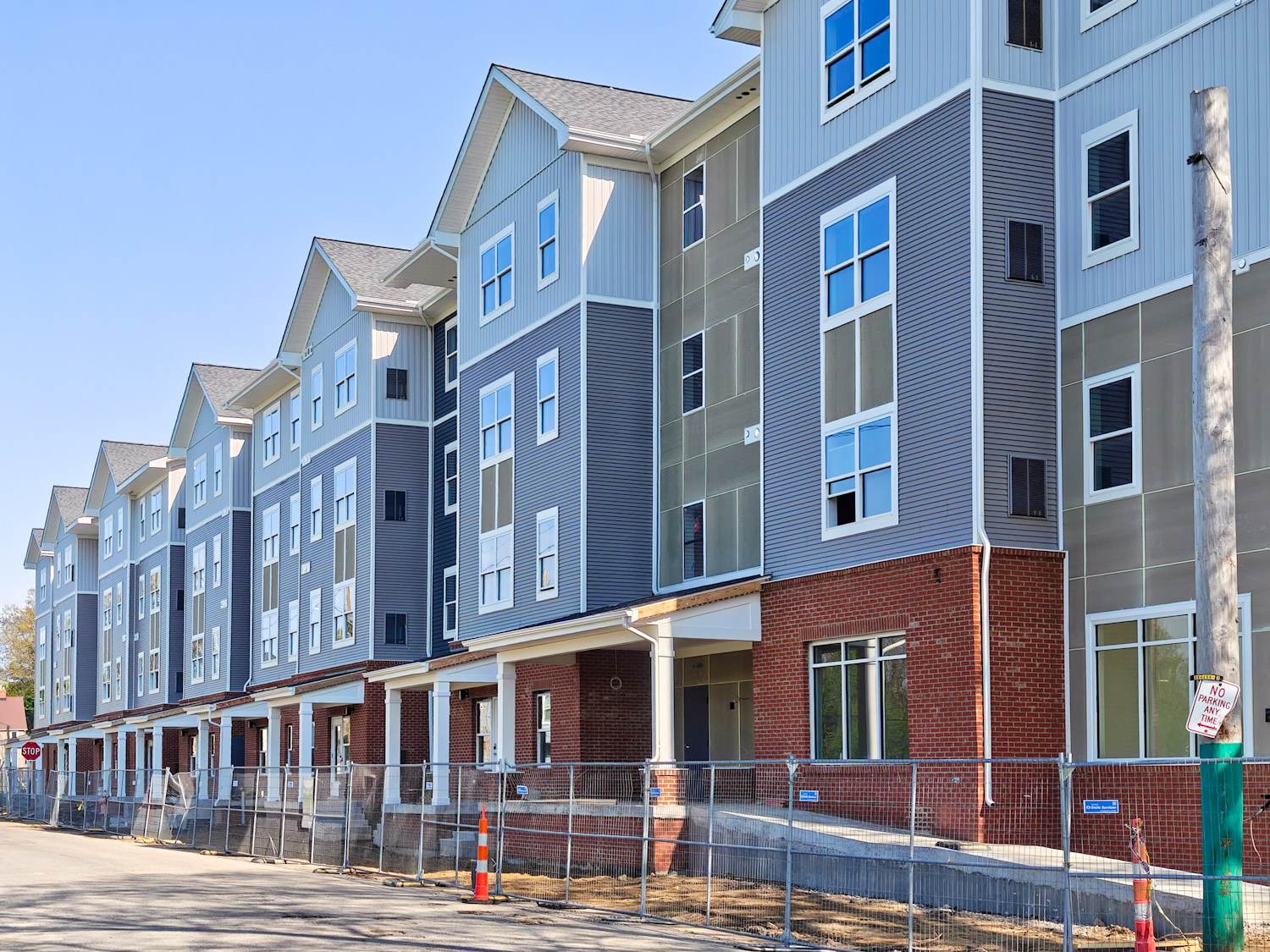
On Churchill Avenue in Glenville, Churchill Gateway’s second phase will be called The Davis II. More new housing, population and economic development for the East Side is the goal of a new tax-increment financing district and expanded form-based code zoning for it (Harrison Whittaker).
A goal of the form-based code is to allow things like a vacant storefront to more easily become a cafe or small business. Or, a new homeowner can add a granny-flat for family or rental income. Or, new housing can be built that fits the scale of the block. And mixed-use corridors can support shops, services and jobs within walking distance.
Neighborhood Planning Lead Adam Davenport said that if all of the housing on the near-East Side went away and someone tried to rebuild the neighborhoods in their original designs, 90 percent of it would be illegal under the city’s current zoning code.
“Current zoning limits housing supply with complex, restrictive regulations, causing prices to rise,” Davenport said. “It also restricts many home-based and small-scale businesses, creating barriers for blue-collar entrepreneurs.”
To engage existing residents, he said the city has held four public meetings, offered a public survey online, posted social media updates, posted 40-plus flyers around the neighborhoods at major bus stops, local business and community spaces.
“We are at the very beginning of the process, not the end,” McNair added. “But we do feel strongly that this is enabling us to create a mechanism that is going to be able to change the trajectory of the East Side of Cleveland and help out the residents that are there and help lead to more prosperity and a period of growth in the city.”
END