
A three-building data center campus is planned in Cleveland’s Slavic Village and could look like this unofficial rendering created by NEOtrans. The developer, Lakeland Equity Group, said it spend heavily to add electric grid infrastructure to accommodate the facility (NEOtrans/ChatGPT). CLICK IMAGES TO ENLARGE THEM.
‘Additional Info Required’ caused city denial
Today’s sudden rejection of a building application for a new $1.6 billion data center in Cleveland’s Slavic Village caught the project’s development team by surprise. But city sources and records revealed the application was rejected because it was incomplete.
On the condition of anonymity, a city source told NEOtrans the application for the 150-megawatt data center campus was rejected because no site plans were presented to the city’s Building Department. The site is a 35-acre trucking firm property at 3560 E. 55th St., off Interstate 77.
Also, the data center’s application in the department’s web portal was updated today with its last entry under Processing Status as “Additional info required.” NEOtrans broke the story of the proposed data center when the plans were submitted to the city on May 5.
The data center’s development team, led by Lakeland Equity Group of Westlake, said they weren’t willing to concede defeat yet and instead were considering how best to respond.
“Lakeland Equity Group is disappointed by this abrupt action by the city,” Lakeland Equity Group said in a written statement. “We are considering our options for immediate next steps.”
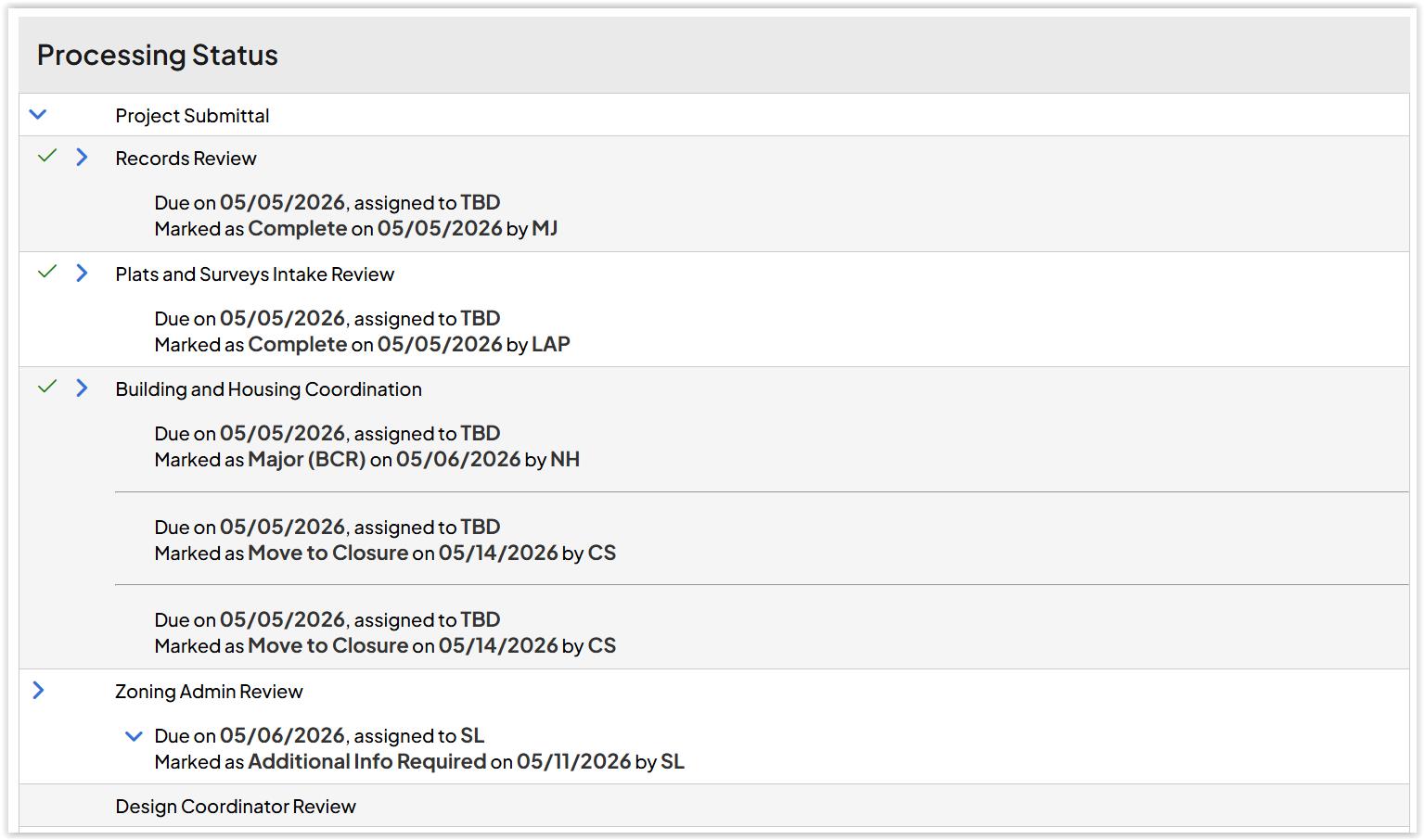
Processing status and actions on the proposed data center campus development application as shown on Cleveland’s Building Department Web portal (City of Cleveland).
In e-mails between NEOtrans and the data center’s development team in the past week, the team said on May 7 that they did not have any drawings to share yet but would soon.
“We are fine tuning some design elements on the current package and should have them available shortly,” a company official said. The Building Department Web portal also noted that, under the standard question “How will you be submitting Plans for your Project?” the application answered “No Plans Provided.”
Sometimes building department applications initially include rough sketches of site plans. As long as they show how the proposed concept would adhere to city zoning codes regarding height, density, setbacks, parking and other features, they can be accepted.
The Morabito site is currently zoned for semi-industry where structures as tall as 115 feet are permitted. The data center buildings are planned to be only two stories tall. The maximum gross floor area of buildings that can be built there is 762,300 square feet — or more than twice what Lakeland is proposing.
As to whether Lakeland would resubmit the application with plans or possibly consider other responses, including legal action, the company did not address such specifics in its written statement.
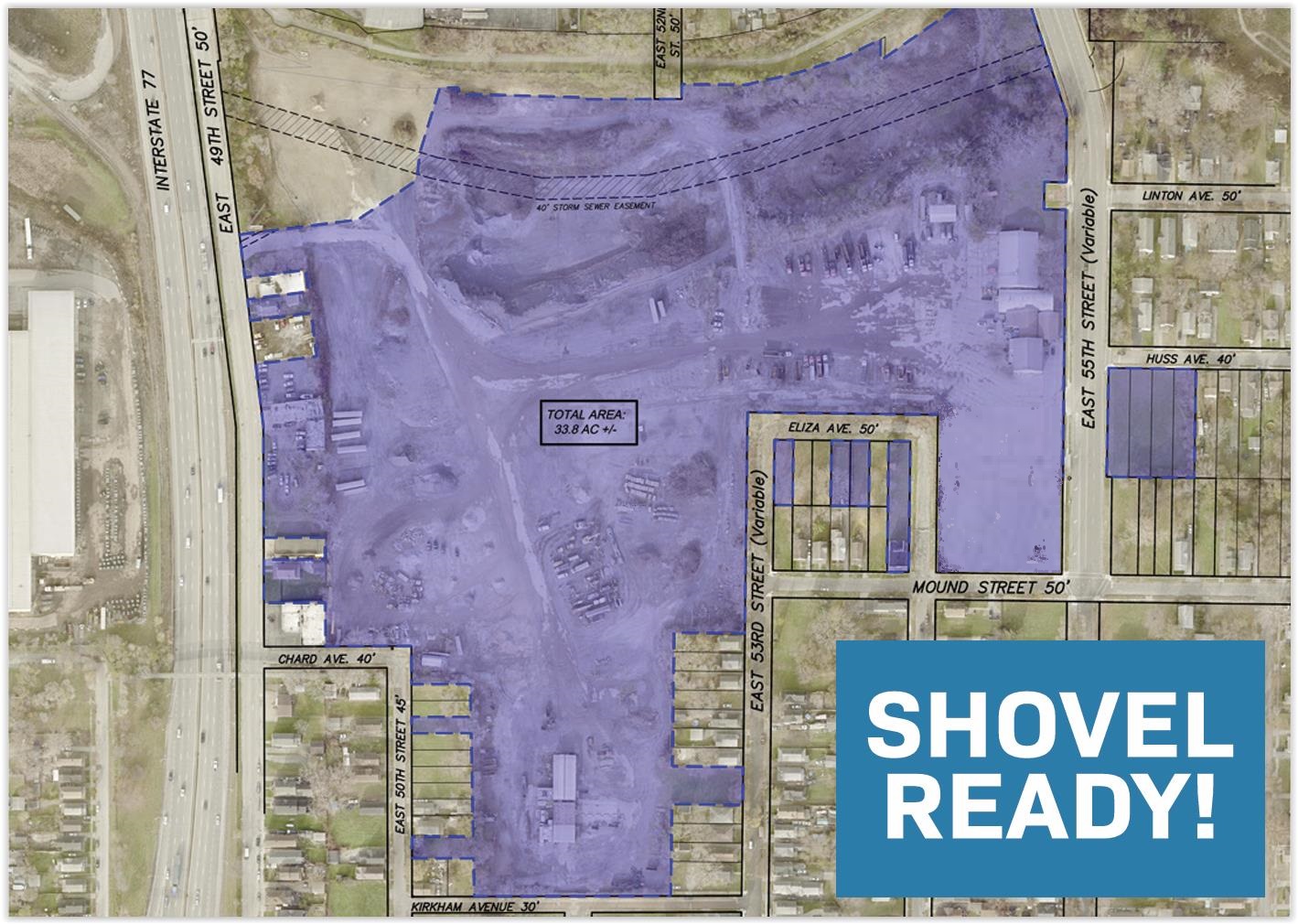
Shown in purple is the 35-acre Morabito Enterprises property in Slavic Village with Interstate 77 on the left and East 55th Street on the right (Morabito).
“We look forward to continuing to work with local government officials and community residents to help everyone consider this important, job-creating project’s merits,” the company said.
The data center campus is proposed to have three buildings set on 35 acres currently owned by Morabito Enterprises, a longtime trucking firm. Land owner Ben Morabito told NEOtrans last year he was trying to sell its property off-market.
The hyperscale data center is projected to use roughly the same amount of electricity as a small city, or 100,000 homes, raising fears of rising electric bills for area homeowners. But the developer said part of its $1.6 billion project budget would be to enhance the local electrical grid.
To cool the facility, the company also said it would use “closed-loop technology that recirculates water without the need for a constant feed, dropping water consumption by 80–90 percent compared to older systems.”
NEOtrans also reported in the past week that Lakeland is trying to get the data center plans approved before City Council can pass a moratorium on building more data centers in Cleveland, citing sources familiar with the project.
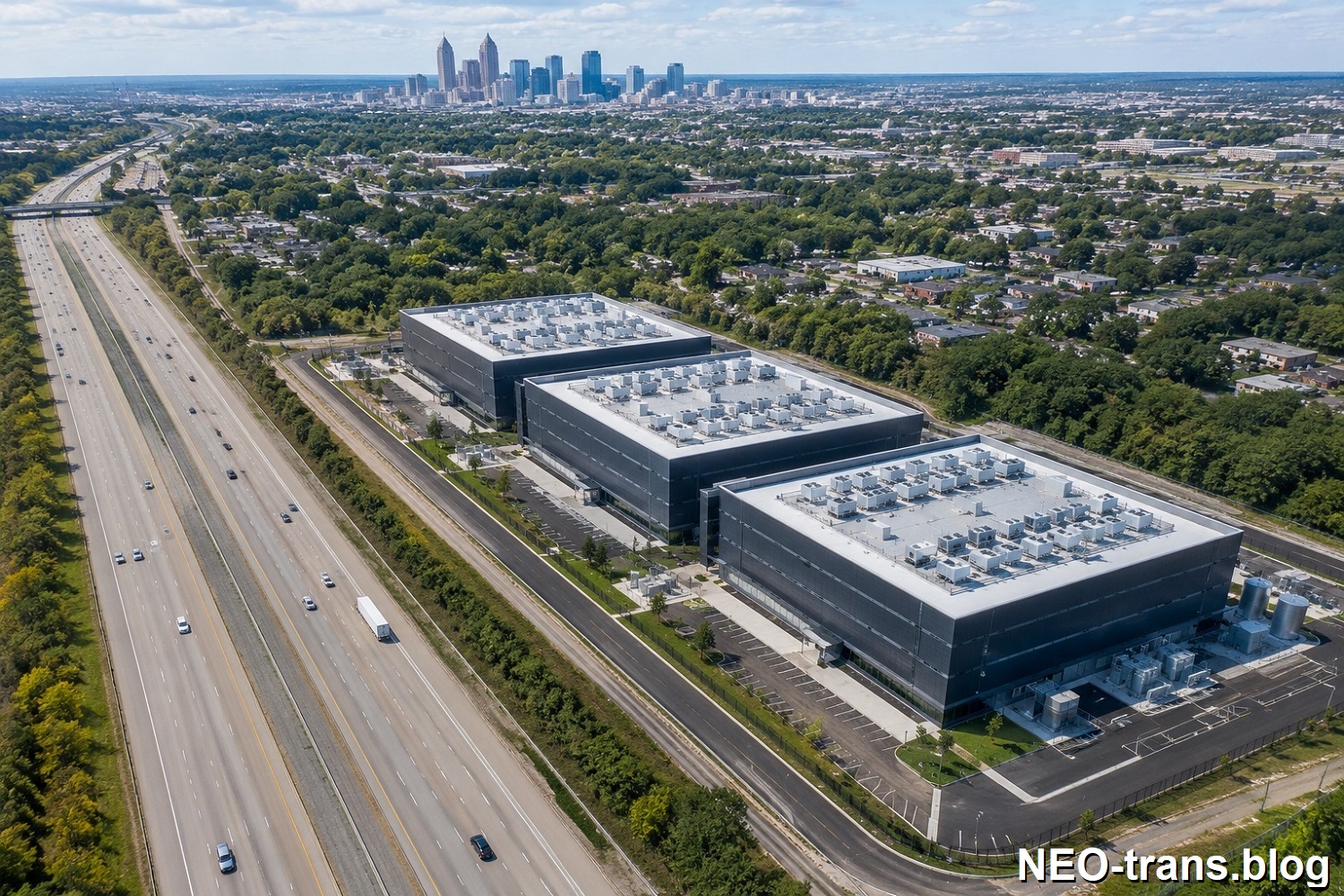
A conceptual rendering of a data center next to an interstate highway like I-77, south of a major downtown area like Cleveland’s (NEOtrans).
“We are doing the work right now to make sure we have strong policies and real safe guards in place to protect our environment and address rising utility costs,” said Mayor Justin Bibb on Instagram, in supporting council’s proposed moratorium.
Moratorium legislation was introduced to City Council April 27 and is undergoing an administrative review. If it goes through council’s customary three readings — one at each City Council meeting — the moratorium cannot be passed in time before goes on summer recess after its June 1 meeting.
Council holds regular meetings on Mondays, but no meeting will be held on May 25 which is Memorial Day. After June 1, council will hold special summer meetings on July 15 and August 19 before returning to its regular weekly sessions on Sept. 14, its calendar shows.
Council could waive the three readings and pass the moratorium ordinance on May 18 or June 1. The measure is an emergency ordinance meaning that, if council passes it with a two-thirds vote in support, it would take effect immediately upon Bibb’s signature, rather than waiting a standard 30 days.
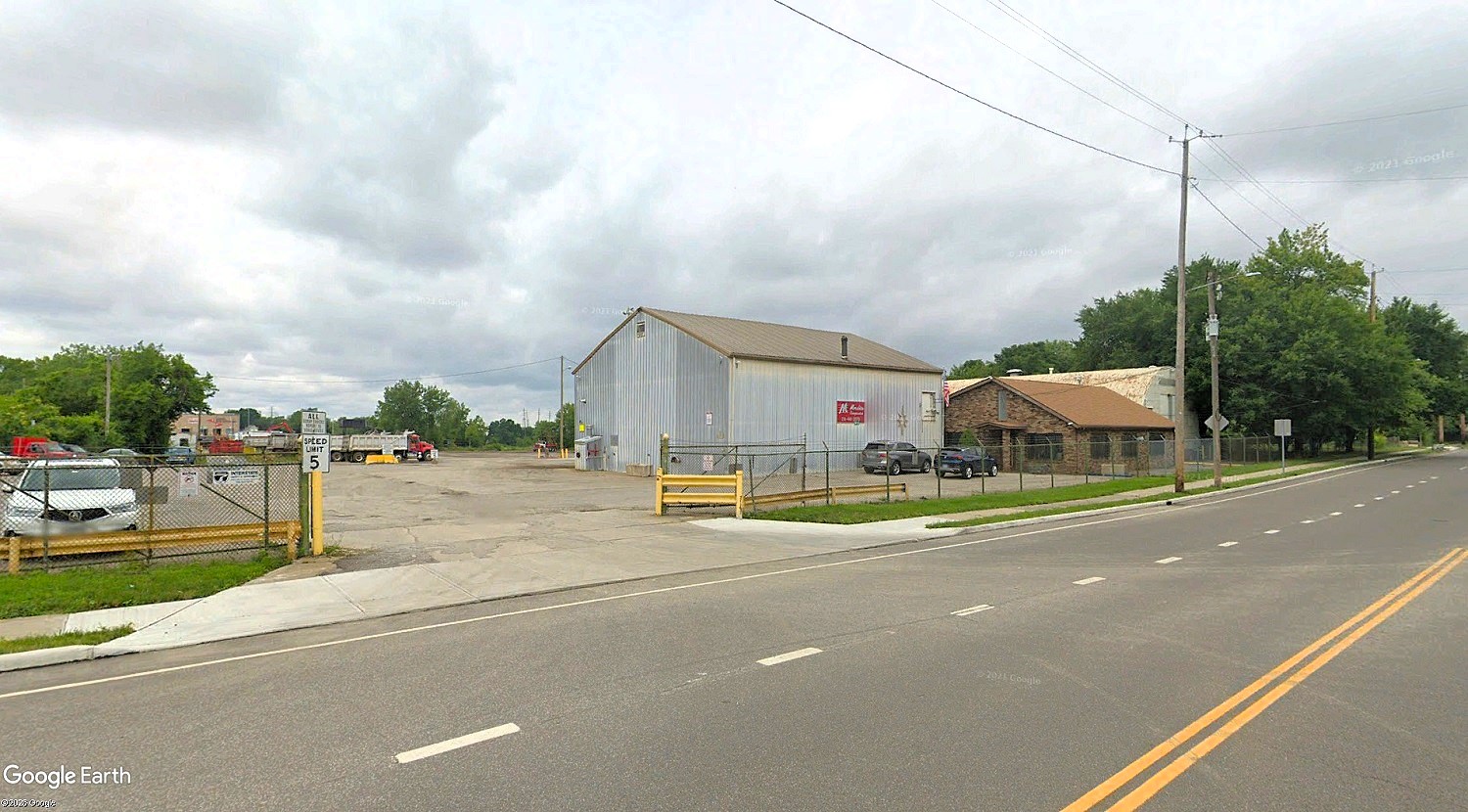
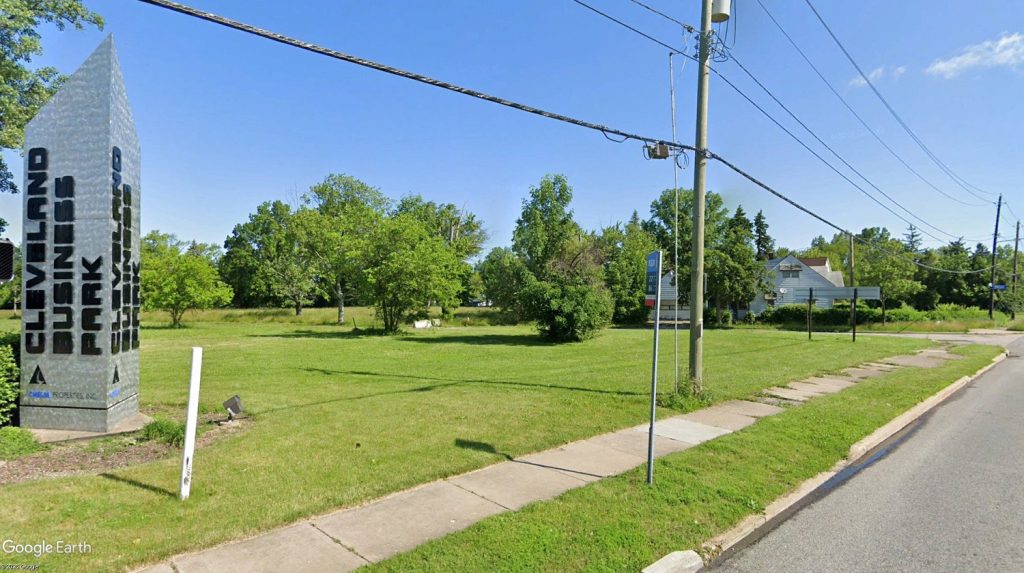
Off East 55th Street, this is the main entrance to the Morabito Enterprises property, home to a trucking operator for more than 50 years (Google).
Ward 15 Councilman Charles Slife, author of the data center moratorium, said he was concerned about the proposed Slavic Village data center merely based on the fact that they are trying to get it approved under the city’s current zoning laws before they might change.
“I remain skeptical,” Slife said. “If I were a resident of that immediate area (in Slavic Village), I would have a lot questions. It would seem that (for the developer) their expedited timeline to get the project approved wouldn’t give me assurances that my questions would be taken into account.”
Slife said he sought the moratorium because, as he dug into the city’s existing zoning codes, it doesn’t differentiate between a small data services company and a multi-million-square-foot facility. He said the city needs to pause the addition of new data centers while it takes a hard look at its zoning code.
“I think we’re not able to offer guidance to our community on how to manage data centers — how big they should be and where they are appropriate and where they are not,” Slife said. “Under the new form-based code, which we’re rezoning more of the city, a data center could be treated as an office use.”
END