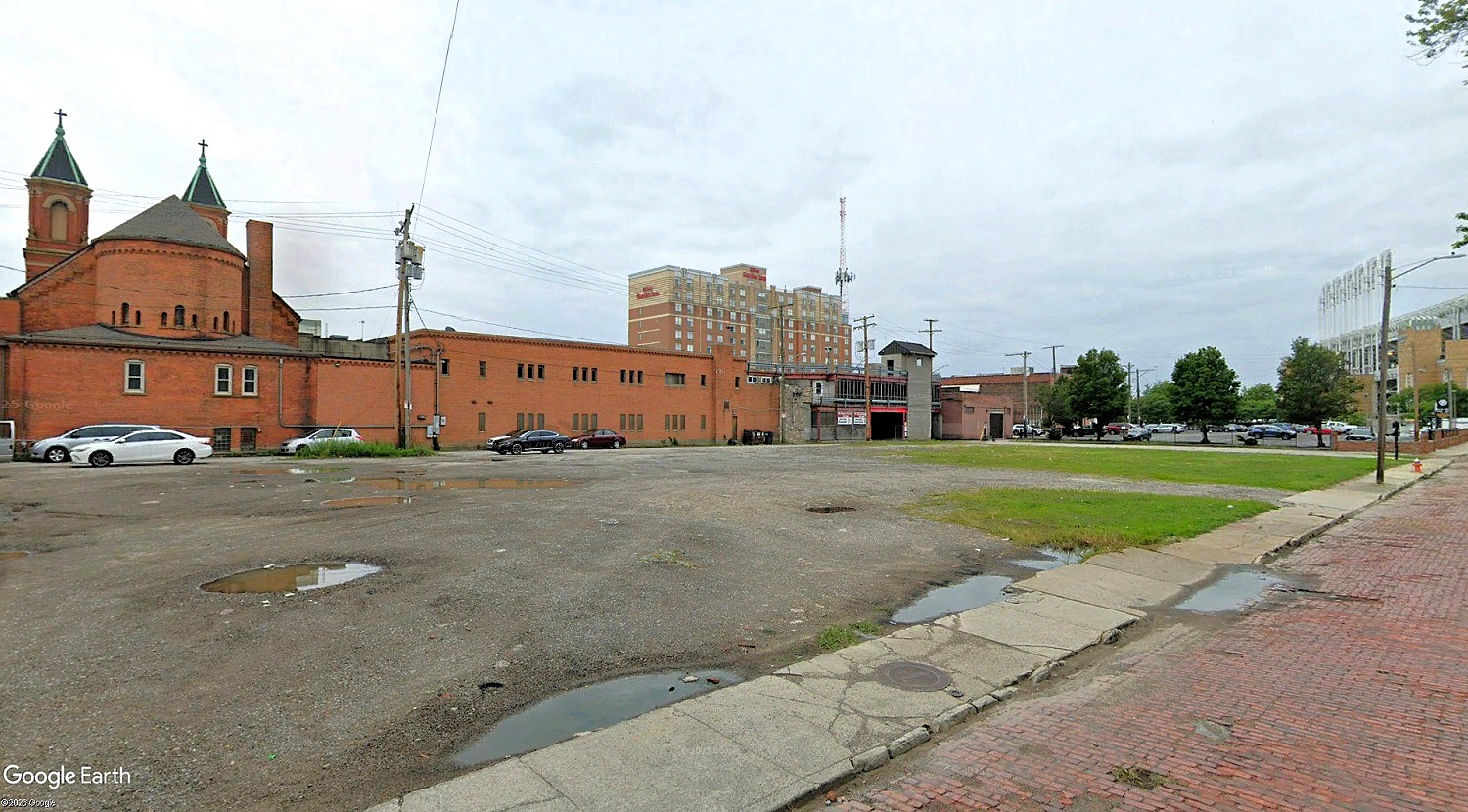
On the south side of Sumner Avenue, next to St. Maron Church at left, is a piece of the land the church’s diocese just acquired to provide parking for the church and to earn revenue from visitors to the Gateway sports and entertainment complex visible at right (Google). CLICK IMAGES TO ENLARGE THEM.
St. Maron wins Sumner parking lot use

An historic church in Downtown Cleveland’s Gateway District won its case before the city’s Board of Zoning Appeals (BZA) today to use a newly purchased property at 1212-1260 Sumner Ave. as a surface parking lot for up to 90 vehicles.
In an emotionally charged two-hour debate, after nearly a year of disagreements, BZA voted unanimously to grant St. Maron Church, 1245 Carnegie Ave., a variance to ignore the city’s zoning laws.
BZA did so in citing that the property was recently used as a parking lot even though it was used as such illegally, according to City Planning Department officials. It won variances to establish the surface parking lot for church and for-hire uses but must meet design requirements for landscaping, drainage and lighting, pending submittal of a site plan.
Since 1997, three years after construction of the Gateway sports and entertainment complex — today’s Progressive Field and Rocket Arena — and six years after the Wolstein Center arena was built, the city prohibited the addition of surface parking lots downtown except in limited circumstances. The Sumner site is located between those venues.
The goal of limiting surface parking lots downtown is to preserve the urban architectural character of downtown, reduce auto emissions and traffic congestion and not discourage new development in a dense setting that makes options to driving more attractive and less parking necessary, said City Planning officials.
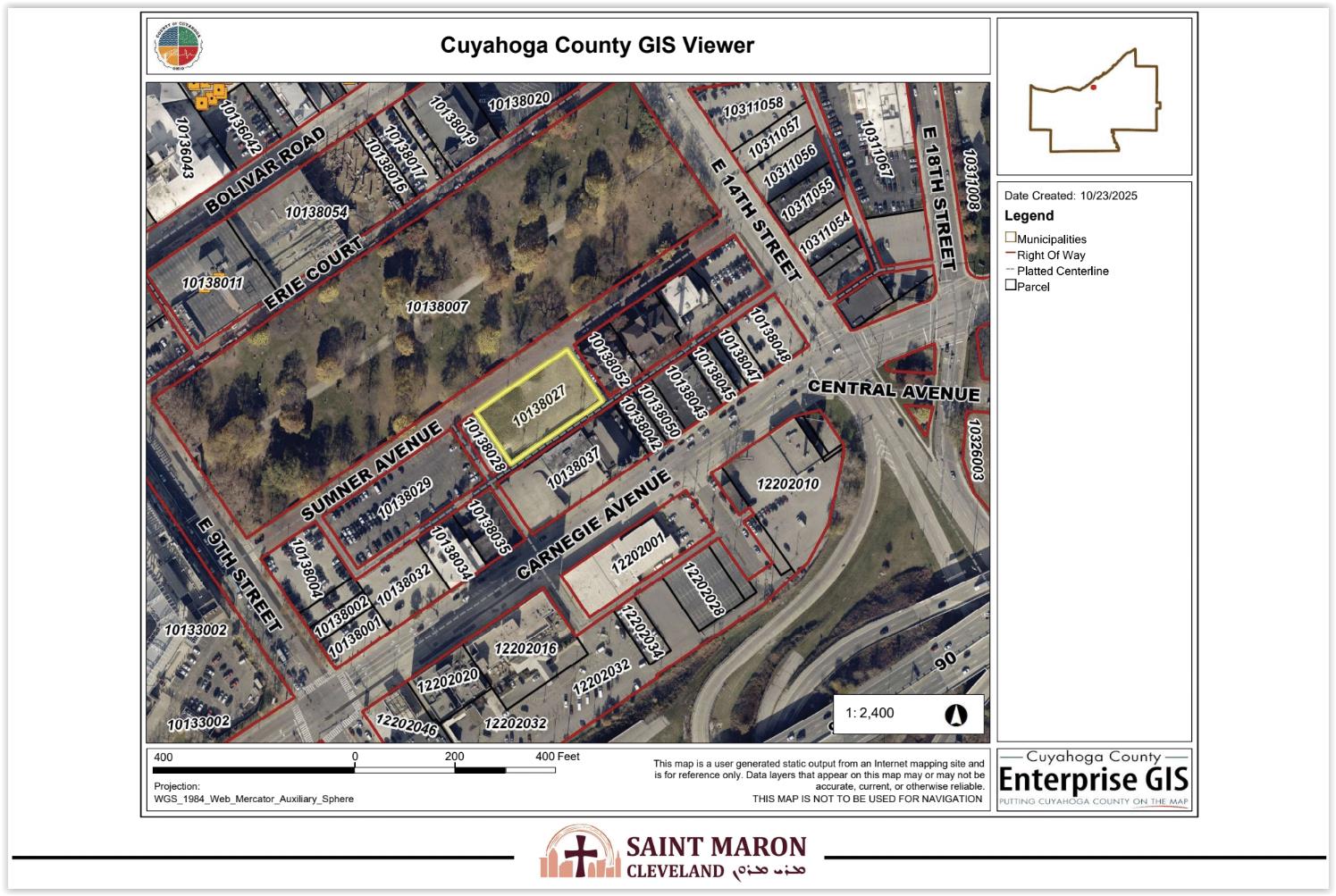
Outlined in yellow is the 0.63-acre parcel on Sumner Avenue that was bought last year by The Eparchy of Our Lady of Lebanon Los Angeles, located between St. Maron Church and the Erie Street Cemetery but also a short walk to the Gateway complex seen at lower left (St. Maron Cleveland).
But members of the St. Maron parish, including their consultant David Bowen, a former City Planning Commission chair, said there has been no successful development of the Sumner site in more than 20 years, let alone more visible parcels at Carnegie and East 9th Street.
“So it’s very difficult until the properties on 9th Street which are on Main and Main are developed first,” Bowen said. “Right now it makes no financial sense.”
“Part of the code talks about what is possible economically,” City Planning Director Calley Mersmann concurred. “But the church and its representatives have not provided evidence to meet the legal thresholds that we have gone over here today. We’re very interested in working with the church as much as possible to redevelop in line with the (city’s building) code.”
In 2024, St. Maron’s diocese, The Eparchy of Our Lady of Lebanon Los Angeles, paid $1.9 million for the vacant 0.63-acre parcel. The land is in a semi-industry district. St. Maron Church has 3,000 parishioners and a sanctuary that holds 500 worshippers.
Father Patrick Kassab, pastor of St. Maron, said the church needs 300 parking spaces but acknowledged in response to a question from the city’s Chief Assistant Director of Law David Roberts that the church’s diocese bought the property so it could generate revenue for the parish like a business would.
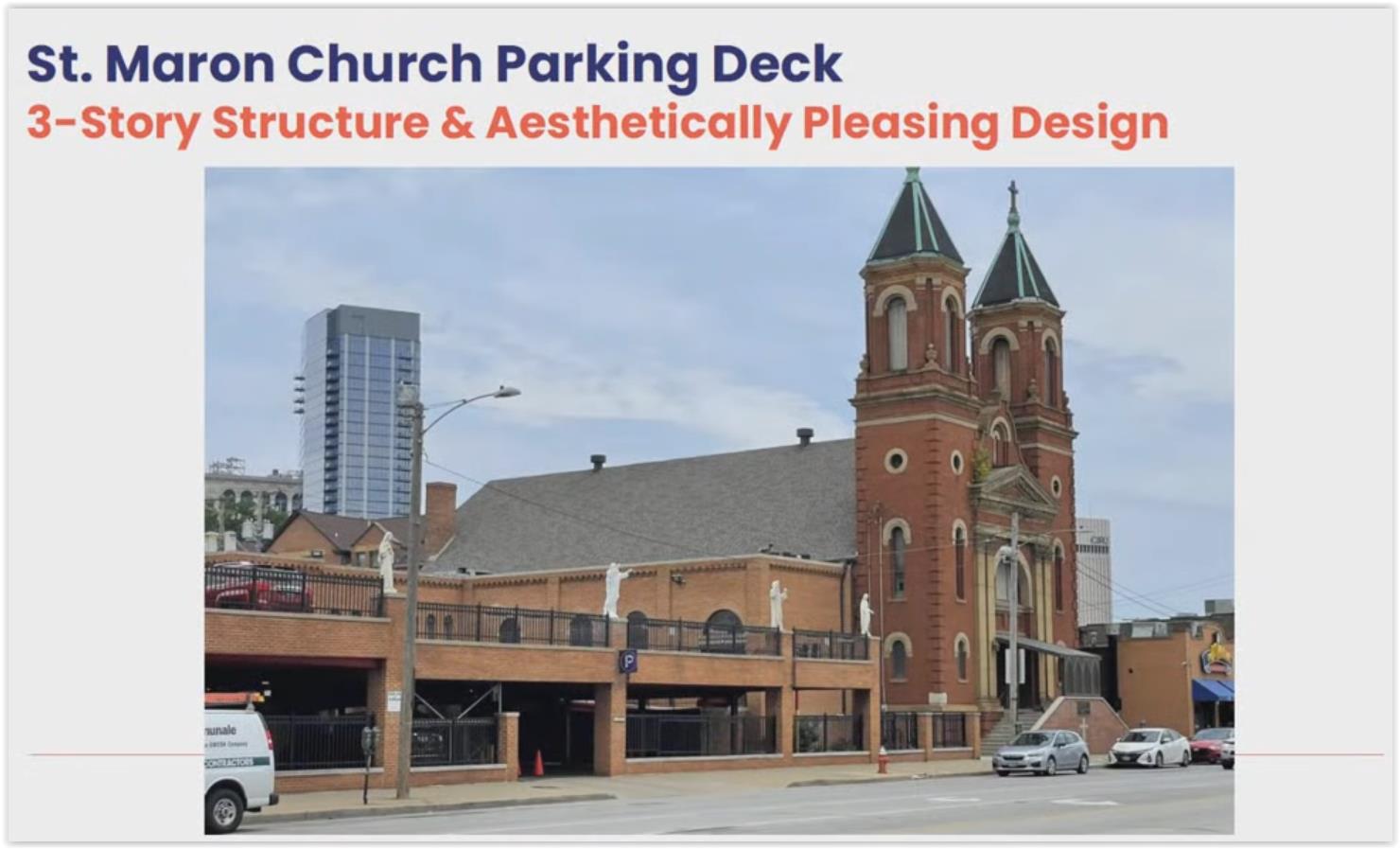
St. Maron Church was built in 1904 as St. Anthony. In 1997-2001, the church built and expanded the parking garage at left into a 120-space facility topped with ornate statues (CPC).
“We know that God is on our side,” Kassab said. “We know that we are on the side of Cleveland. Now we will know if Cleveland is on our side because it’s been a headache since last June.”
St. Maron’s assembly building on Carnegie was razed in 1996 for a church parking deck that it built a year later and was expanded twice, once in 1998 and again in 2001 along with a new church addition in 1999. That deck offers 120 spaces for church use and for the public, including Gateway events.
But even after the 90-space lot is built, city officials said the church will need roughly another 90 spaces to meet its parking goal of 300 spaces or restore housing nearby so as much parking isn’t needed. Many of St. Maron’s parishioners who attended today’s BZA hearing listed suburban home addresses.
“One of the things that is challenging is that is something that I do support — an opportunity for more surface lots for a church,” said Ward 5 Councilman Richard Starr.
The church was built as St. Anthony in 1904 when the neighborhood was known as Big Italy. It was sold in 1939 to a Lebanese Catholic congregation and has since been known as St. Maron Maronite Catholic Church.
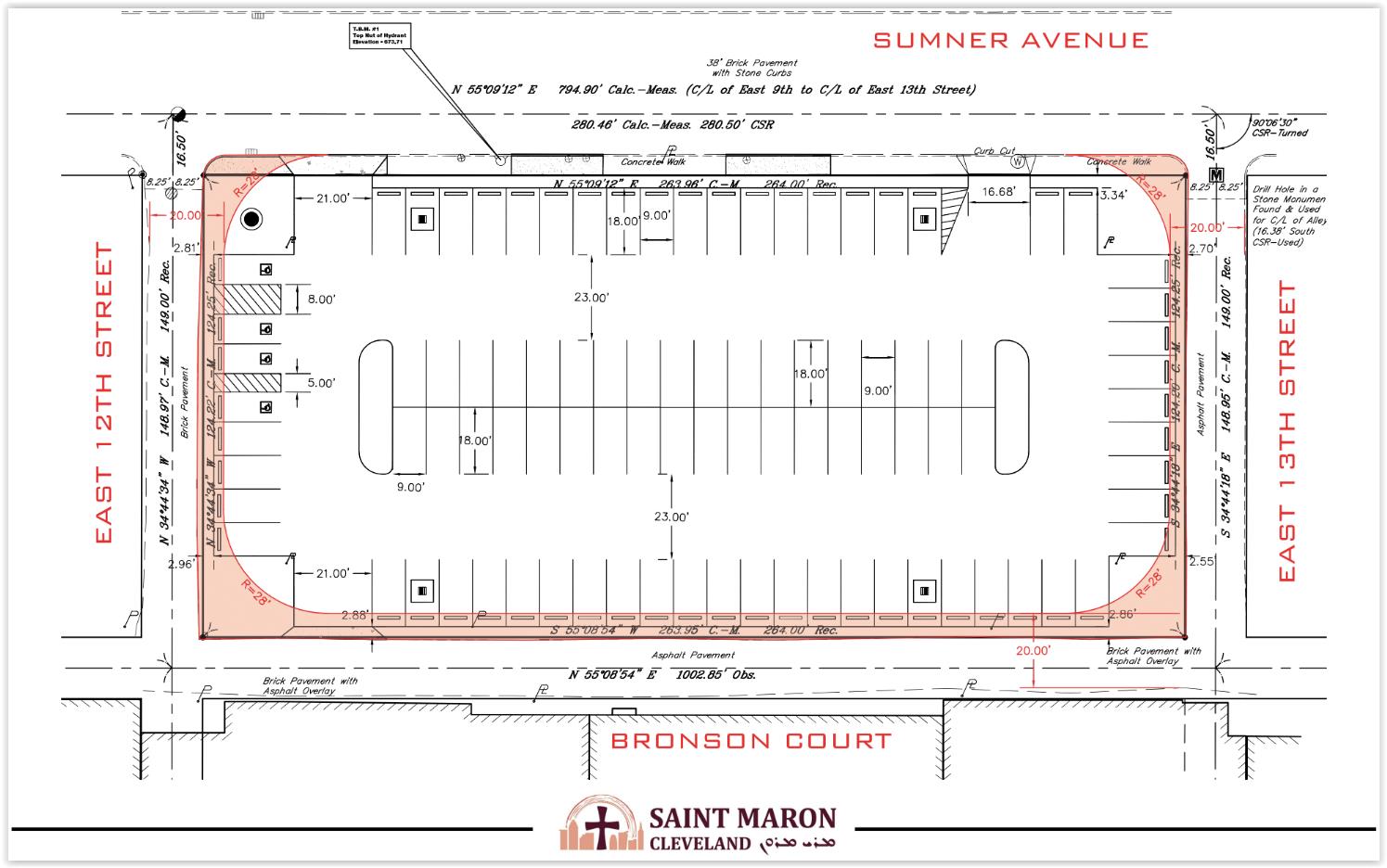
The church’s plans for a 90-space parking lot on the vacant land it just acquired (St. Maron Cleveland).
Bowen said when the suburbs were farmland, most people walked or took transit to this church — something the city is trying to re-establish by restoring the urban fabric of downtown which has lost hundreds of buildings to parking lots since the 1950s. A compromise would be to construct parking garages.
Downtown Cleveland City Planner Dan Shingle said a 180-space parking garage could cost about $13.7 million. Demand for parking in the Gateway District is growing with the Cosm entertainment venue being built on parking lots and Cleveland gaining WNBA and soccer team franchises, justifying the construction of more garages.
In Gateway, where parking for events gets $50 to $60 per vehicle, a parking garage would be able to generate $2.5 million to $5 million per year in revenue — enough to finance the construction and operation of a garage, Shingle said.
“Unfortunately we just don’t have the money to do what the city is asking for,” said St. Maron parishioner Diad Feghali. “Maybe down the road five years from now, 10 years from now, we’ll have some money. We could put something together.”
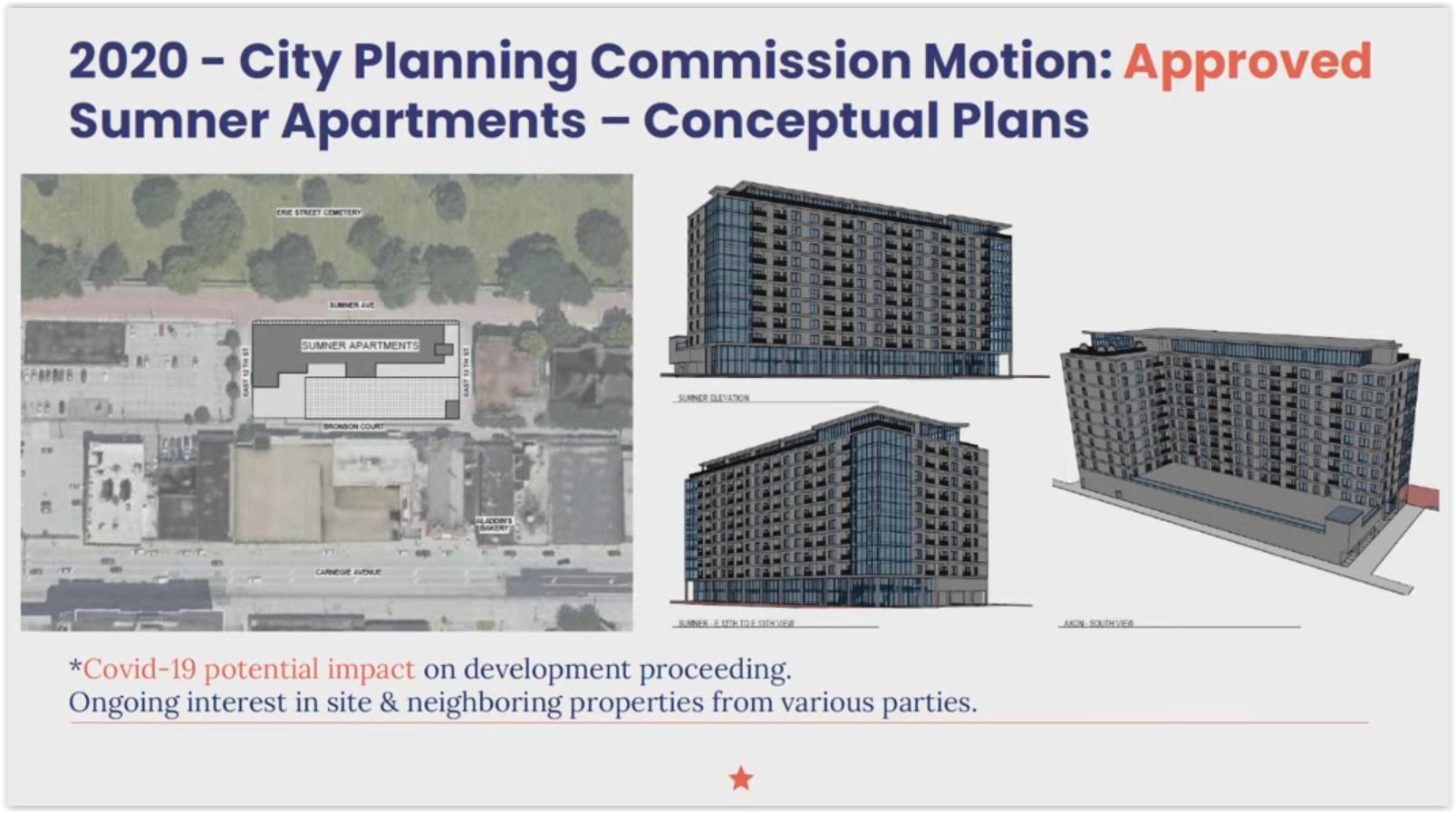
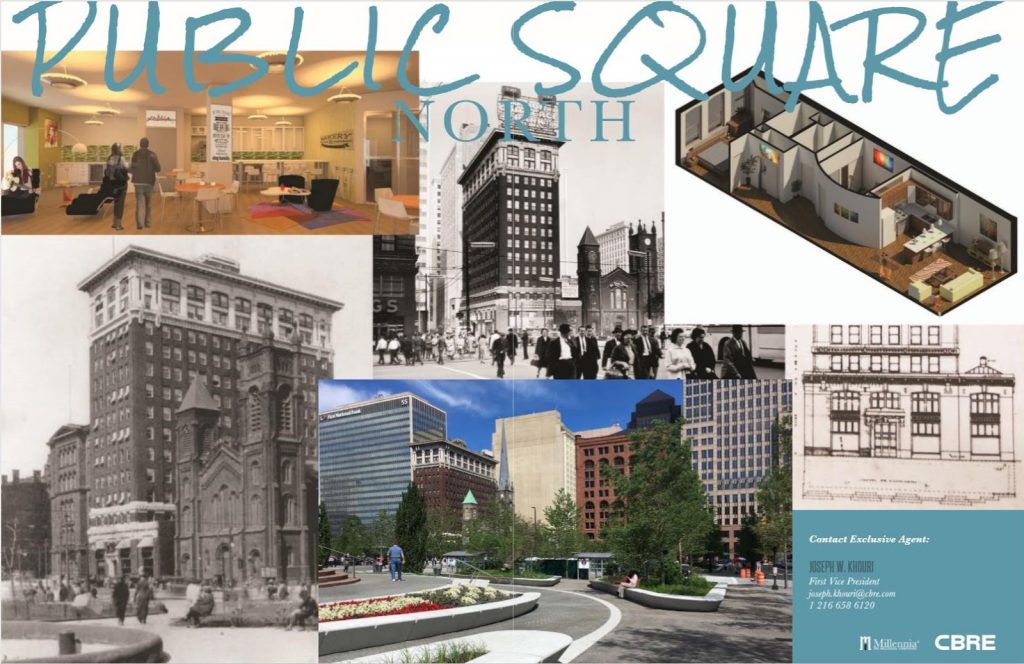
In 2020, Salus Development of Cleveland planned a 12-story apartment atop a two-level parking deck on the property acquired four years later by the church. But the proposed development succumbed to the pandemic (CPC).
But he emphasized that St. Maron is a non-profit organization that is barely breaking even.
“So it’s not just the law,” Feghali added. “It’s the humanity and a thing called common sense. I mean, if you lose your humanity you lose basically your existence. I’m really disappointed about this. I just wish the city would look at it a different way.”
Other downtown churches have their own garages or agreements with neighboring garages or on-street parking permits. But parishioners said the high demand for and cost of parking in the Gateway District makes shared parking impractical.
The Sumner property wasn’t vacant land or a parking lot prior to 1997 when the prohibition on new surface lots was passed so it cannot be grandfathered in. Under city law, downtown surface parking lots can approved by the city following the demolition of an existing building but a plan for a new building or other non-parking use must be approved first.
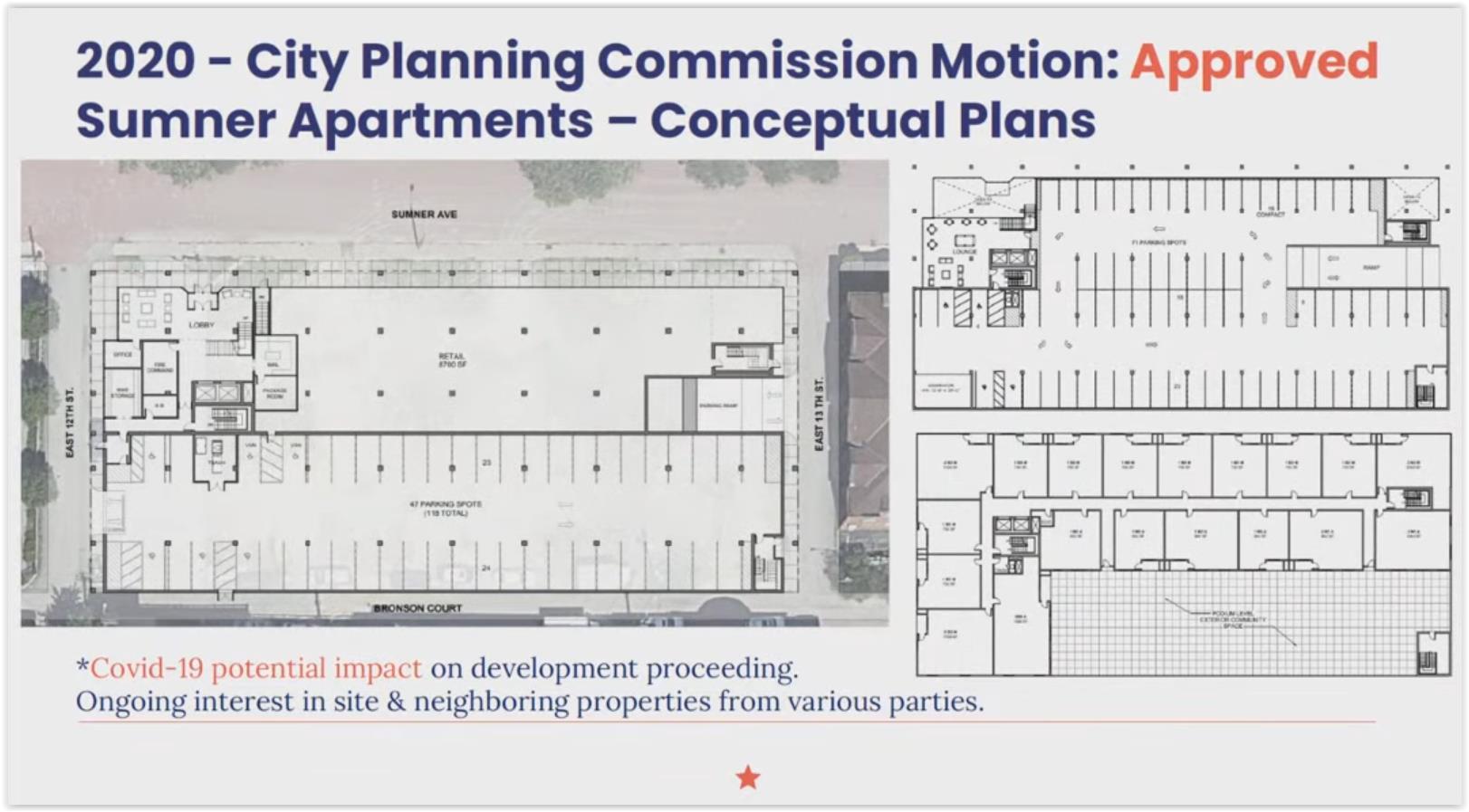
Another graphic showing conceptual floor plans of Salas Development’s plans for apartments on Sumner Avenue (CPCP).
A temporary lot is allowed for one year and can be renewed for one more year or converted to a non-parking use approved by the commission. A number of surface lots have been added downtown since 1997 and continued for years despite the city not enforcing the one-year permit and one-year renewal.
That was how the Sumner parking lot came to be. A Greyhound bus repair garage on the site was demolished in 2005 and an interim parking lot was built with the city’s approval because the property owner, Frangos Group, submitted a long-term plan for a new development.
But that development was never built, Shingle said, and the city didn’t enforce the parking lot prohibition for that property until 2017 when the city’s Division of Assessments and Licenses issued a cease and desist order to Frangos’ USA Parking Systems.
In 2020, planning commission approved an apartment project by Salus Development of Cleveland for the Sumner site but it failed to progress amid the pandemic. Another development project on the next block north, the 184-unit Ten60 Bolivar Apartments, did move forward and opened last year.
END