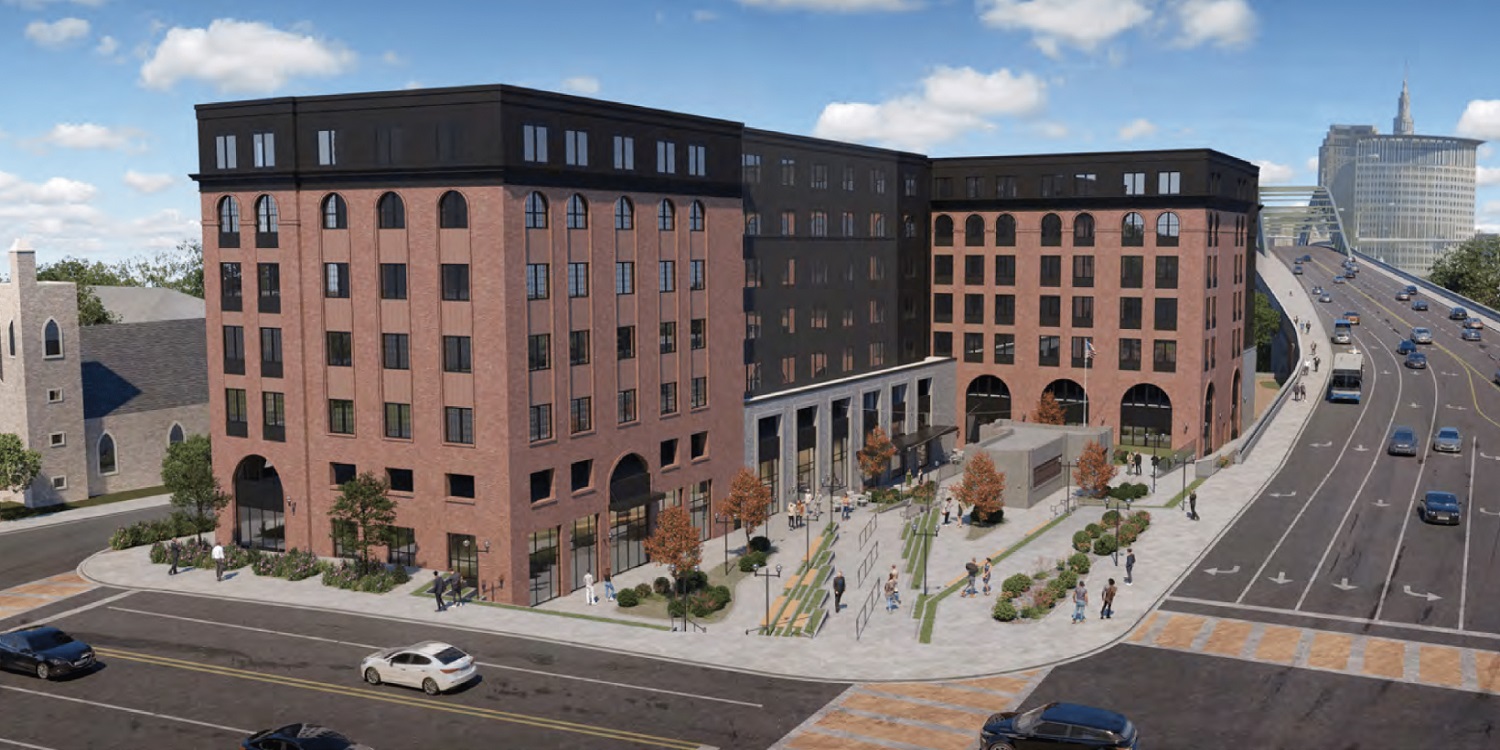
It’s a rendering that’s led almost every article about Bridgeworks, the elusive but promising mixed-use development proposed at the northeast corner of the Detroit-Superior Bridge and West 25th Street near downtown. But there is activity swirling about the project, perhaps more so now than in years (Geis). CLICK IMAGES TO ENLARGE THEM.
Development team notifies city of intent

It looks like it’s finally happening. After more than seven years of project development, multiple redesigns, financing shortfalls, and occasionally dim prospects, demolition, site preparation and construction of Bridgeworks is due to start in the middle of June.
But activity is already happening around the site, at 2429 W. Superior Ave. in Cleveland’s Ohio City neighborhood. Work crews for general contactor Geis Construction are already poking around the long-closed Cuyahoga County Engineer buildings, most of which will be demolished.
“The construction loan has closed and we will be mobilizing and starting construction in two weeks!” exclaimed a happy Brandon Klein, vice president of design at Geis Companies, based in suburban Streetsboro and Downtown Cleveland. “Very excited to get this one to the starting line!”
“The Bridgeworks project has been about resilience,” said Graham Veysey, a principal at Bridgeworks LLC. “Resilience is in the DNA of every single Clevelander including the whole project team who stayed with this to make a significant project happen at one of the most prominent intersections in Cleveland.”
Bridgeworks LLC is a Cleveland-based partnership of M. Panzica Development led by Michael Panzica and Grammar Properties led by Veysey and his wife Marika Shioiri-Clark. The partnership had previously built the 11-story Church+State nearby at 2818 Church Ave.
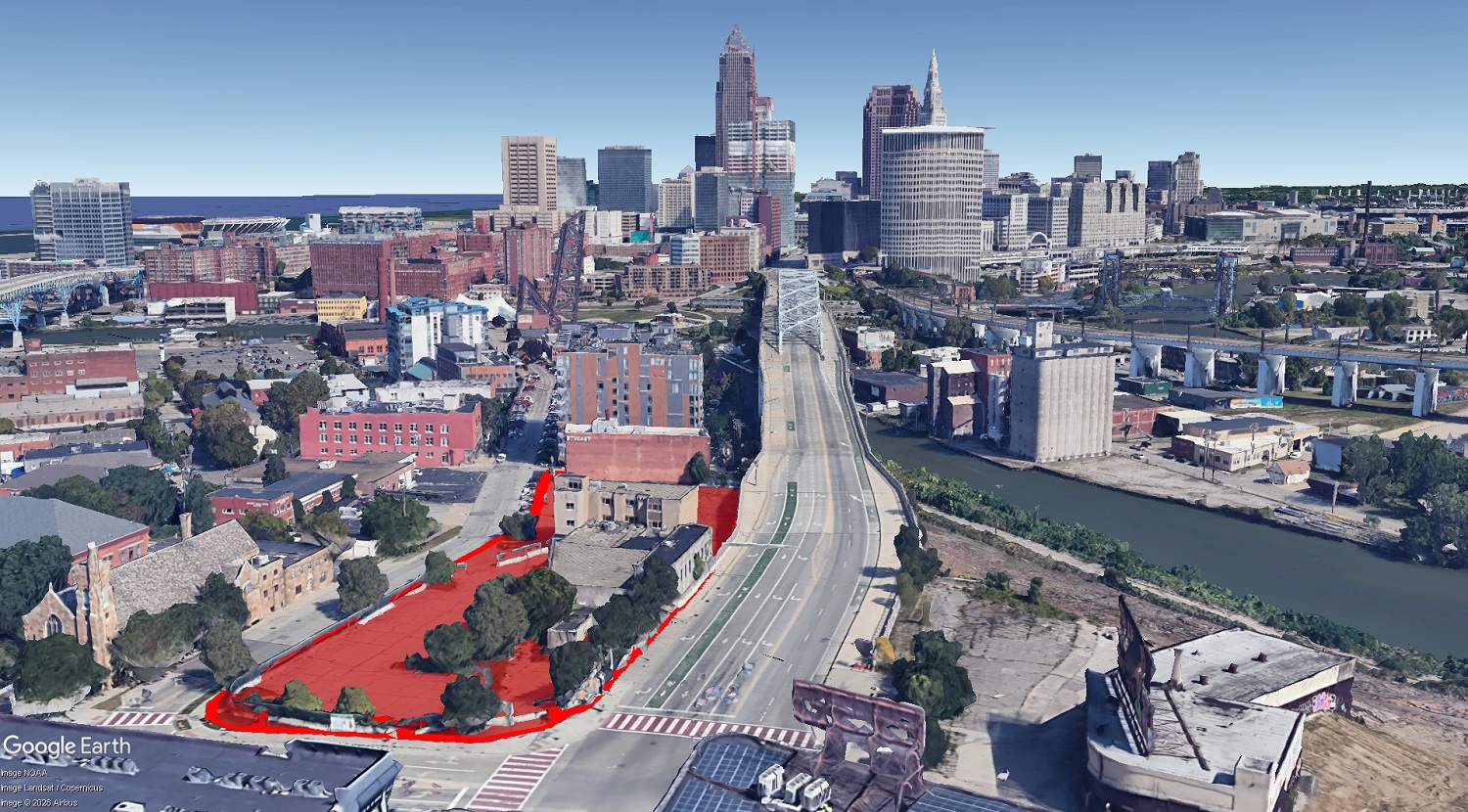
Shown with its land shaded in red, the nearly 2-acre Bridgeworks’ site at the west end of the Detroit-Superior Veterans Memorial Bridge is about to be cleared, prepared and built upon after years of trying to come up with a funded building plan (Google).
Jim Hrubik, an architect at Geis notified the city’s Building Department on May 21 via a letter of intent that “The subject project is preparing to move forward and is seeking a building permit.”
The letter also provided some particulars about Bridgeworks’ construction, such as its projected cost — $58.5 million. It also noted the duration of constructing the 294,636-square-foot building — estimated to be 24 months.
The large disparity between Bridgeworks’ construction cost and its $82.5 million development cost is one of the reasons why it has been so difficult to get this project over the finish line.
The development cost includes many things like demolition, relocating old street and sewer infrastructure, property and easement acquisitions that extend beyond the buildable site, architectural and legal fees, city zoning and permit fees and other soft, sunk costs, plus the construction costs.
The construction costs alone are the part of the project that will create 219 workforce apartments, a 199-space garage, and 1,200 square feet of ground-floor space that ultimately will produce revenue and service the debt to build and sustain Bridgeworks. As a workforce apartment building, its rents will not be luxury, but more mid-market.
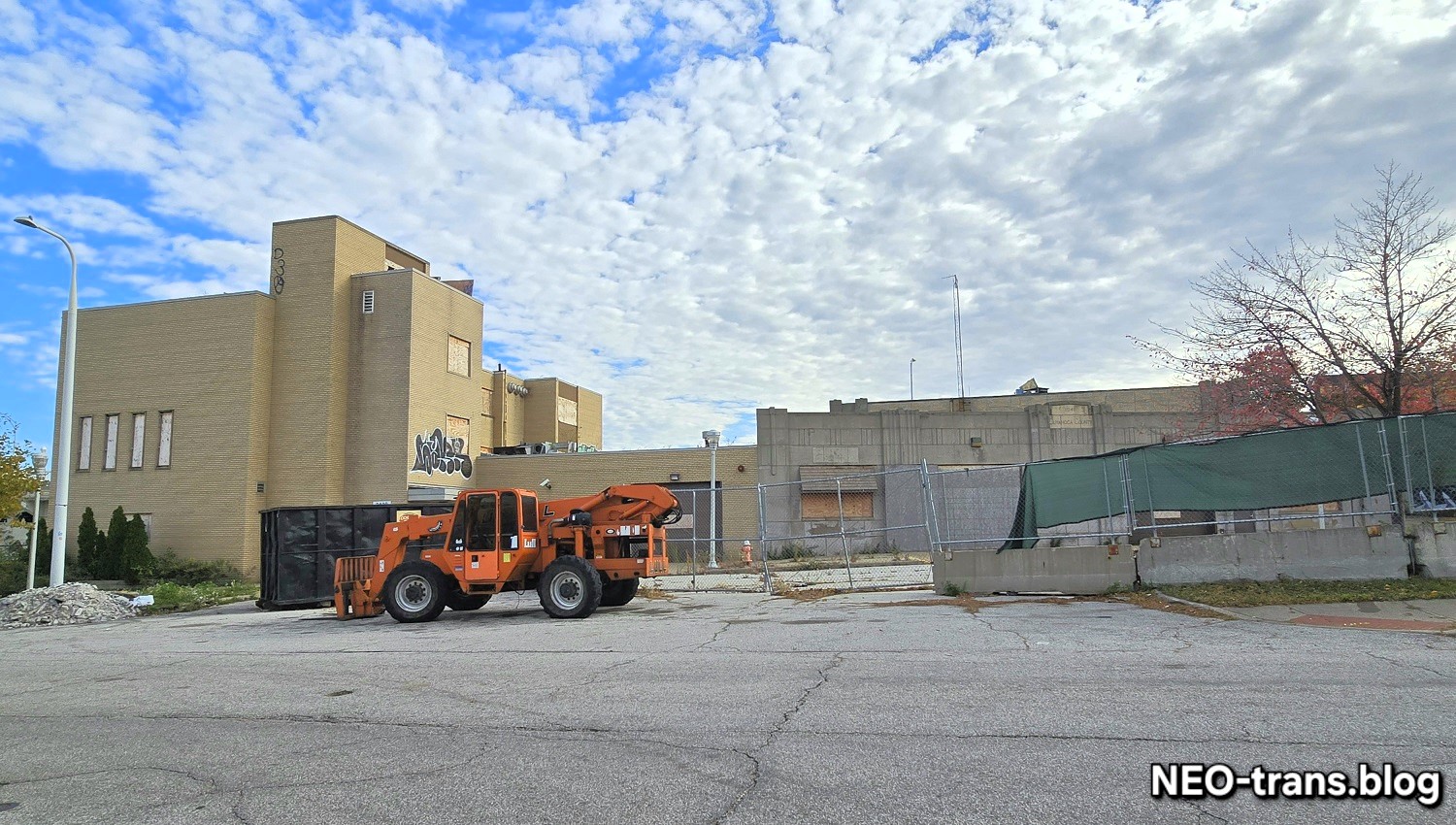
Heavy equipment has occasionally shown up on the site of Bridgeworks to remove asbestos and salvageable items from the former Cuyahoga County Engineer’s buildings to be demolished (NEOtrans).
Hrubik’s letter of intent was in response to a January letter from Glenn Murray, the city’s assistant building official, which requested the information that Hrubik provided last week in order to get the building permit issued.
Murray informed the development team at that time that the city approved the architectural blueprints for Bridgeworks. But Geis didn’t respond right away because financing had not closed.
Construction must start within a year of a building permit’s issuance or the permit will expire. Permit fees for a project of Bridgeworks’ price tag will cost hundreds of thousands of dollars. So a contractor will pick up a permit for a job only when it is fully funded.
NEOtrans has been following the Bridgeworks saga for more than seven years. In fact, the story goes back to our earliest days as an urban-core real estate breaking news blog. Bridgeworks acquired the property from the county five years ago for $4.15 million and, last week, replatted the property’s lines as two parcels.
Until recently, the latest news involving Bridgeworks was that demolition contractor Sitetech, Inc. of Lorain County was permitted by the city to take down the vacant Cuyahoga County Engineer’s offices, labs and garage. A ticket booth and entry point to the former streetcar subway station below Detroit-Superior will remain.
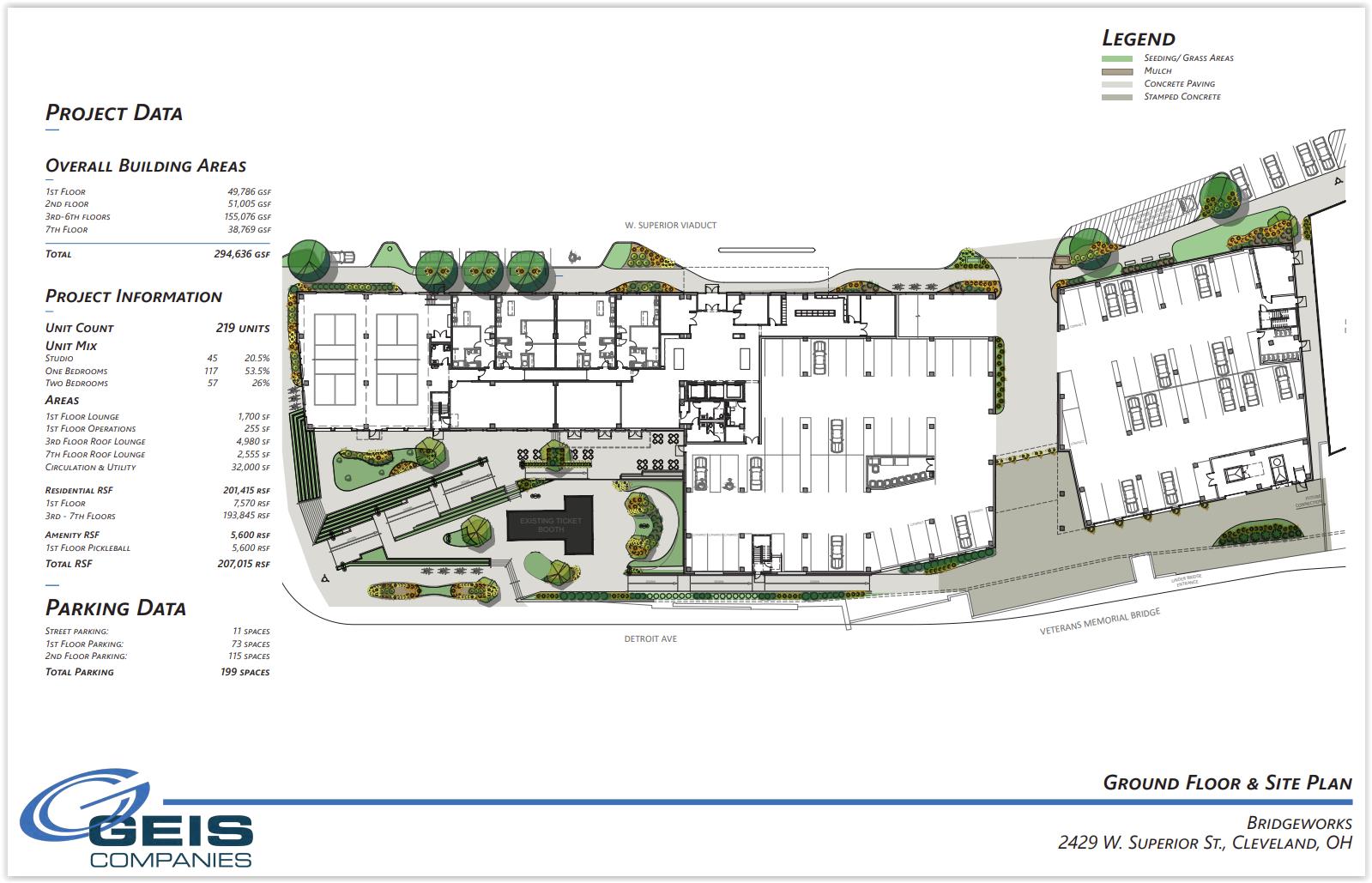
Site plan and ground-floor uses at Bridgeworks, with the Detroit-Superior Bridge at bottom, West 25th Street at left, and West Superior at top (Geis).
But the demolition permit was not yet picked up by the contractor because a Stormwater Pollution Prevention Plan wasn’t submitted. The July 15 approval has a shelf life of one year upon which it expires.
Demolition work involves razing a two-story structure plus a garage totaling 89,794 square feet. A bulkhead would be attached to sewers per Water Pollution Control regulations. And the contractor will control dust, remove all foundations, plus discontinue and cap all utility connections.
Crews will also haul away all debris, backfill with clean fill, comply with all state and federal asbestos rules and stormwater regulations, wrote Project Manager Brian Draves of Sitetech, Inc. in the demolition permit application. Demolition costs were estimated at $364,128.
Last June, $25 million in taxable lease revenue bonds were approved by the Port of Cleveland board for Bridgeworks. The financing was the final public financing piece to be approved.
END