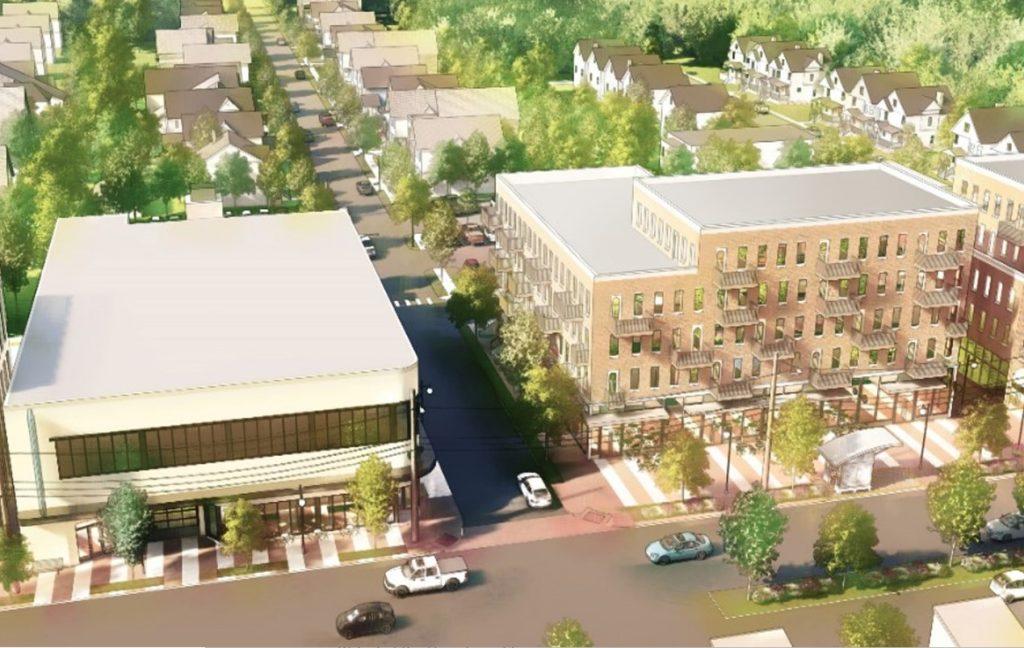
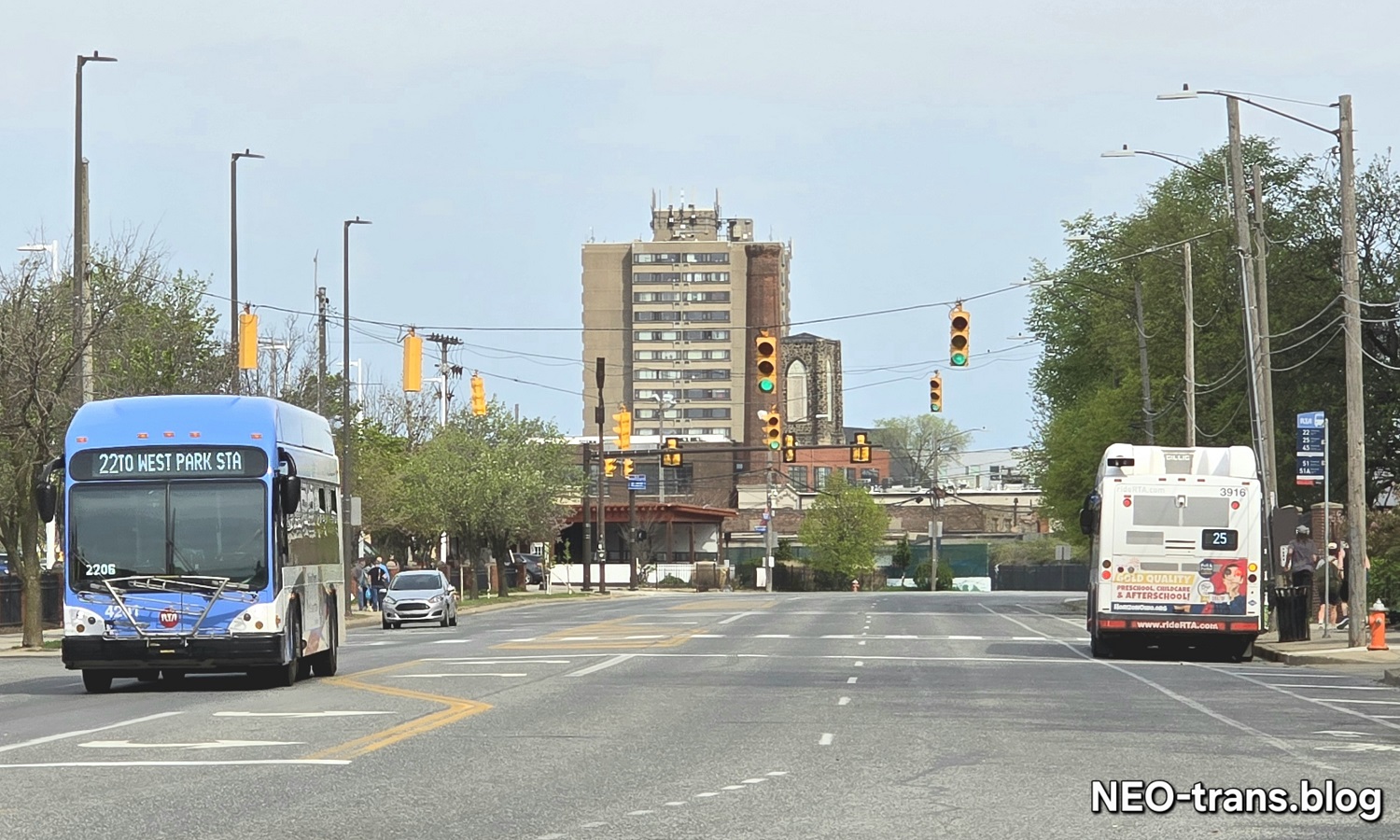
Some Cleveland streets, such as the northern portion of West 25th Street in Ohio City, see very frequent bus service because more than one route is combined here. But without a new source of revenue there will be fewer buses which means fewer connections and thus fewer destinations and jobs will be accessible by transit (NEOtrans). CLICK IMAGES TO ENLARGE THEM.
Bus, rail services would grow with tax hike

The Greater Cleveland Regional Transit Authority’s (GCRTA) Board of Trustees learned today the bus and rail agency is facing one of three potential futures. While there are solutions to all three, GCRTA staff said only two would offer some benefits in addressing costs that are spiraling out of control.
The one option that didn’t involve a large, new source of revenue such as a sales-tax hike would likely require reducing or eliminating bus services on two-thirds of routes in Cuyahoga County each year until January 2029. Additional service cuts would likely follow until new revenue sources are found.
The other two options assumed increasing a 1-percent countywide transit levy that hasn’t risen since voters approved it on July 22, 1975. Those options allowed increasing service a little or a lot, and delaying any thoughts of service cuts a little or a lot, GCRTA staff said in a detailed presentation.
Raising the countywide sales tax by 0.25 percent would allow minor transit service increases in the coming years until inflation might again force service cuts by 2039. Or a 0.5-percent sales tax hike would afford more frequent services and hold off any consideration of service cuts until at least 2064.
But few of the service expansions considered by GCRTA involve new bus or rail routes, except for running the Blue/Green light-rail lines from Shaker Heights west of Tower City to the Airport and restoring the Nos. 263 North Olmsted and 246 Westlake Park-N-Ride express bus routes to downtown.
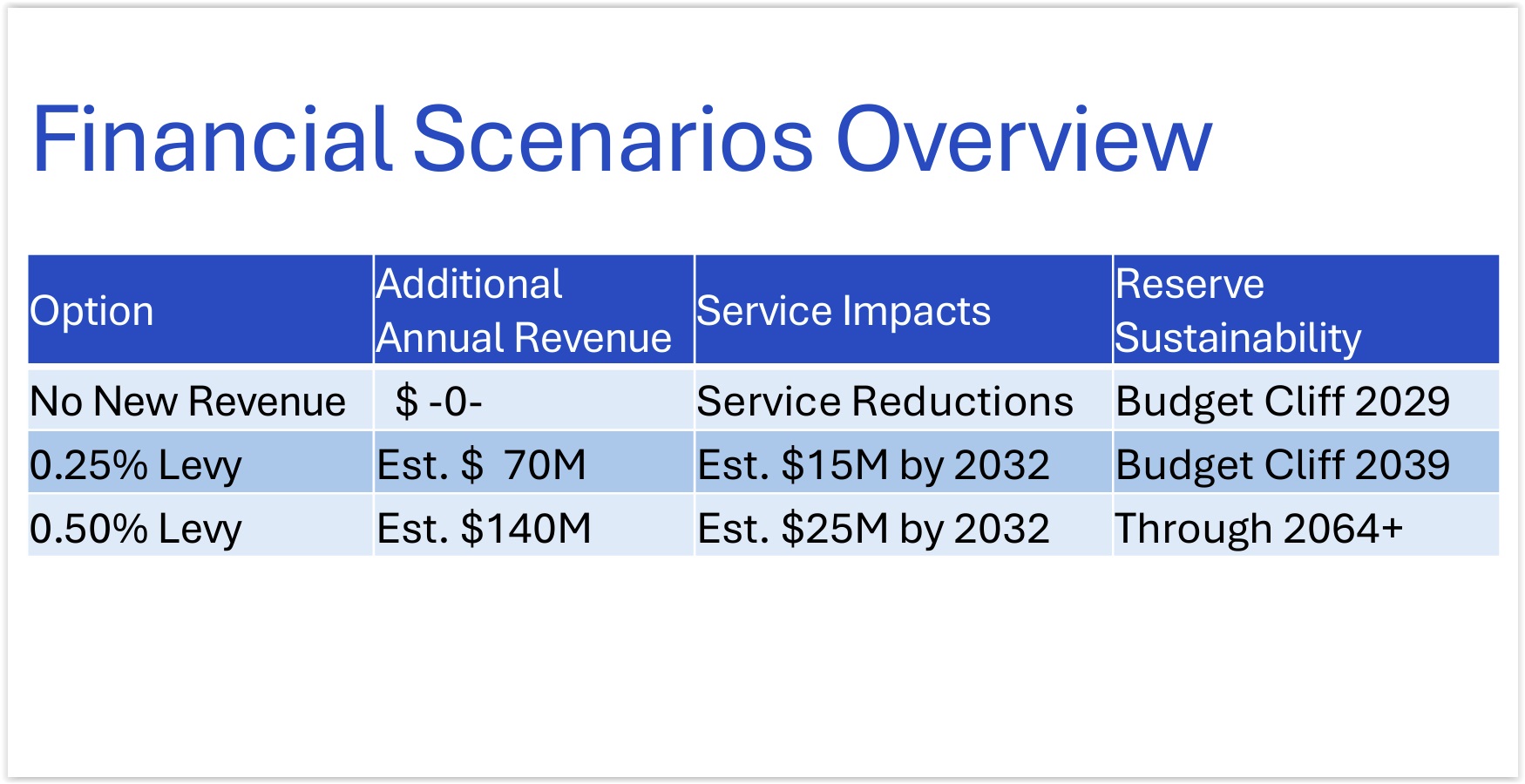
The three basic choices for the Greater Cleveland Regional Transit Authority to deal with its budget situation in the coming years — one is to cut and the other to afford more frequent services until 2039 or until at least 2064 (GCRTA).
Instead, most service increases would involve more frequent service on existing lines. That’s better than the alternative — major service cuts, GCRTA staff told board members at today’s meeting.
However, cost-saving options like reducing salaries, wages, benefits and staffing, or increasing automation, contracting out bus and rail transit operations, or real estate opportunities were not proposed.
After the budget cuts that were approved for this year, with minimal service cuts, GCRTA anticipates it will have to make another $30 million reduction in expenses by the end of 2029 absent additional revenue. That includes a $17 million service reduction over three years and another $13 million in other organizational cost savings.
The service reductions could include the discontinuation of 10 of GCRTA’s 41 remaining bus routes. It used to have more than 60 routes in the first decade of the 2000s before several rounds of service cuts were made to cope with growing inflation and declining sales tax revenues.
After cutting 10 routes by the start of 2029, GCRTA officials said the remaining routes would see less frequent service which means longer wait times for a bus or train and a less useful network with worse connections every day.
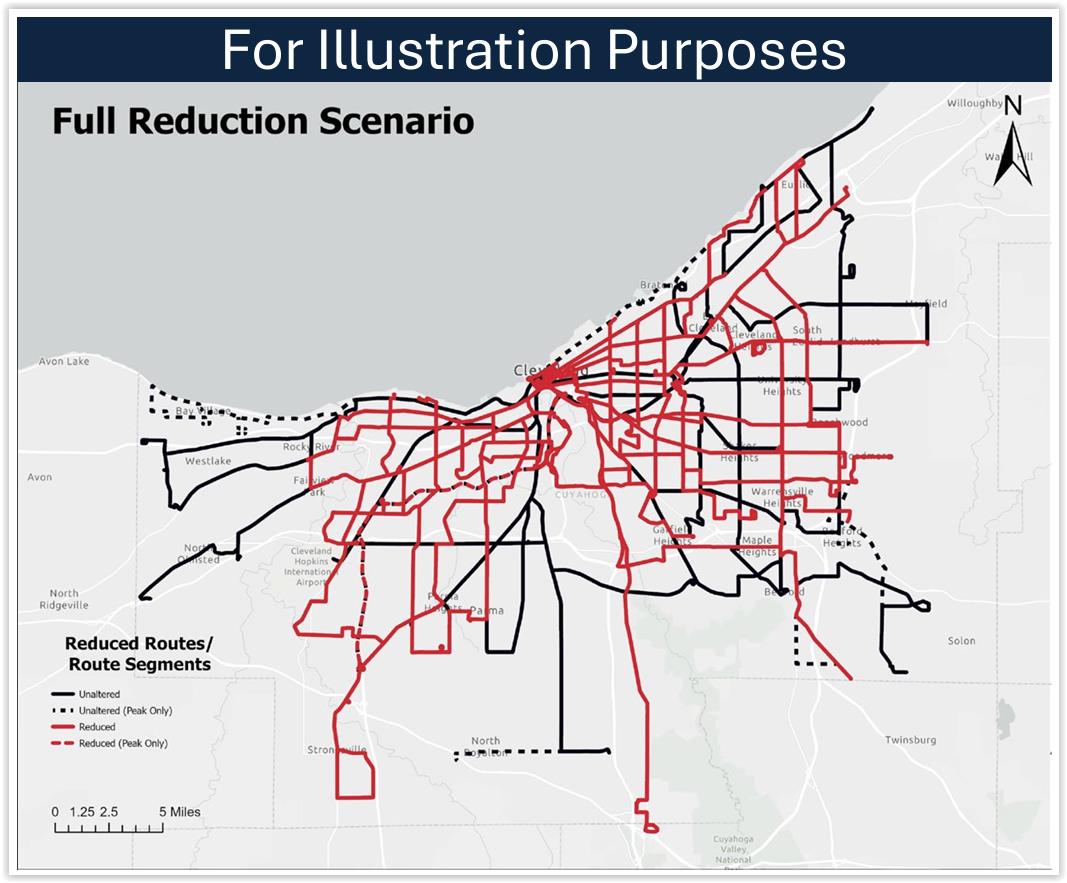
Absent additional revenue, service reductions are anticipated every January, resulting in reduced services on all of the routes shown in red above by January 2029 (GCRTA).
Paratransit service, whose coverage area is based on the regular route network under the federal Americans with Disabilities Act, would also see a coverage reduction due to the discontinued regular bus routes.
Such service cuts could reduce transit access to 524,000 jobs and the homes of 800,000 people. Of that about 68,500 jobs and 175,000 people will lose access to transit services offering a departure every 15 minutes or better on weekdays, said GCRTA Service Management Director Joel Freilich.
GCRTA General Manager & CEO India Birdsong Terry said the service cuts are a non-starter. In fact, she considered today’s meeting part of “a journey to the ballot box.”
“What are the options?” she asked the board. “What do we find possible with projections of funding that could come in from ballot box initiatives at whatever percentage the board decides to instruct us to go after. We are a little beyond research (mode now).”
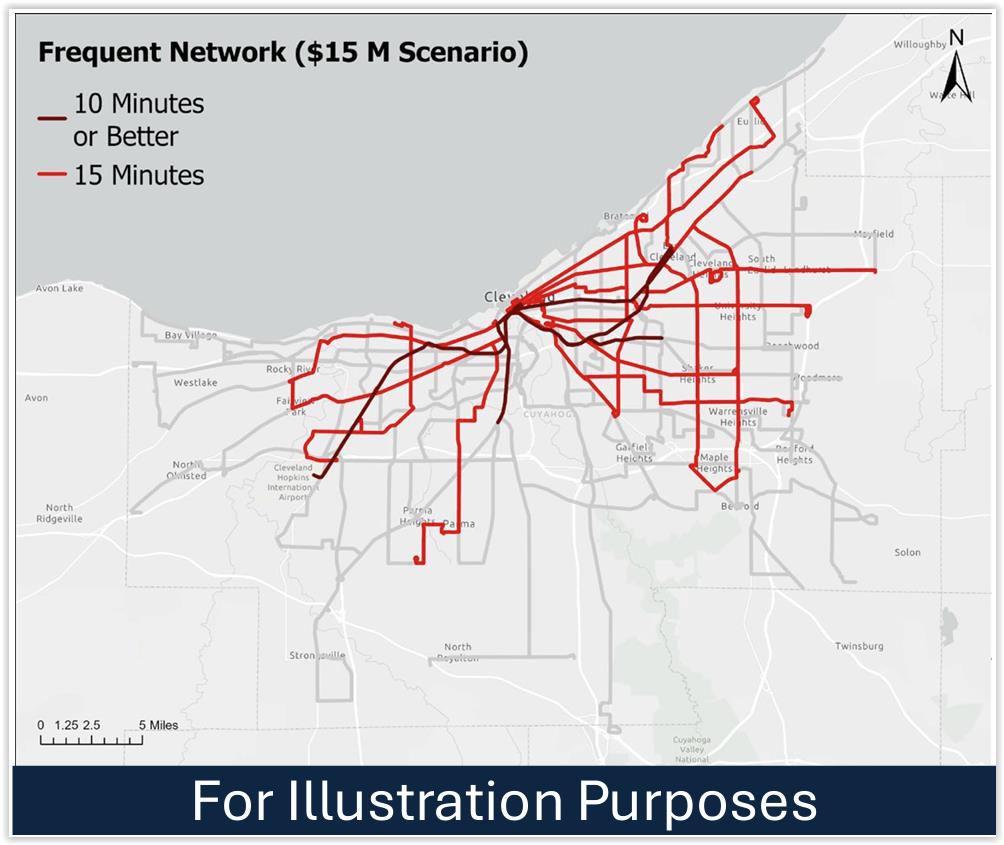
A $15 million-per-year improvement in transit services means 22 of the 41 bus and rail routes in the network will receive service improvements. That means 59 percent of jobs in Cuyahoga County will be within a half-mile of improved service. Another 52,000 jobs will get access to service every 15 minutes or better and another additional 132,500 people will live within a half-mile from a service operated every 15 minutes or better (GCRTA).
In addition to less frequent service every day, weekday services could be discontinued on the bus route Nos. 2, 8, 16, 34, 35, 39, 55B/C branches and 251. Light-rail service on the Green Line (Shaker Boulevard) could be discontinued after 8 pm on weekdays.
All service reductions would require public hearings under federal law before any cuts can be made. Less frequent service means making fewer connections to other routes, Freilich explained.
“If you can’t make connections, the automobile analogy is, you can drive but you’re not allowed to turn the steering wheel,” he said. “So that does limit your destinations. A transit network depends on your ability to make connections. You can’t just limit all your activities to the street you’re on.”
At a June 16 GCRTA board meeting, the agency’s staff said GCRTA’s operating budget would need a transfer from its Revenue Stabilization Fund of $33.5 million to make ends meet in 2027 — even after the budget cuts approved earlier this year.
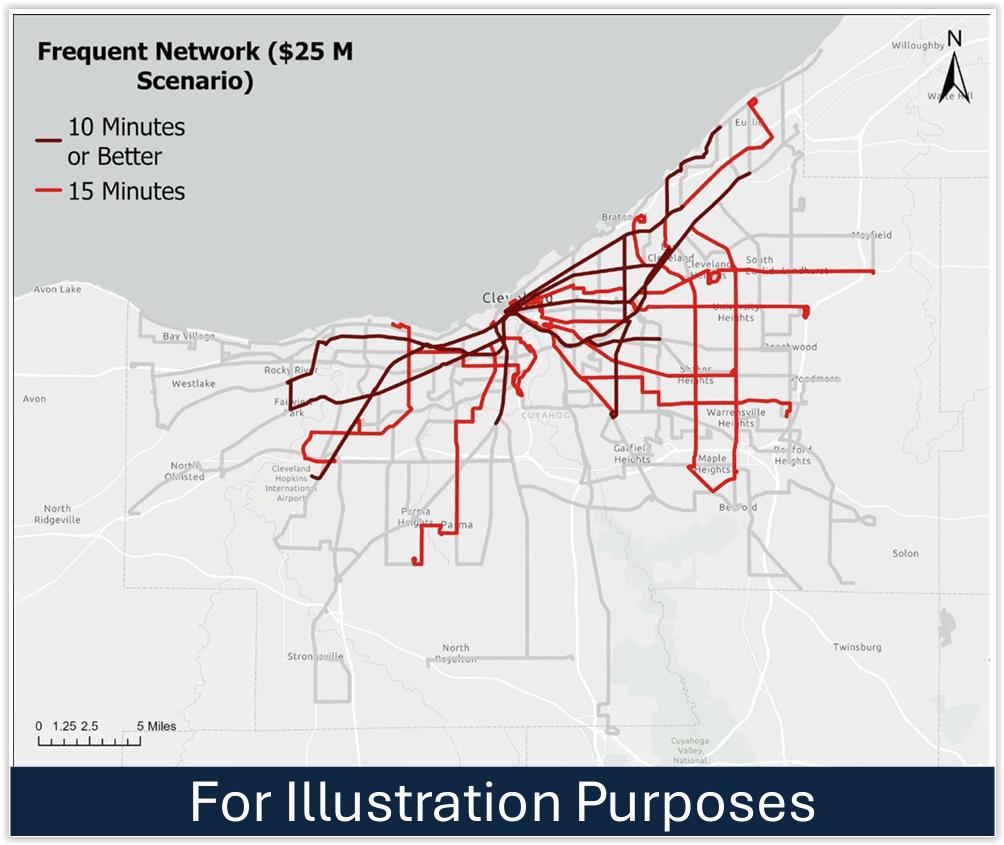
With $25 million more per year, 31 of the 41 bus routes in GCRTA’s network will receive service improvements. That means 70 percent of jobs in Cuyahoga County will be within a half-mile of improved service, plus 273,000 jobs and 301,000 people will get access to service every 10 minutes or better service and another 62,000 jobs and 341,500 people will get access to service every 15 minutes or better (GCRTA).
Since it is GCRTA policy to maintain a reserve fund equal to 30 days of operating expenses to cover any emergencies, this expected 2027 transfer represents a budgetary gap that needs to be immediately addressed, said GCRTA Public Information Officer Robert Fleig.
“As a result, the first $33.5 million of the potential proceeds from the new revenue of $70 Million — under the 0.25 percent scenario — and the $140 million — under the 0.50 percent scenario — will be to mitigate the structural gap,” Fleig told NEOtrans.
Under the 0.25-percent sales tax hike, that would leave $15 million per year for new services and $21.5 million per year for increasing the operating reserve from 30 days to 90 days. Under the 0.50-percent hike, that would avail $25 million per year for new services and $81.5 million to lengthen the operating reserve to 180 days.
And either option would provide a local funding share to leverage state and federal grants for keeping GCRTA’s bus and rail fleet, plus their infrastructure and facilities in a state of good repair, said Rajan Gautam, deputy general manager of finance and secretary-treasurer of the board.
END