
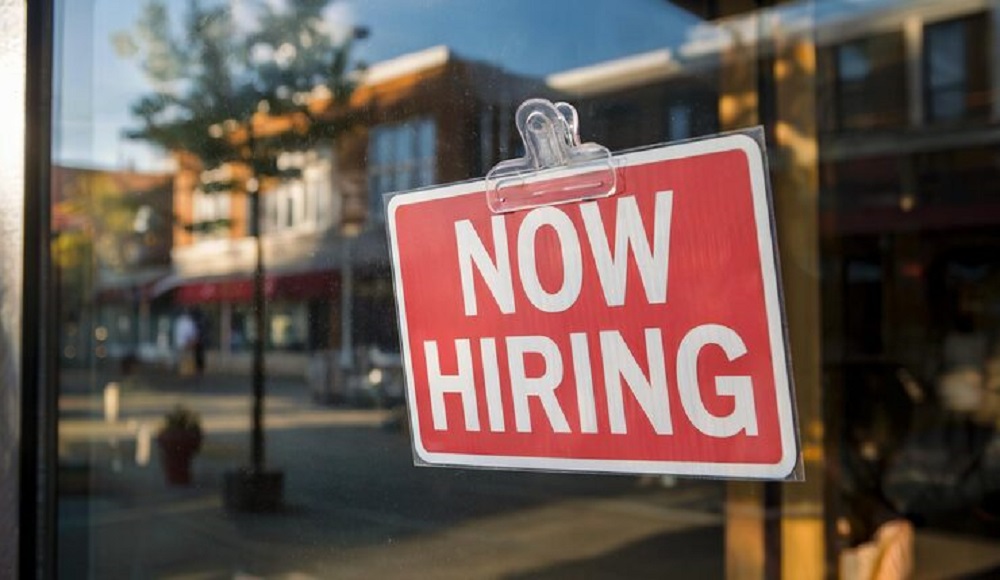
Signs of a good economy in the first half of 2026 in Greater Cleveland are well-documented in a new report by PNC Financial Services Group (Contributed). CLICK IMAGES TO ENLARGE THEM.
Region rebounds in economy and population
Ask anyone two years ago which Ohio city had the strongest labor market and the answer was simple: Columbus. Years of economic investment bolstered by a rapid influx of residents has produced one of the nation’s fastest-evolving cities, located in Central Ohio. Ask that same question today, and there is a new answer: Cleveland.
Indeed, an August regional economic analysis report by PNC Financial Services Group claims there’s a new leader in the Ohio labor market in the first half of 2026. It suggests that, in the state recently crowned as tops-in-the-U.S. for business by CNBC, the Cleveland metropolitan area is outperforming the rest.
Things are mixed bag however for Ohio at large. Based purely on employment growth, the most-improved award goes to Sandusky. The area saw a whopping 5 percent year-over-year growth rate compared to the state rate of 0.4 percent and the national rate of 0.3 percent.
In terms of larger metropolitan areas it was the Cleveland, Cincinnati and Dayton regions which led the statewide and national growth rates so far this year.
In contrast, “Columbus has struggled to maintain momentum after leading Ohio’s labor market for much of the post-pandemic period,” according to the report. So far, Central Ohio has lost jobs in three out of the six months through June 2026, a net decrease of -0.1 percent.

Employment and housing data from the first half of 2026 paints a pretty picture for Cleveland’s economy (NEOtrans).
Several other small metro areas in Ohio such as Lima and Springfield saw employment fall with Toledo leading the way at a 1.3 percent decrease. Rust Belt cities like Akron (-0.1 percent), Canton (-0.5 percent) and Youngstown (-0.4 percent) saw decreases in employment, too.
Multiple factors have led to Cleveland taking top-job market honors. The first is due in part to Cleveland’s strong recovery of hiring in goods-producing industries after three years of contraction nationwide.
The region’s manufacturing sector has “narrowed the performance gap relative to both Ohio and the nation since mid-2025.” A strong year of manufacturing growth in Cleveland, the report notes, was bolstered in part by Ohio’s growing supply chains in aerospace and semiconductor industries.
In fact, nearly all sectors mentioned in the report saw moderate to healthy increases in employment in Cleveland. These include finance and insurance, professional and business services as well as real estate, thanks to Cleveland’s robust housing market.
In general, Ohio’s housing market and home-price growth has continued to surpass the national average this past year. But according to the report, “regional performance varies significantly.”
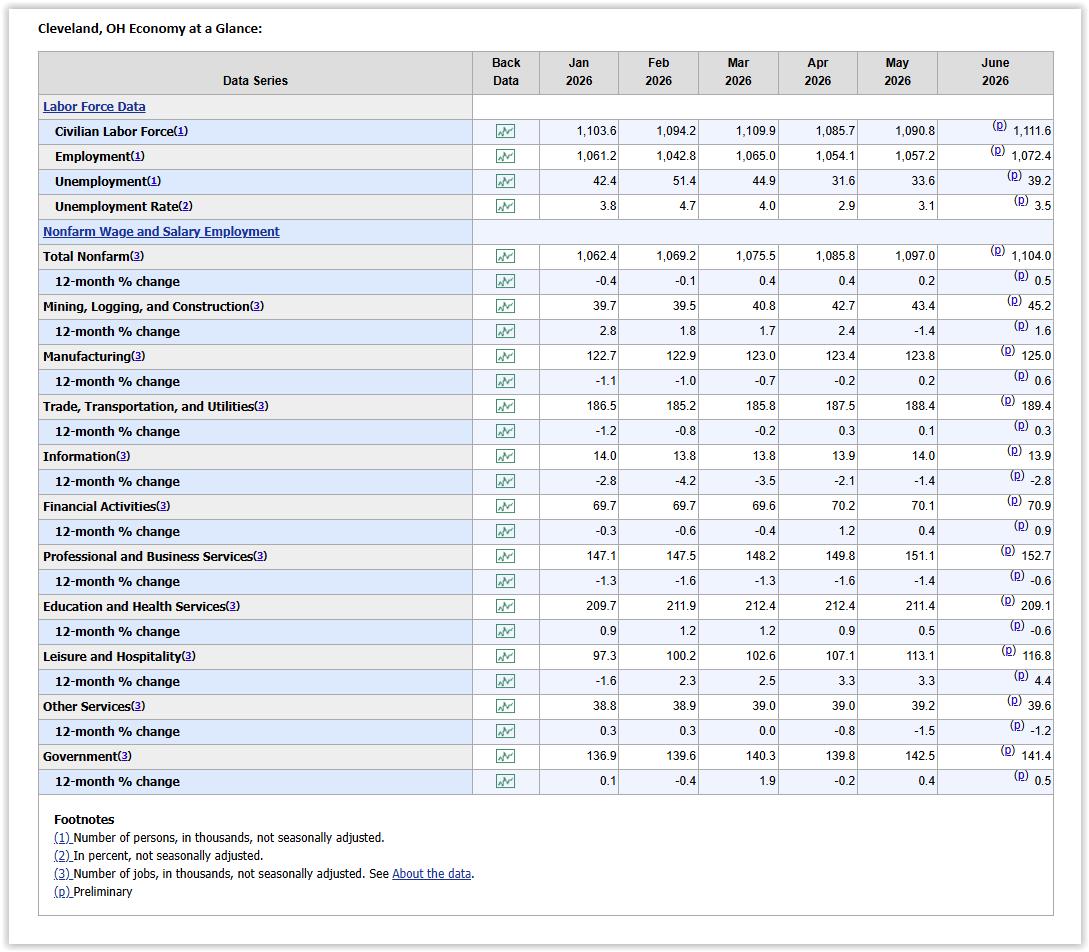
This chart shows the employment status within various sectors of the Greater Cleveland economy compared to the same month last year (BLS).
While the recently-hot Toledo housing market has “cooled substantially,” look for Cleveland to remain one of the strongest and most-affordable markets in Ohio in comparison to other cities like Cincinnati.
The brightest spot for the region was a substantial 4.4 percent year-over-year employment increase in the leisure and hospitality sector, which far-surpassed the statewide gain of 0.7 percent. Employment in that sector is now the highest it has been in a decade.
Sobering however were the modest decreases in local education and health services sector employment. Despite being home to some of the country’s largest and well-renowned hospital systems, the region’s rapid growth in the healthcare industry appears to be cooling slightly.
Expect Northeast Ohio’s healthcare industry to post additional gains however once billions in investment from the Cleveland Clinic, University Hospitals and MetroHealth systems come online in the coming years, requiring additional healthcare workers.
The region has come a long way in terms of unemployment as well. According to the Bureau of Labor Statistics (BLS), the region saw peak unemployment in February 2017 at 7.2 percent (excluding the pandemic). In the decade since, unemployment has been cut in half.
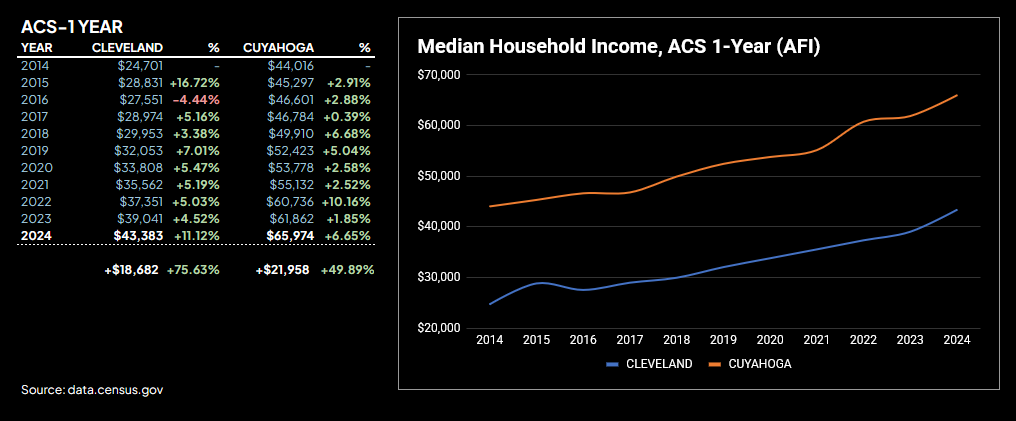
Steady growth in median household income in Cleveland and Cuyahoga County greatly outpaced the national average between 2014 and 2024, according to data from the US Census Bureau (Census).
The current rate in June 2026 is 3.5 percent, lower than the current national unemployment rate of 4.2 percent according to BLS. Likewise, total non-farm employment in the Cleveland metro is 1.104 million in June 2026 — its highest point since June 2019, when 1.118 million were employed.
The strength of Cleveland’s growing labor market is also evident in rapidly-growing median household income (MHI) and rebounds in population. From 2014 to 2024, MHI in Cleveland proper has grown by 75.63 percent and 49.89 percent in Cuyahoga County.
This means the average household now makes an additional $19,000 and $22,000 than they did a decade ago respectively, adjusted for inflation. The national average MHI growth by comparison was only 21.24 percent during this period, according to data from the Federal Reserve Bank of St Louis.
The strong labor market in Cleveland in recent years and “brain gain” via an influx in college-educated adults has boosted incomes throughout the region. This is supported by 2025 Vintage census estimates which show that both the city of Cleveland proper and the metropolitan area a whole have gained population at an increasing rate each year since 2023 after decades of decline.
If Cleveland is to continue this momentum and stay at the top of the labor market in Ohio, the region will have to build off of these positive trends to ensure sustained economic success into the next decade.
END