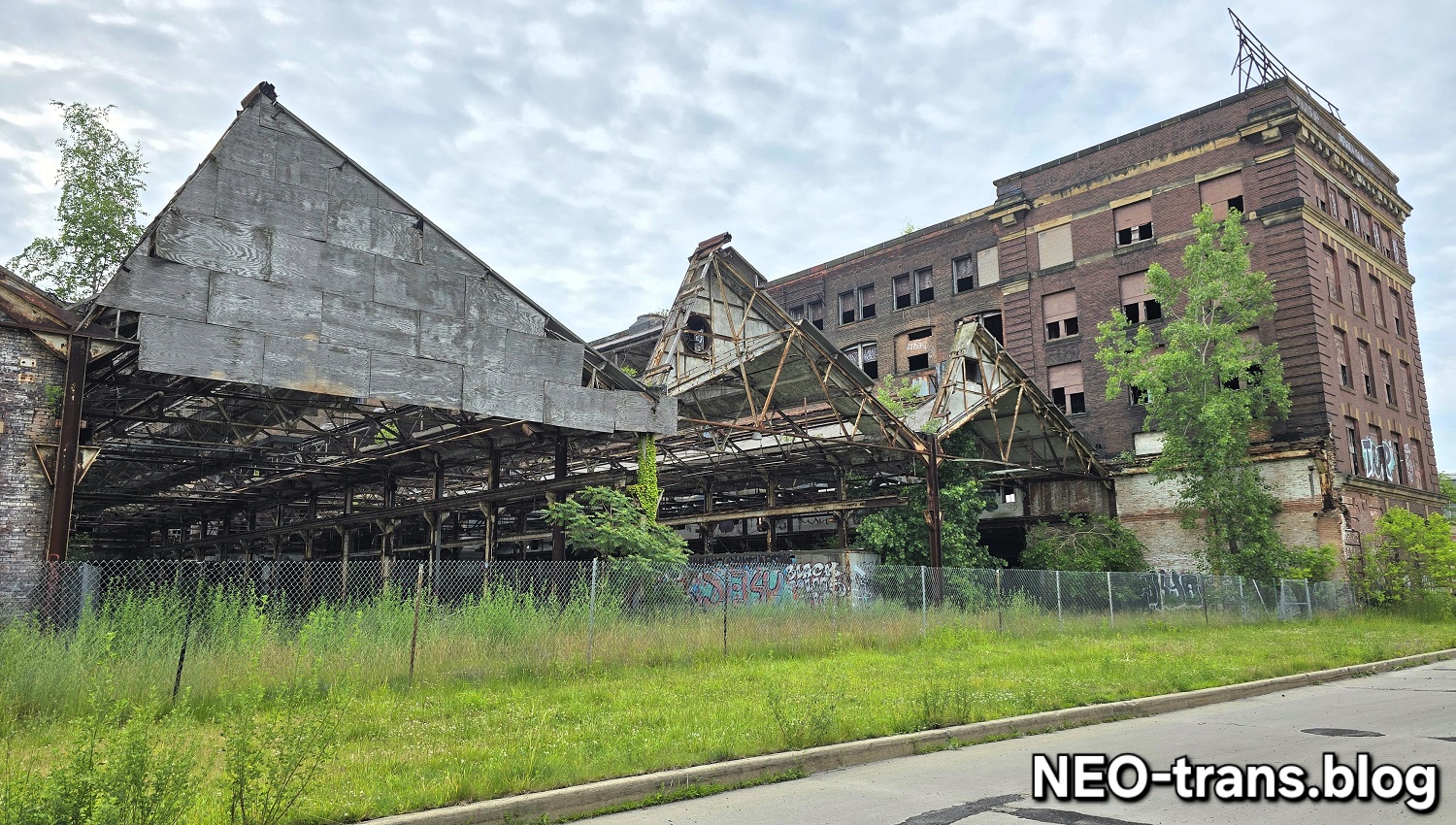
The foundry section, at left, of the long-vacant Warner & Swasey factory on Carnegie Avenue near East 55th Street is to be demolished for parking for residents in the to-be-redeveloped, surviving portion of the complex at right (NEOtrans). CLICK IMAGES TO ENLARGE THEM.
$2M rehab funding gap may have solution
Four decades after the venerable Warner & Swasey factory in Cleveland’s Midtown neighborhood closed, good things appear to finally be coming together for a rebirth of the 3-acre site.
Pennrose LLC, based in Philadelphia, announced today that it has closed on the purchase of the former machine-tool factory at 5701 Carnegie Ave. The purchase, which closed Sept. 26, was described by Pennrose as a “pivotal milestone” in the redevelopment of the 194,000-square-foot former manufacturing facility into a vibrant mixed-use, mixed-income community.
And yesterday, Pennrose closed on financing from Cuyahoga County to fund the building acquisition, with a Pennrose-led development team that includes MidTown Cleveland Inc. working toward a mid-December closing on construction financing for the full redevelopment project.
The former city-owned property was transferred to an affiliate of Pennrose LLC for $2,236,134. Now that it is sold, the proceeds of the sale will be loaned by the city to Pennrose to be one of the many resources that, when combined, will pay up to $52 million in site preparation and construction costs.
For much of this year, Pennrose had identified all but about $2 million to pay for those costs. But Geoff Milz, Pennrose’s director of development, told NEOtrans today that there may be financial resources available by mid-November to close that gap before other, time-limited financing expires at the end of this year.
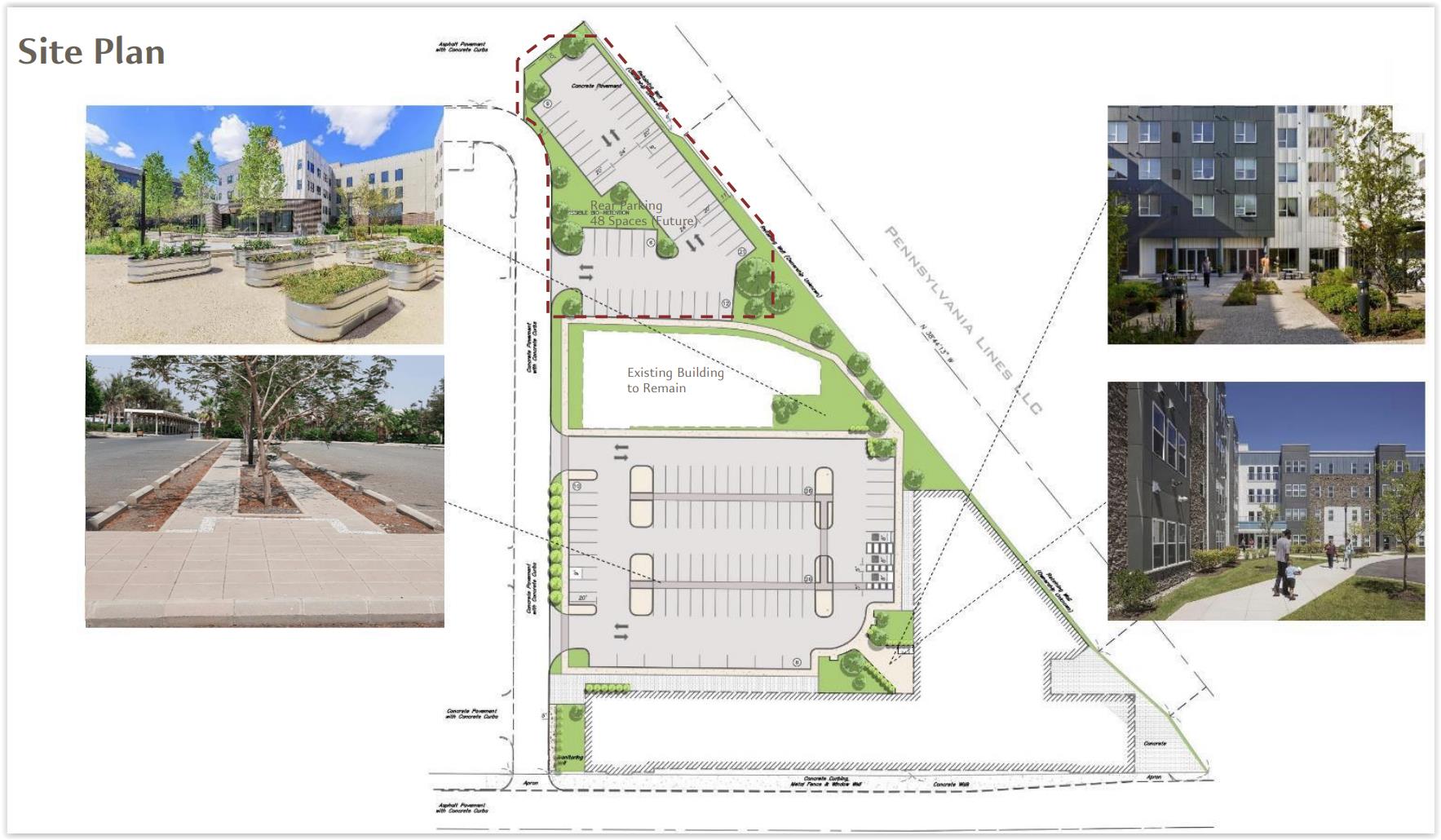
Site plan for a redeveloped Warner & Swasey site, recently owned by the city of Cleveland but now transferred to Pennrose. This shows the area where the foundry sheds are now and how they would look after they are razed for parking (Moody Nolan).
However, he declined to discuss those resources out of concern that he might jinx them. At the end of August, he told NEOtrans that Pennrose had just put the construction work out for a “hard bid” in order to learn the actual building cost.
“The acquisition was a big step forward because it allowed us to deploy a source from Cuyahoga County that would have expired but for the early acquisition of the building,” Milz said in an e-mail.
“The city and county have been tremendous partners as we have worked through challenge after challenge,” he continued. “It is clear that everyone wants this project to be successful and I am optimistic that we will be able to deliver a transformational project in Midtown. Stay tuned.”
The acquisition advances the transformation of the building, which has stood vacant since 1985, into approximately 140 residential units ranging from studios to three-bedroom apartments, along with up to 22,000 square feet of commercial space in a later phase.
The development will serve both seniors and families with apartments affordable to households earning 30-60 percent of Area Median Income (AMI), or $43,383 in 2024, as well as market-rate workforce housing for households earning 60-120 percent AMI.
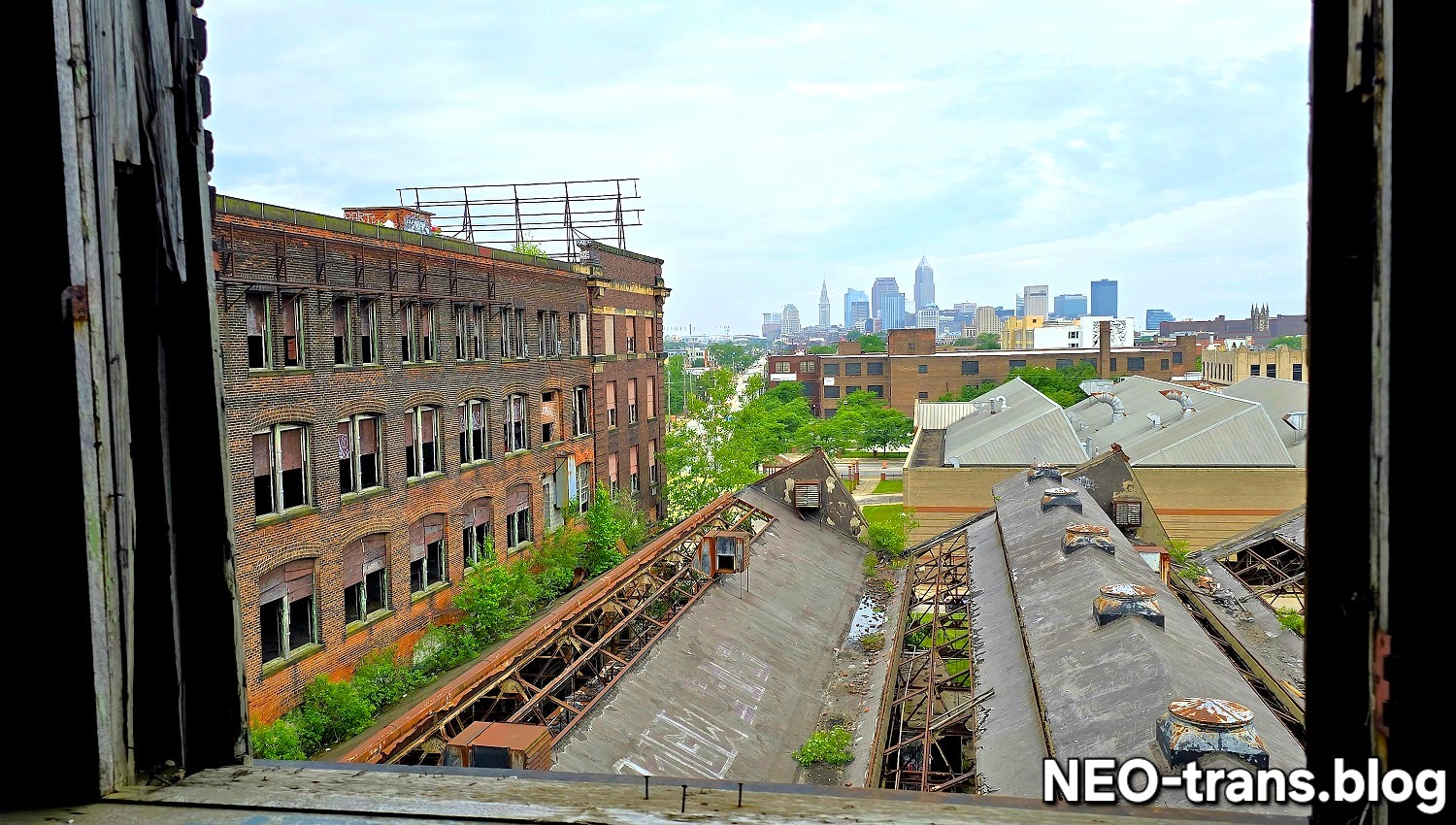
A view of Downtown Cleveland from the Wedge Building portion of the Warner & Swasey complex. This portion will be cleaned up and sealed for a future phase. The apparent poor condition of the foundry sheds below is why they will be demolished (NEOtrans).
The adaptive reuse project will preserve the once-elegant five-story structure originally constructed in 1905 for the Warner & Swasey company, whose legacy of engineering innovation and precision instruments helped transform the 20th century.
Although the masonry building is faded and battered by decades of Cleveland weather, Milz described the building as “a tank.” The same cannot be said for the glass-and-steel foundry portion of the complex, where mature trees now grow. That section will be demolished for parking for the to-be-rejuvenated building.
“This acquisition represents years of planning and partnership coming to fruition,” Milz added. “Warner & Swasey will be a model for how historic preservation and inclusive housing development can work together to revitalize neighborhoods and create opportunities for residents across the income spectrum.”
The phased development will start with the building along Carnegie. There, floors two and three will have 56 units of affordable senior housing and floors four and five will have 56 units of family housing, or 112 units total.
The ground floor of the Carnegie Building will have commercial space, built out in a future phase. The Wedge Building along the railroad tracks will be cleaned up, remediated and then sealed — its 28-unit workforce housing component will be saved for another, future phase.
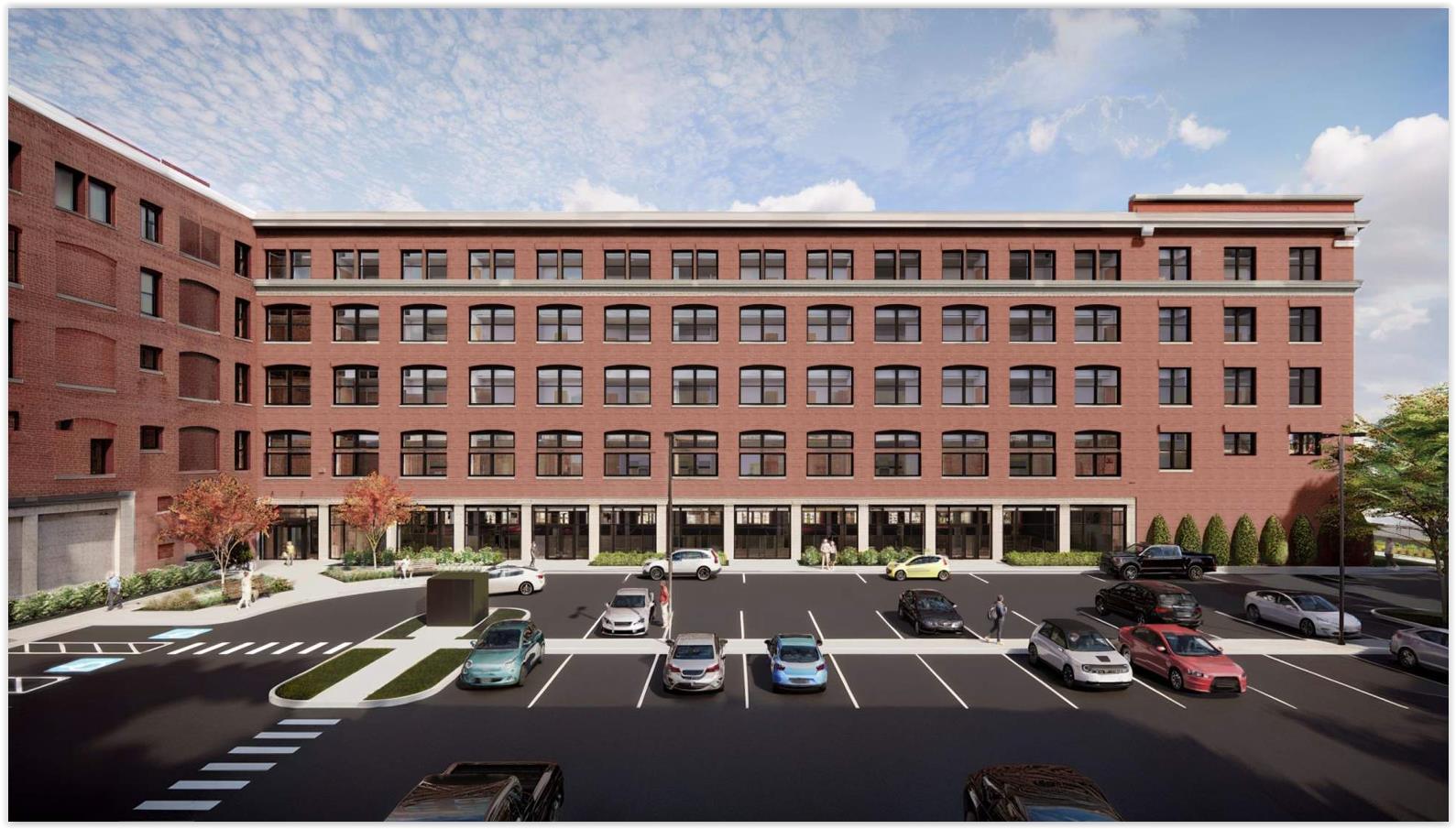
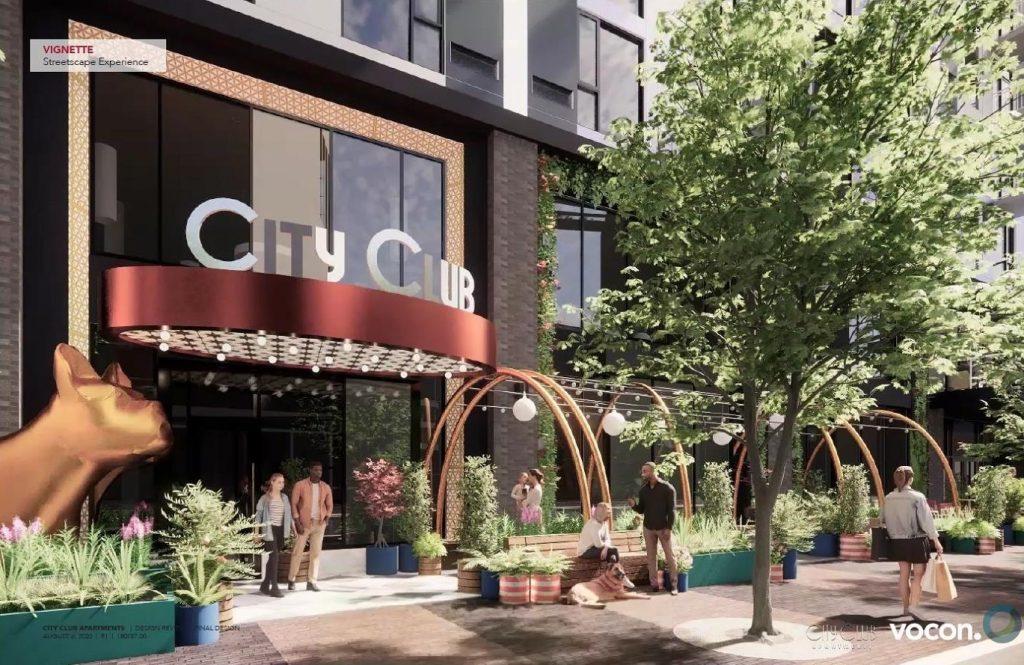
Hopefully in the not-too-distant future, this will be how the Warner & Swasey site will look once it is redeveloped (Moody Nolan).
Unique architectural features from the building’s manufacturing past will be preserved and incorporated into amenity spaces, including a second-floor rooftop terrace and outdoor gathering spaces.
Redevelopment of the Warner & Swasey site has often been described as a potential catalyst for redevelopment of the East 55th Street corridor, especially where it intersects the major east-west thoroughfares of Chester, Euclid, Carnegie and Cedar that link downtown with University Circle.
Recent redevelopment activity in Midtown has so far evaded the vacant lots along East 55th. That redevelopment includes the Agora Theater Complex, Link 59 offices, new townhomes, and a full-service grocery store. Warner & Swasey is one block south of the 24-hour HealthLine bus rapid transit route on Euclid Avenue.
“The Warner & Swasey redevelopment is transformational for Midtown,” said Ashley Shaw, executive director of MidTown Cleveland, the area’s community development corporation and a partner in the project.
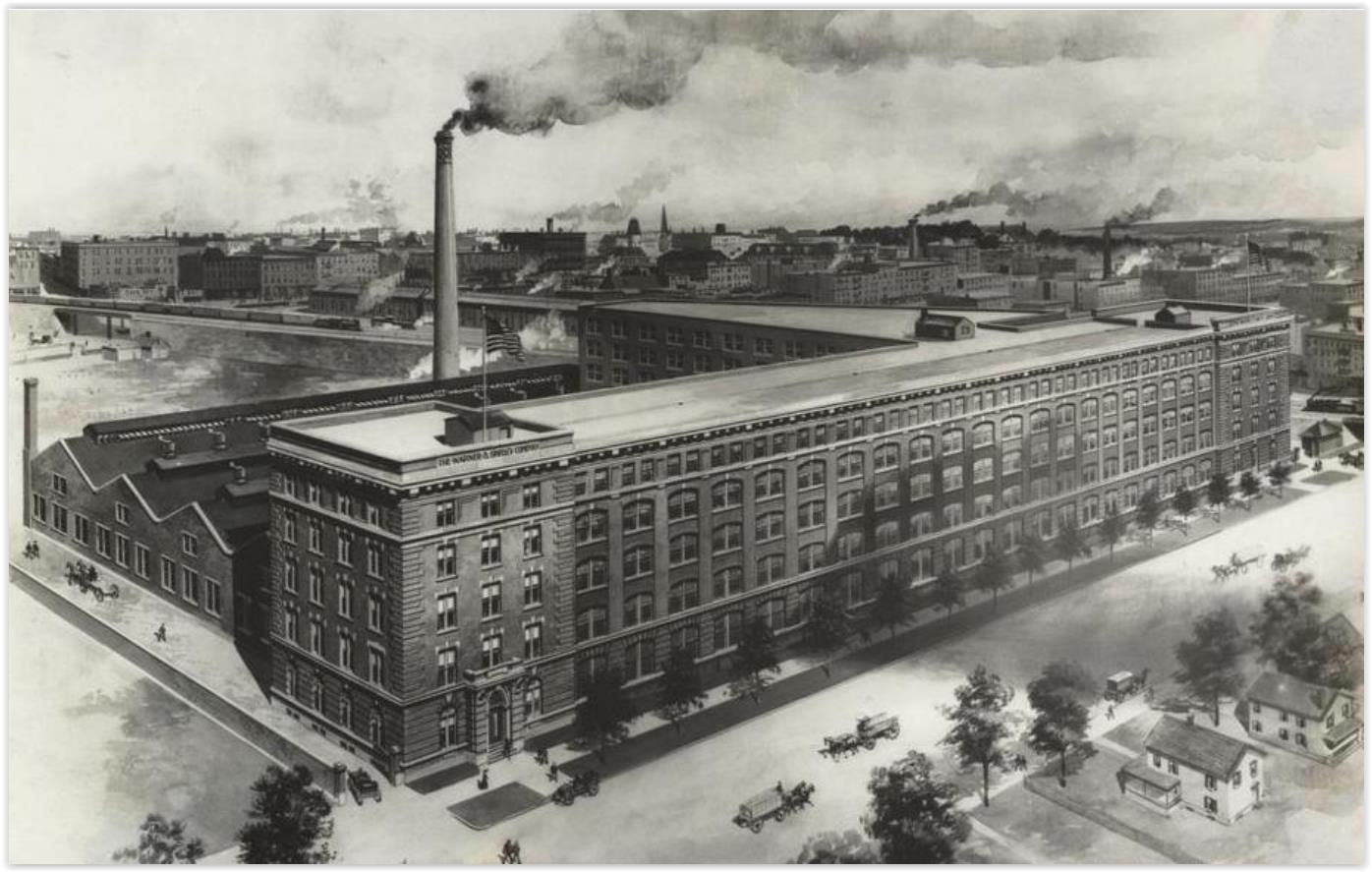
Warner & Swasey dates to 1880 when a partnership of Worcester Reed Warner and Ambrose Swasey launched a machine tool-making powerhouse that grew to employ up to 7,000 people during World War Two (contributed).
“This project will bring much-needed housing options to our neighborhood while preserving an irreplaceable piece of Cleveland’s manufacturing legacy,” she said in a written statement. “Pennrose’s vision for mixed-income, mixed-population housing aligns with our goal of creating a diverse, inclusive community where longtime residents and newcomers alike can thrive.”
The project is being developed in partnership with the City of Cleveland, which owned the property for years, and represents a significant investment in affordable housing and neighborhood revitalization along the Carnegie Avenue corridor.
In a request for approvals process, the city selected Pennrose in 2018 to oversee Warner & Swasey’s redevelopment. Pennrose has experience in redeveloping large, vacant, neglected structures like the former St. Luke Hospital, 11311 Shaker Blvd., into affordable housing.
“We’re honored to be entrusted with bringing new life to this iconic Cleveland landmark,” Milz said.
END