
A building that was left for dead many times over the past four decades displayed a hopeful message for the first time in a long time last night under a full moon. A timetable for its recovery was projected onto the long-vacant Warner & Swasey building on Carnegie Avenue (MidTown Cleveland). CLICK IMAGES TO ENLARGE THEM.
Final funding piece needed special OK
Warner & Swasey co-developers Pennrose and MidTown Cleveland today announced the closing of the last gap in the financing for the $64 million redevelopment of the historic factory, located at 5701 Carnegie Ave. in Cleveland’s MidTown neighborhood.
The development team said they are “racing towards closing” of their financing package, scheduled for Dec. 15. That will mark a triumphant moment and critical milestone in the long-awaited redevelopment of the former manufacturing site that was threatened with demolition many times.
While construction is set to begin in January 2026, work is already underway to start stabilizing the building, including blocking stairwells and safety improvements, said Ashley Shaw, executive director at MidTown Cleveland in a phone interview.
The factory’s sheds, which have mature trees growing up through them, will be razed for construction staging and, ultimately, parking for the new apartments. Next, the building’s roof will come off. Then, each of the floors will need to be rebuilt section by section with materials lowered in through the opened roof.
Rehabilitating the 194,000-square-foot factory will transform the facility into a vibrant mixed-use, mixed-income community. At this and predecessor buildings, Warner & Swasey manufactured machine tools for more than a century until 1985.

Projected messages alternate on the facade of the historic Warner & Swasey building, highlighting the long struggle to assemble financing from the 24 sources of funding for the brick building’s rehabiltation. However the sheds at left will be demolished for construction staging and parking for the apartments in the building at right (MidTown Cleveland).
Once complete, the initiative will preserve the five-story historic landmark, which has sat vacant for 40 years, and deliver 112 rental apartments in the first phase and approximately 28 units and 22,000 square feet of commercial space in the second phase.
“The herculean effort and widespread community support that went into getting the Warner & Swasey redevelopment across the finish line is representative of how much this iconic landmark means to the Cleveland community,” said Geoff Milz, director of development at Pennrose, in a written statement.
He said the project is a testament to how “creative solutions can preserve community assets and deliver meaningful housing opportunities.” In recent months, he was reluctanct to divulge how his team intended to close a $4 million gap in the financing. But today it can be revealed.
The Ohio Housing Finance Agency staff made a special approval of a highly coveted 9 percent Low Income Housing Tax Credit (LIHTC) for the project. It was done outside of OHFA’s routine schedule of board-approved LIHTC awards.
It was the last of 24 different capital funding sources amassed to realize the complicated project, including from the City of Cleveland which sold the 3-acre property to Philadelphia-based Pennrose two months ago for $2.2 million.
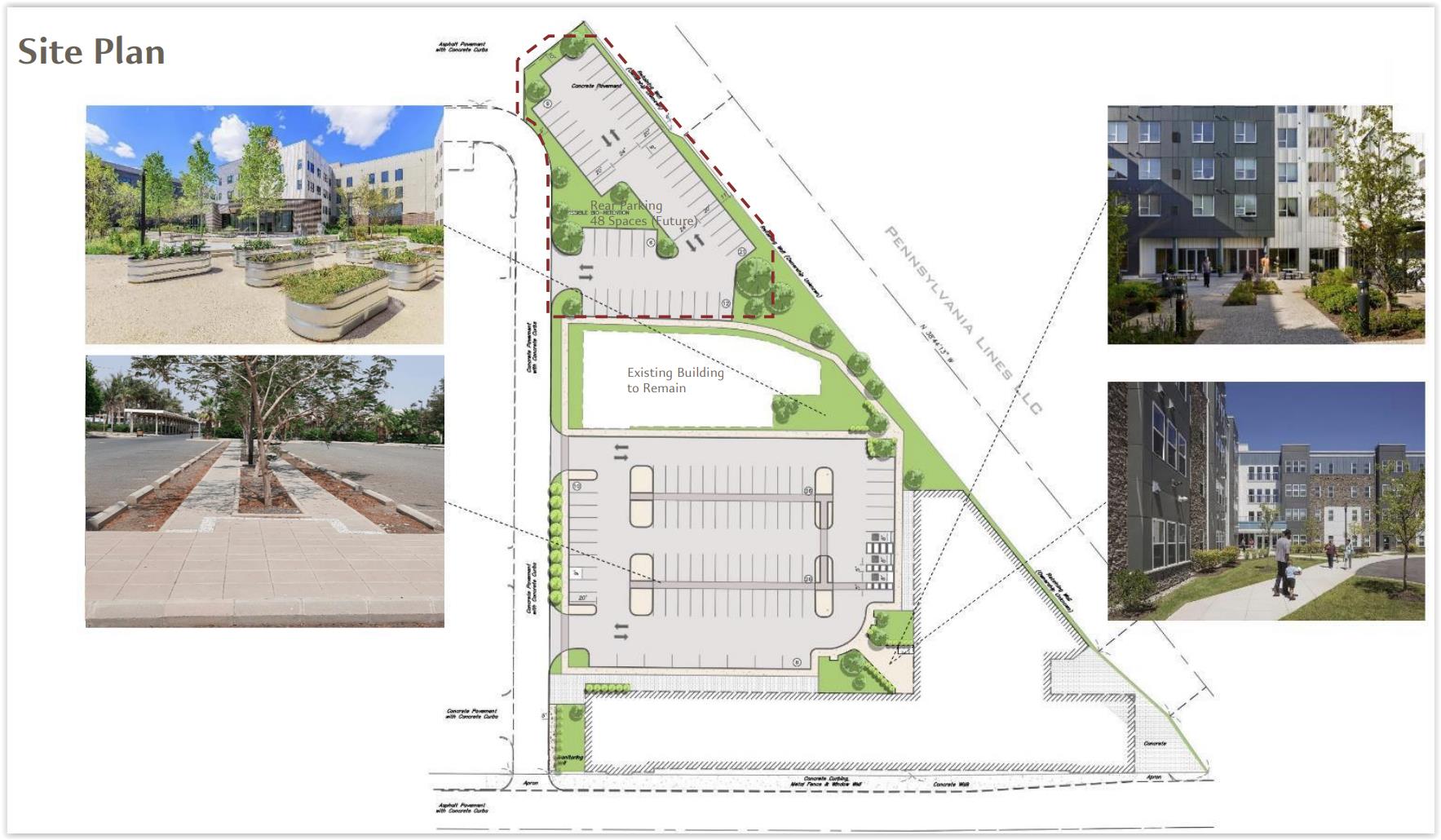
Site plans for the Warner & Swasey site on Carnegie Avenue, between East 55th Street and the elevated Norfolk Southern railroad tracks. The first phase will renovate the building along the bottom of the image, dubbed the Carnegie Building. The Wedge Building that extends north from it will be secured and whiteboxed for the second phase (Moody Nolan).
“Through this multi-million-dollar investment from my administration, we will support the redevelopment and preservation of this 115-year-old building, advancing our shared commitment to provide affordable housing for Clevelanders,” said Mayor Justin Bibb. “Today’s announcement is a powerful demonstration of how the Cleveland Era is coming to life – creating new opportunities that strengthen our neighborhoods while honoring our heritage.”
Planned are studios plus one- and two-bedroom apartments designed to serve individuals, seniors and families at a wide range of incomes, including affordable housing units available at 30-60 percent of Area Median Income (AMI) in the first phase. Units will be available for higher-income households as part of phase two.
Phase one will deliver 112 apartments, with one style for seniors and another for families. Phase two will add 28 housing units with ground-floor commercial spaces. The development team plans to preserve and incorporate the building’s unique architectural features into amenity spaces, including a second-floor rooftop terrace and outdoor gathering spaces.
Shaw recalled that Ayonna Blue Donald, who was director of the city’s Department of Building and Housing from 2017 to 2021, refused to sign city inspector requests to demolish Warner & Swasey that came across her desk.
Former Cleveland Planning Director Bob Brown also fought to save the historic building from the wrecking ball. He now serves on the board of MidTown Cleveland, a community development corporation. Those were just two among many who advocated for the building to be saved and rebuilt.
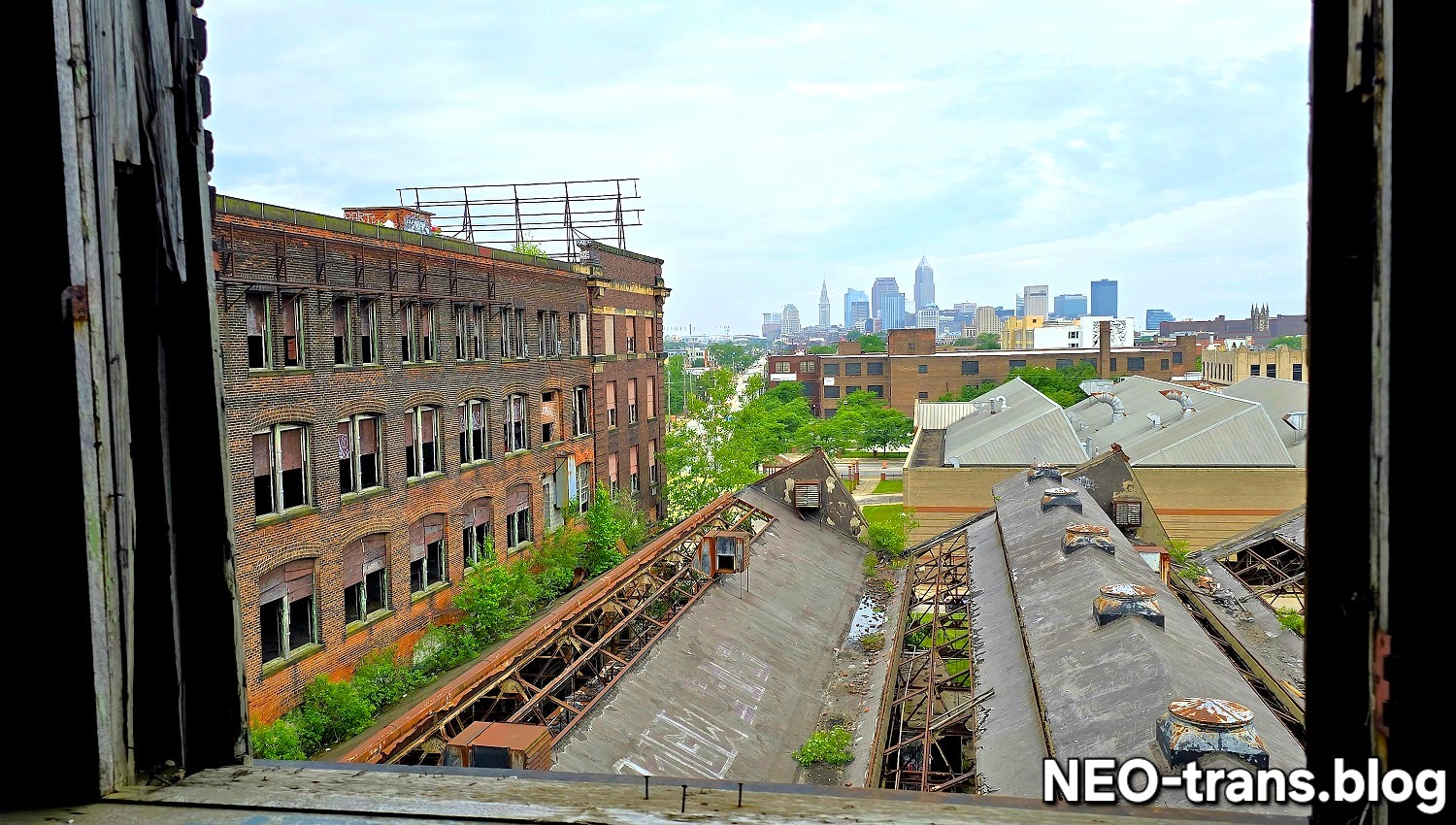
When rebuilt, this view of the city from the Wedge Building will be available to workforce-rate-paying residents in the second phase. The first phase will focus on the Carnegie Building at left. The sheds below will give way to parking (NEOtrans).
“I wanted to honor the many people over the decades who fought to preserve it,” Shaw said. “It’s an emotional thing with so many people connected to this building.”
She said there’s also an economic side to preserving and reviving the Warner & Swasey building. Demolishing or rehabilitating the historic brick building could have taken the neighborhood in two very different directions.
“This is a moment where we could shift the future of MidTown by reviving a highly visible building that sits in the middle of so much activity and investment and yet is still vacant,” Shaw said.
“If we take it down, it’s just another vacant site,” she added. “Will another vacant site be a catalyst like a redeveloped building would? The owners of a lot of these vacant properties are watching what we do here. If we can bring back Warner & Swasey, it will bring to light some of these other vacant properties.”
END