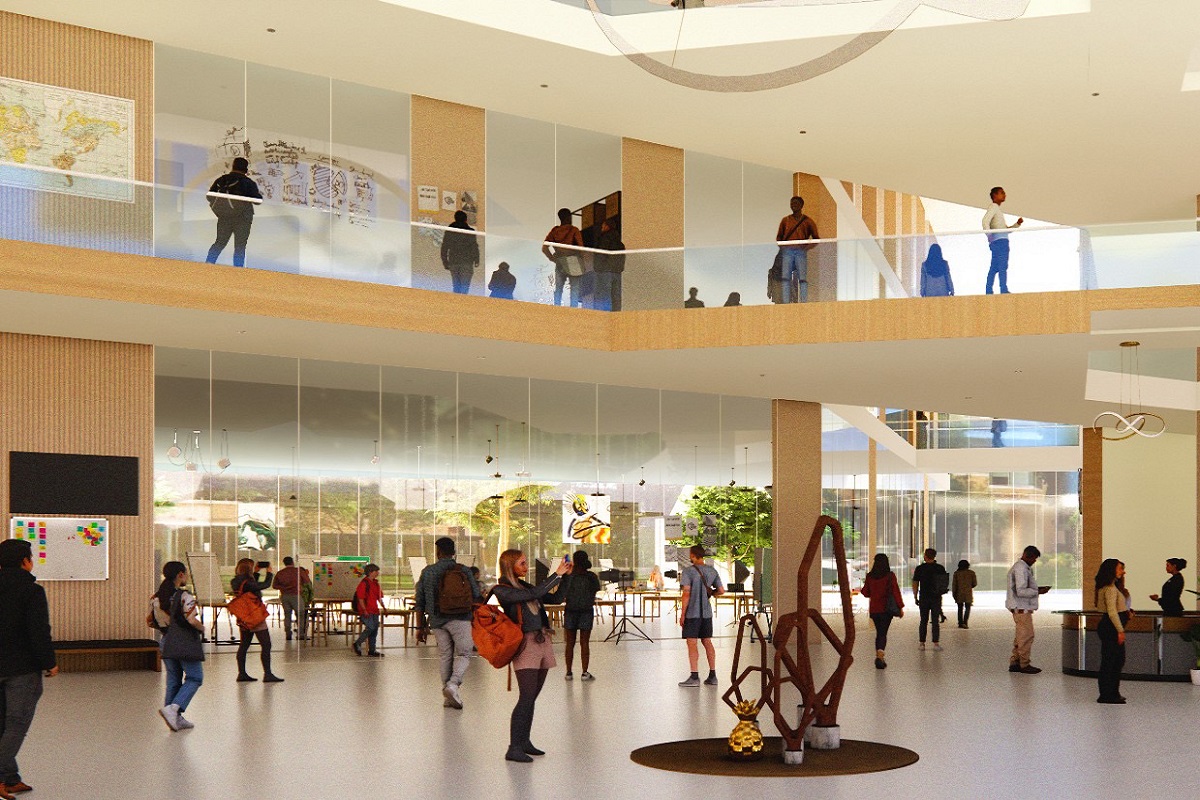
A rendering of the interior of Case Western Reserve University’s proposed new Jack, Joseph and Morton Mandel Humanities Building on Bellflower Road (CWRU). CLICK IMAGES TO ENLARGE THEM.
New Humanities Building among benefits
As Case Western Reserve University (CWRU) celebrates its bicentennial, the Jack, Joseph and Morton Mandel Foundation has made a $125 million commitment gift to the university. Not only is it the largest gift in the foundation’s history, CWRU says it’s likely the biggest gift ever to higher education in Ohio.
A principal beneficiary of the gift is to build the Jack, Joseph and Morton Mandel Humanities Building at 11333 Bellflower Rd. in Cleveland’s University Circle district. The planned 50,000-square-foot building is designed as a campus anchor for human-centered digital scholarship, interdisciplinary creativity and community partnerships.
As planned, it would combine humanities studies from across several buildings through collaborative workspaces, state-of-the-art classrooms and specialized research zones to support immersive and interdisciplinary learning and inquiry.
Its location would put the new building alongside CWRU’s Jack, Joseph and Morton Mandel School of Applied Social Sciences and Mandel Community Studies Center on Bellflower Road, according to a written statement from the university. Detailed plans for the new humanities building are not yet publicly available.
The new facility was included in CWRU’s most recent campus master plan. The building would consolidate CWRU’s humanities programs from six sites around campus into a single location — a 1.6-acre property that had an abandoned fraternity house on it until CWRU got permission from the city in 2024 to raze it.
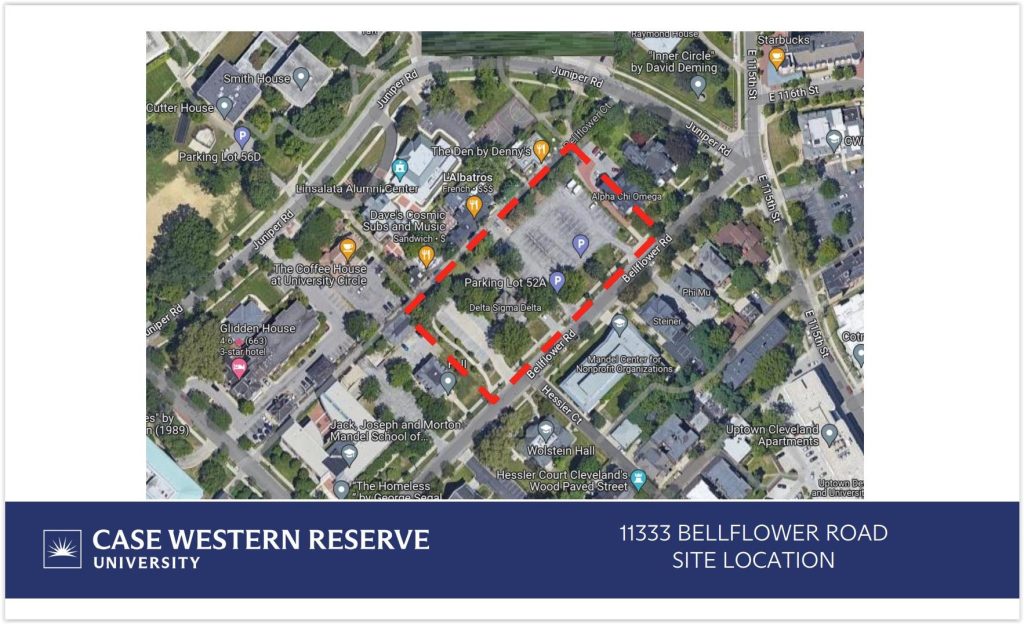
Site of the planned new Jack, Joseph and Morton Mandel Humanities Building on Bellflower Road. A former fraternity house shown within the building site has since been demolished (CWRU).
CWRU bought the fraternity house in 2022 for $340,000 from Lambda Chapter Corp., county records show. In 2023, the City Planning Commission denied the university’s request to demolish the house, citing the lack of a plan for reusing the site for anything more than a surface parking lot.
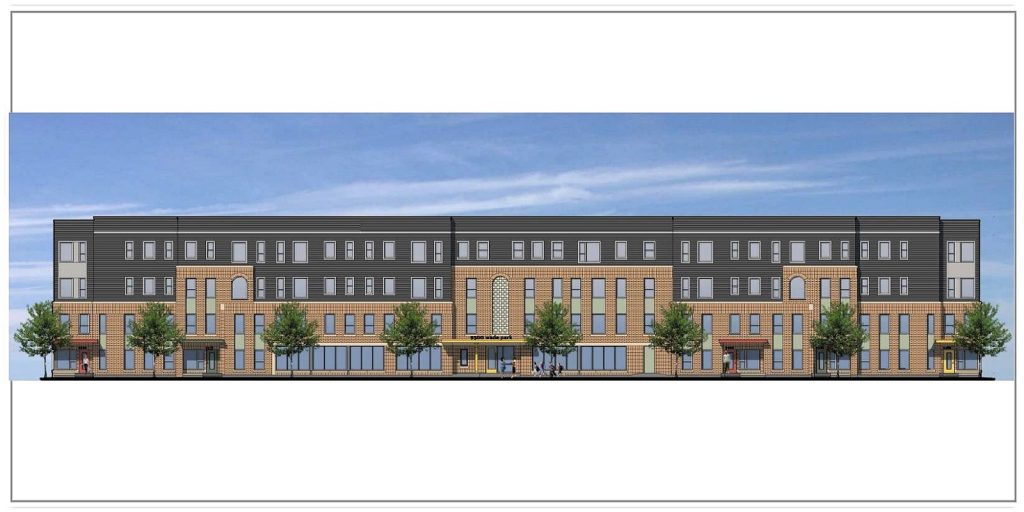
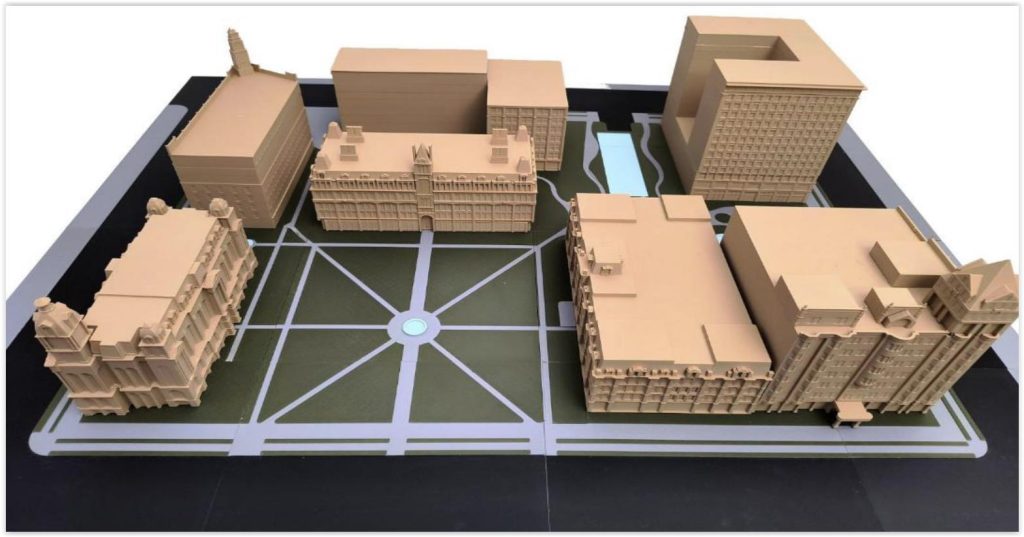
A massing for the humanities building which CWRU later supplied was sufficient to win the city’s support for the demolition. But that massing showed a larger structure — anywhere from 100,000 to 150,000 square feet.
“The Mandel Foundation’s investment in Case Western Reserve reflects our continued belief in the increasing value and importance of higher education, particularly in the humanities,” said Stephen Hoffman, the Mandel Foundation’s board chair and member of the CWRU Board of Trustees.
“It represents our confidence in President (Eric) Kaler’s leadership and vision as well as the remarkable momentum of this university as it celebrates its bicentennial,” he added.
In addition, the gift will allow CWRU to more than double the existing scholarship endowment capacity at the Jack, Joseph and Morton Mandel School of Applied Social Sciences through the continuation of the Mandel Dean’s Scholarships.
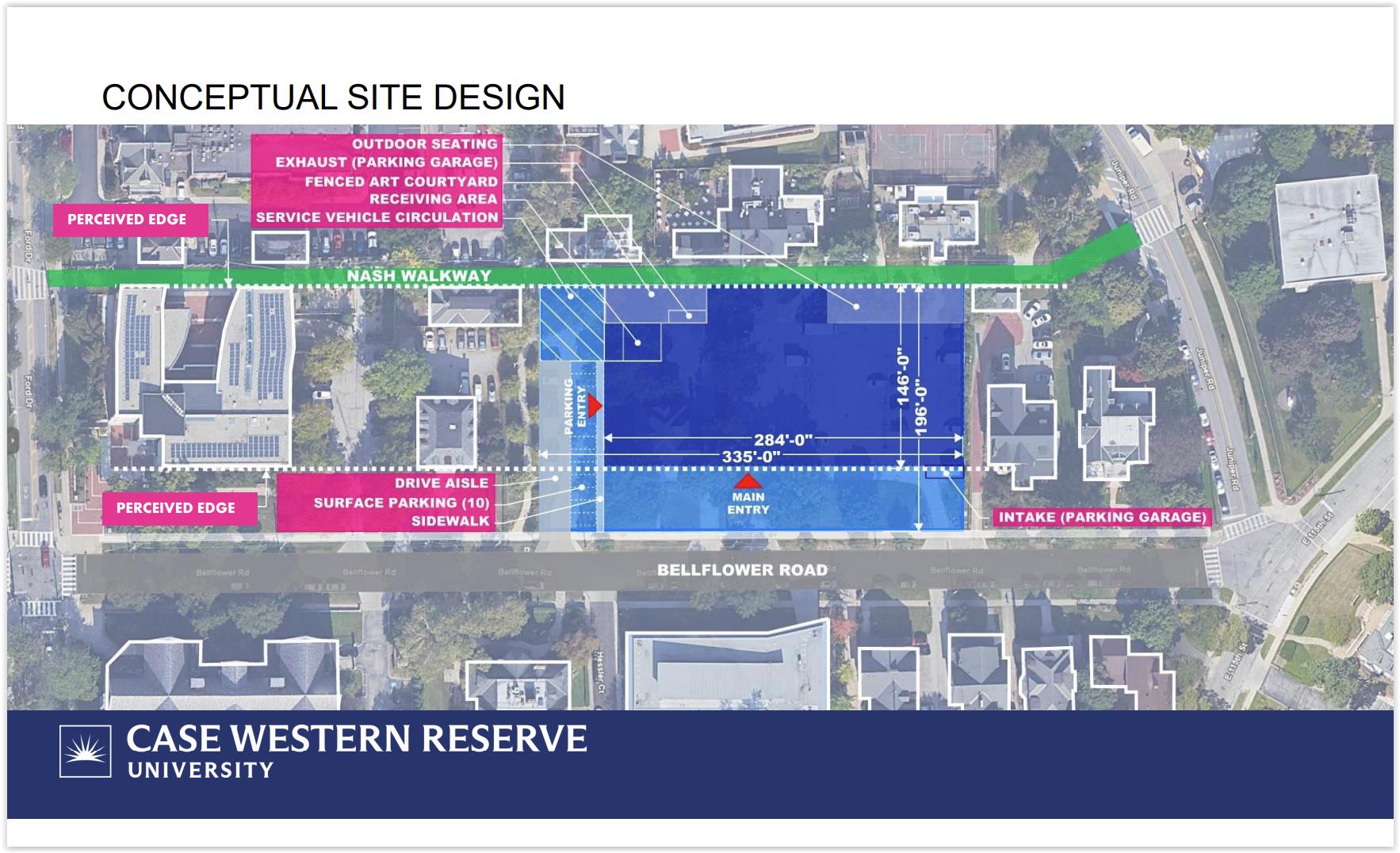
Conceptual footprint of a larger humanities building on Bellflower Road. The actual building will be smaller but may include many of the features shown here (CWRU).
The gift will create the Morton L. Mandel Presidential Chair, with President Kaler as the inaugural holder. This is intended to empower the president with flexible, discretionary resources to respond to emerging opportunities, accelerate innovation, and invest in academic initiatives.
The Experimental Humanities Program in the College of Arts and Sciences will be expanded through this gift. That includes academic programs, scholarships, stipends, and mentorship opportunities for Mandel Fellows in the Experimental Humanities.
Founded in 1826, CWRU was ranked this year as a top-25 university in the USA by TIME magazine. It was named one of 20 “New Ivies” by Forbes. And it became the fastest-growing research university in the elite 71-member Association of American Universities.
“The Mandel Foundation’s historic commitment is a reflection of the exceptional work done each day by our students, faculty and staff; their efforts have inspired this investment that will be transformative for the humanities, nonprofit leadership and, most importantly, our students,” said CWRU President Kaler.
“We are grateful for the visionary partnership of the Mandel Foundation over the decades and its continued support of Case Western Reserve,” he continued.
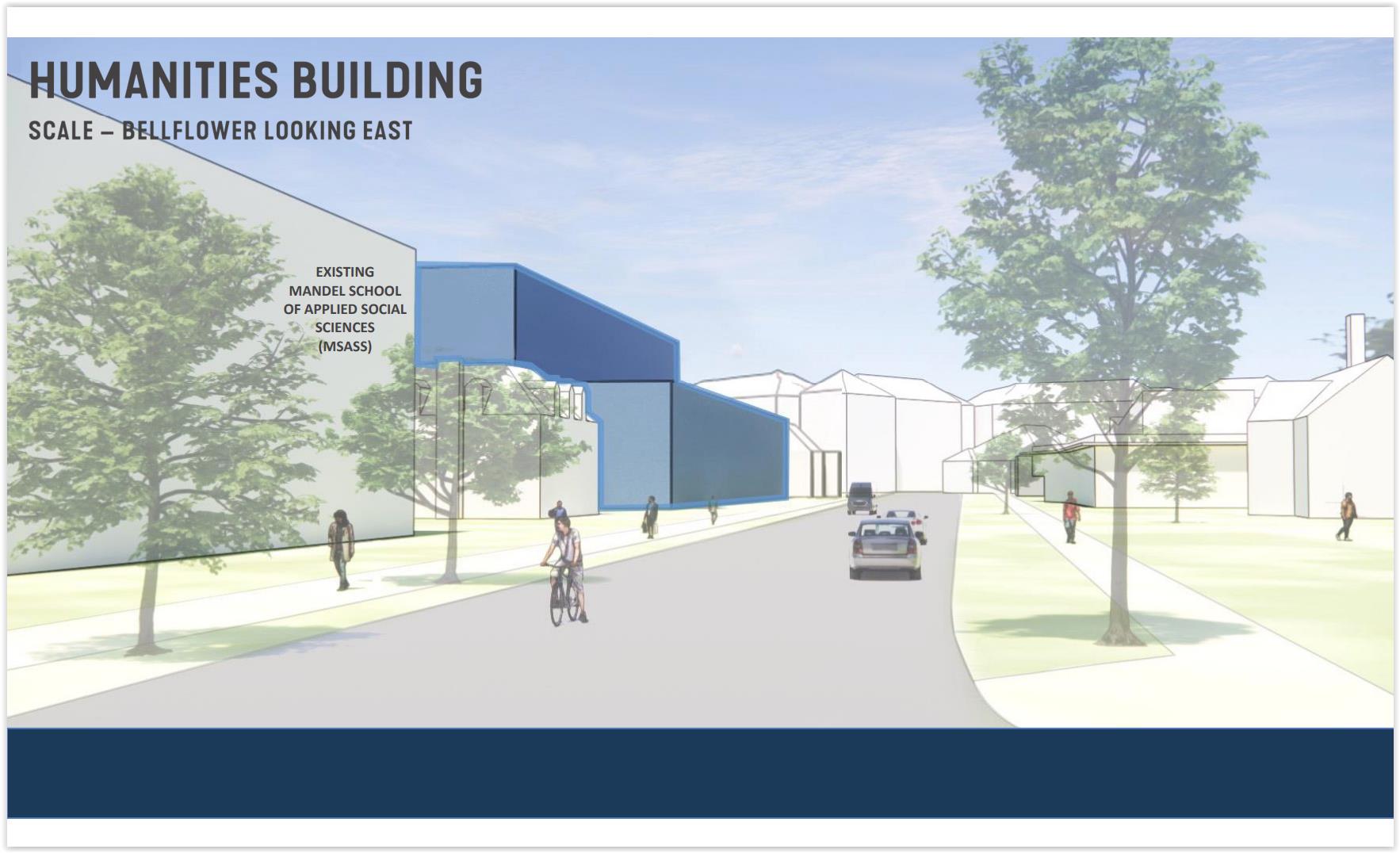
A massing, which shows scale and location of a building rather than its textures and features, for the planned humanities building was displayed in this 2024 graphic. The actual structure will be smaller than what is shown here (CWRU).
Notably, it marks a distinct investment in the humanities and social sciences at a critical juncture for the fields in higher education. Through much of the commitment, the university will elevate the humanities as a central force in shaping interdisciplinary discovery and driving ethical, inclusive technological advancement.
The commitment also aims to address the need for quality social workers in Ohio and the nation—providing significant, scalable scholarship support to make a top-ranked education possible for the purpose-driven nonprofit leaders of tomorrow.
“Case Western Reserve has always been a priority of the Mandel brothers and the Mandel Foundation,” said Jehuda Reinharz, president and CEO of the Mandel Foundation. “This historic gift represents a commitment to the present and future of the university, and an investment in the leaders it develops whose meaningful advances will improve our city and our society.”
Morton Mandel graduated from CWRU in 2013 — 74 years after he began his studies there. Along with his two brothers, Jack and Joe, he founded the Premier Automotive Supply Company in 1940, which later became one of the world’s leading industrial parts and electronic components distributors.
For decades, the Mandel brothers and the Mandel Foundation have supported programs and projects at CWRU, gifting $70 million to facilities and programs for applied sciences, social sciences and community studies.
END