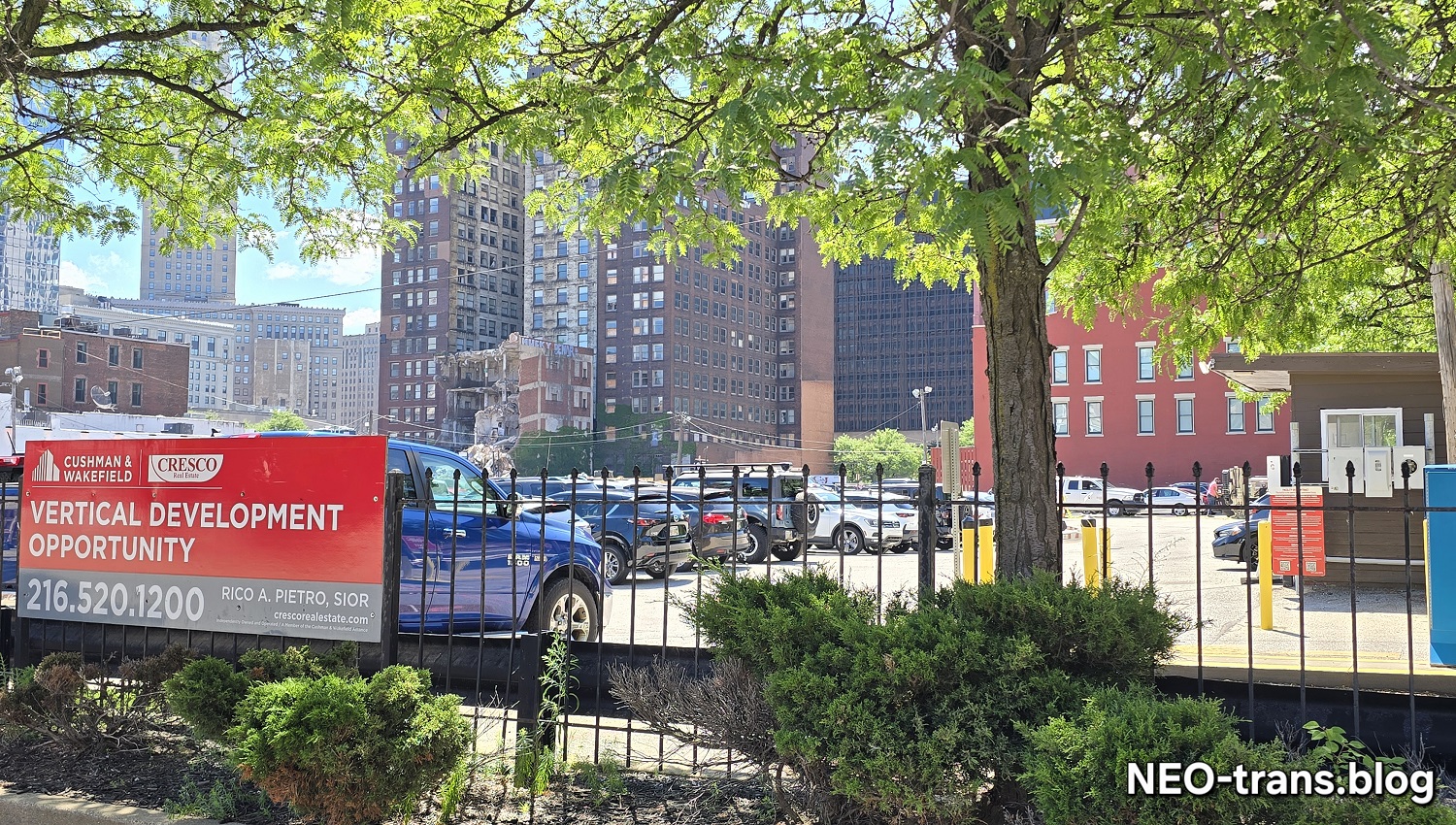
A parking lot at the corner of West 9th Street and St. Clair Avenue in Downtown Cleveland’s Warehouse District may indeed be the subject of a vertical development based on the workers in the background drilling for core samples at locations around the lot this week (NEOtrans). CLICK IMAGES TO ENLARGE THEM.
Development may be low-rise, mixed-use
A large parking lot in Downtown Cleveland’s Warehouse District that’s been up for sale twice since 2019 apparently is now under a purchase agreement with a buyer who seems interested in developing it.
But closing that deal means first conducting some due diligence on the 2.3-acre site at the southeast corner of West 9th Street and St. Clair Avenue. Crews were on-site this week conducting that geotechnical research, presumably for a new building or buildings. They weren’t drilling with the intent of keeping the site as a parking lot.
The site, having an address of 1365 W. 9th, is owned by an affiliate of Cleveland-based real estate firm Stark Enterprises and operated by LAZ Parking.
The buyer of the site is not known and the lead broker for Stark, Cushman & Wakefield CRESCO Principal Rico Pietro, said he was unable to divulge any information about the pending deal.
“You have a good nose for activity,” he said. “I cannot comment at this time.”
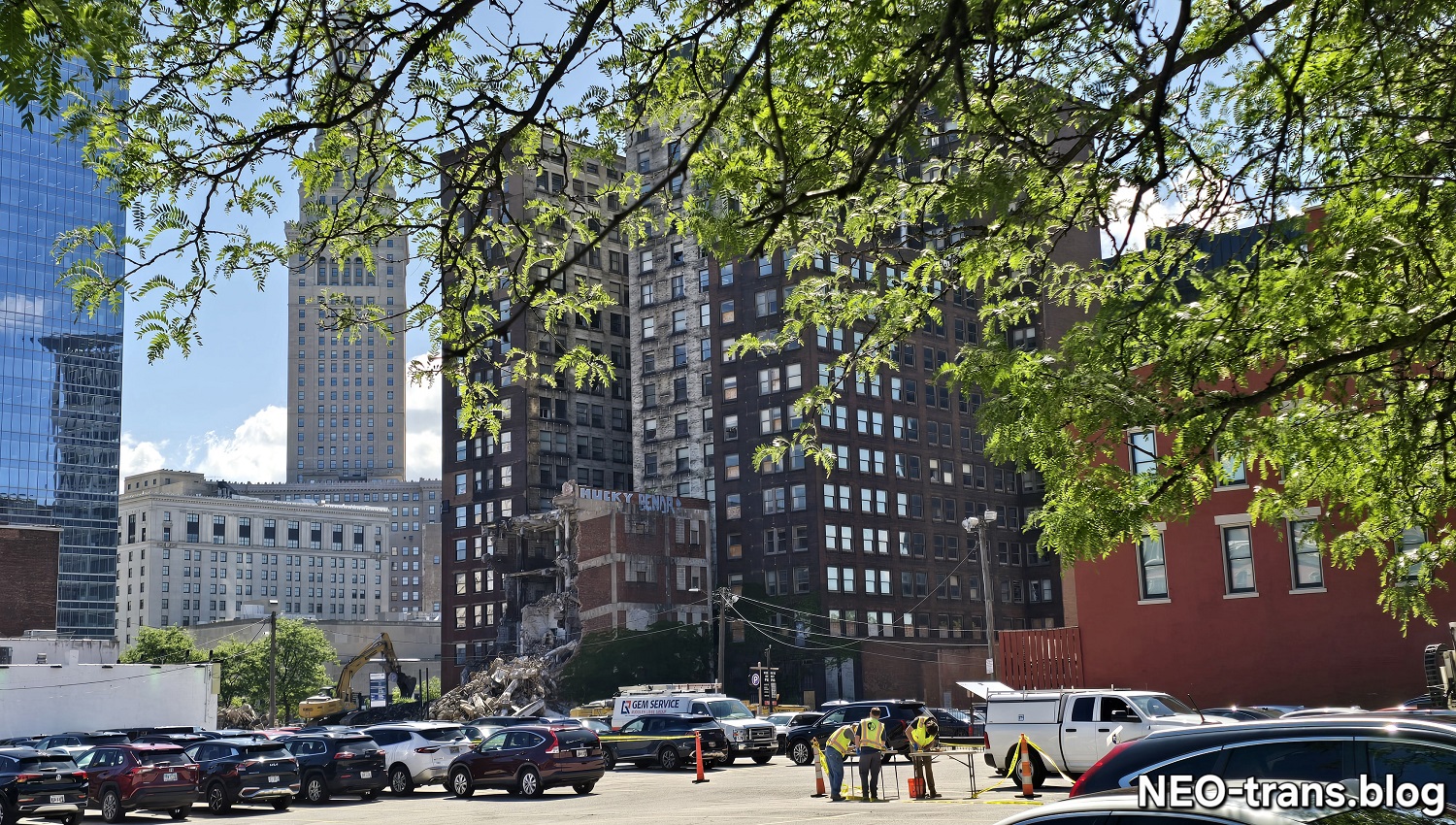
Geotechnical survey crews were working this week at the West 9th Parking Lot which apparently has a buyer who is interested in developing the lot with new uses (NEOtrans).
In December 2025, Pietro told NEOtrans that he had out-of-town suitors for the property, including one with deep pockets that had stepped up to sign a purchase agreement for the neighboring Rockefeller Building that was offered in the same CRESCO listing.
That deal fell through, but K&D Group of Willoughby stepped in to buy the Rockefeller. It is demolishing the Rockefeller’s obsolete parking garage, so it can be replaced with a new 500-space garage topped with an amenity deck for the residentially redeveloped Rockefeller Building.
K&D Group Vice President Douglas Price IV told NEOtrans on Monday that the decorative arch at the vehicular entrance for the historic garage was saved by crews so it could be incorporated into the design of the new garage.
Stark Enterprises Vice President of Marketing and Communications Stacie Schmidt said she couldn’t comment about the pending sale of the West 9th Parking Lot.
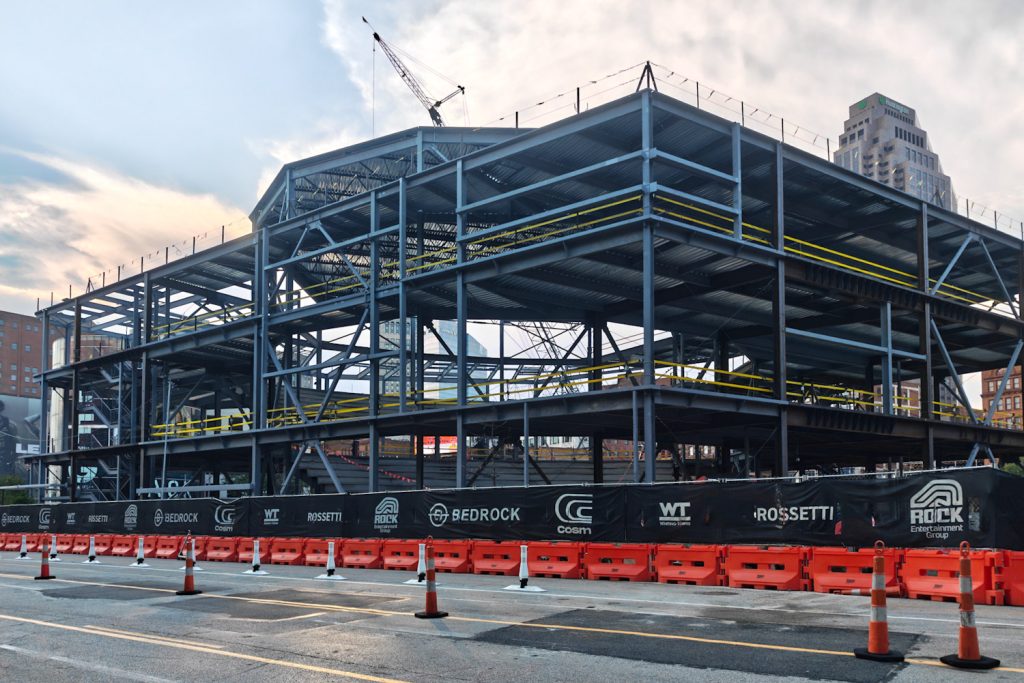
Stark’s West 9th Street Parking LLC paid $9.5 million for the property in 2014 but never formally proposed a development for it. After the construction of Sherwin-Williams’ nearby headquarters on a 5-acre parking lot and Stark’s sale of its 3-acre Gateway District parking lot to Bedrock for Cosm and future mixed uses, this lot is one of the last “parking craters” left downtown.
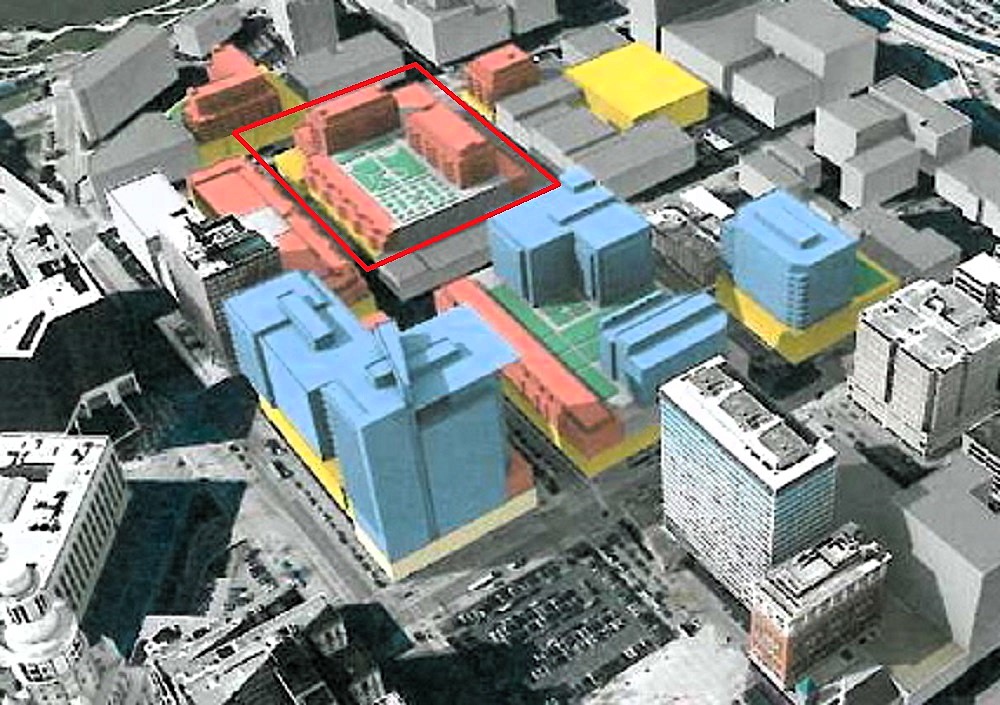
In the early 2000s, Stark Enterprises envisioned redeveloping multiple sites in the Warehouse District. Blue-shaded structures are offices, red is residential and yellow is parking. In 2014, it acquired the West 9th Parking Lot, outlined in red, with the intent of developing it. But Stark never followed through on that vision (Stark).
Stark is going to want to recoup its investment, at least. And so will the buyer. At a potential purchase price of roughly $5 million per acre, it may take more than just parking revenues to recoup it.
CRESCO estimates the 350 parking spaces on this lot generate anywhere from $1.1 million to $1.3 million per year. If the buyer seeks more than just passive net income starting in the 2030s, it may have to seek what CRESCO’s calls a “generational” development here.
Zoning for the site is Limited Retail Business and allows structures up to 600 feet tall. The site is located in the Victorian-era Historic Warehouse Landmark District which was listed on the National Register of Historic Places in 1982.
NEOtrans nosed around the site yesterday and talked with geotechnical survey crews working for EnviroCore of Plain City, a suburb of Columbus, and Resource International Inc., based in Columbus but with a local office in Garfield Heights.
The workers confirmed they were drilling to collect soil samples from below the parking lot’s pavement and the 12- to 15-foot-deep brick and stone foundations of historic buildings more than 200 years old. Core samples were drilled from multiple locations throughout the site.
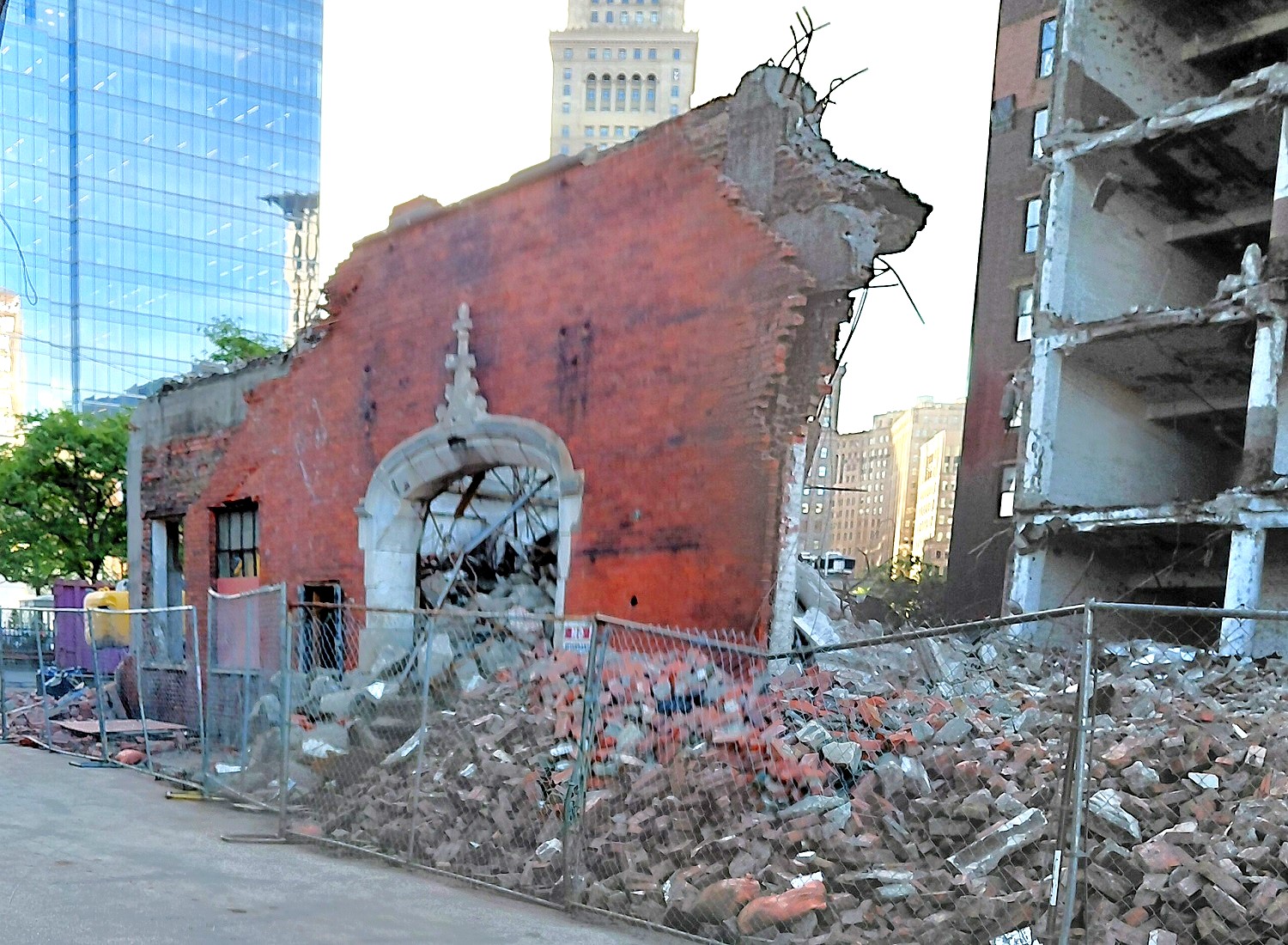
Next to the West 9th Parking Lot, the obsolete garage for the Rockefeller Building is being demolished. But crews saved this decorative arch which was the vehicular entrance to the 1925-built garage (Contributed).
But they said their drilling and sampling was to a depth of only 20 feet. If this is the extent of their explorations, it suggests that a high-rise is not in the buyer’s interest. In fact, it may be far less.
NEOtrans asked a couple of construction experts what can be inferred from the depth of the geotechnical sampling. While both spoke on the condition of anonymity, they agreed that a shorter and/or lighter structure may be under consideration here.
“At a 20-foot depth,” one expert said, “you’re looking at something with simple spread footers and overall not very tall.” Spread footers are a thickened concrete base to distribute a structure’s concentrated load across a larger area of soil. It prevents a building from sinking.
“For a lighter-weight three- or four-story building, we’d go 25 to 30 feet if we knew the soils were decent,” the expert continued. “If we had reason to be concerned with poor soils, we’d go deeper to be safe.”
Another expert agreed and said the structure’s weight, and not necessarily the height, was the key factor. A parking garage would likely be heavier than a commercial building of the same height. And a residential building of the same height as the commercial building might be lighter still.
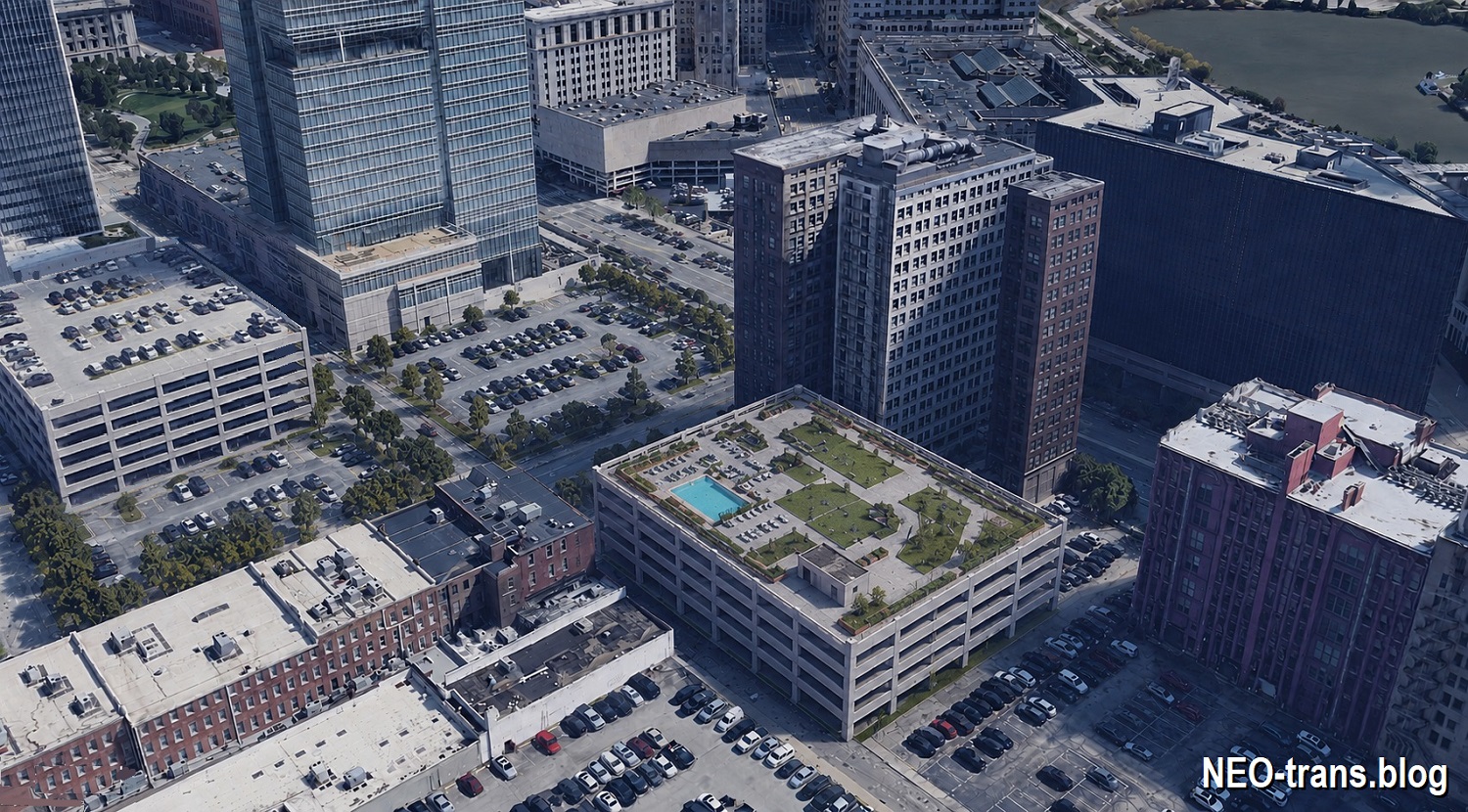
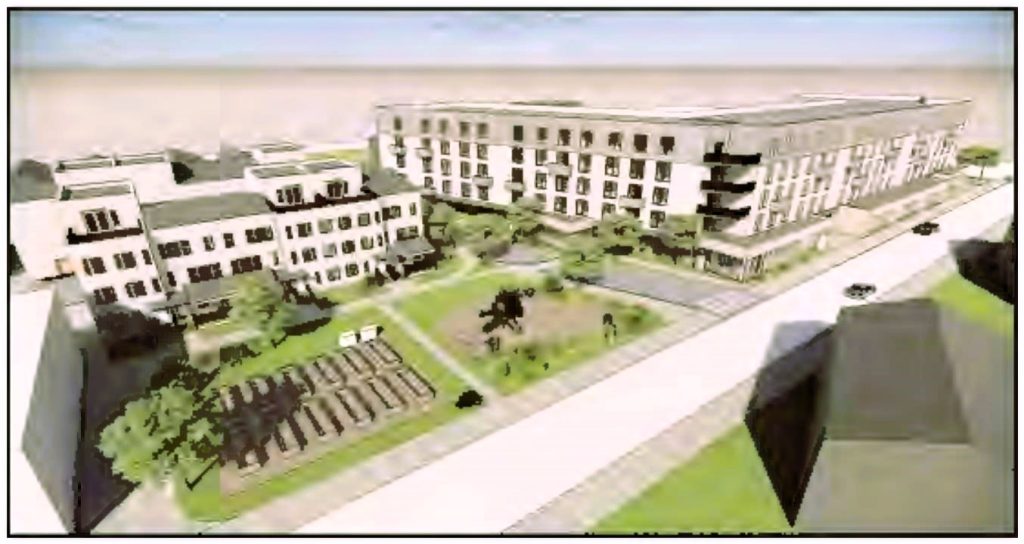
This is an unofficial, conceptual rendering of what a 500-space parking garage with an amenity deck on its roof, behind the Rockefeller Building, could look like. Such a garage could supply the parking needs of the Warehouse District if one or more surface lots are developed (NEOtrans).
Based on the depth of the soil sampling, it’s possible that a residential structure might range in height of those already surrounding the site. To the west of West 9th, north of St. Clair and along West 6th Street, historic structures are four and five stories tall.
To the south of it, along Superior, structures range in height from the nine-story-tall Perry-Payne and Brotherhood of Railroad Trainmen buildings to the 17-story Rockefeller Building.
According to geotechnical surveys done in 2020-21 for the Sherwin-Williams headquarters tower, the soils below the Warehouse District consisted of grayish-brown fine sand and moist, trace silt to a depth of more than 30 feet before transitioning to clay.
Bedrock, capable of supporting structures of more than 20-30 stories, wasn’t reached until drilling more than 200 feet below the surface. To support the 616-foot-tall Sherwin-Williams headquarters, reinforced concrete caissons had to be sunk to bedrock.
But buildings ranging in height from 15-30 stories, without parking, might require a several-foot-thick concrete mat, called a floating pad. An example of this is the 23-story Skyline 776 apartment tower that opened last year on Euclid Avenue. It used a 5- to 7-foot-thick concrete mat foundation.
END