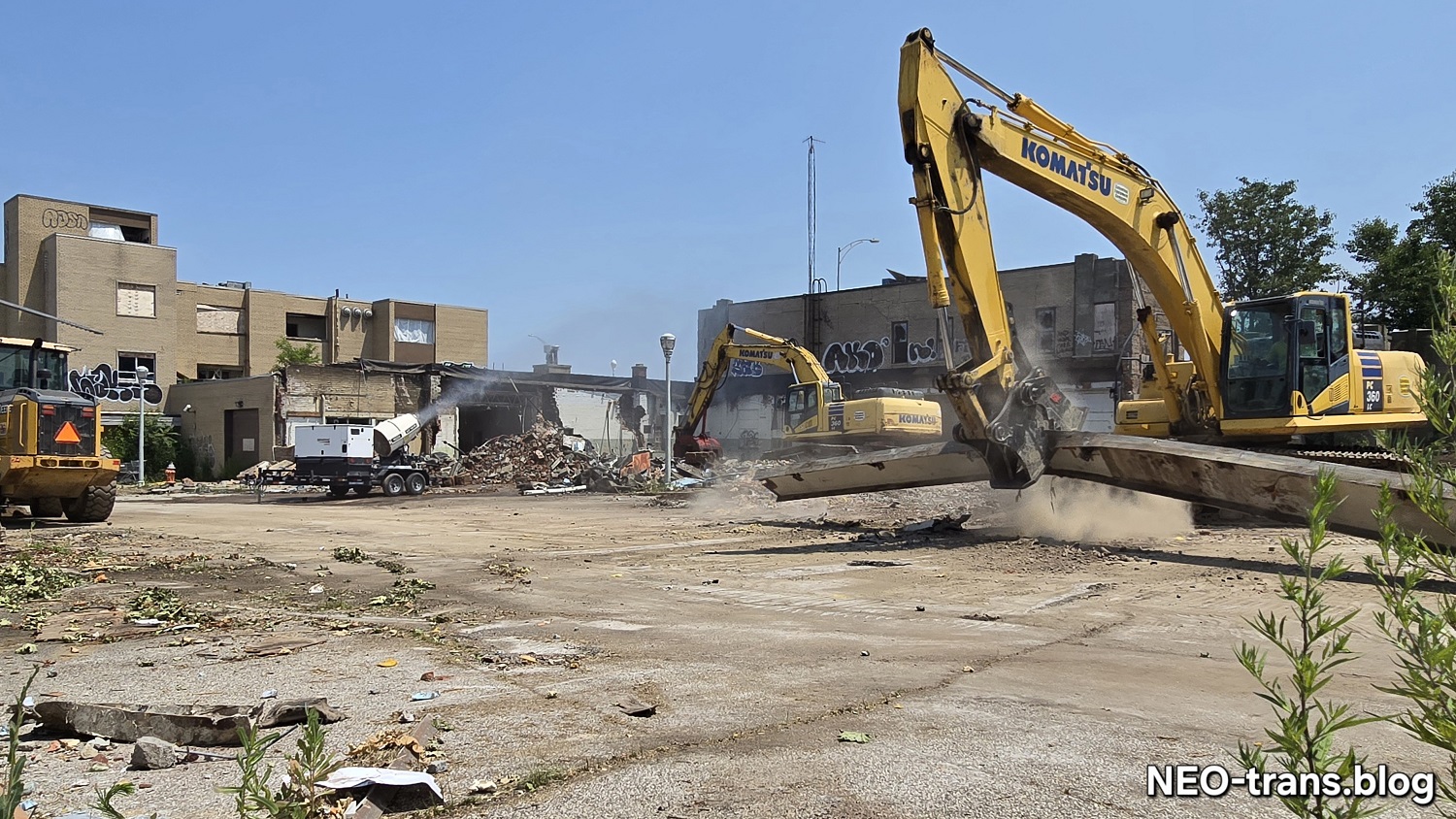
Workers and their heavy equipment began taking down the former Cuyahoga County Engineers’ buildings at the west end of the Detroit-Superior Bridge in Cleveland’s Ohio City neighborhood (NEOtrans). CLICK IMAGES TO ENLARGE THEM.
Construction of apartments to follow
Demolition crews started working this week to raze the former Cuyahoga County Engineers’ garage and lab complex at the northeast corner of the Detroit-Superior Bridge and West 25th Street for the long-planned, multi-family Bridgeworks development.
The demolition has been a long time coming. The engineers’ buildings, dating from the 1940s to the 1960s, were vacated nearly a decade ago and were getting more vandalized over the years. The 2-acre site has an address of 2429 W. Superior Ave. and is in Cleveland’s Ohio City neighborhood.
A new demolition permit application was submitted to the city June 23 by JS Paris Excavating of Youngstown. It showed an updated cost of $1,074,813 for demolition of existing building structures, foundations, utilities and associated site improvements.
“Scope includes disconnecting and removing existing water, sanitary sewer, and storm sewer as required,” wrote Jason Paris, vice president of JS Paris Excavating in the application. Work will also “Remove and dispose of all site concrete, including sidewalks, curbs, pads and pavement.”
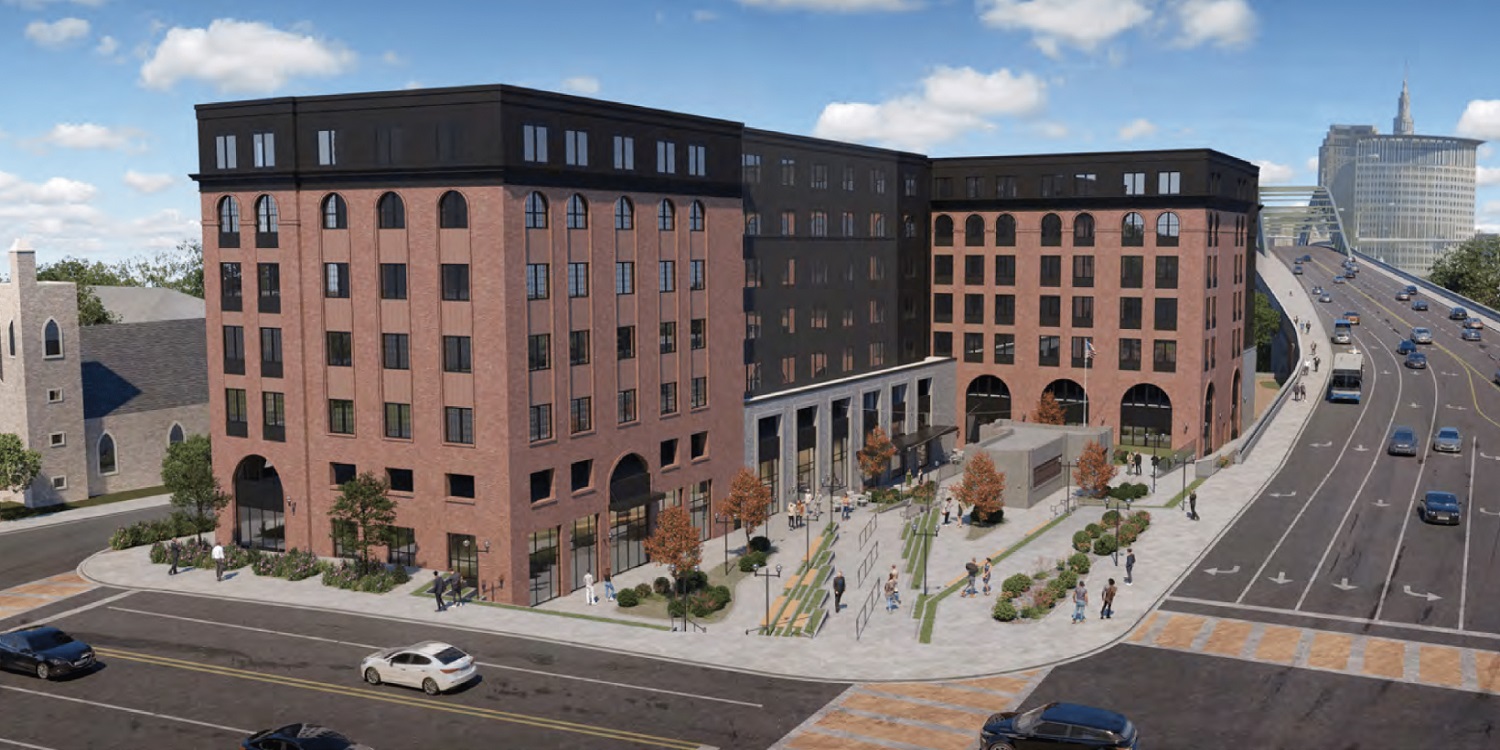
With a revised construction cost of $48.45 million, the Bridgeworks development at the Ohio City end of the Detroit-Superior Bridge is getting underway. Downtown Cleveland is in the background (GLSD).
But the work involves more than just demolition. His contract also prepares the site for the construction of the 294,636-square-foot Bridgeworks development, featuring 219 workforce apartments, a 199-space parking garage, and 1,200 square feet of ground-floor space.
Site work will “Perform site grading in accordance with approved plans and install new proposed utility infrastructure, including water, sanitary sewer, storm sewer, electric, gas, and communication services as applicable,” Paris added.
Not to be demolished is a 110-year-old, stone-cladded ticket booth for a vacant streetcar subway on the adjacent, lower level of the Detroit-Superior Bridge which connects Ohio City to downtown.
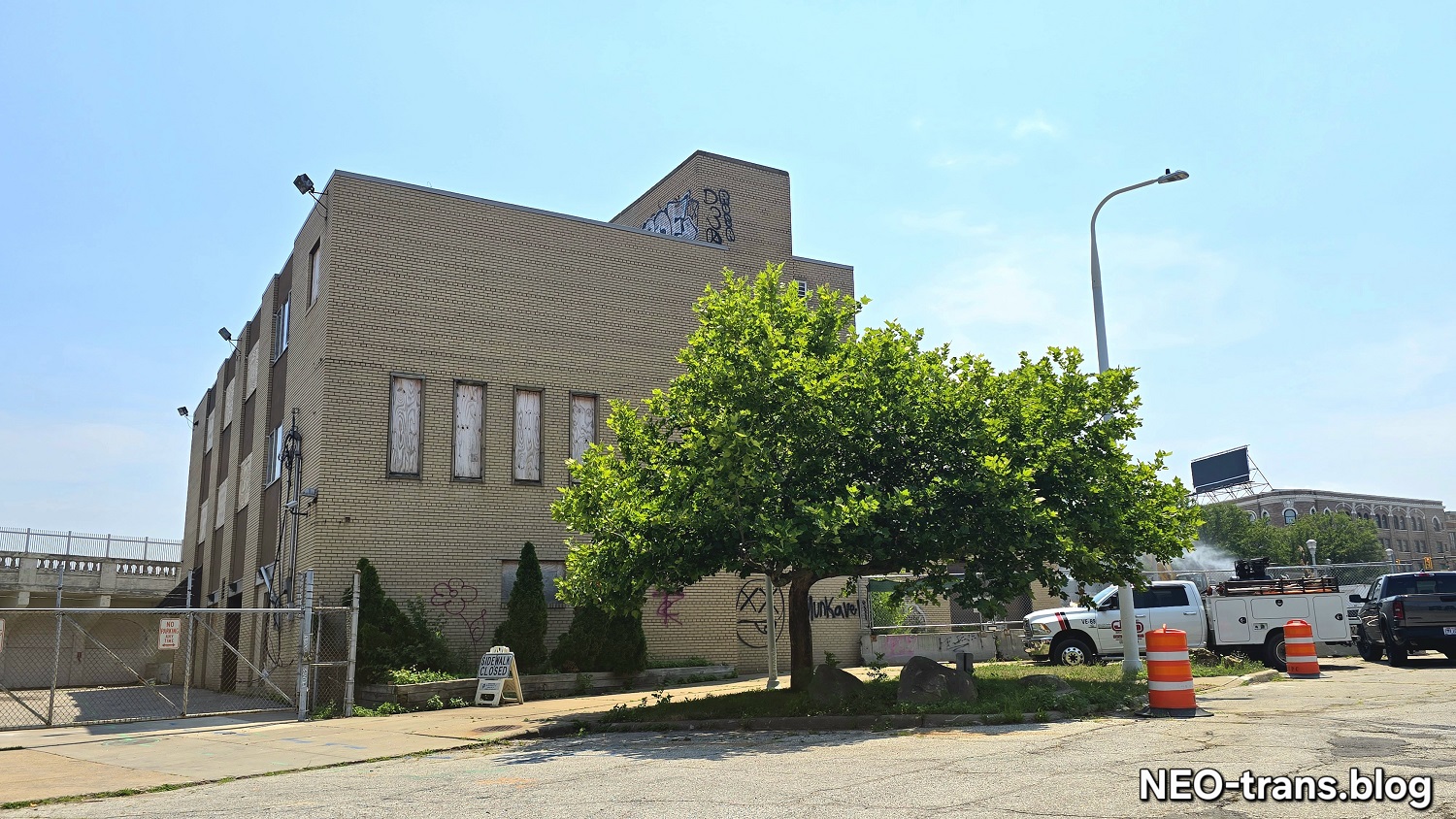
Demolition crews are working from west to east at the former Cuyahoga County Engineers’ site which means the largest building on the site, seen here, will likely be the last to come down (NEOtrans).
Demolition costs for a two-story lab and office building plus a single-story garage structure were previously estimated at $364,128 by Sitetech, Inc. in a prior demolition permit application.
The prior demolition permit, approved by the city on July 15, 2025, was due to expire one year after issuance if work had not visibly gotten underway. That’s why work had to get underway this week. And while the demolition cost went up, overall construction cost estimates went down.
Bob Fridrich, president of Geis Construction, Bridgeworks’ general contractor, wrote an e-mail to the city Building Department on June 8 that the construction cost estimate of $58.5 million was not correct. Instead, it is $48.45 million, according to the department’s Web portal.
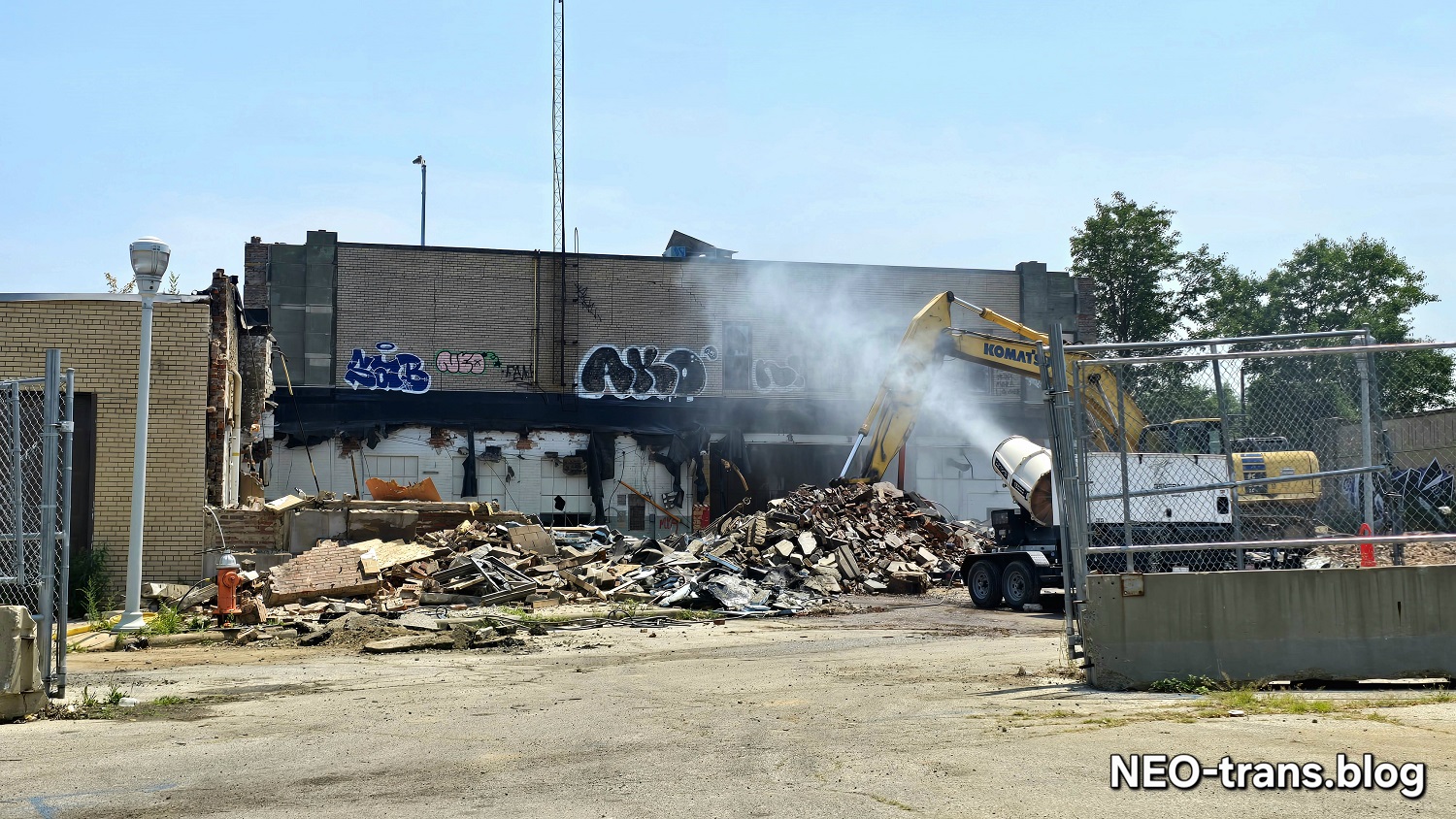
The county engineers’ garage is coming down under a mist of water to prevent dust from getting airborne. And a few workers managed to walk through the mist today on yet another a 90-degree July day in Cleveland (NEOtrans).
The construction cost of a project determines the building permit fees that a general contractor is responsible for paying for that project. In this case, the building permit fee for Bridgeworks is $359,801.88, public records show.
That does not include separate permits for electrical, plumbing and heating-ventilating-air conditioning systems. There will also be separate submissions for the automatic fire sprinkler and fire alarm and detection systems, as well as for special inspections and signage, according to city records.
Development costs for Bridgeworks are much higher — up to $82.5 million. That includes many things like demolition, relocating old street and sewer infrastructure, property and easement acquisitions that extend beyond the buildable site, architectural and legal fees, city zoning and permit fees and other soft, sunk costs, plus the construction costs.
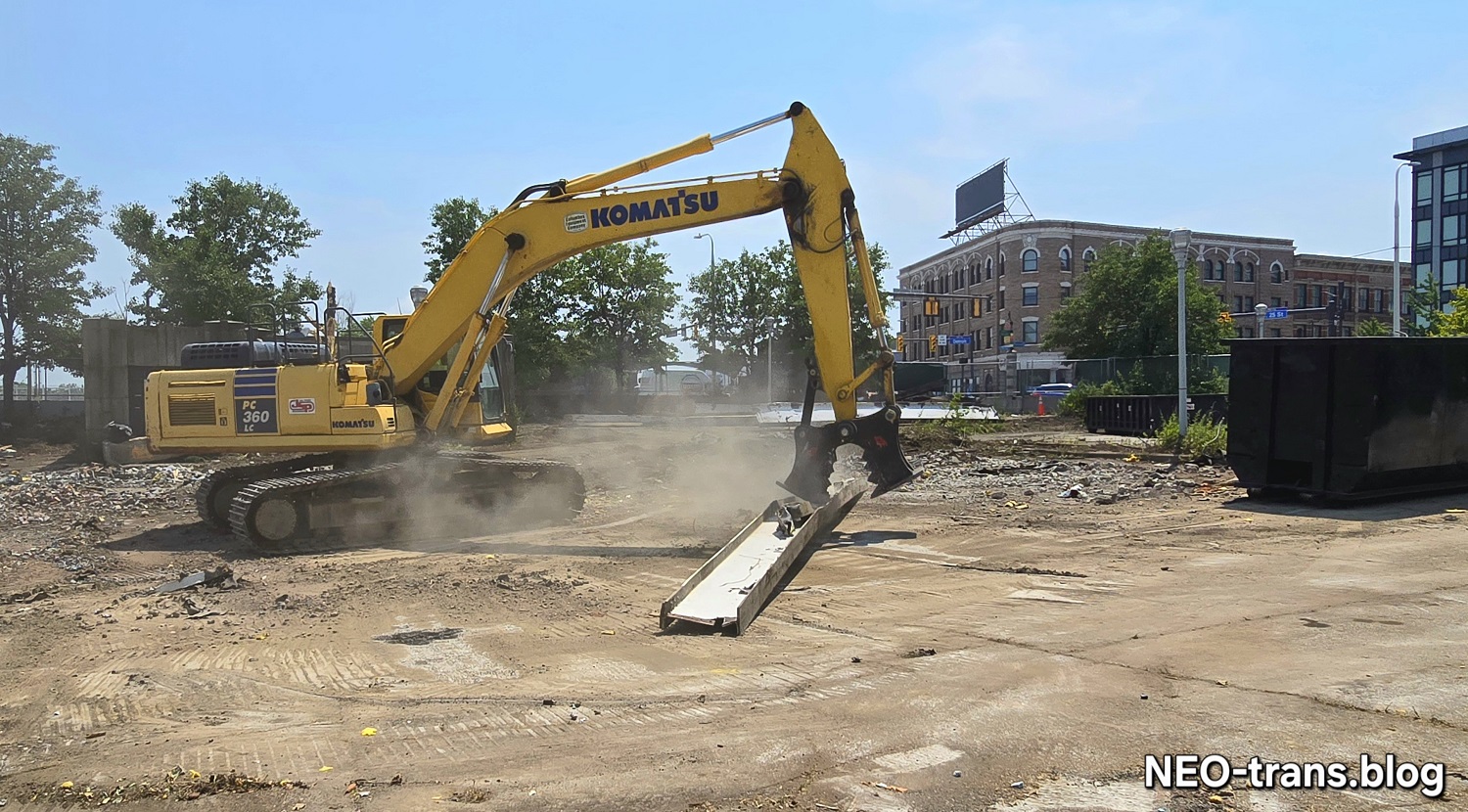
Demolition work involved cutters to break up steel beams for easier disposal. In the background is the historic Forest City Savings & Trust Co., converted to apartments over retail less than a decade ago and the more modern The Quarter apartments, also above retail spaces (NEOtrans).
The last user of the county engineers’ building was the Cuyahoga County Personnel Review Commission. Its offices and staff moved out in 2019, according to county real estate consultant Allegro Real Estate Brokers & Advisors.
The Cuyahoga County Engineer, which plans, builds and maintains all Cuyahoga County-owned roads, bridges and structures, became the Department of Public Works during the county’s reform in 2009. Its offices moved to the new county administration building at East 9th Street and Huron Road downtown.
The demolition has been a long time in coming because the Bridgeworks project has been a long time in coming. But movement on the project became more noticeable toward the end of 2025. The project’s origins go back much farther, however.
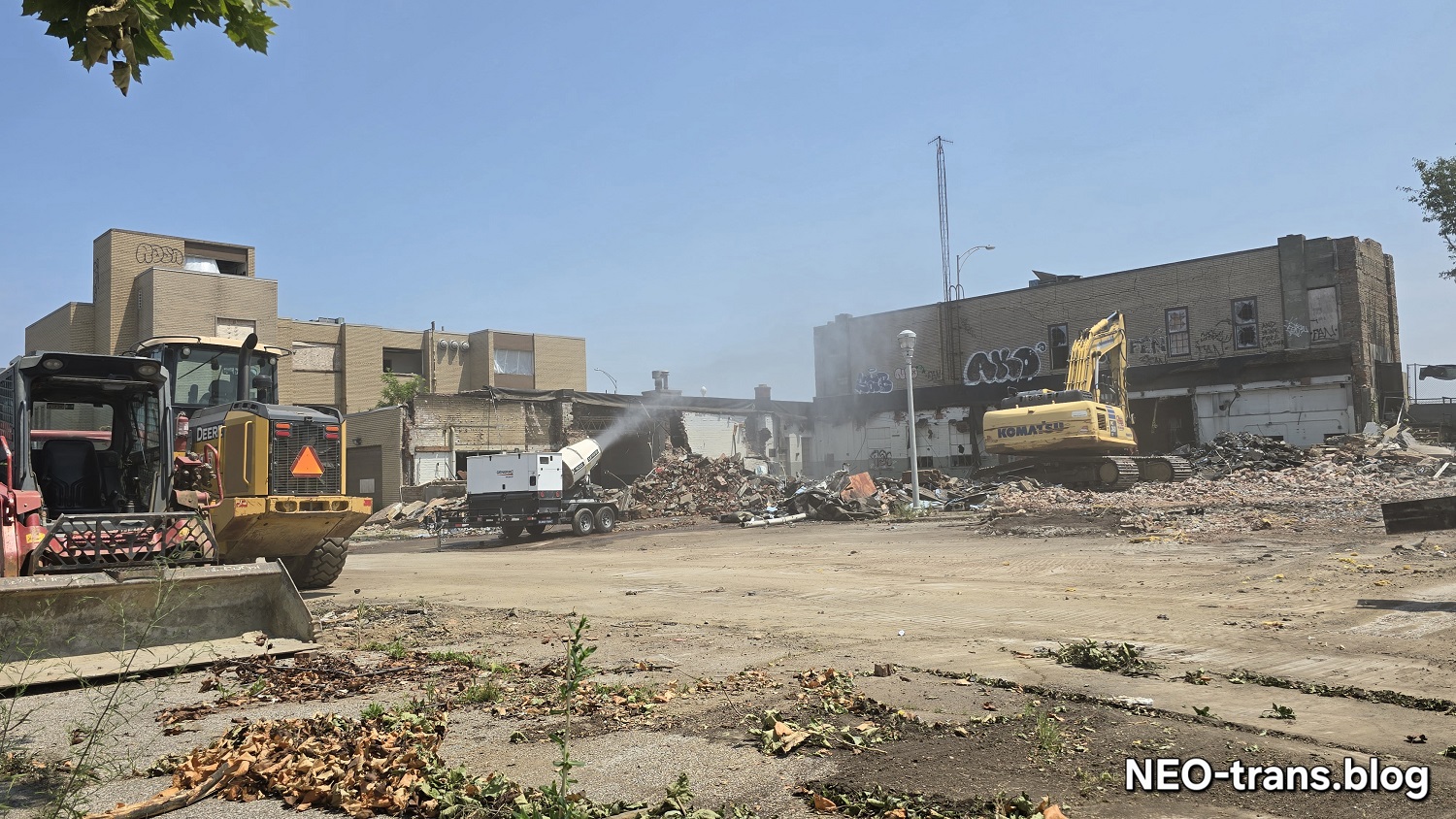
All of the structures to be demolished are visible here, including the county engineers’ garage, lab and office buildings (NEOtrans).
NEOtrans broke the story in May that Bridgeworks project was a go and was the first back in 2018 to reveal that the county Engineers’ property would likely hit the market. And we were first to report in 2019 that a Cleveland-based group led by Michael Panzica was the buyer.
That group became Bridgeworks LLC which also included Grammar Properties led by real estate investor Graham Veysey and his architect wife Marika Shioiri-Clark. The same partnership had previously built the 11-story Church+State nearby at 2818 Church Ave.
“The Bridgeworks project has been about resilience,” Veysey told NEOtrans. “Resilience is in the DNA of every single Clevelander including the whole project team who stayed with this to make a significant project happen at one of the most prominent intersections in Cleveland.”
END