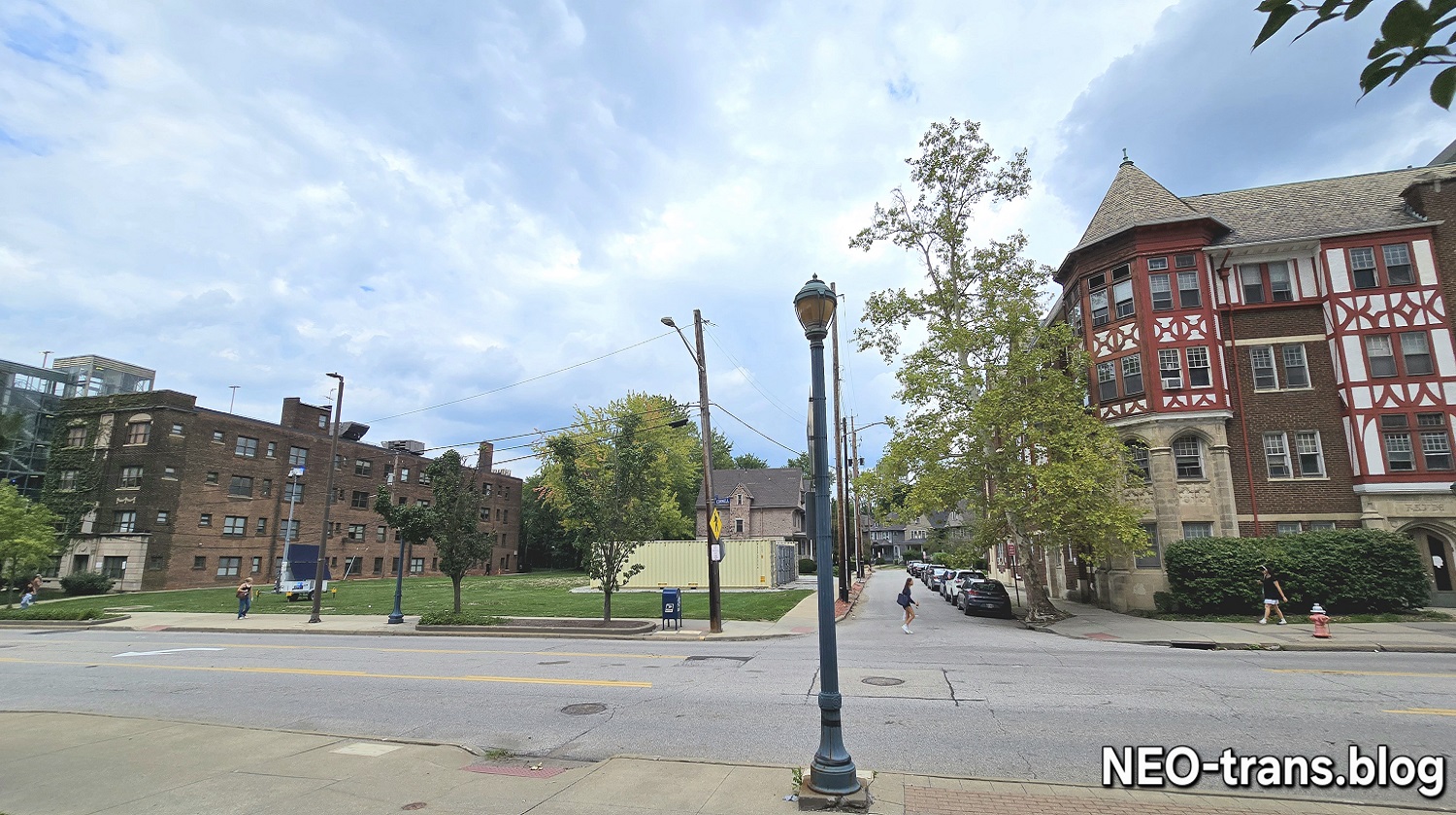
Every structure visible in this northward looking view from Cornell Road in University Circle, from the brick Foley Building at left, to 12 houses on East 115th Street including the street, to the Fayne Apartments at right, are proposed to be removed from this scene in the coming years by University Hospitals for temporary parking lots (NEOtrans). CLICK IMAGES TO ENLARGE THEM.
Raze 12 homes, 2 buildings for parking
Article updated Sept. 10 with UCI quote.

University Hospitals will seek a recommendation tomorrow morning from a city design-review committee to demolish 12 historic homes it owns along East 115th Street in Cleveland’s University Circle district. Two neighboring buildings, one with offices and the other with 44 apartments, may also join them soon on the take-down list.
Those same homes were threatened with demolition at various times over the past 50 years with University Circle Inc. (UCI) stepping up to maintain them for UH until 2022. UCI said it supports a fair process for UH’s plan to be considered by the City. UH is asking the City Planning Commission to join in support.
For the past 25 years, almost no maintenance has been done on the endangered 12 houses, city records show. They have not been rented out and their utilities were disconnected. It has led some to accuse UH and UCI of attempting to justify demolition by neglect.
But UCI said it has spent nearly $1 million from 2000-2020 repairing and maintaining all 16 buildings along East 115th. UH officials said that it is “in the business of patient care, not housing,” per its presentation to the City of Cleveland’s Central East Design Review Committee.
As an advisory panel, the committee cannot approve or reject the demolition application. It can recommend or not recommend that the full citywide Design Review Committee or Landmarks Commission of the City Planning Commission respond to a proposed course of action.
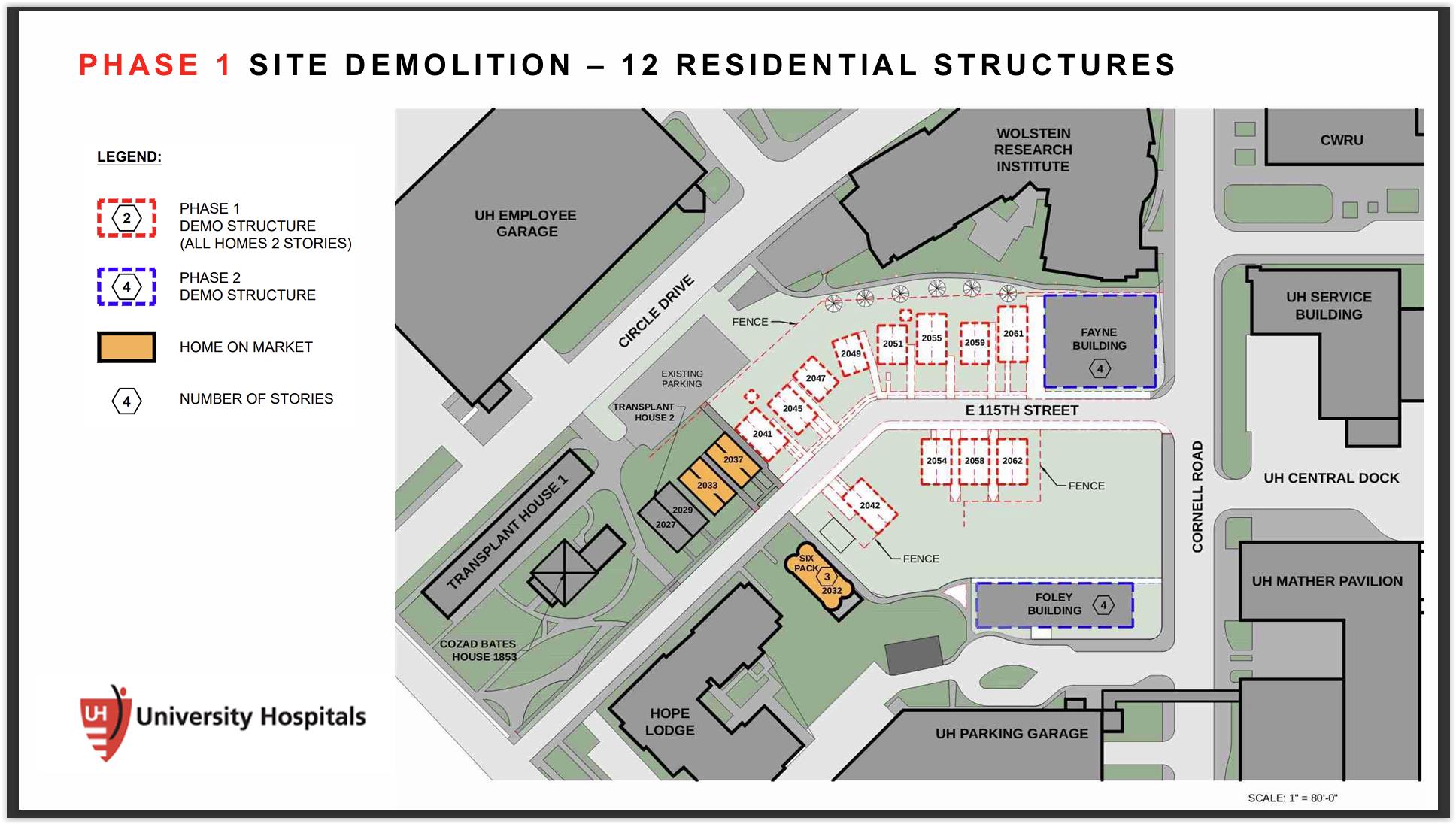
The first phase of altering East 115th Street includes demolishing 12 homes and selling three residential structures, including the brick “six-pack” apartment building (UH).
If the citywide Design Review Committee or Landmarks Commission denies the pending demolition request, UH will not be able to move forward with its plans. If the citywide panel approves the request, UH can submit demolition permit applications for the structures.
There are 15 houses on East 115th plus a three-story brick “six-pack” six-unit apartment building. At the north end of the street, it is placing two houses up for sale along with the six-pack apartment building. The third house is to remain with UH as temporary housing for residential transplants.
In the place of these 12 houses plus the two buildings, along with a section of East 115th itself north of Cornell Road, UH envisions constructing a Healthcare Center of Excellence building in the future.
But for the foreseeable future, UH is asking the city to remove the structures so UH could provide two interim parking lots and greenspaces around them.
“We have an opportunity and a desire to clear this land so that we can continue to grow University Hospitals in order to fulfill our mission and serve the community,” UH said in an e-mailed statement to NEOtrans and in its presentation.
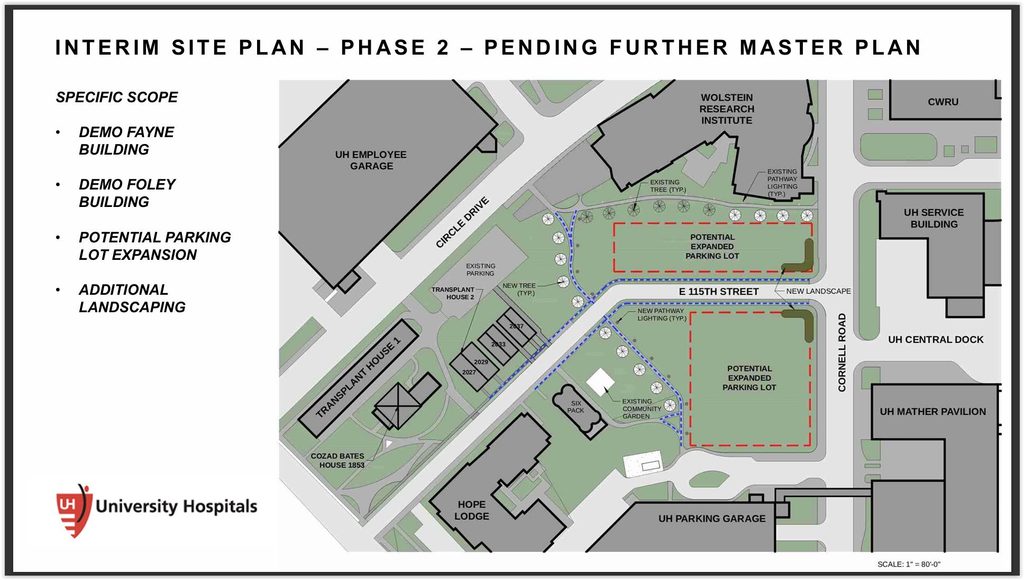
Phase two would include demolishing the Fayne Apartments at the northeast corner of East 115th Street and Cornell Road as well as the Foley Building containing UH offices just beyond the northwest corner. North is at the left in this map (UH).
“We will work with our partners to salvage and repurpose parts of the homes that UH has owned for decades and are seeking permission to raze the structures thereafter,” UH continued. “We are still working to determine the best long-term use for the property, but it will ultimately be based on the clinical needs of our patients.”
In its main campus masterplan in 2005, UH proposed building a future Healthcare Center of Excellence here. UH was about to seek an update of the masterplan in 2020 when the COVID-19 pandemic hit. The health system said it will likely seek an update of the campus masterplan as early as next year.
But the year 2005 seems to be important in the fate of East 115th. According to UH’s presentation to the city, only one building permit for repairs and maintenance was submitted by UH and UCI and approved by the city after 2005 for any of those 12 houses.
That was in June 2011 for installing 30 linear feet of water piping for $1,000 in the house at 2042 E. 115th. city records show the only other building permit sought for any of the 12 houses since then was for a $2,000 neon sign requested in April 2018 at 2061 E. 115th. It was denied by the city.
“Public reporting indicates that the properties were vacated and utilities discontinued which contributed to their deterioration,” wrote Cleveland Restoration Society President Kathleen Crowther in a Sept. 3 letter to the city, objecting to their demolition. “That deterioration should not become a self-fulfilling justification for demolition.”
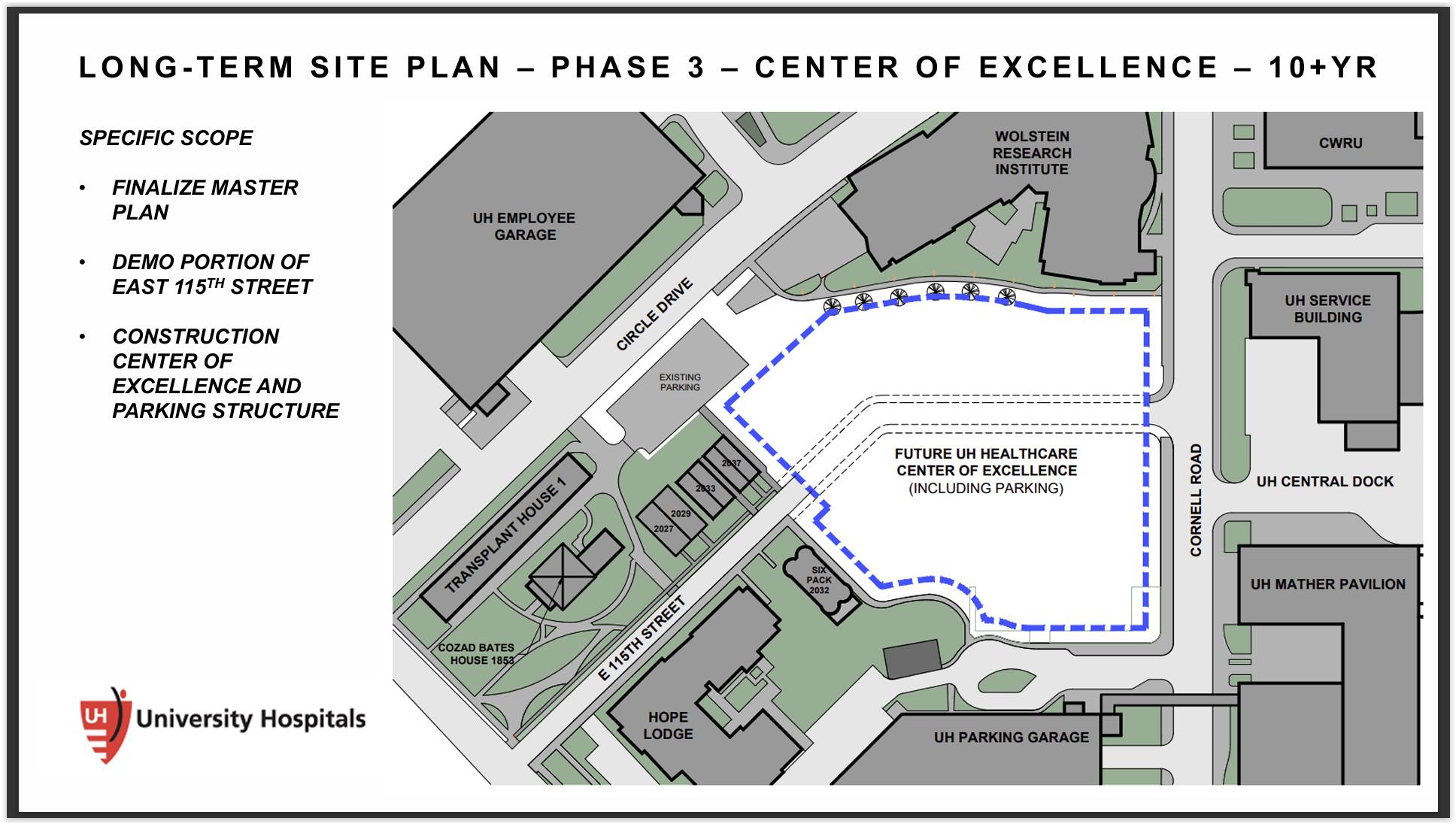
In the past, University Hospitals has considered a Healthcare Center of Excellence building in place of East 115th Street, 12 historic houses, an apartment building, an office building and a recently demolished training center (UH).
Despite the visible decay to the exterior condition of the houses over the years, only one house, 2062 E. 115th, was cited by the city for violating its building code regarding exterior maintenance, public records show. That was in Sept. 2024. UH appealed but a disposition of that case is unknown.
The houses were built in the late 1800s and early 1900s. UH sought to demolish them in 1976 but was rebuffed by community activists. While UCI and later UH steadily acquired them in the 1970s and 80s, UCI agreed to lease them from UH, maintain them and rent them out to residents.
“Changes to the residential housing requirements in the City of Cleveland and UH’s inability to commit to a long-term lease resulted in UCI (to) begin discussions to terminate some of the houses that required more investment,” UH’s presentation added. “UCI continued to return houses to UH and ultimately fully terminated the Master Lease in July 2022.”
“East 115th Street is a remarkable, intact collection of century-old residences that represents an increasingly rare portrait of University Circle’s residential history and character,” Crowther added. “The concentration of these houses and their craftsmanship creates an intact streetscape that warrants proper stewardship and care to ensure this enclave is not lost.”
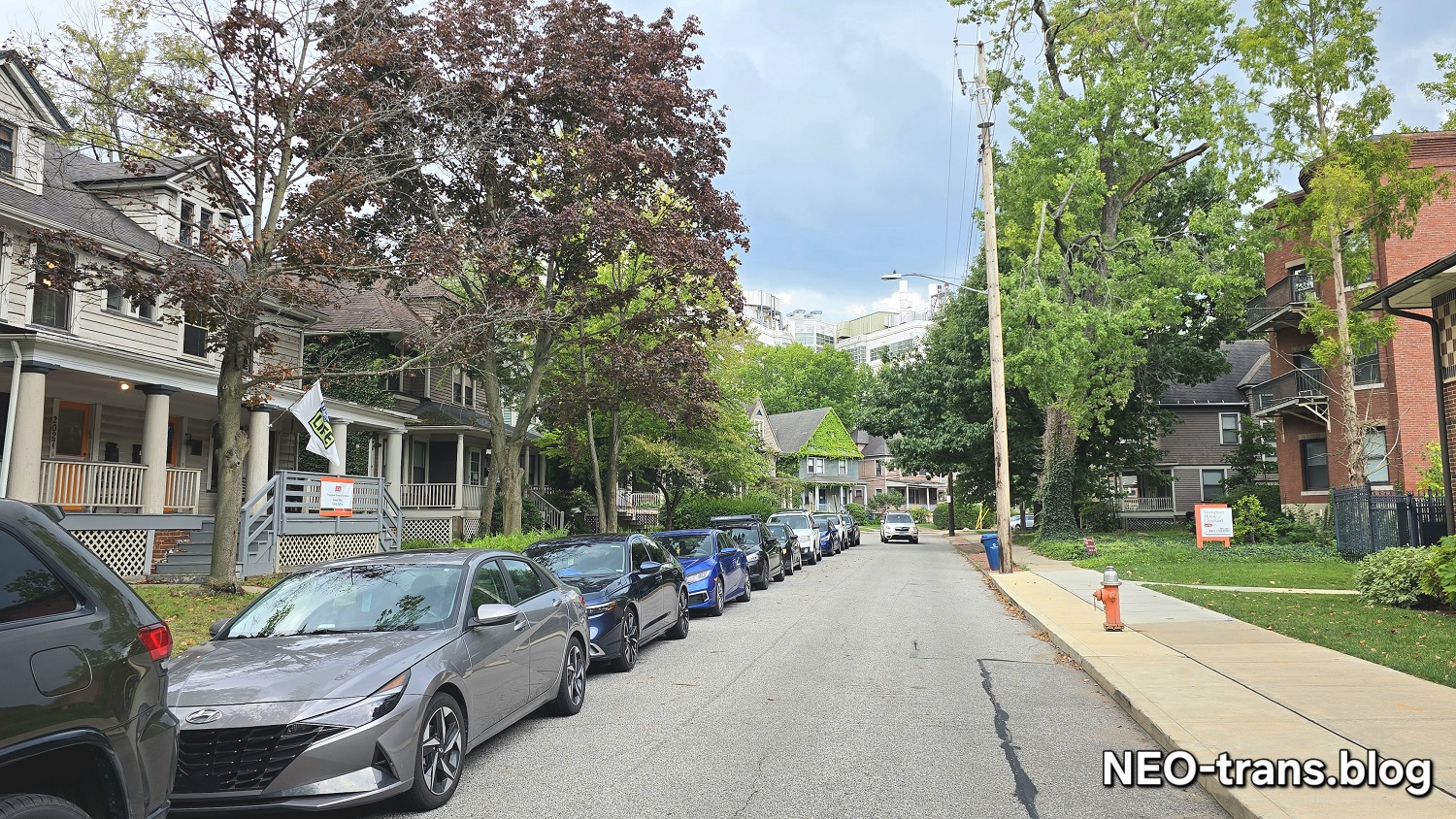
Storm clouds are brewing over East 115th Street. Looking south on the street, the first three houses on the left and the brick six-pack on the right are to remain. Beyond those, all of the houses and the street are to be removed (NEOtrans).
She continued, saying that “Neither University Hospitals nor University Circle Inc. have publicly shared a redevelopment plan explaining why demolition of the entire neighborhood seems necessary.”
“It would be helpful to know what (UH’s) plans are,” said Ward 6 Councilman and City Council President Blaine Griffin when asked to comment on the demolition request. “I understand they’ve wanted to do something with that site. But I want to see their plan.”
“We acknowledge that there are competing priorities here, and UCI hopes for an outcome that balances them,” said Heidi Hudak, UCI’s chief marketing & experience officer. “We appreciate and support the UH plans to retain four buildings adjacent to the Cozad-Bates House to preserve the historical context of this established community Landmark.”
The Cuyahoga Land Bank received a $230,000 grant from the Ohio Department of Development to carry out the demolition work. The 12 houses are to be removed in a first phase of demolition, funded by the grant.
In a second phase, UH will seek to demolish two larger buildings. The first is UH’s 22,000-square-foot Foley Building, 2061 Cornell. Originally built in 1926 as an apartment building, it was converted to offices by UH.
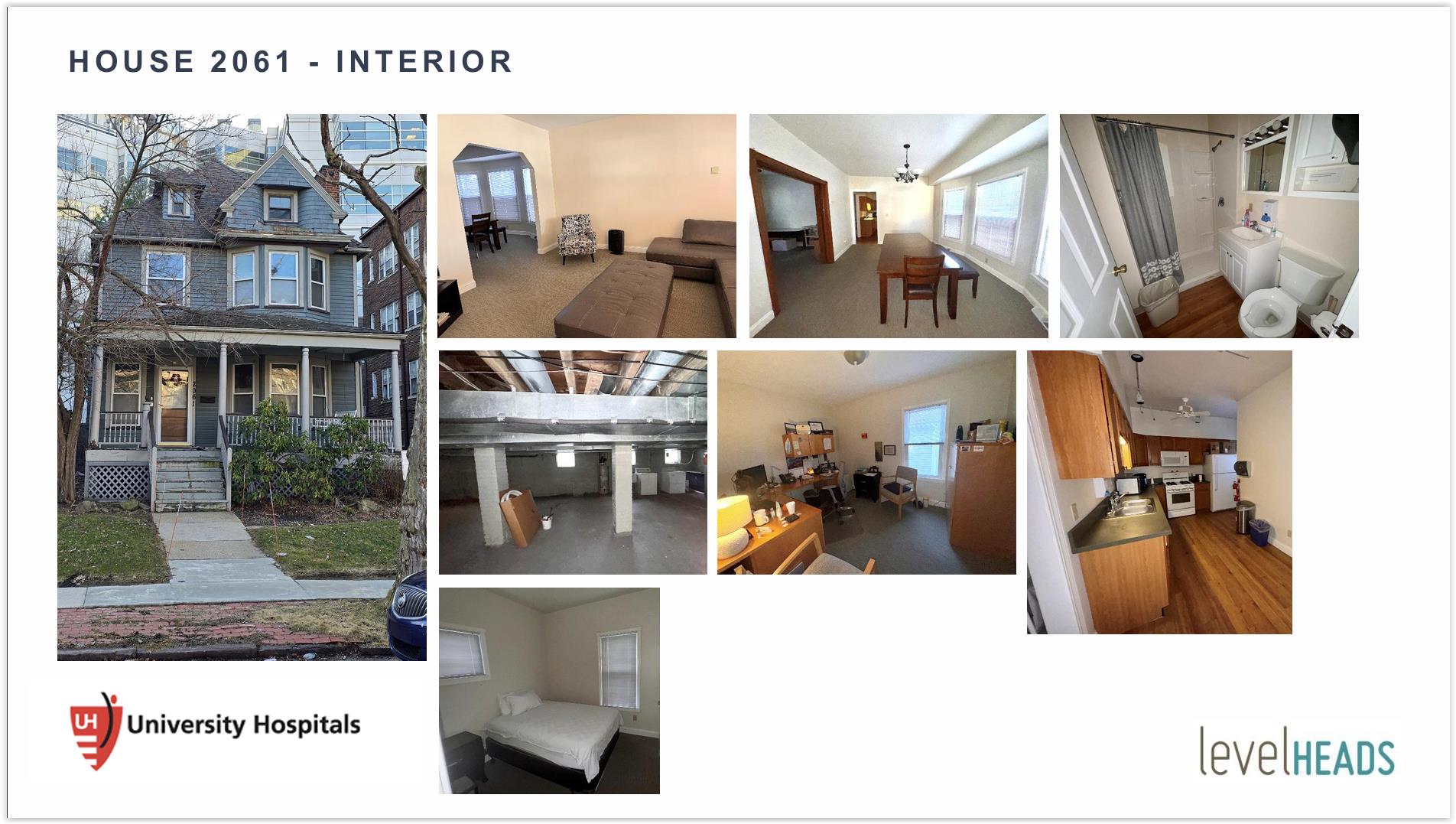
This is one of the East 115th Street homes proposed to be demolished. Admittedly it is in better condition than most (UH/LevelHEADS).
The other is the 99-year-old, 44-unit Fayne Apartments, 2085 Cornell, which UH has owned since 2015. It was managed briefly by The Coral Company of Independence for UH but Coral never owned it, said Coral’s CEO Peter Rubin.
In 2023, city records show UH demolished a single-story, 17,000-square-foot trauma training center at 2071 Cornell, at the northwest corner of East 115th. But three years later, it remains a vacant lot — aside from a collection of shipping containers stored on the site.
Griffin said historic preservation can be frustrating due to a community’s desire to save historic structures being greater than the real estate market’s ability to sustain them. And, further, that reality varies from neighborhood to neighborhood.
“I always have a challenge to take on a historical preservation project and no one steps up to buy them,” the councilman said. “It gets me frustrated when people pick and choose what houses they’re going to be upset about and try to protect. A house in Buckeye should be just as worth saving as a house in University Circle.”
END