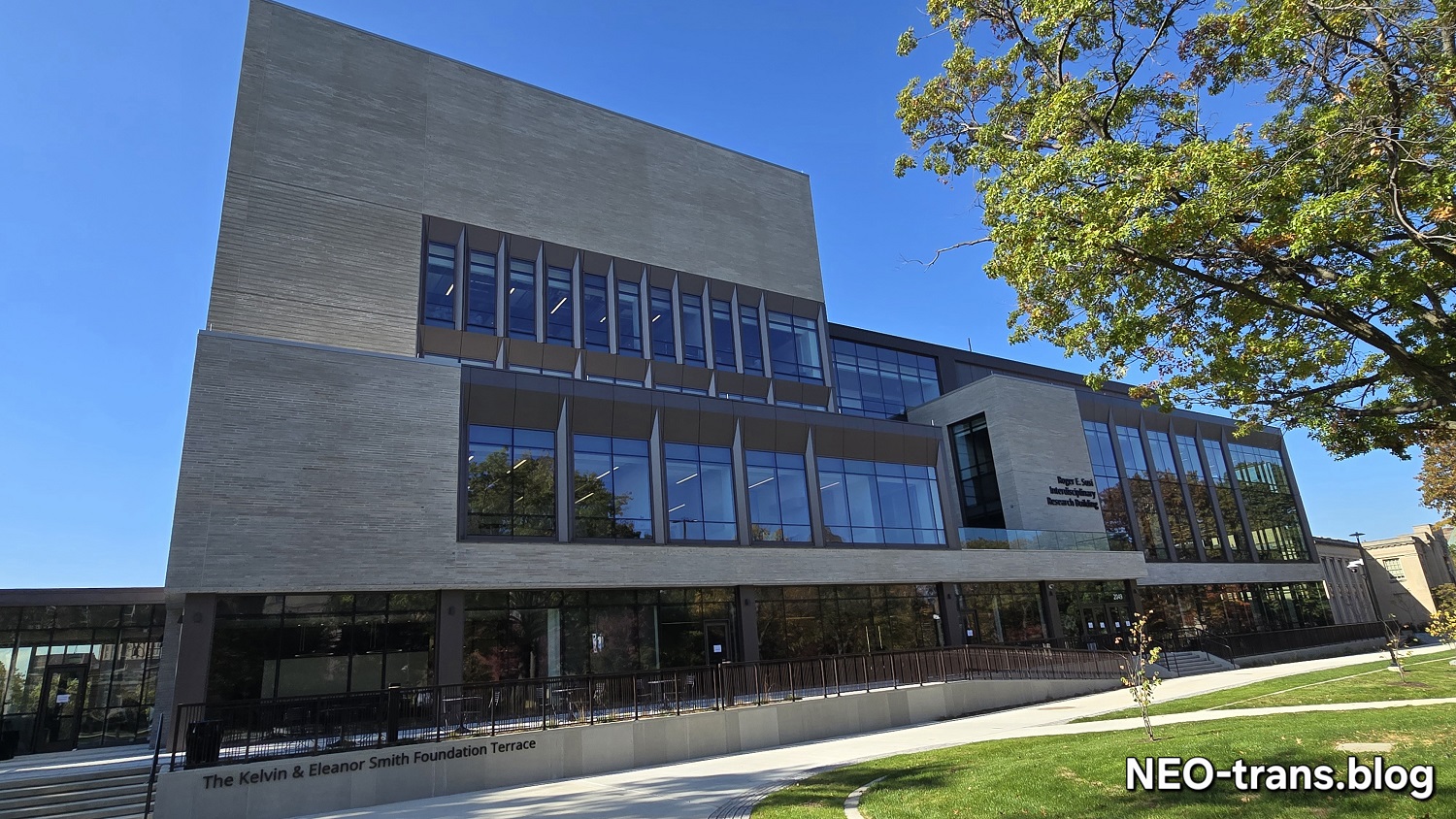
The ribbon was cut last night for the new Roger E. Susi Interdisciplinary Research Building, seen here from Case Commons at Case Western Reserve University. But construction will continue for the next month. Faculty, students and research teams will start relocating in December from throughout campus to the new building (NEOtrans). CLICK IMAGES TO ENLARGE THEM.
$50M gift names new science, engineering building
Yesterday was the ribbon cutting ceremony. Today was the media tours. Tomorrow the future starts for Case Western Reserve University’s (CWRU) new Roger E. Susi Interdisciplinary Research Building, 10900 Euclid Ave., in Cleveland’s University Circle.
And the interdisciplinary science and engineering building, with some final touches of construction work being done over the next month, is called the Susi building thanks to a $50 million gift that was publicly announced today.
Susi, a 1977 CWRU graduate who became an entrepreneur and founder of medical startups, made his way as a self-proclaimed tinkerer. His work eventually led to the world’s first successful vital-signs-monitoring device for MRI patients.
His current company, Iradimed, was named one of the nation’s top 100 small companies by Forbes in 2023, and is known for its MRI infusion pump. It’s the kind of work the university hopes to see more of as a result of this new, $300 million building.
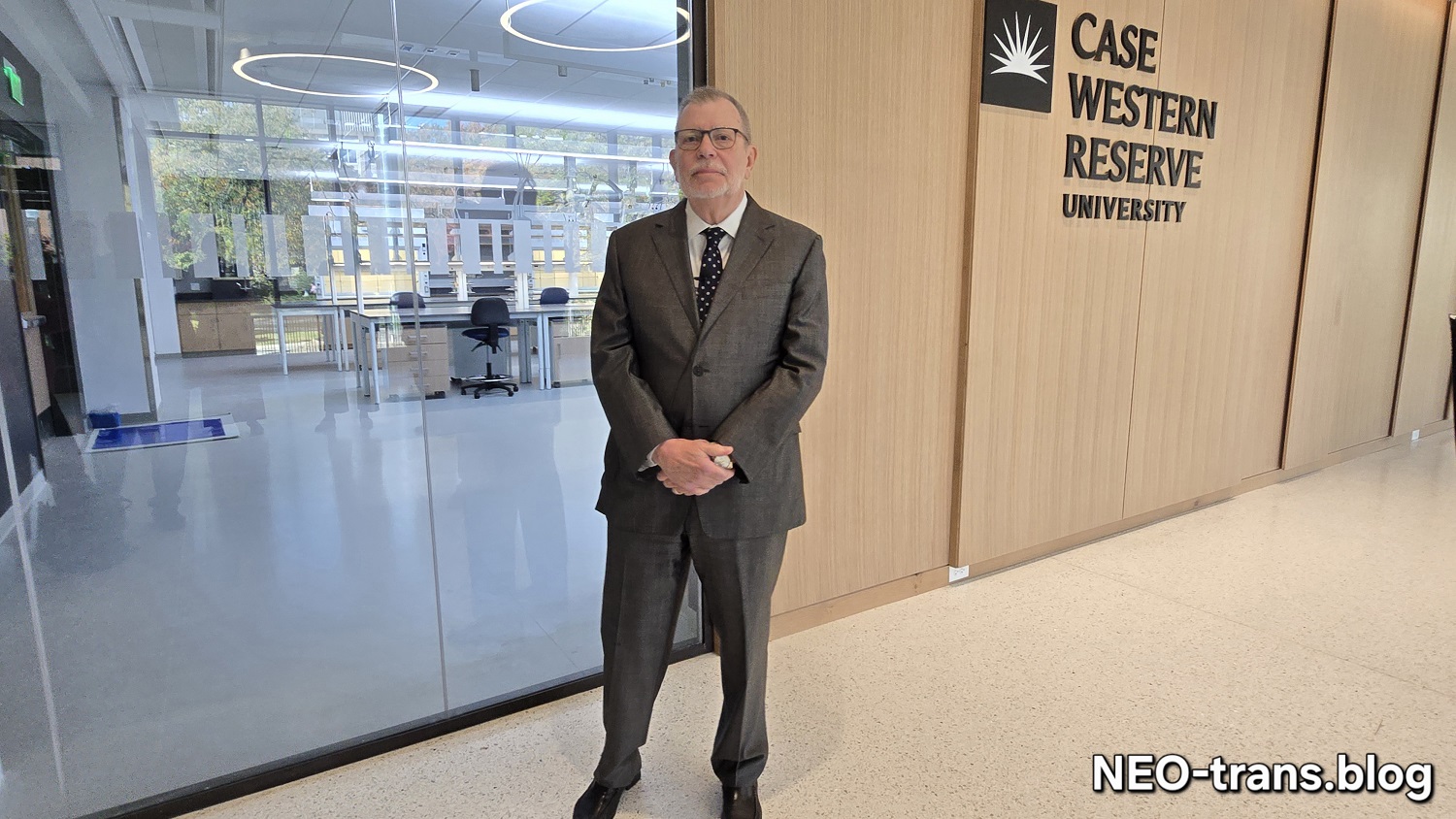
Case Western Reserve University President Eric Kaler stands in the entryway for the new Roger E. Susi Interdisciplinary Research Building (NEOtrans).
“It starts with the open structure and just bumping into people,” Susi said of the new building and its layout. “Then you go upstairs into these malleable labs. These collaborations should result in great research outcomes.”
Construction started on the 189,000-square-foot Susi building in early 2024 following the demolition of Yost Hall on Case Quad. From that university commons side of the structure, it stands three stories tall. From the Martin Luther King Jr. side, it’s five stories tall due to the natural topography.
From both sides, the structure features lots of a glass — inside and out. The exterior bird-safe glass, is intended to create a public presence and let in natural light. The interior glass is to promote interaction and curiosity and collaboration. Minnesota-based architectural firm HGA was the project’s lead designer.
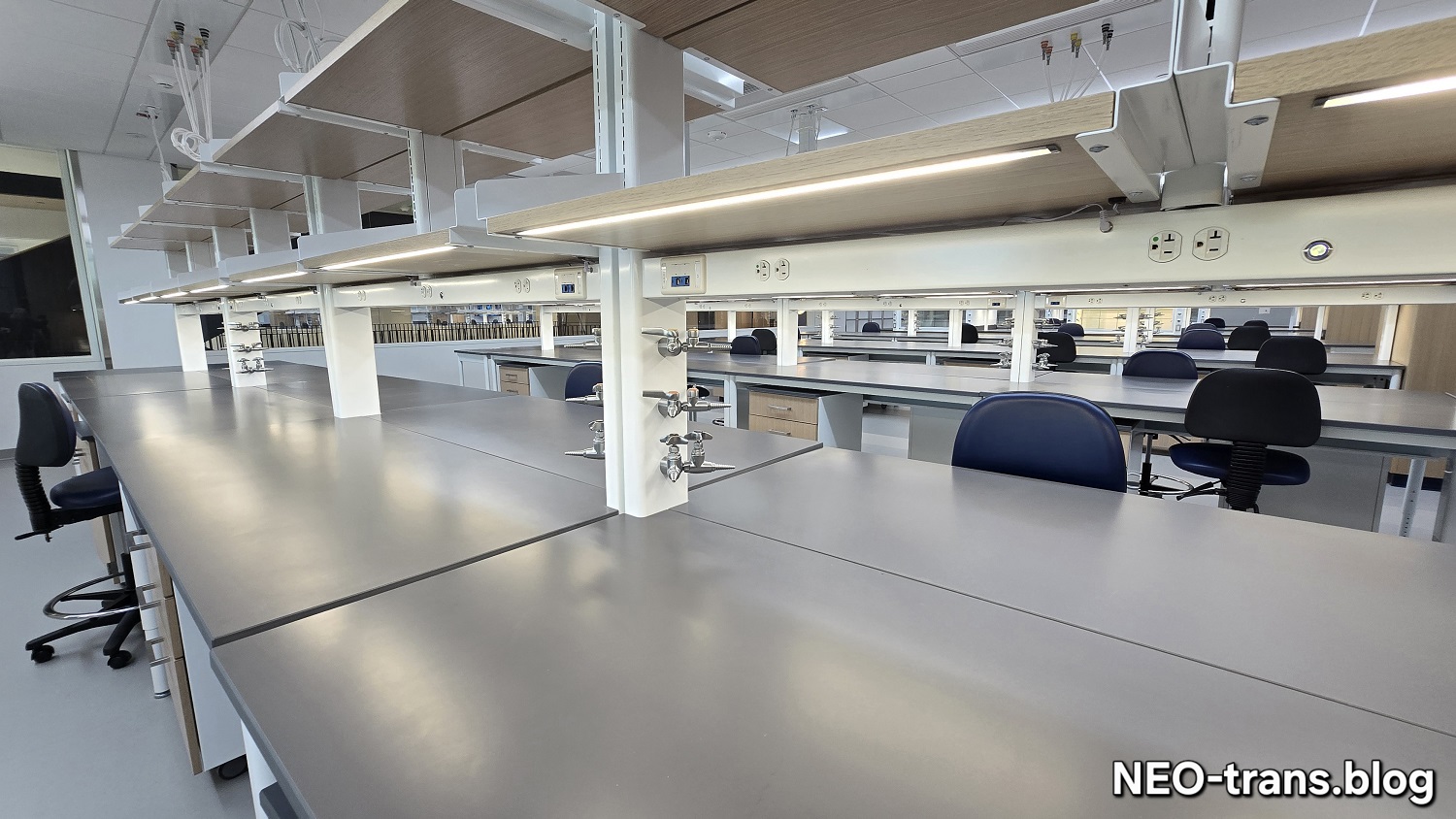
Lots of lab space is provided in the new new interdisciplinary science and engineering building in rooms surrounded by glass so passersby can see students and research teams learning, discovering and collaborating (NEOtrans).
“Roger and (his wife) Kayoko (Susi) were among the first to support this building and to fully embrace our vision for its mission and impact on our research enterprise,” said CWRU President Eric Kaler.
“Their gift is truly transformational — for the Susi Interdisciplinary Research Building, for the researchers and students working in the Susi Building labs, and, importantly, for the life-changing outcomes made possible by the innovation and discovery that will occur here,” he added.
Philanthropic support was instrumental in bringing the $300 million project to life, with donors giving a total $165 million and the rest matched by the university’s century bond program. That includes a $15 million gift made just last month by The Kelvin & Eleanor Smith Foundation.
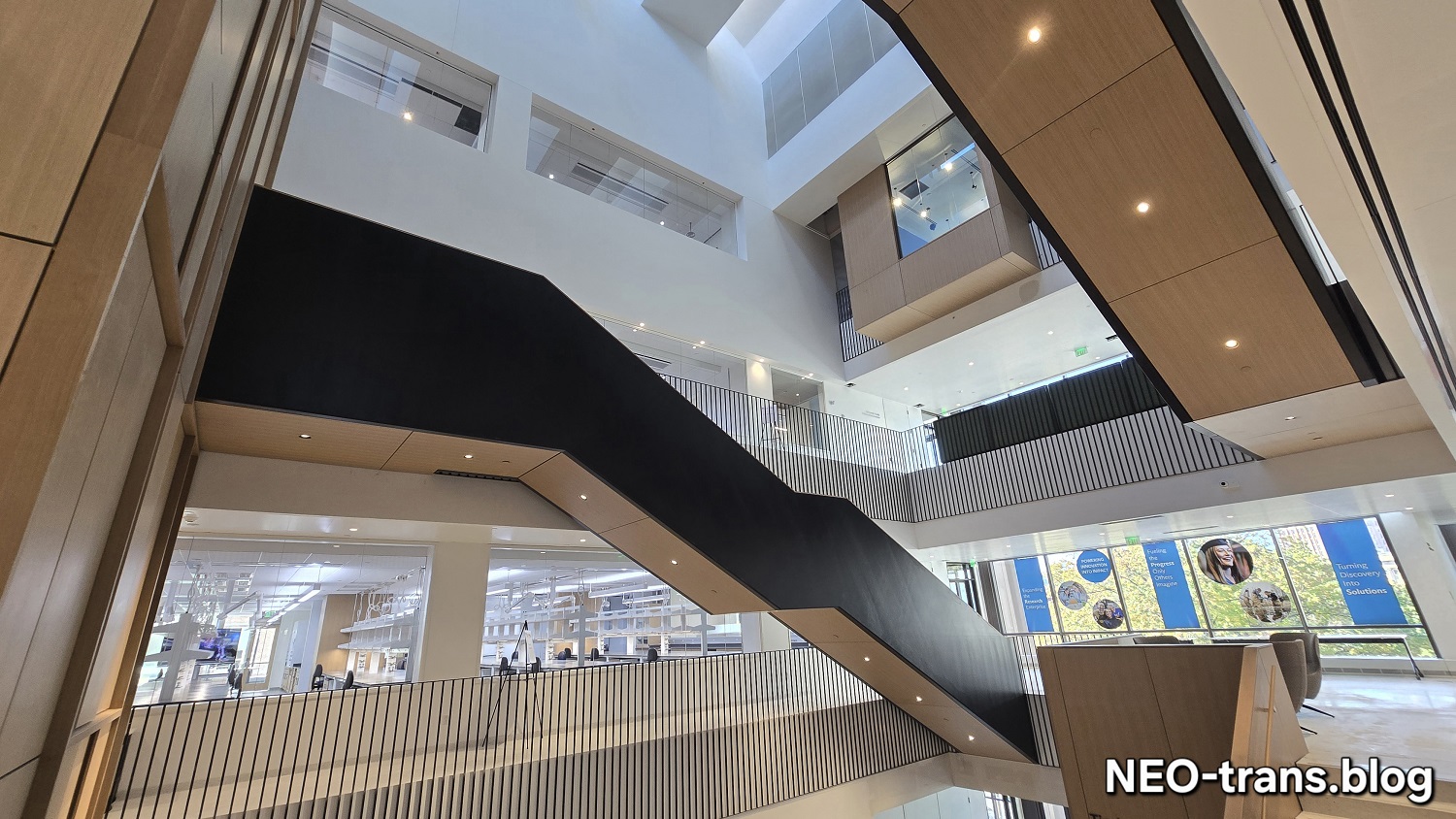
There are lots of open spaces in the the new Roger E. Susi Interdisciplinary Research Building, designed by architectural firm HGA, to create interaction. And where there are non-load-bearing walls, they are often made of glass (NEOtrans).
The Susi Building houses wet labs, dry labs and a core lab. There are open areas — including the Tinkham Veale Gateway and The Kelvin & Eleanor Smith Foundation Terrace — building collaboration into its structure.
Researchers will be advancing interdisciplinary work in seven unique areas known as research clusters. Those are the James M. Galm, PhD, PE Electrochemical Engineering & Energy Science, advanced materials and manufacturing, molecular therapeutics, precision diagnostics and therapeutics, neurotechnology, neurorobotics, plus climate and ecosystem science.
Those studies were scattered at different locations throughout the CWRU campus. Now they and 300 researchers — faculty, students and research teams — will be united under one roof starting this December.
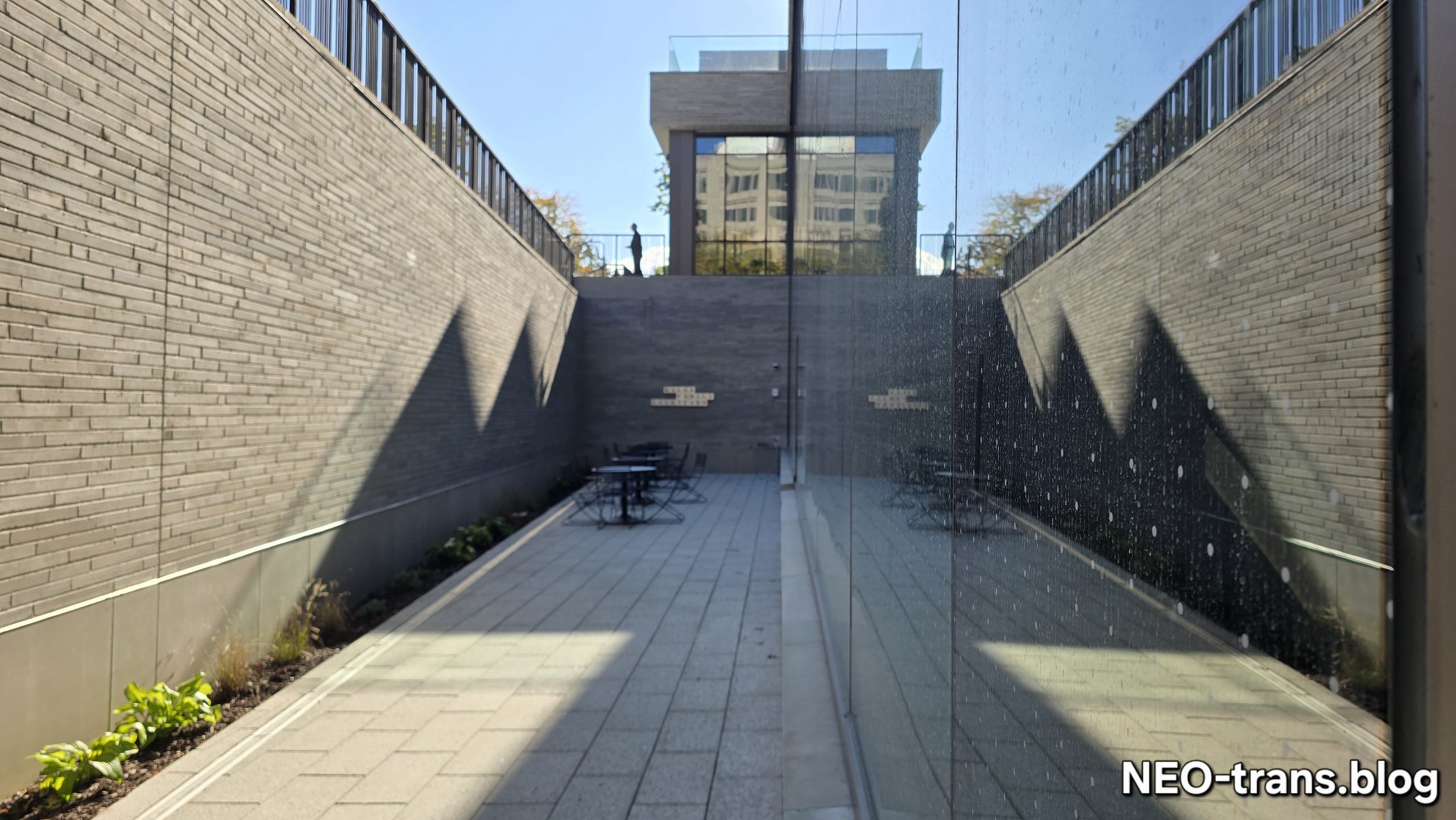
Lots of exteriors use bird-safe glass to provide natural light into the building and to give the structure a presence from the outside, especially at night. This is an outdoor sitting and dining area below the Case Quad, next to the building’s Caribou Coffee shop and cafe (NEOtrans).
The new building and its researchers will also be among the key players in putting to work an historic $160 million National Science Foundation grant awarded in July to a Northeast Ohio coalition led by CWRU.
The coalition, the NSF NEO-SMART Engine in Northeast Ohio was rewarded for its Regional Innovation Engines program. NEO-SMART stands for Northeast Ohio Strengthening Manufacturing for American Resilience through Technology.
Kaler said the new facility will help CWRU land additional grants, including for the boldest fundraising campaign in the university’s 200-year history. Called Breakthrough Point, CWRU is seeking to raise $2.5 billion in the coming years to turn more ideas into impact.
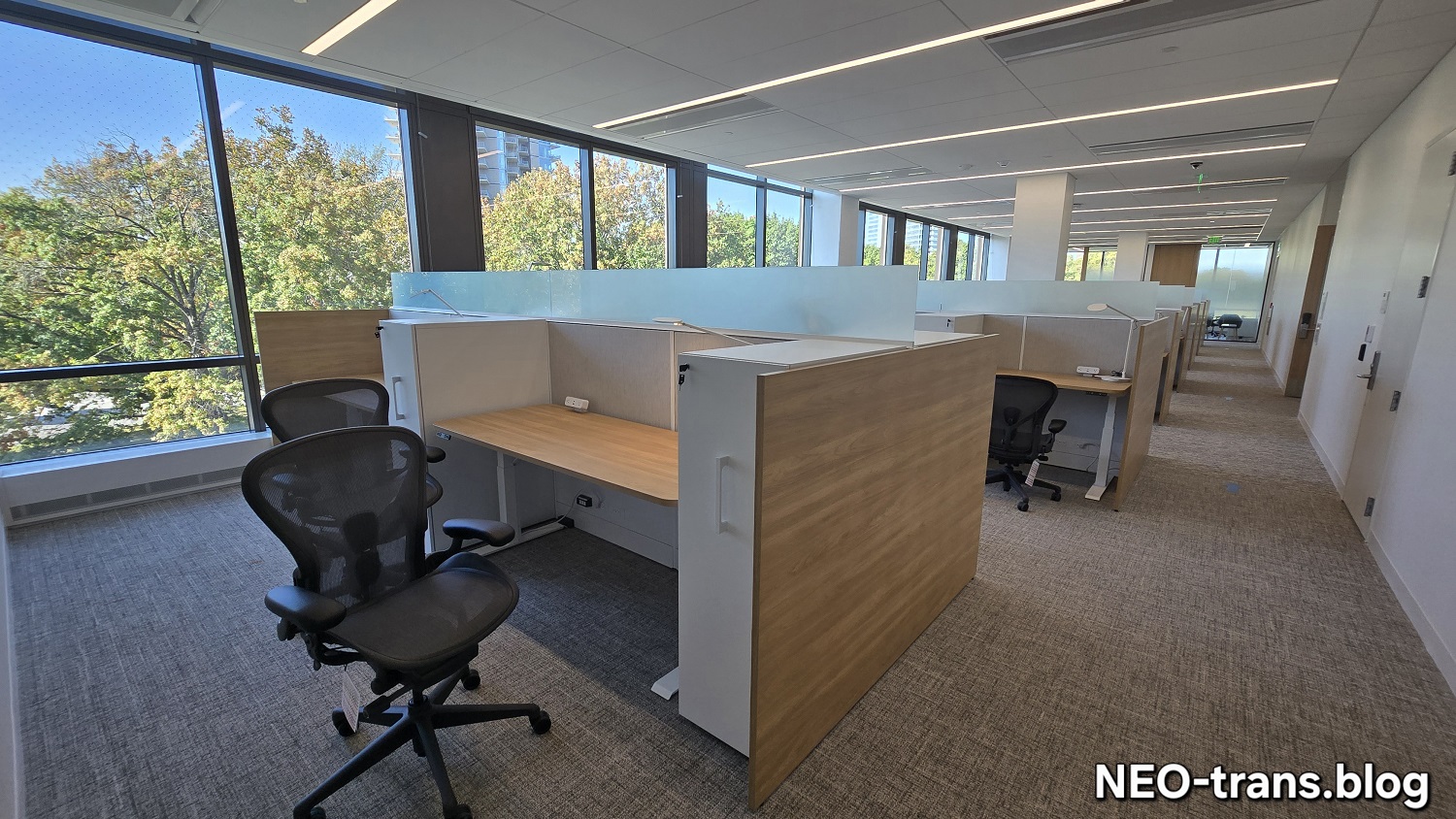
Graduate students working on projects or studies will have offices in this space overlooking Martin Luther King Jr. Boulevard (NEOtrans).
“The timing of this campaign is intentional,” Kaler said. “It capitalizes on our remarkable momentum and will accelerate our growth and impact as one of the country’s leading research institutions.”
“Our $2.5 billion goal is ambitious,” he acknowledged. “And we are primed to achieve it, driven by our 200-year history of a bias for action and fueled by a collaborative university community that is innovative, future-focused and results-driven.”
NEOtrans was first to report in 2022 that CWRU was moving forward with constructing a new interdisciplinary science and engineering building. It was included in the university’s 2018 campus masterplan but construction was delayed slightly by the pandemic.
END