A new levy for public transportation in Cuyahoga County offers hope to transit riders and those who would like better, more frequent transit options to be available to them rather than dependency on more cars and parking (NEOtrans). CLICK IMAGES TO ENLARGE THEM.
Levy info, options weighed by board
Potential new bus services and even rail extensions were offered as possibilities if the Greater Cleveland Regional Transit Authority (GCRTA) puts a larger sales tax levy on the countywide ballot in 2027 and voters support it.
Those were among the suggestions from community leaders and organizations as GCRTA staff communicated their financial situation to them in recent weeks. The GCRTA board could decide next month to put a 0.25-, 0.35- or 0.5-percent levy before voters in May or November of next year.
Without any levy, GCRTA will begin to cut hours of available bus and rail services by 20 percent immediately after a levy failure. The cuts will affect 75 percent of GCRTA’s 40 bus and rail routes, with seven bus routes discontinued entirely.
At Tuesday’s board meeting, the 0.35-percent sales tax levy was a new option, proposed to GCRTA staff in talking with business, government and social service leaders in Cuyahoga County.
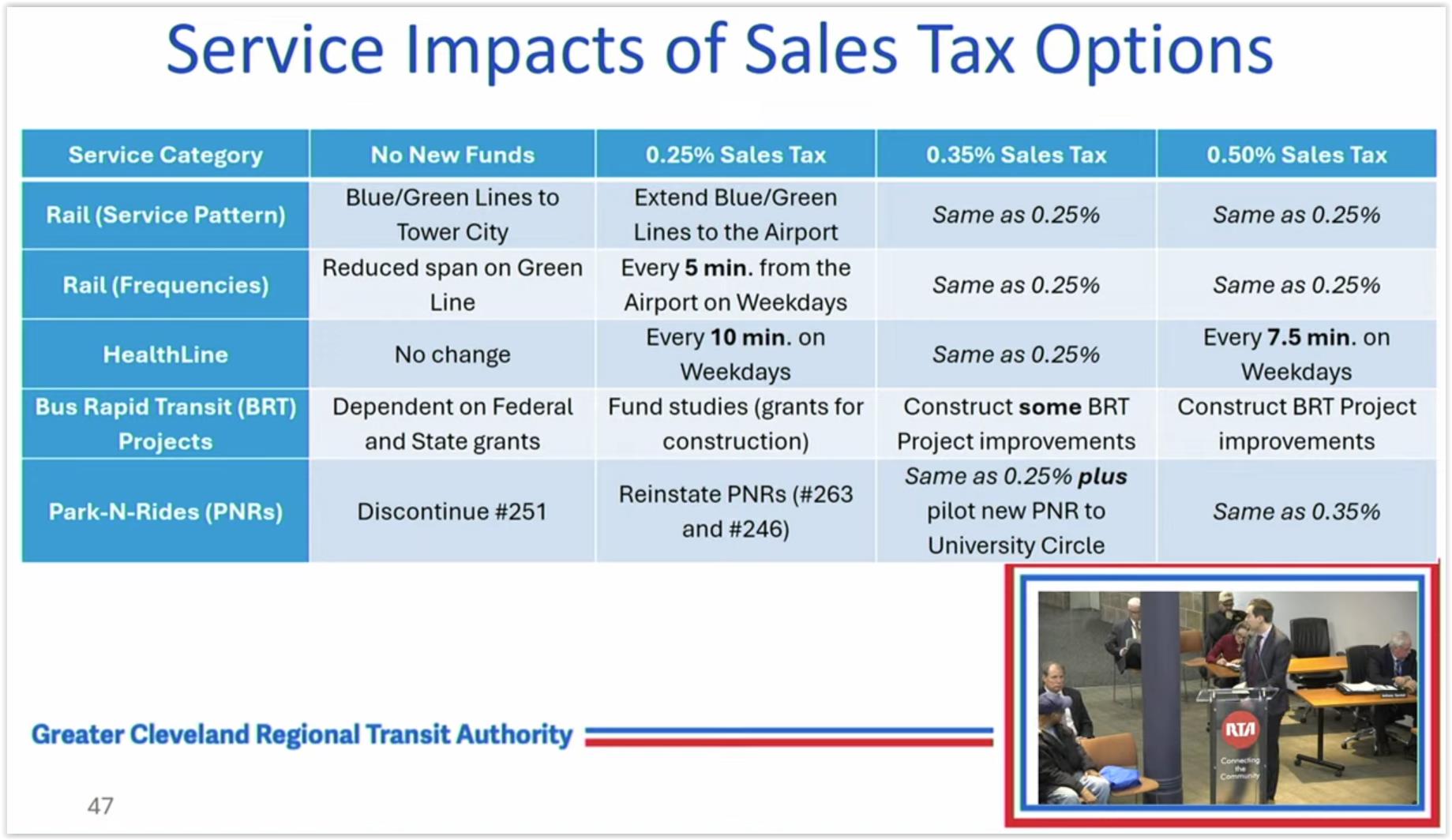
Service frequencies, new bus rapid transit routes and changes in park-n-ride express bus services based on funding options (GCRTA).
Those stakeholders requested data on that option, including how long GCRTA could enjoy financial stability and what level of additional services could be afforded. The 0.25-percent levy would generate $70 million per year and provide financial stability until about 2041.
A 0.35-percent levy would generate $112 million per year and offer stability until the early 2050s. The 0.5-percent sales tax hike would generate $140 million and stabilize the transit system to near 2070, although forecasting that far out was acknowledged by GCRTA board and staff members to be less precise.
The 0.35-percent levy would be enough to improve service frequency on 56 percent of bus routes compared to 50 percent of bus routes for the 0.25-percent sales tax and 75 percent of routes for the 0.5-percent levy, according to a GCRTA staff presentation to the board.
But the 0.35-percent option would provide GCRTA with more resources to pursue a few new bus rapid transit (BRT) corridors on existing streets like Broadway, Lorain, Superior, and Detroit avenues whereas the 0.25-percent option could only fund new plans for them. The 0.5-percent option would allow GCRTA to fund BRTs in all 12 priority corridors that don’t already have BRT or rail service.
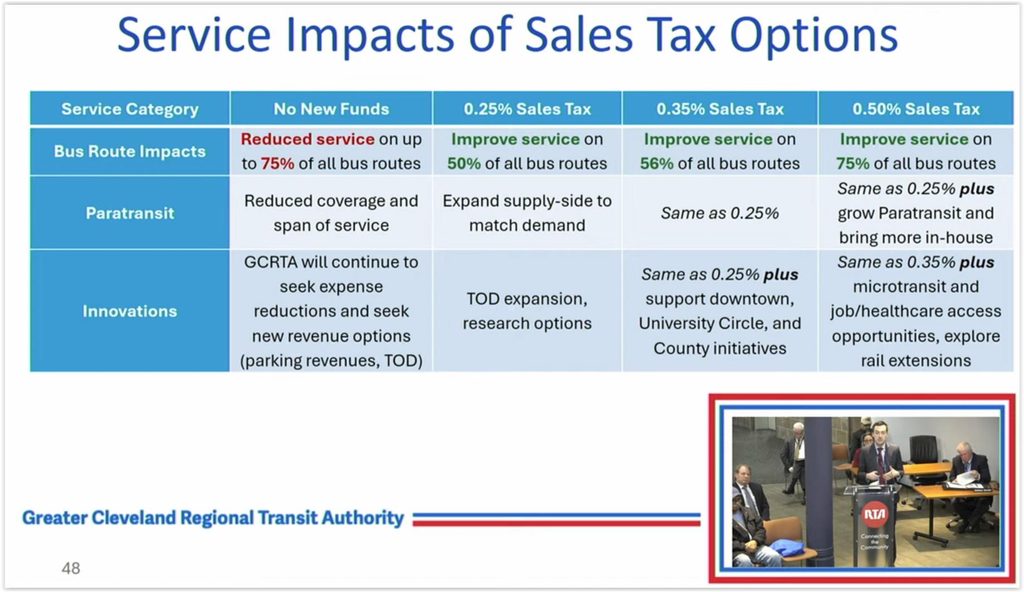
The extent of bus, paratransit and even rail service expansions plus transit oriented development and mictrotransit innovations at various funding levels (GCRTA).
While GCRTA intends to run the light-rail Blue and Green lines west of Downtown Cleveland to Hopkins International Airport under all of the levy options, it cannot afford to do so without additional sales tax revenues.
GCRTA CEO and General Manager India Birdsong Terry emphasized that, levy or no levy, GCRTA will still replace its aging railcar fleet starting next year with its new standardized trains that will allow them to operate systemwide. But without a levy, it will only be able to replace the existing rail service as it operates now, minus evening service on the Green Line.
She said that expanding east-side rail service to the west side, with trains running every five minutes in both directions west of East 55th station, will provide a better link between downtown hotels and restaurants to the new Huntington Bank Field and its supportive development in Brook Park.
Like the 0.25-percent levy, the 0.35-percent option would also allow GCRTA to restore express bus services between Downtown Cleveland and the park-n-ride lots in North Olmsted and Westlake.
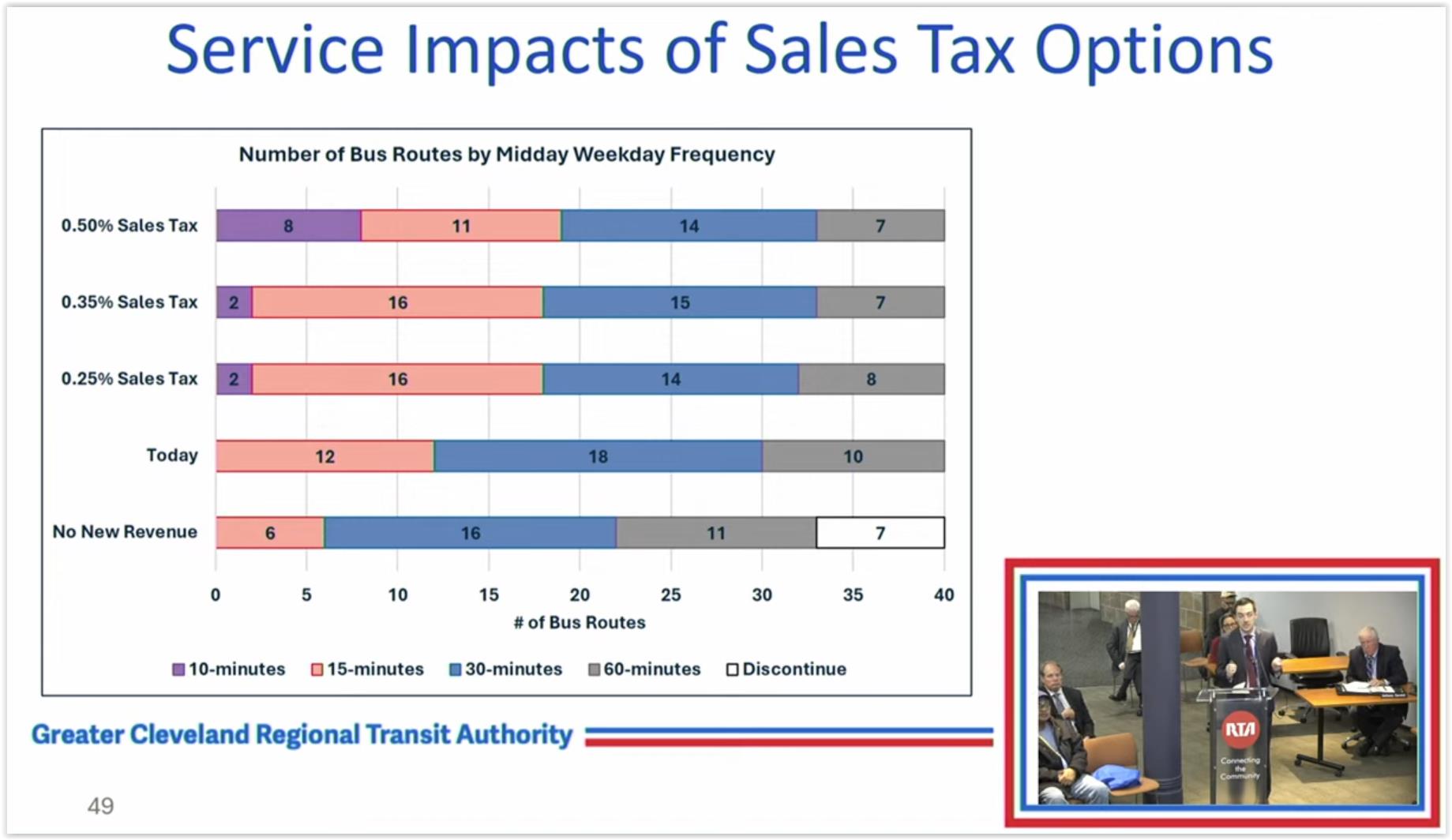
The frequency of service on bus routes at different funding levels is shown here (GCRTA)
The 0.35-percent option would offer enough resources so GCRTA could consider new bus services like operating express buses from western suburbs to University Circle as a pilot to see if it succeeds. Growing employers in University Circle are seeking to demolish housing and businesses for more parking.
“We have a lot of parking availability on our west-side park-n-ride lots,” said Rubén Morgan, GCRTA’s manager of operations analysis. “We know that there is demand out to University Circle in order to better manage the traffic in that area so there’s not anything concrete, just an idea to pilot something to serve that heavy economic hub.”
GCRTA board and staff discussed why pursue a pilot, or test-case of an expanded service that’s never been attempted before. There was concern expressed that success wasn’t guaranteed, thus needing to try a test to serve a growing area like University Circle.
“This is where Cleveland suffers and everybody suffers,” Terry said. “If you haven’t been in a growth pattern for decades, then the fear is if we build it will they really come? My answer to that in my opinion is if you don’t build it then nobody comes.”
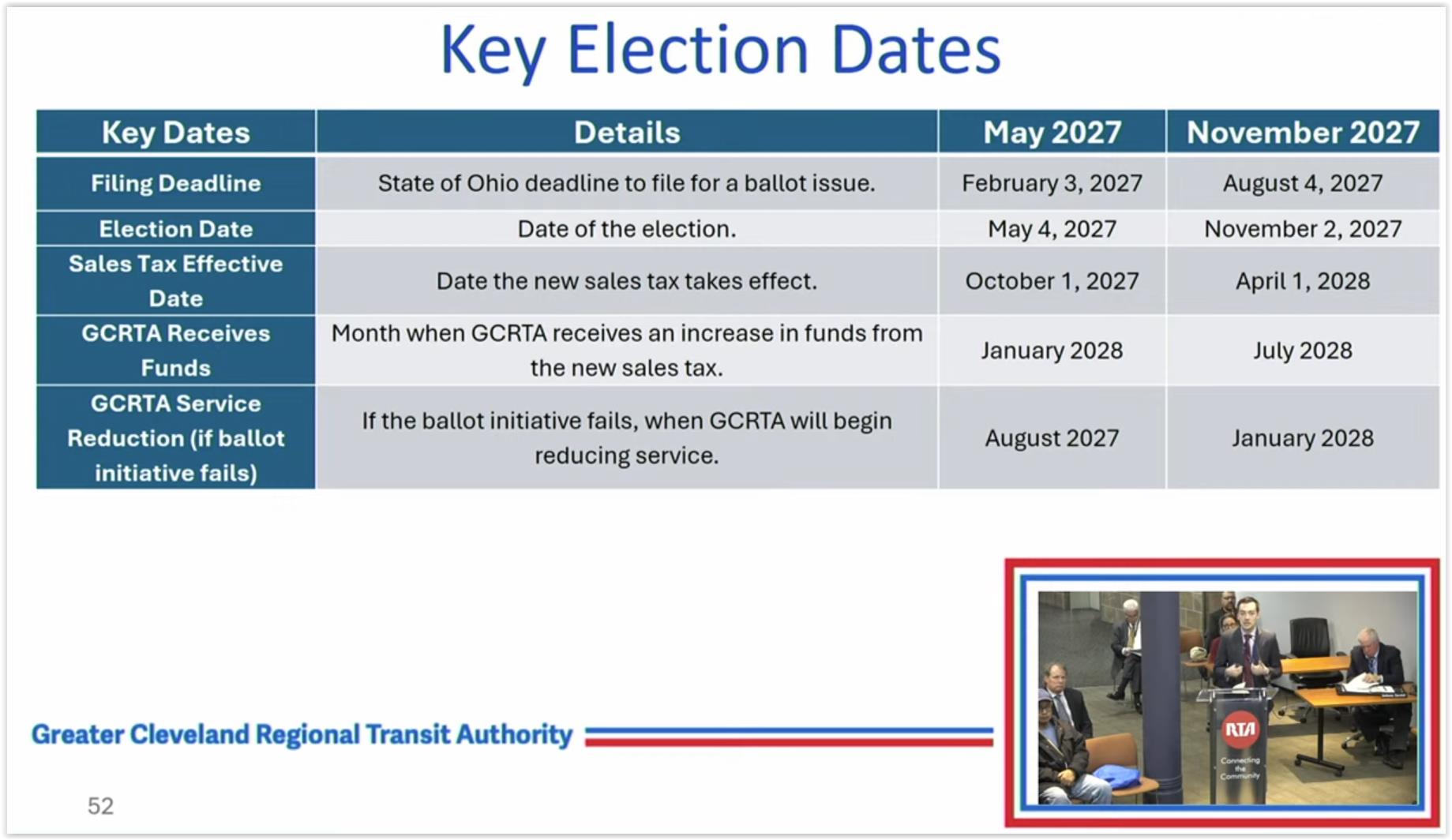
Transit officials are considering putting a sales tax levy on the ballot in May or November of 2027. That is affected by and will affect a number of things including the state’s deadline to file the ballot request with the Cuyahoga County Board of Elections, when the sales tax takes effect, and when the revenues start coming in. Since GCRTA is facing a fiscal cliff by 2029, it needs to start generating revenues or cutting costs as soon as possible to avoid it (GCRTA).
And that’s where one of the biggest surprises emerged in GCRTA’s thinking about the future. Political and business leaders expressed concern that GCRTA wasn’t providing enough information on a the economic return on investment from a sales tax levy. They wanted to see the value added from it.
“At 0.50 (percent), we’d be looking at a lot more of other things we can do,” Morgan said. “What can we do with paratransit? What can we do with better (microtransit) access at (employment) locations? How can we maybe potentially explore rail extensions? A lot more can happen at 0.5 (percent) that right now that’s not very feasible without additional funds.”
Newly built rail extensions cannot be considered with a sale tax hike of less than 0.5 percent, he said. But others noted that new bus and rail routes aren’t the only transformative changes that offer a value-added proposition.
GCRTA Service Management Director Joel Freilich said that more frequent transit on existing routes is a transformative change because it allows choice transit use to become more practical. Frequent transit allows a family to reduce its driving or even reduce the number of cars owned by that family.
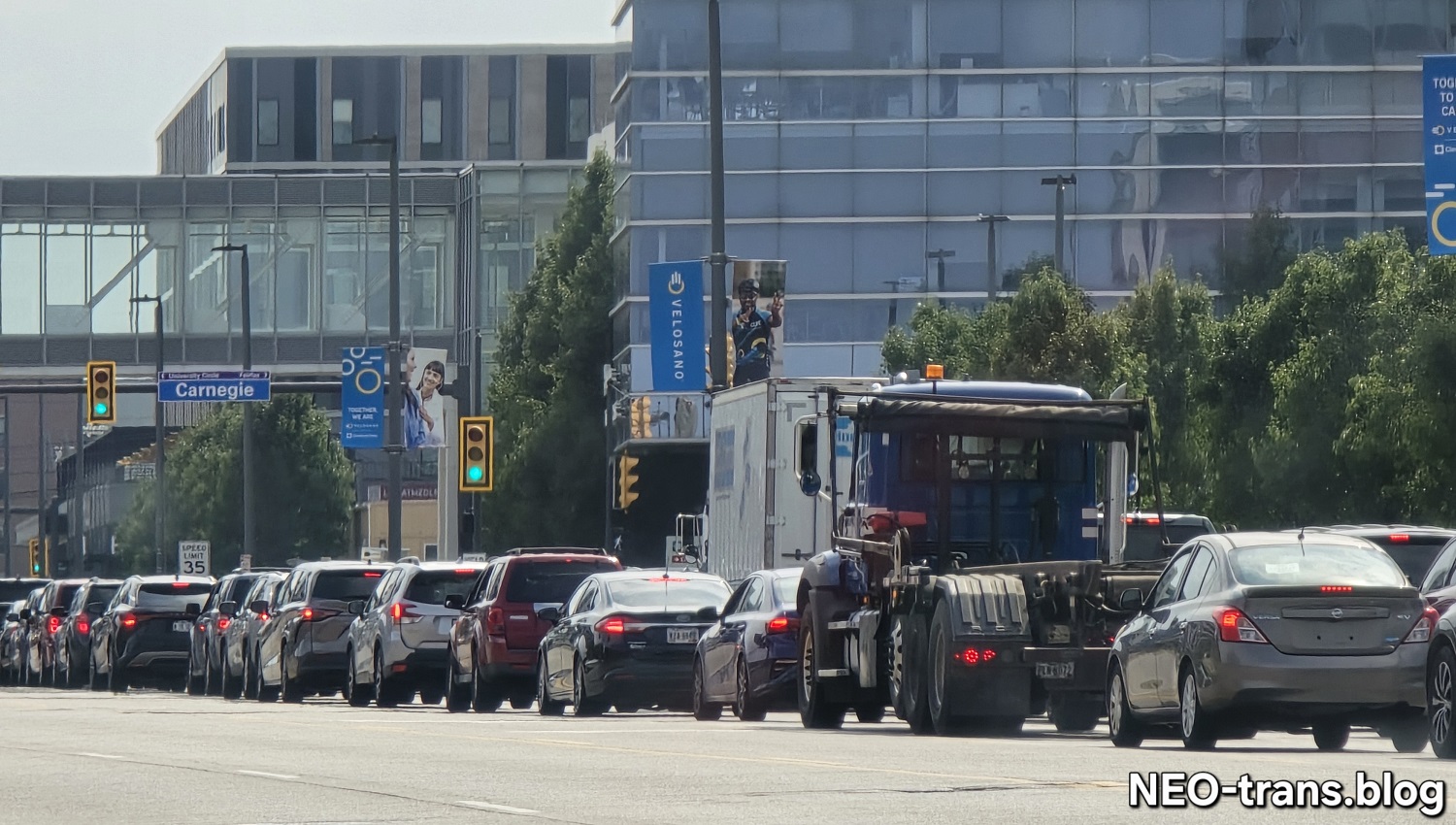
Economic growth, traffic congestion and parking concerns in University Circle has the Greater Cleveland Regional Transit Authority considering new services here if a sales tax levy passes in 2027 (NEOtrans).
“That saves them a good deal of money which they then spend at small businesses located in Cuyahoga County,” he said. “That business owner now has to go up from eight employees to nine and that person gets a job and spends their money at small businesses in Cuyahoga County. Frequency means prosperity. Prosperity is something our community needs more of.”
Staff emphasized that GCRTA’s countywide sales tax are not and will not be levied on things like groceries, gasoline/diesel fuel, prescription drugs, and housing rent or mortgages. Sales taxes are not the same as property taxes. Even at the largest potential sales tax increase, they noted the impact would be 50 cents on a $100 purchase.
GCRTA is funded primarily by a 1 percent countywide sales tax since 1975. Fares produce less than 10 percent of GCRTA’s revenues. Countywide population losses have eroded GCRTA’s revenues and unfunded mandates since 1975 like providing costly paratransit service have raised expenses.
More recently, the Ohio General Assembly in 2018 eliminated sales taxes on Medicaid managed care organizations resulting in a $20+ million per year loss to GCRTA. Federal COVID relief funds temporarily masked that loss.
END