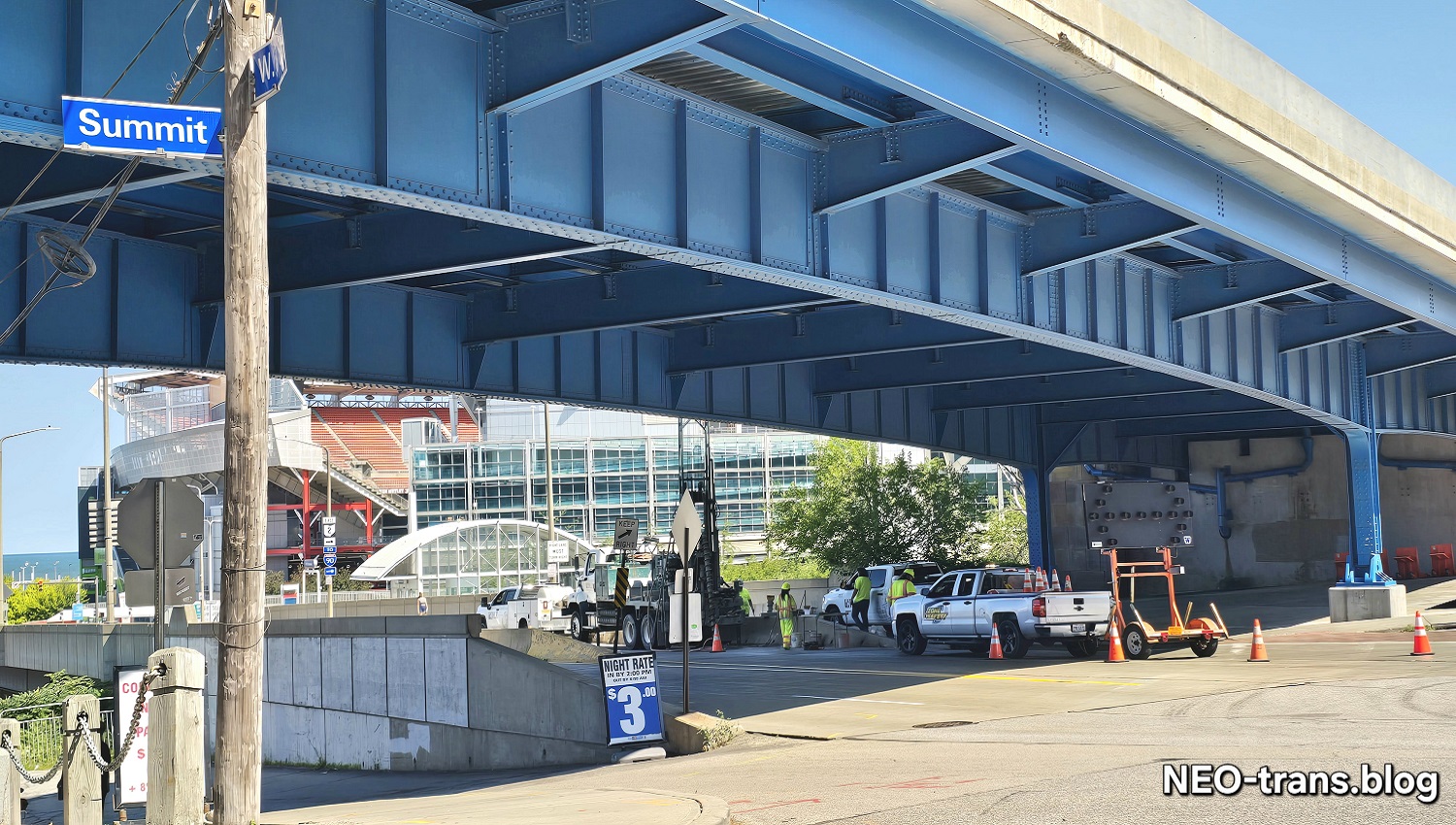
Everything visible in this scene on July 30 at West 3rd and Summit streets in Downtown Cleveland is scheduled to be removed in five years. That includes the narrow West 3rd bridge over the railroad tracks, the Shoreway bridge overhead, and Huntington Bank Field. Geotechnical crews are seen here collecting test soil samples for that coming change (NEOtrans). CLICK IMAGES TO ENLARGE THEM.
First signs of construction due Sept. 2027
The timetable for the remake of Downtown Cleveland’s lakefront is starting to come together. That includes not only the start of demolition of infrastructure for the new Shoreway boulevard but also for the clearance of Huntington Bank Field to offer a development-ready site.
A progressive design-build timetable for the many moving lakefront puzzle pieces was among the many documents shared yesterday by the City of Cleveland with potential construction contractors.
They are seeking to build the North Coast Connector comprised of a new 35-mph downtown lakefront boulevard and a land bridge — a pedestrian walkway over the lakefront railroad tracks and boulevard.
Total cost of that first phase of work is estimated at $285 million for which local, state and federal funding is in hand. The new boulevard will replace bridges and unsafe interchanges at West 3rd and East 9th streets with six new at-grade intersections.
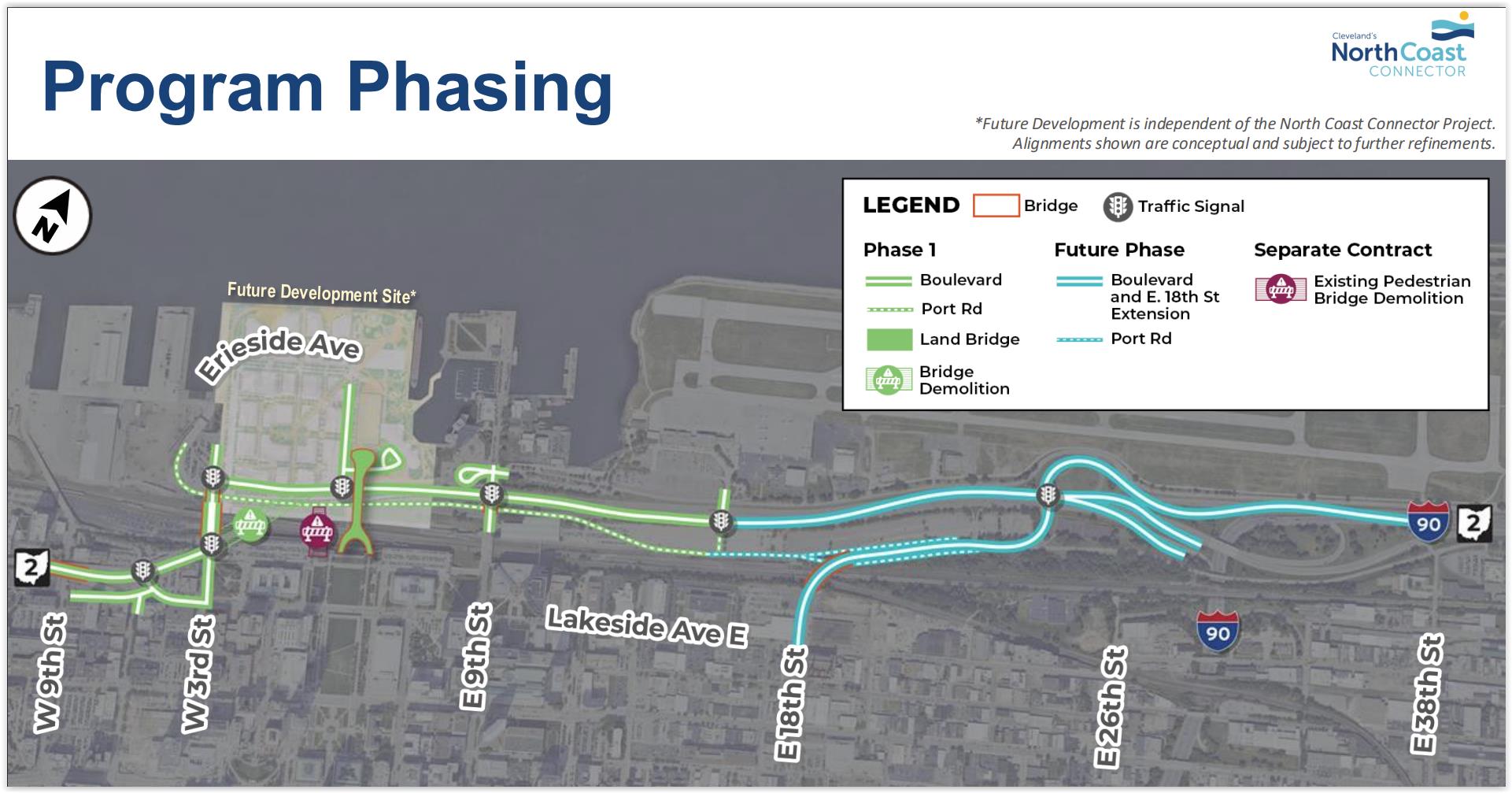
These are basic features and two phases of the North Coast Connector — the Shoreway redesigned as a boulevard and a new land bridge over the boulevard and lakefront railroad tracks (City of Cleveland).
The first signs of construction are due to appear in September 2027. But they won’t be for what replaces the stadium or even for the new boulevard.
Instead, they will be for the land bridge — which is why city officials in recent weeks were so adamant against Cuyahoga County officials urging the land bridge be built as an expansion of the Huntington Convention Center of Cleveland. No funding exists for a convention center expansion.
With funding in hand for the land bridge, final design of the land bridge got underway last month, city documents show. And the design work is due to be wrapped up as early as May 2027.
“The new concept of the land bridge reflects that we no longer need to account for stadium pedestrian traffic,” the city’s North Coast Connector Web page notes. “Our goal with the land bridge is to create an accessible, safe pedestrian pathway to reach the water in a shorter timeframe.”
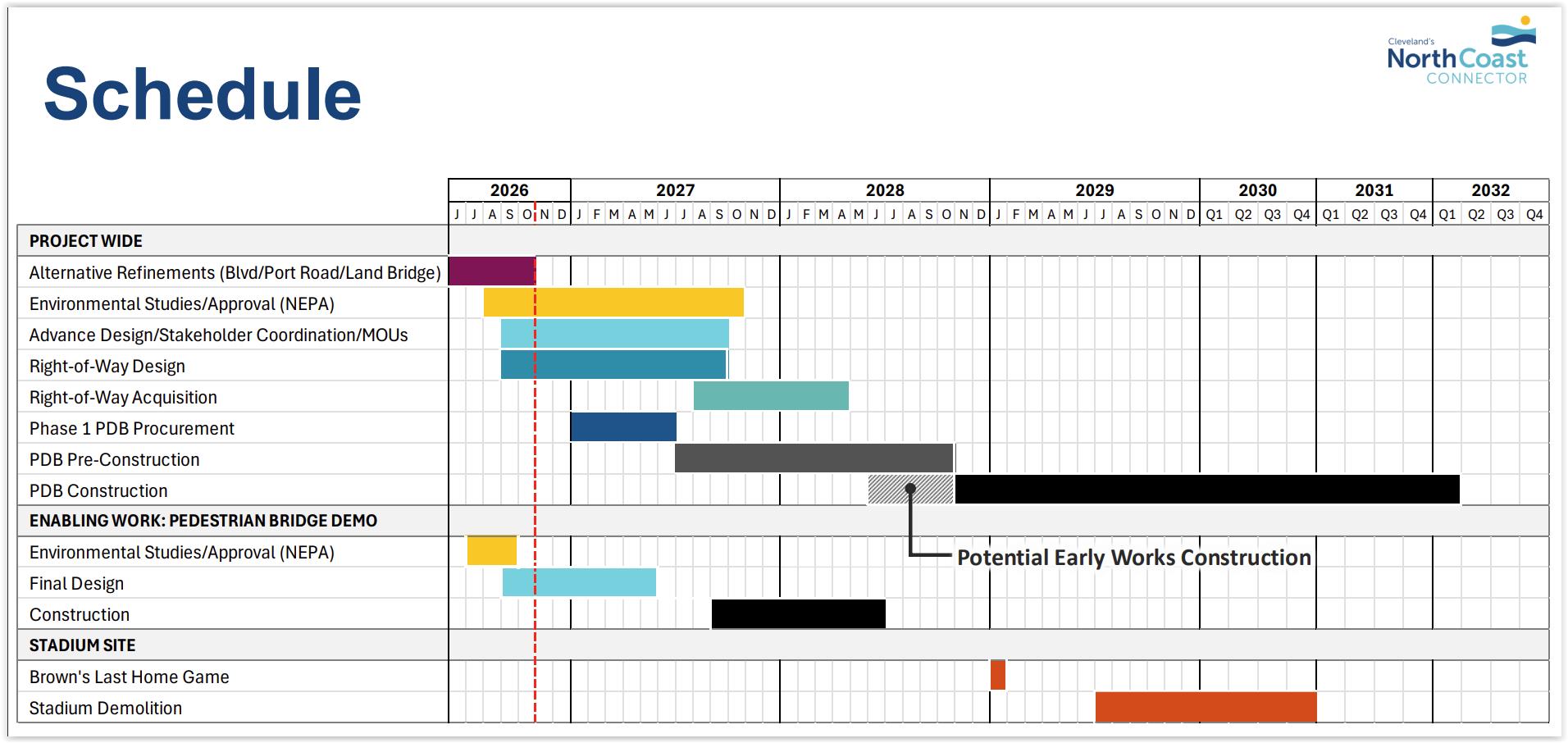
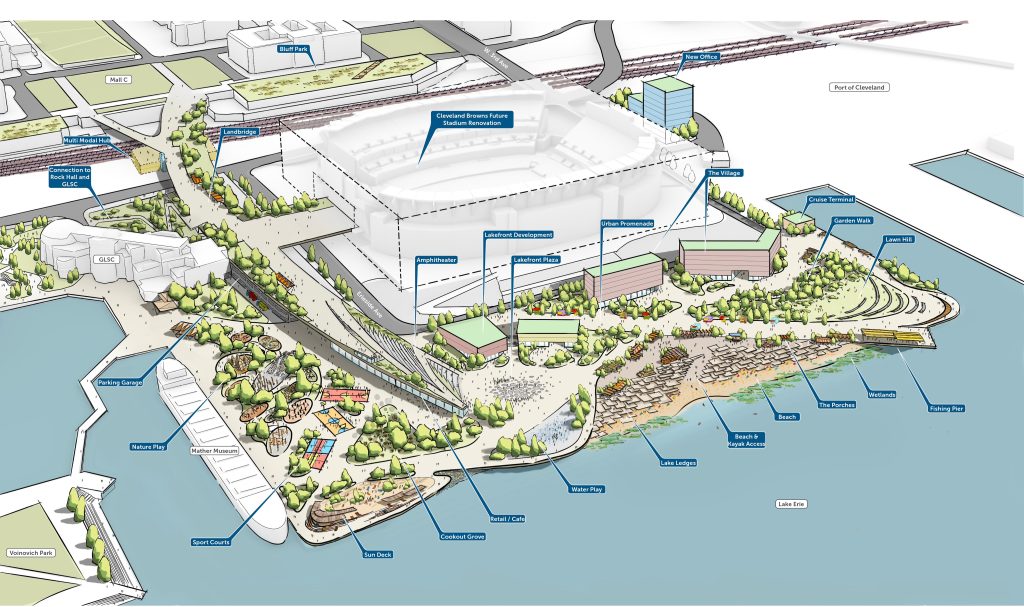
There are lots of moving parts to the North Coast Connection and to the future of development on the current site of Huntington Bank Field (City of Cleveland).
Construction of the land bridge is due to be finished in June 2028 — just as early construction works, including relocating sewers and power lines, could start for the new boulevard. Completion of the boulevard’s first phase is tentatively scheduled for the first quarter of 2032.
A second phase for the boulevard, from the east end of the to-be-removed East 9th Street ramps to the Inner Belt curve, including the construction of an extended East 18th Street to the new boulevard, is part of as-yet unfunded phase two. There is no timetable for that phase, documents show.
The new, pedestrian-friendly boulevard is viewed by Mayor Justin Bibb’s administration and others as the key to unlocking a redeveloped, year-round lakefront vision featuring a new street grid, housing, shops, parks, and other public spaces.
That updated vision, minus the stadium — replaced by a park that’s the same size, shape and location as the stadium’s current playing field — was released publicly on Monday. DiGeronimo Companies was named in December 2025 as the lakefront’s master developer.
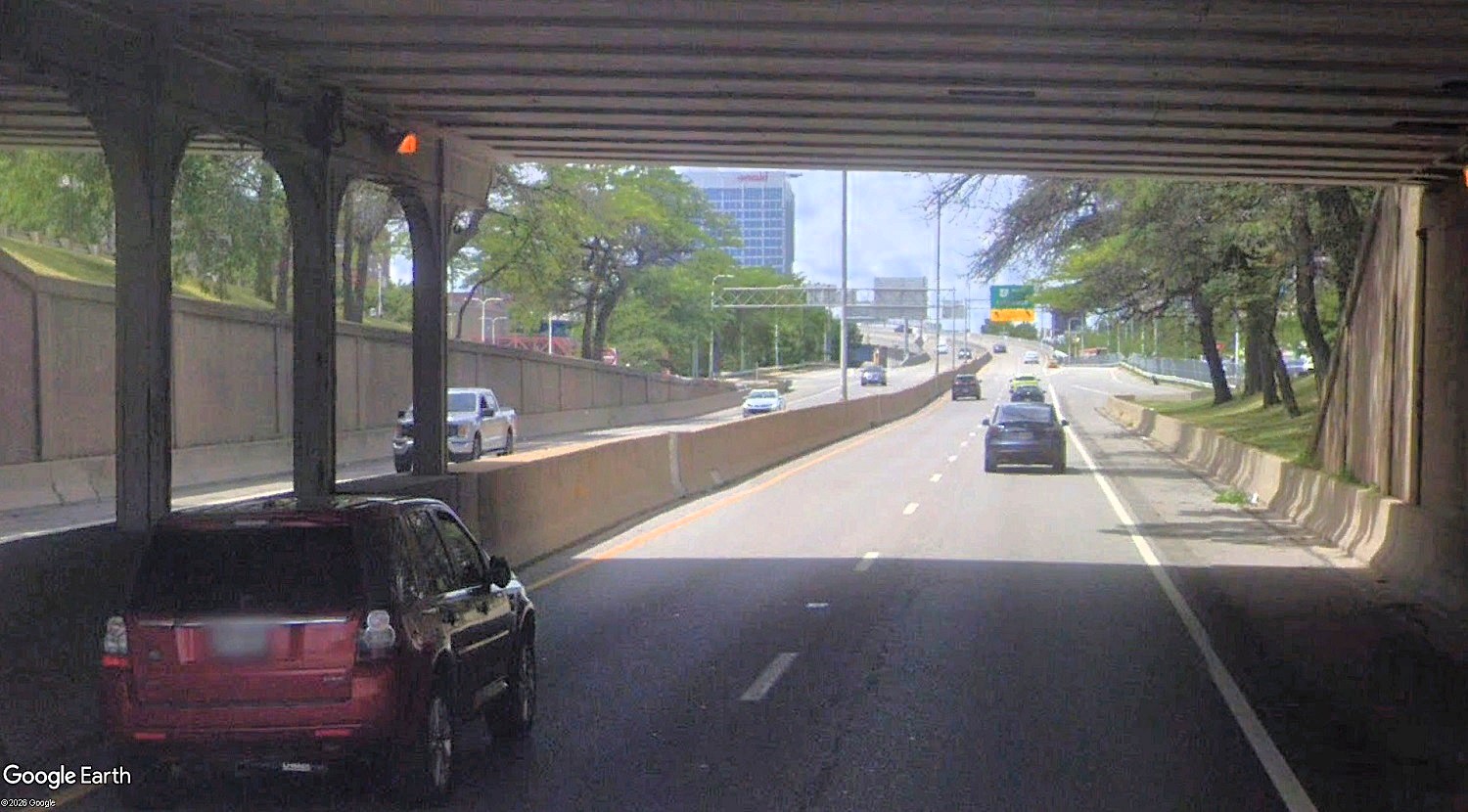
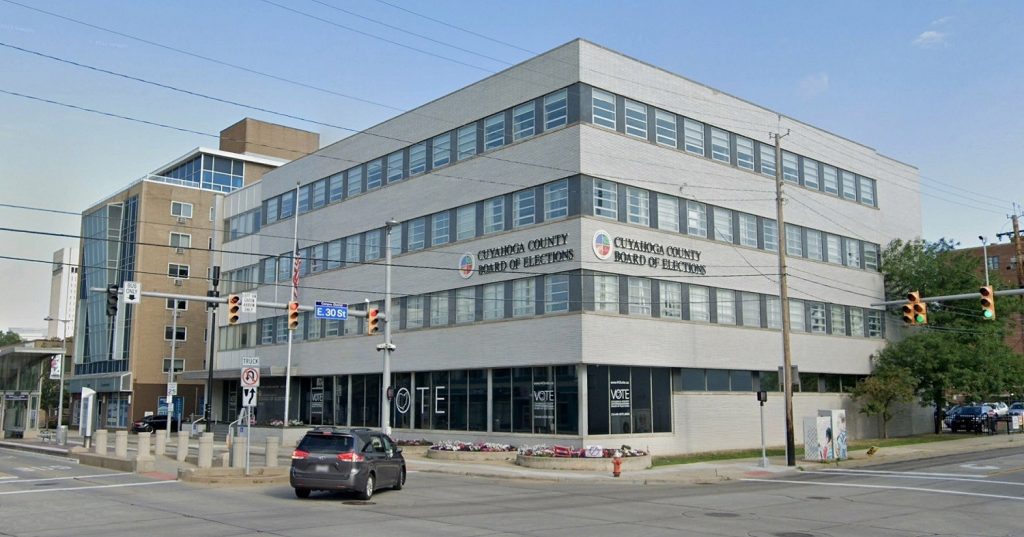
Another scene that’s due to dramatically change in the next five years — this Shoreway underpass below East 9th Street and the curving Shoreway bridge in the distance to the west will both be gone, replaced by a boulevard with intersections (Google).
But, as often happens, timetables can and do change. For example, the July 2029 start of a year-long demolition of the second home of the Cleveland Browns is dependent on construction progress of the Browns’ third home in suburban Brook Park.
If work on the new Huntington Bank Field in Brook Park is delayed, so will be the demolition of the current stadium, built in 1999. Yet that structure is unlikely to survive long enough to still be there for the 100th anniversary of the Browns’ first stadium, Cleveland Municipal, built on that site in 1931 and razed in 1996.
To accommodate for construction delays in Brook Park, the city has provided the Haslam Sports Group, owners of the Browns, with an option to extend the football team’s 30-year lease at the city-owned lakefront stadium by up to two years to the end of the 2030 football season.
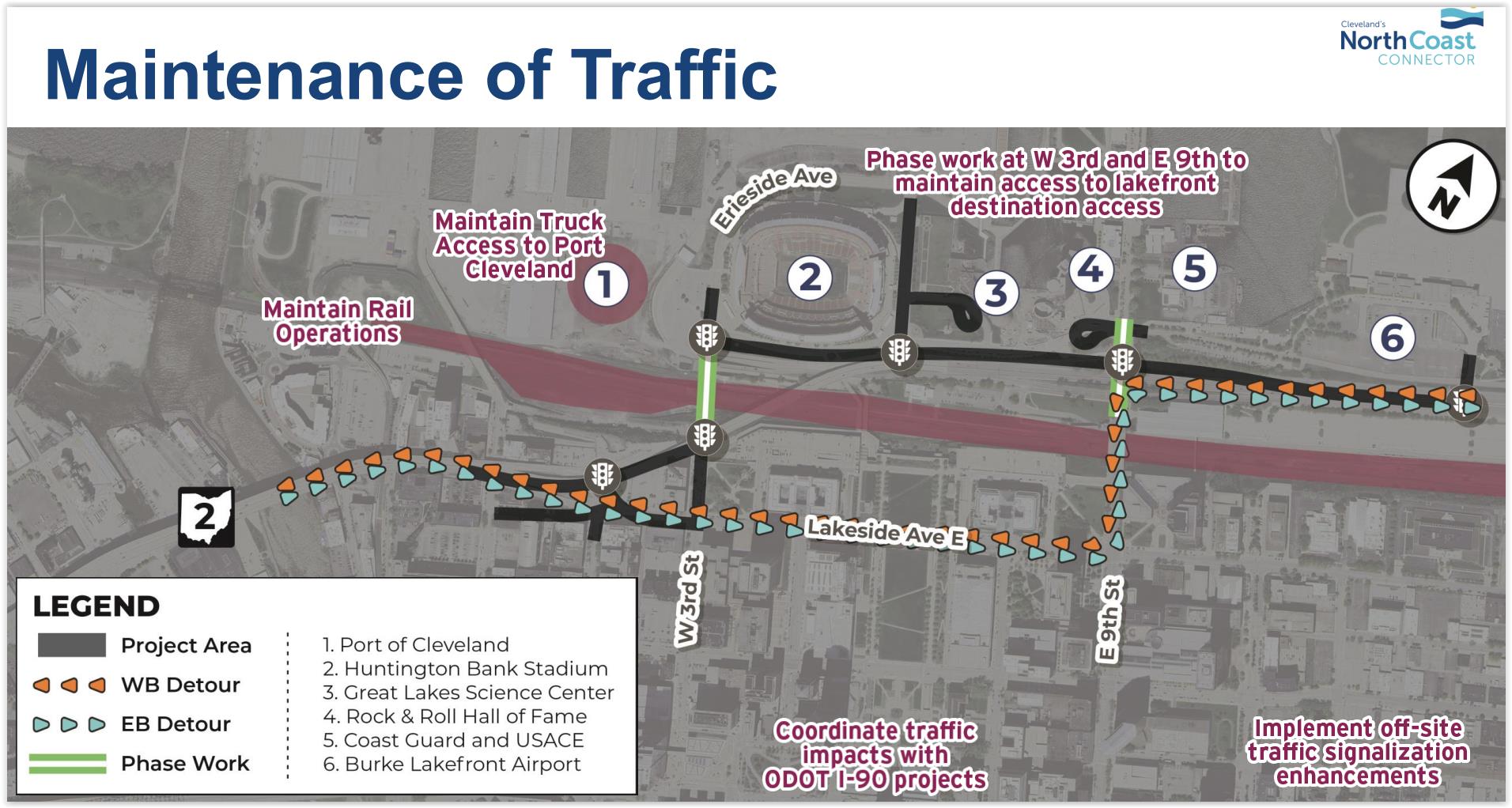
This detour for Shoreway traffic downtown could be in place for more than three years starting in late-2028. However, most of the construction that could affect stadium traffic isn’t due to start until after the Cleveland Browns relocate to Brook Park after the 2028 season — if construction in Brook Park is on time (City of Cleveland).
In exchange for that and dropping all legal challenges to its Brook Park move, the Haslams’ settlement provided the City of Cleveland with $100 million, most of that going to lakefront redevelopment including $30 million for demolition of the 1999-built stadium.
With such a large project, of course not everyone is happy — including with the basic concept which is to turn the city’s oldest freeway built in the late 1930s into a multimodal boulevard. Among them is Ward 15 Councilman Charles Slife who chairs council’s Transportation Committee.
He said he is concerned the project, even after the construction detours are done, will make driving through Downtown Cleveland slower and more difficult.
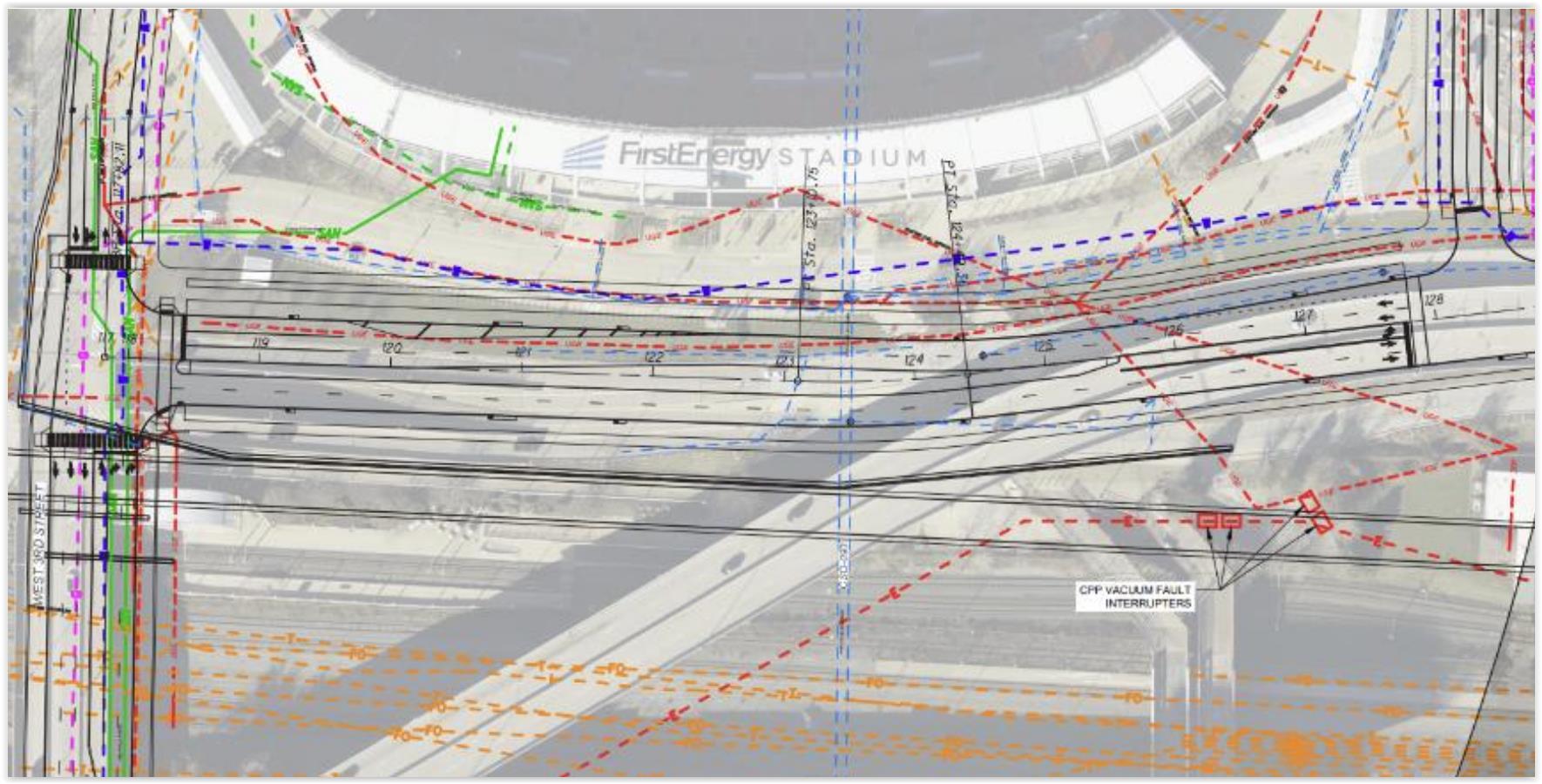
This graphic looks like an incredibly complex mess of infrastructure — and that’s the point. It shows how complicated the infrastructure — above and below ground — is in the vicinity of West 3rd Street at left and the existing Huntington Bank Field at top and the railroad tracks below. Amid all of that are sewer lines, power lines, gas lines, communication lines and more (City of Cleveland).
Bibb administration officials agreed that they are trying to slow down traffic through downtown to make it safer and more comfortable for pedestrians and better connect the central business district with Lake Erie. As for making travel more difficult, the city’s North Coast Connector Web page responded to that concern, too.
“Some of the traffic that travels through downtown, from one side to the other, will divert to other roadways, such as Interstate 90,” the site noted. “On these roadways we do see some sections where traffic does not operate as well as it would without the additional vehicles, but overall there aren’t significant problems.”
“On the boulevard itself and at downtown intersections, we’re still examining how many lanes we would need for through traffic and how and where turn lanes might be,” it continued. “We need to balance these lanes in the best way possible to maintain pedestrian and bicyclist safety.”
END