
Green Bay Packers fans walk to Lambeau Field from their car, parked on the front lawn of a house in a residential neighborhood near the stadium. Many homes in Green Bay and neighboring Ashwaubenon have offered stadium parking for decades (Used with permission from NBC 26 WGBA-TV). CLICK IMAGES TO ENLARGE THEM.
Haslams may seek more land for more parking

Last night, in the hours before the Green Bay Packers hosted the Washington Commanders for a football game at historic Lambeau Field, fans did what they do everywhere else. They parked their cars, maybe did a little tailgate partying before walking to the stadium and paid a handsome price for the privilege.
But instead of paying it to a guy in a booth or to a machine with a gate, either guarding entry to a huge parking lot, they handed over cash to a family to park on their lawn in front of their house. That house and many others are close enough to hear the loudspeakers, music and fans’ roar at the 81,441-seat stadium.
While Lambeau Field is located in Green Bay, it’s barely within the city limits. If someone crosses the closest street to the south of the stadium, they step into the suburban neighborhoods of Ashwaubenon, WI. There and in other residential districts, homeowners park anywhere from one to 10 cars in their front yards for each game or major event at Lambeau.
Last spring, during the National Football League (NFL) college draft, residents were raking in up to $200 per car to park in their yards. Some homeowners have regular customers and give them discounts. And it’s all cash — not taxable. Residents said the income helped them afford taking trips or even putting their kids through college.

Residents in Ashwaubenon, WI wave football fans into their front-yard parking spaces during National Football League college draft at nearby Lambeau Field in Green Bay last spring and charged a pretty penny for it. Green Bay’s stadium has the least amount of acreage dedicated to public parking in the NFL (Used with permission from NBC 26 WGBA-TV).
The reason for this unique setup, among many others surrounding the Packers (ie: community-owned team, operated not-for-profit, smallest NFL market, etc.), is that it has the second-least amount of land devoted to public parking among NFL stadiums not located in a downtown/central business district. That doesn’t count the front-yard neighborhood parking.
NEOtrans mapped the land used for public parking lots, dedicated to stadium events at 15 non-downtown NFL stadiums using GoogleEarth and measured the acreage for each. The stadiums are listed and ranked at the bottom of this article.
While Green Bay has the second-least amount of public parking lots, about 60 acres worth, it probably has the fewest actual parking spaces among non-downtown NFL stadiums. It’s “probably” the fewest because of how Las Vegas comes in with the smallest land area devoted to parking — a rank that is deceptive.
Allegiant Stadium for the Las Vegas Raiders, located in suburban Paradise, NV, has just 50 acres of land devoted to parking. But across Interstate 15 is the south end of The Strip of large casinos and their larger parking garages that serve double-duty on game days.
Surface parking lots have a typical range of 90 to 150 spaces per acre, depending on the amount of landscaping, handicapped spaces, walkways, driveways, etc. Green Bay has just 5,400 to 9,000 dedicated stadium parking spaces. Las Vegas almost certainly has more spaces because it includes multilevel casino garages that dedicate large blocks of stalls to gameday parking.

Lambeau Field in Green Bay, WI has only 60 acres of land dedicated to stadium parking, which is actually an increase in recent years. The site is surrounded by residential neighborhoods that contribute more parking on game days but don’t count in the parking acreage (Google).
The Haslam Sports Group, owners of the Cleveland Browns, want to build the 16th non-downtown NFL stadium. Some people may be surprised at how few NFL teams actually play their home games at downtown stadiums.
Since two of the NFL’s stadiums — SoFi Stadium in Inglewood, CA (Los Angeles) and MetLife Stadium in East Rutherford, NJ (New York City) — each host two NFL teams, more than half of the 32 NFL franchises do not play their home games in downtown stadiums.
According to NEOtrans’ calculations, the Brook Park stadium sought by the Haslam Sports Group could have anywhere from 80 to 90 acres of parking lots, or less than 9,000 parking spaces — not the 12,000 spaces often touted by the Haslams.
That would mean it could have the third-least amount of parking area among non-downtown NFL stadiums. The overall site acquired by an affiliate of the Haslams in June measures 177.16 acres, according to updated county records.

The National Football League stadium with the least amount of parking acreage is Allegiant Stadium in the Las Vegas suburb of Paradise. But that’s deceptive because it relies on partnerships with huge, multi-level casino parking garages across Interstate 15 (Google).
Limited parking is a reason why the Haslams recently approached the Greater Cleveland Regional Transit Authority (GCRTA) about building a new train station on the Red Line rapid transit next to the stadium site.
The Red Line has a train every 15 minutes in each direction, 22 hours a day. But at standing-room capacity, the trains would skim off about 10 percent of a maximum gameday attendance of 69,500 fans.
The last new station GCRTA built from scratch was the Little Italy-University Circle Station in 2015. It cost $17.5 million. Today, the same station could cost about $25 million — something GCRTA doesn’t want to pay considering the limited use of NFL stadiums.
The number of Brook Park stadium parking spaces is not a set figure. It depends on the final stadium site layout, which the Haslam Sports Group still hasn’t nailed down yet.
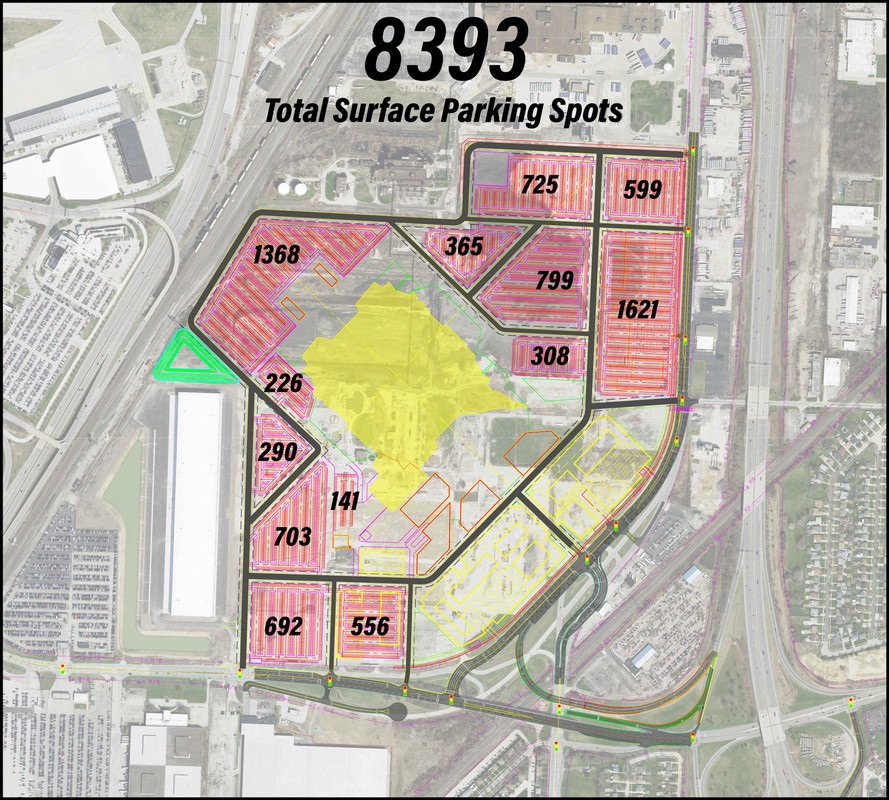
A recent Haslam Sports Group’s site plan for the new, enclosed Huntington Bank Field, future development, and parking areas surrounding them — plus planned road/walkway infrastructure. The numbers show the actual number of parking spots depicted in the Haslam’s application to the Ohio Department of Transportation’s Transportation Review Advisory Council (ODOT TRAC/Noah Belli).
Their data assumes that 30-40 acres will be devoted to the new, enclosed Huntington Bank Field and its pedestrian apron, plus another 40-70 acres of land for stadium-area development including restaurants, shops, hotels, housing and other entertainment.
That is based on a parking map delivered by the Haslam Sports Group earlier this year to the Ohio Department of Transportation (ODOT) for its funding request to support new roadway infrastructure into its proposed Brook Park stadium site.
If no development is built around the new stadium, and for at least the first few years after the Browns relocate in 2029 there probably won’t be much, then the Brook Park stadium could have anywhere from 120 to 160 acres of parking, or up to 17,000 spaces. That would boost its ranking to anywhere from fourth to eighth among non-downtown stadiums with the least parking.
NEOtrans asked Haslam Sports Group Chief Communications Officer Peter John-Baptiste for a breakdown of how many parking spaces would be available after the stadium and supportive development, including any parking garages are added to the site.
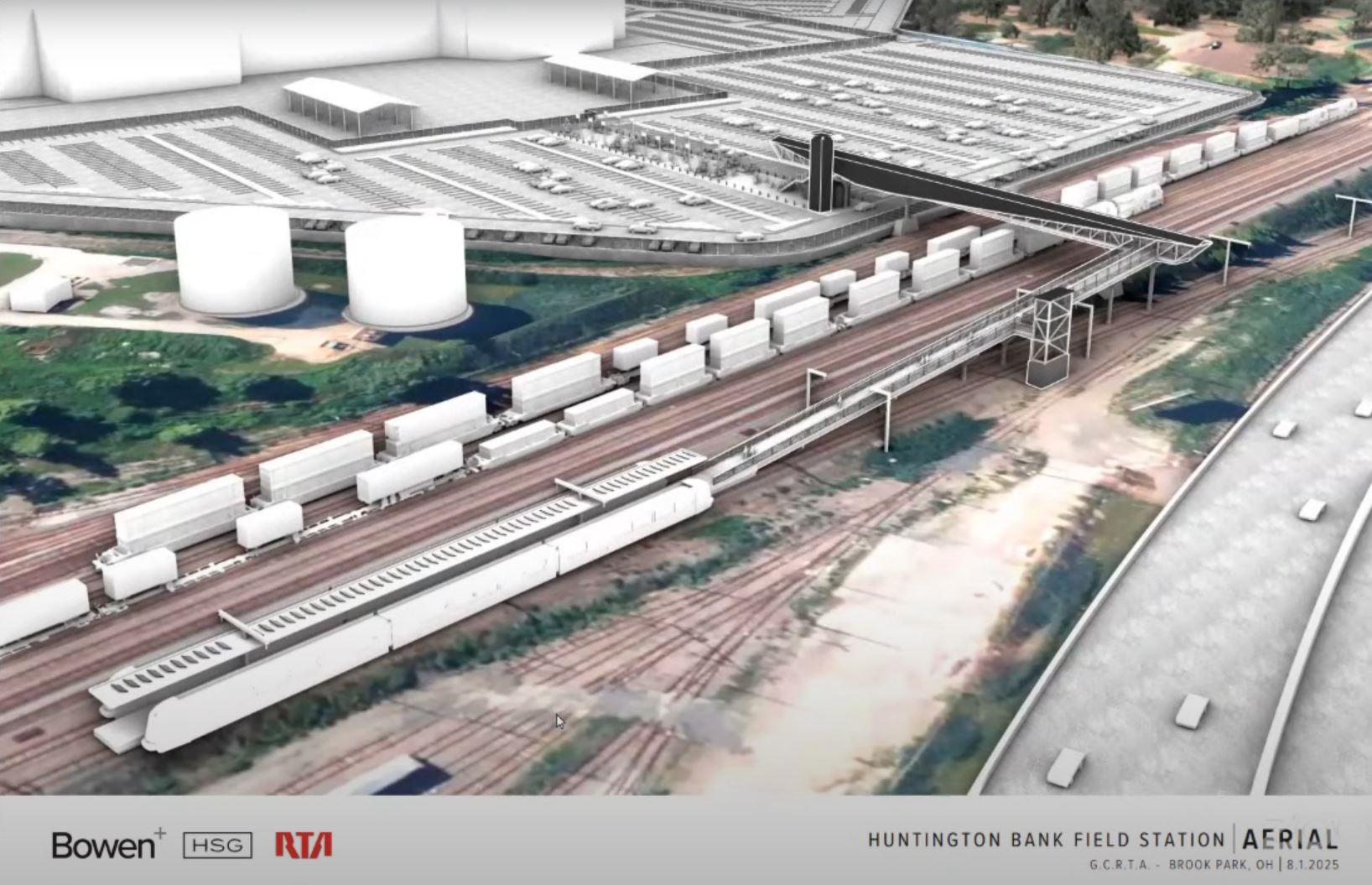
A conceptual rendering of what a new Red Line train station for the new stadium could look like, viewed looking southeast with Berea Freeway at the lower right and the stadium at the top (HSG-Bowen).
He has yet to provide that information, perhaps because the stadium site layout is still fluid. And it got potentially more fluid after ODOT-Aviation denied a construction permit for the stadium.
ODOT-Aviation said the stadium would intrude into flight patterns for nearby Cleveland Hopkins International Airport, a story first broken by NEOtrans. The Haslams may appeal the decision or resubmit their permit with the stadium in a new location, farther south from the flight path for the airport’s east-west Runway 10/28.
According to sources close to the Haslam Sports Group, more land may be acquired for more parking and future development. It could be added southwest of the stadium site, between Berea and Brook Park, to create more synergies with the Browns’ headquarters and practice facility in Berea, plus mixed-use development now under construction next to it.
The Haslams and DiGeronimo Companies are jointly developing District 46, a mix of housing, hotel, retail and community athletic facilities named after the Browns’ inaugural year of 1946. It is next to the Cleveland Browns’ CrossCountry Mortgage Campus, 76 Lou Groza Blvd. But, there apparently is no roadway or pedestrian infrastructure planned for development to the south.

This is what the site plan supplied by the Haslam Sports Group to ODOT-TRAC looks like with its parking acreage mapped out on Google Earth, and at the same scale of the Green Bay and Las Vegas/Paradise stadium sites (Google).
The infrastructure the Haslams are seeking from ODOT does include a new walkway from the new stadium site over Henry Ford Boulevard. It would be located to the east of the stadium, next to the intersection with Hummel Road.
The walkway could support the acquisition of nearly 30 acres of commercial properties between Henry Ford and Interstate 71. If their few, smallish structures were demolished, these lands could offer another 3,000 stadium parking spaces.
The location of the proposed overhead walkway, next to Hummel which has an underpass below I-71, could also open up land to the east side of the interstate for redevelopment as parking lots. One underutilized, narrow parcel next to the east side of the highway extends all the way up to Brookpark Road and, by itself, measures 18 acres.
Hummel’s underpass of I-71 also provides access to the neighborhoods east of the busy CSX railroad line. If Browns fans can be trusted to safely cross the tracks, used by 50 daily freight trains at speeds of up to 60 mph, perhaps neighborhood residents could also earn some cash from parking on their front lawns, like those in Green Bay.
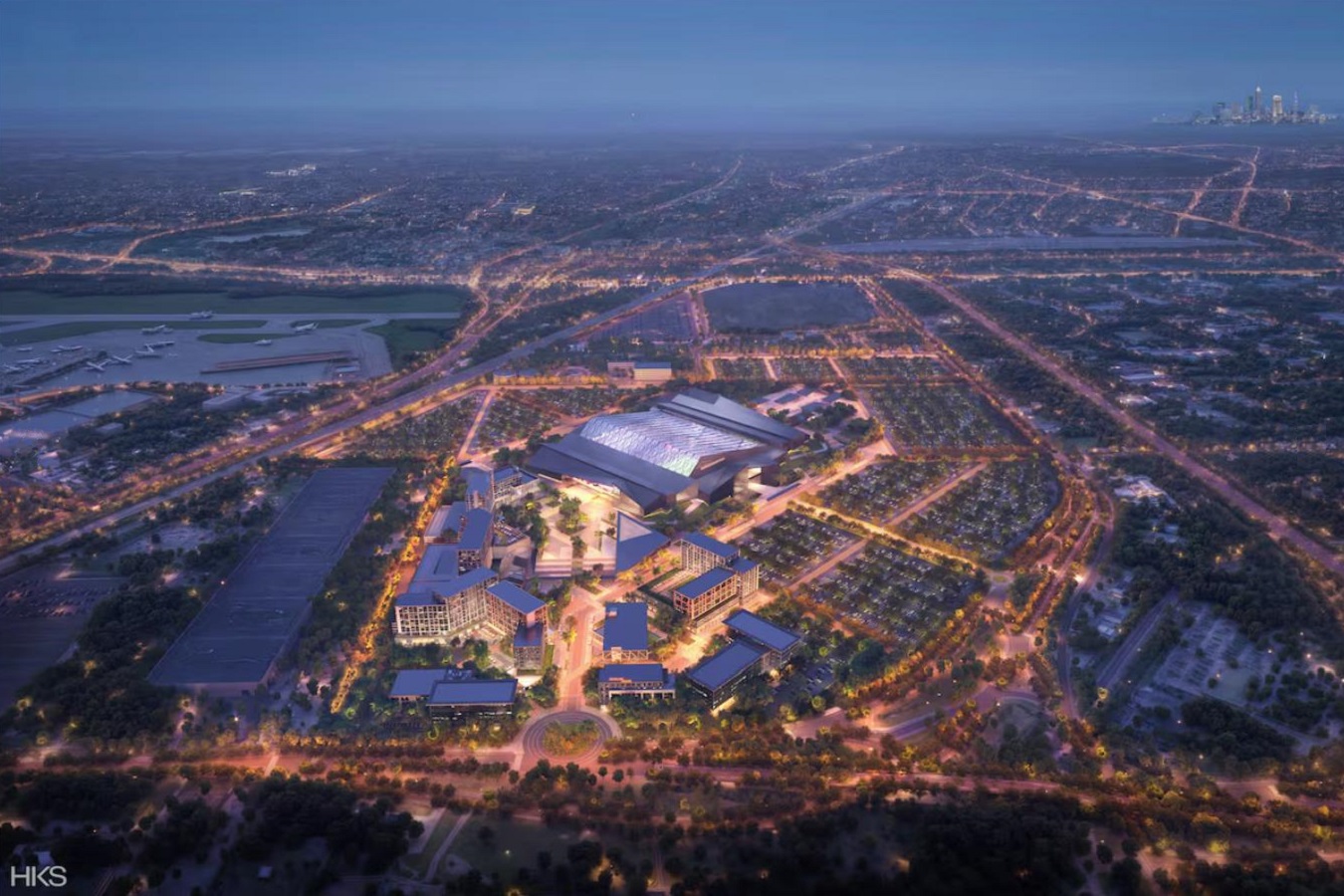
An aerial view looking north at the planned Huntington Bank Field in suburban Brook Park with Snow Road across the bottom. This is based on a different site plan from the one the Haslam Sports Group submitted to the Ohio Department of Transportation for road infrastructure work and thus results in only about 80 acres of on-site parking (HKS).
Ranking of non-downtown NFL stadiums by acres devoted to parking (from fewest to most) :
1. Las Vegas/Paradise, NV – 50 acres
2. Green Bay, WI – 60 acres
?? Cleveland/Brook Park, OH – 80-90 acres
3. San Francisco/Santa Clara, CA – 108 acres
4. Los Angeles/Inglewood, CA – 130 acres
5. Kansas City, MO – 143 acres
6. Miami/Miami Gardens, FL – 144 acres
7. Buffalo/Orchard Park, NY – 150 acres
8. Dallas/Arlington, TX – 152 acres
9. Tampa, FL – 168 acres
10. Philadelphia, PA – 169 acres
11. Washington DC/Landover, MD – 178 acres
12. Phoenix/Glendale, AZ – 179 acres
13. New England-Foxborough, MA – 187 acres
14. NYC/East Rutherford, NJ – 204 acres
15. Houston, TX – 242 acres
END