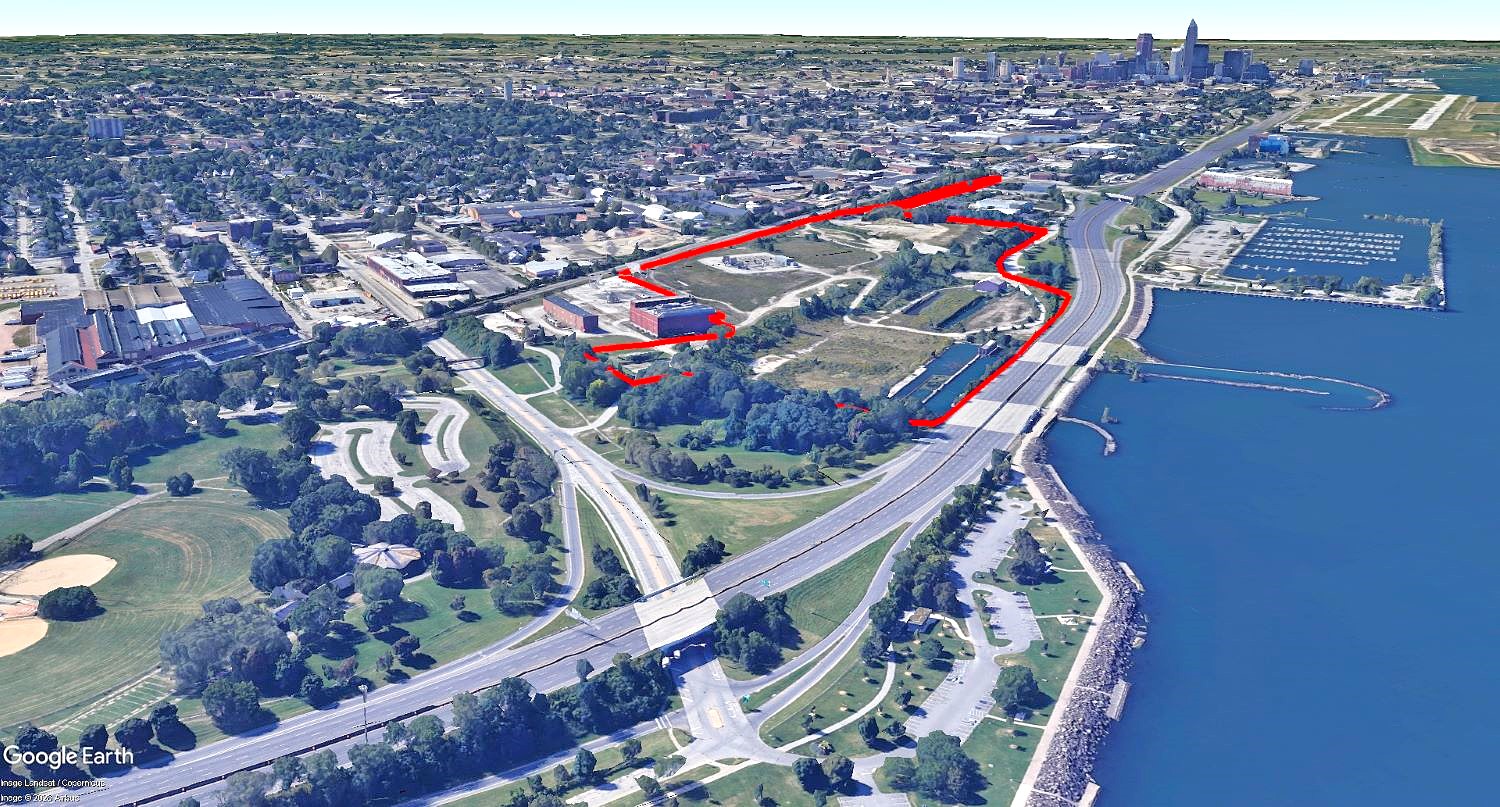
After the former Lake Shore Power Station was leveled in 2017 and its site cleaned in the last two years, the 62-acre property outlined in red is now on the market. What happened next will decide the long-term future of one of what may be the most consequential development sites in Greater Cleveland (Google). CLICK IMAGES TO ENLARGE THEM.
Lakefront site offered for industrial, mixed-use
While the 50-acre Downtown Cleveland lakefront redevelopment has most of the attention right now, an even larger lakefront redevelopment site has just hit the market. And its future re-use will influence the fate of the lakefront east of downtown for decades to come.
The question is — how should it be developed? Should it be developed with industry, warehouses, data centers, housing, or a mix of residential, recreation, restaurants and retail? Those questions could be answered shortly.
The reason is that the 62-acre former Lake Shore Power Station property, 6800 South Marginal Rd., is now listed publicly for sale or lease by Cushman & Wakefield-CRESCO Real Estate of Independence. No asking price or rent was published.
Making the property available is Lake Shore Acquisition Company LLC, an affiliate of Utah-based Industrial Development Advantage LLC (IDA). NEOtrans broke the story of it acquiring the property in 2023. It has spent the last two years cleaning up the site so it could be offered as a developable property.
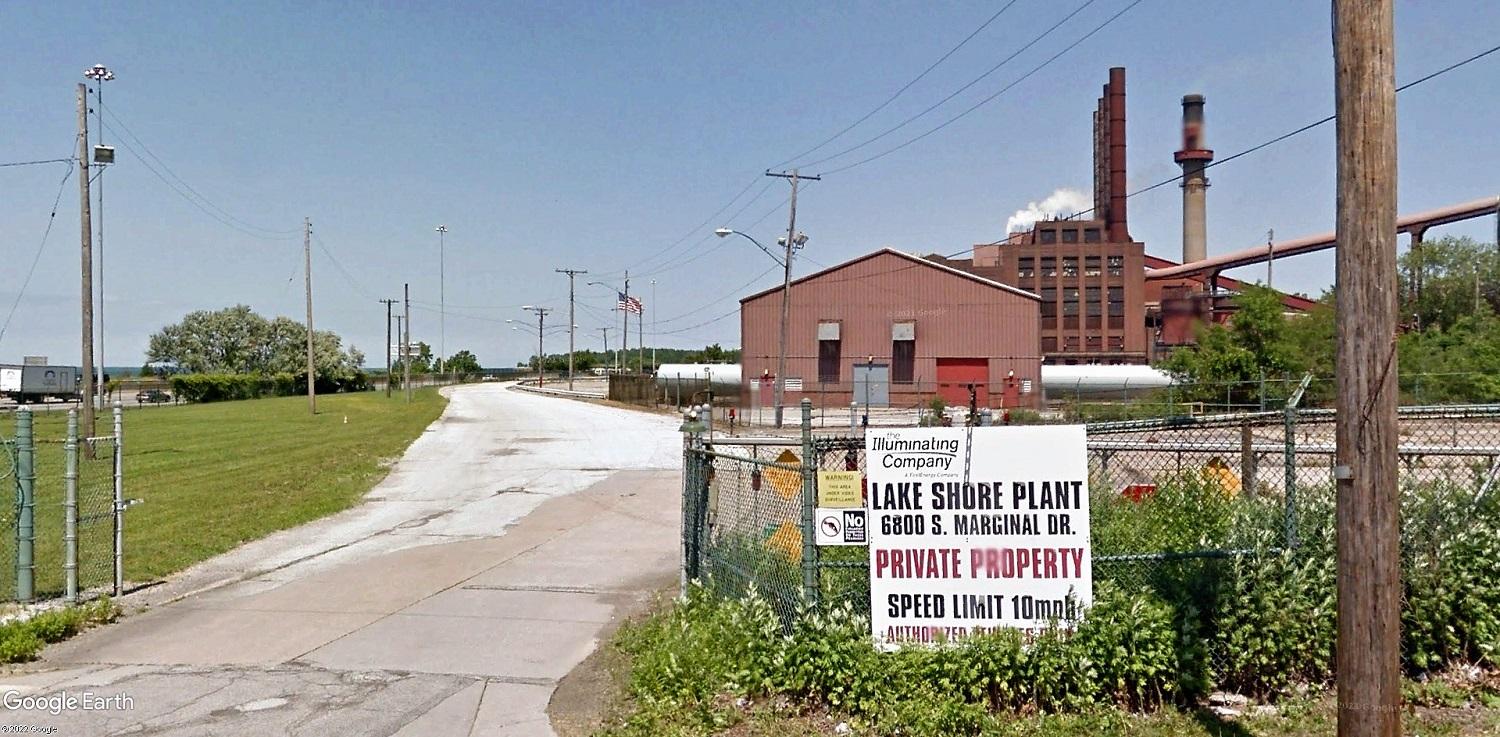
On its 100th anniversary in 2011, the Lake Shore Power Station was already in the process of getting shut down. It would be imploded six years later (Google).
Rico Pietro, a principal at Cushman & Wakefield-CRESCO, said just about anything is on the table at this point and nothing has been decided with regards to the future of the lakefront property. Not only is the property for sale or lease but they are looking for joint ventures, too.
Pietro, who also is a principal in an Independence-based real estate design-build-lease development firm called DBL Development LLC, said his company is partnering with IDA to reuse the site.
DBL includes Erik Loomis, president of a Euclid-based construction firm Loomis Companies. Pietro said any reuse would be done in a manner that is supported by the community, led by Cleveland Mayor Justin Bibb and his staff.
“DBL Development is in partnership with IDA and we look forward to a new chapter for our 60-acre site on South Marginal,” he told NEOtrans. “We are not certain of the (preferred) use yet, but are excited to work with the Bibb Administration.”
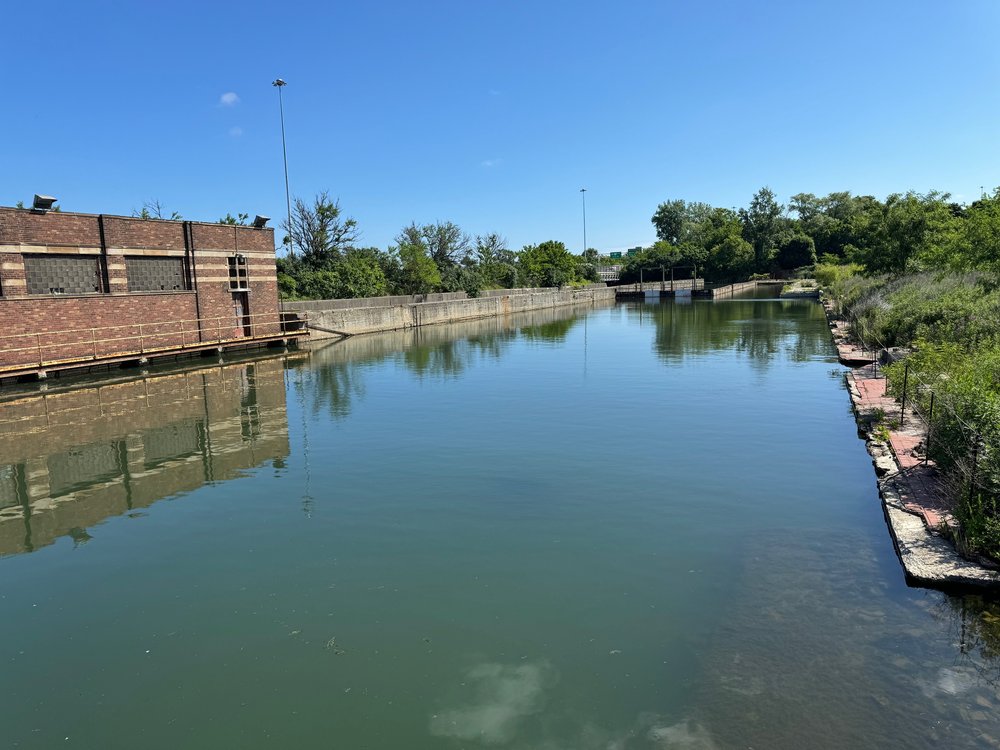
A cooling pond left over from the former Lake Shore Power Station along Interstate 90 and the Lake Erie shoreline, east of Downtown Cleveland (IDA).
But what is giving some lakefront advocates cause for concern are some of the potential uses for the site — as suggested in the real estate brokerage’s marketing materials.
“The site presents exceptional redevelopment potential for industrial, mixed-use, or large-scale logistics users within the City of Cleveland Opportunity Zone and is an ideal data center location as a former FirstEnergy power plant with unlimited water access from Lake Erie,” Cushman & Wakefield-CRESCO’s listing notes.
“The power plant site should be reserved for residential and supporting enterprise like restaurants, retail, and park development,” said Dick Clough, founder and executive board chair of the Green Ribbon Coalition.
“The proximity to Gordon Park overlooking the lake and CHEERS (Cleveland Harbor Eastern Embayment Resilience Strategy) footprint makes the site prime for residential development,” he added. “It would be a generational tragedy to construct some massive structure on the site like a data center.”
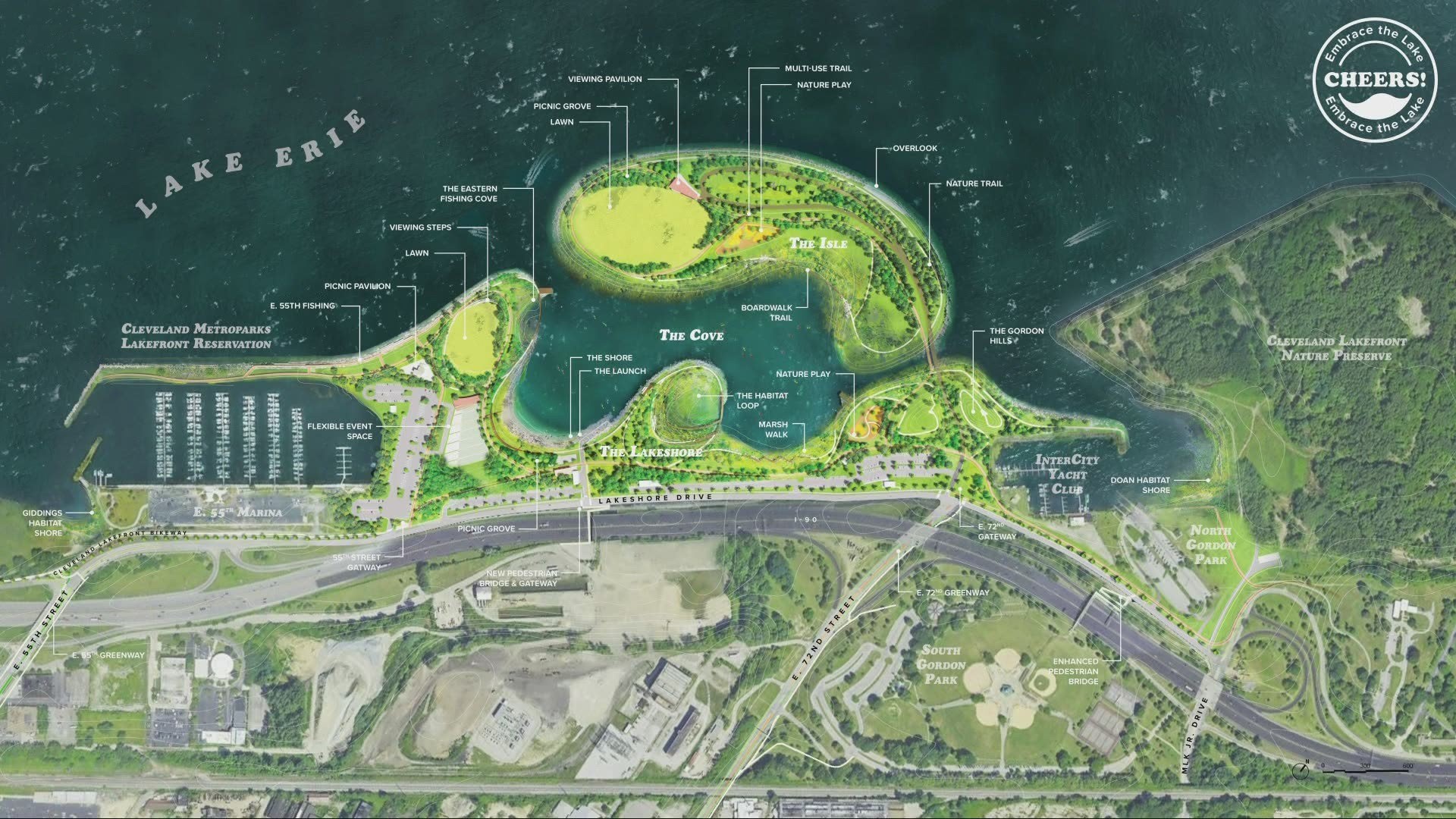
The Port of Cleveland won state funding last month to advance design and property acquisition for the Cleveland Harbor Eastern Embayment Resilience Strategy (CHEERS) to expand the shoreline north of Interstate 90. The former Lake Shore Power Station site is just south of the highway, between East 55th and East 72nd streets (Metroparks).
The city has created a lakefront design review district from Edgewater Park to Gordon Park. Clough urged that it be used to establish and enforce “sensible development” north of the CSX and Norfolk Southern railroad tracks. The old Lake Shore Power Station site is zoned for general industry, allowing manufacturing, warehousing, recycling, junk yards, and data centers.
The former coal-fired Lake Shore Power Station once belonged to Cleveland Electric Illuminating Co., then FirstEnergy, then Energy Harbor. The plant, built in 1911, was closed in 2015 rather than be upgraded to meet new air quality standards to reduce mercury and other toxic metal emissions.
Energy Harbor imploded the plant in spectacular fashion in 2017 and most of the remaining structures were razed since, leaving a large, nearly empty site next to Gordon Park and the East 55th Marina.
Only an electrical substation, a small storage building and several cooling ponds remain. Energy Harbor spent several million dollars clearing and cleaning the property, public records show, in addition to later work done by IDA.
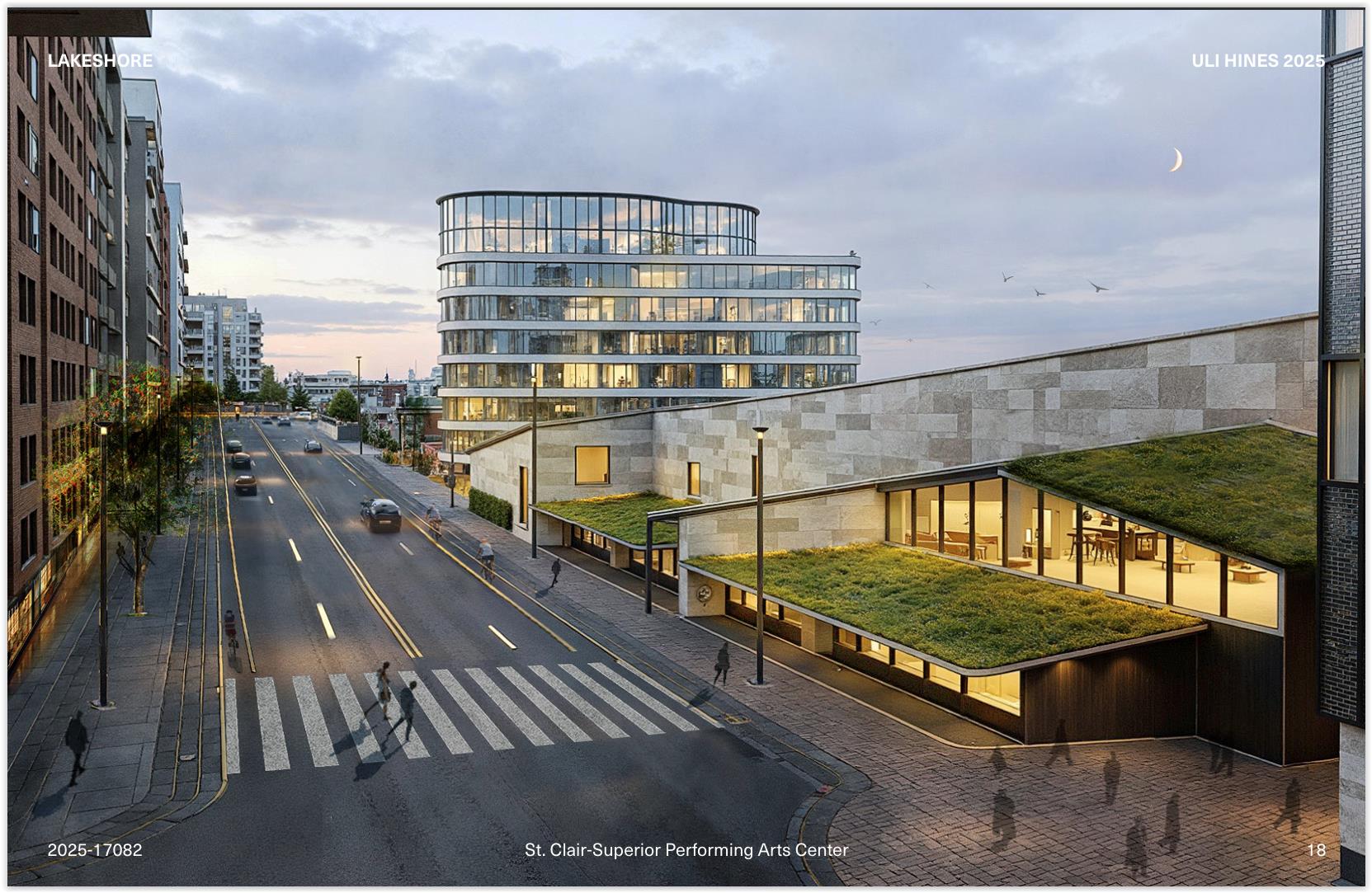
A team of Harvard University and Massachusetts Institute of Technology students won first place in a global competition to design a new future for the former Lake Shore Power Station site. None of the 83 competitors proposed anything other than a mixed-use lakefront neighborhood of residential, offices, retail, cultural offerings and recreational settings (Harvard-MIT).
The site last year was the subject of a global design contest — the 23rd annual Urban Land Institute(ULI)/Gerald D. Hines Student Urban Design Competition. The winning plan was advanced by a team of Harvard University and Massachusetts Institute of Technology (MIT) students, netting for them a $35,000 prize.
Their plan was a three-phase, 2.25-million-square-foot mixed-use development with a project value of more than $1.1 billion. But what was even more interesting is that all 83 of the competing proposals had some form of post-industrial mixed use for the site.
All considered a mix of some or all of the following — residential, office, institutional, business incubators, retail, hotel and recreational uses. None of the universities and their urban design teams proposed industrial, warehousing or data centers for the huge lakefront site.
END