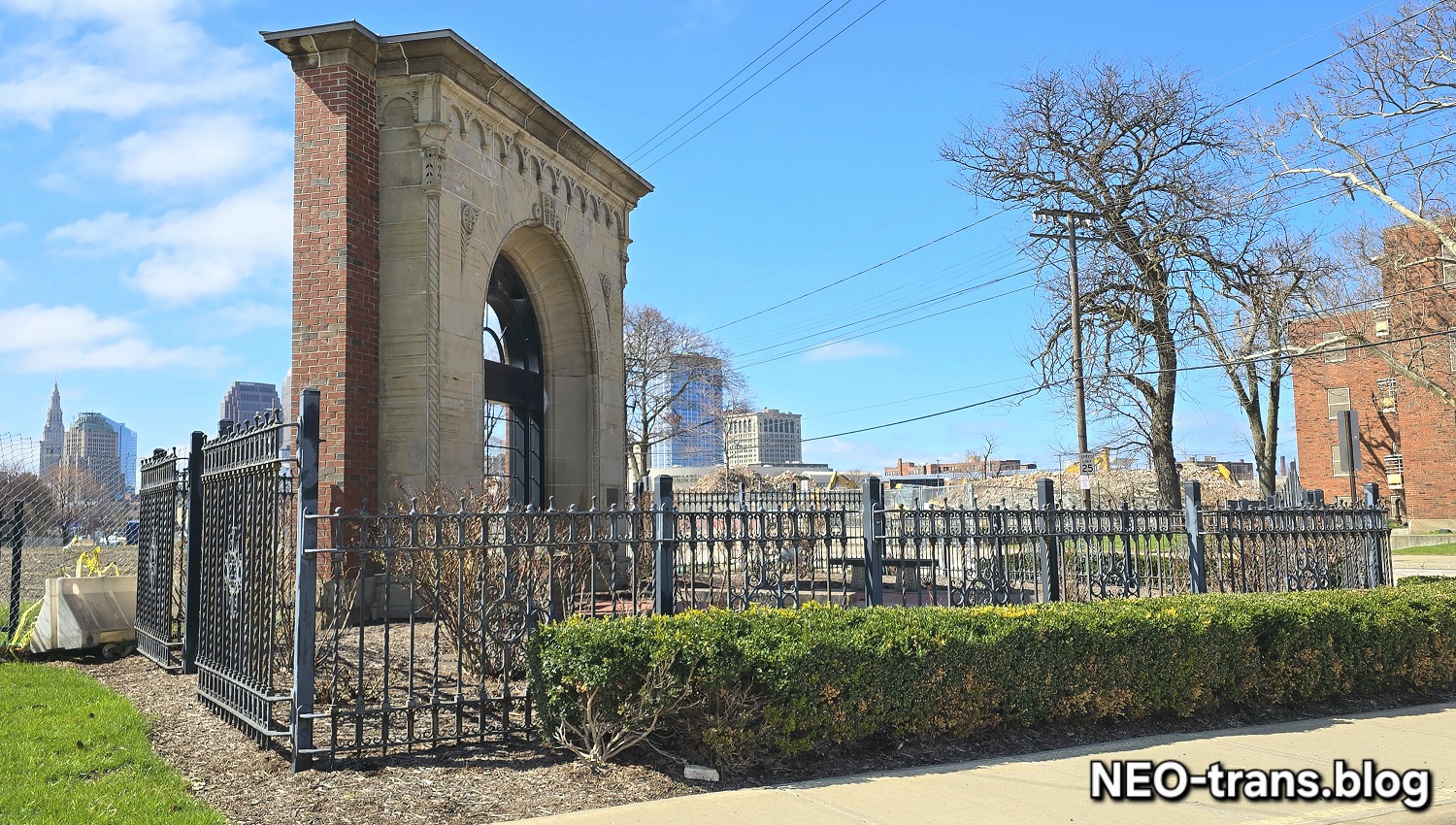
There’s a lot to unpack in this photo at East 24th Street and Central Avenue. First is the Nurses Home arched doorway, a survivor from multiple demolitions of St. Vincent Charity Hospital, leaving a vacant lot at far left. In the center beyond the fence are piles of rubble from another demolition, that of the Cuyahoga County Juvenile Justice Center. And at far right is a corner of the 22-acre Olde Cedar public housing and may be demolished, too. Downtown Cleveland is in the distance (NEOtrans). CLICK IMAGES TO ENLARGE THEM.
All structures in area may be razed

Mega-redevelopment sites are emerging all around Downtown Cleveland. There’s the 50-acre lakefront site that includes the to-be-demolished Huntington Bank Field. There’s the nearly 40-acre Bedrock Riverfront site. There’s the 62-acre ex-Lake Shore Power Plant site just east of downtown. And there’s the 450-acre site that now contains Burke Lakefront Airport.
In fact there’s so many mega-sites around downtown entering the picture simultaneously that they may overwhelm the ability of the region’s public and private sectors to address them all in a timely or effective manner. And they’re emerging when the downtown office and market-rate residential markets have gone flat.
Another is getting added to the picture at the south end of the Campus District, once called the St. Vincent Quadrangle. But it’s not getting noticed yet, not when it’s competing with those four large-lot, higher-profile waterfront mega-sites that can capitalize on the booming experiential economy.
Piece by piece, parcels ranging in size from 0.22 acres to 22 acres are adding themselves to another potential mega-development site on the southeast side of Downtown Cleveland. Yet they are coming into play at the nearly same time by the fact that their old land uses are getting cleared or are about to.
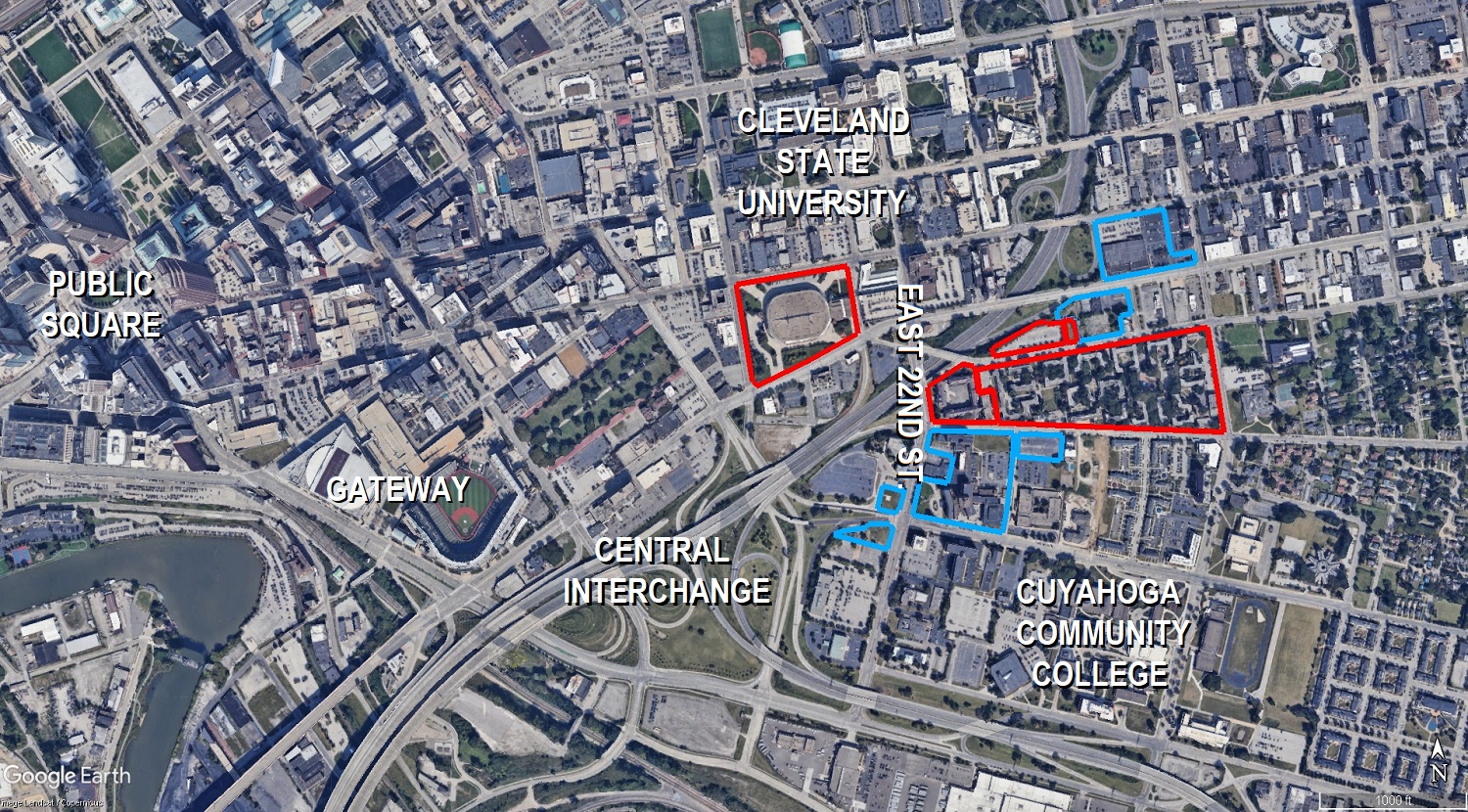
In play are a grouping of small- to medium-sized properties in the Campus District, on the southeast side of Downtown Cleveland, that collectively are as large as notable waterfront mega-redevelopment sites. Sites outlined in red are owned by government agencies and those in blue are privately owned (Google/NEOtrans).
Those properties at the south end of the Campus District are:
- 21.8 acres = Cuyahoga Metropolitan Housing Authority’s (CMHA) Olde Cedar housing project
- 10.12 acres = former St. Vincent Charity Medical Center
- 9.6 acres = Cleveland State University Wolstein Center arena
- 4.45 acres = Central Cadillac/Porter Properties
- 4.4 acres = former Cuyahoga County Juvenile Justice Center
- 2.5 acres = Grasslot Investments/Wiley
- 0.22 acres = other government owners
There has not been much attention paid to the redevelopment opportunity offered by this collection of properties. And there’s probably been even less news coverage of what’s envisioned to be built on them.
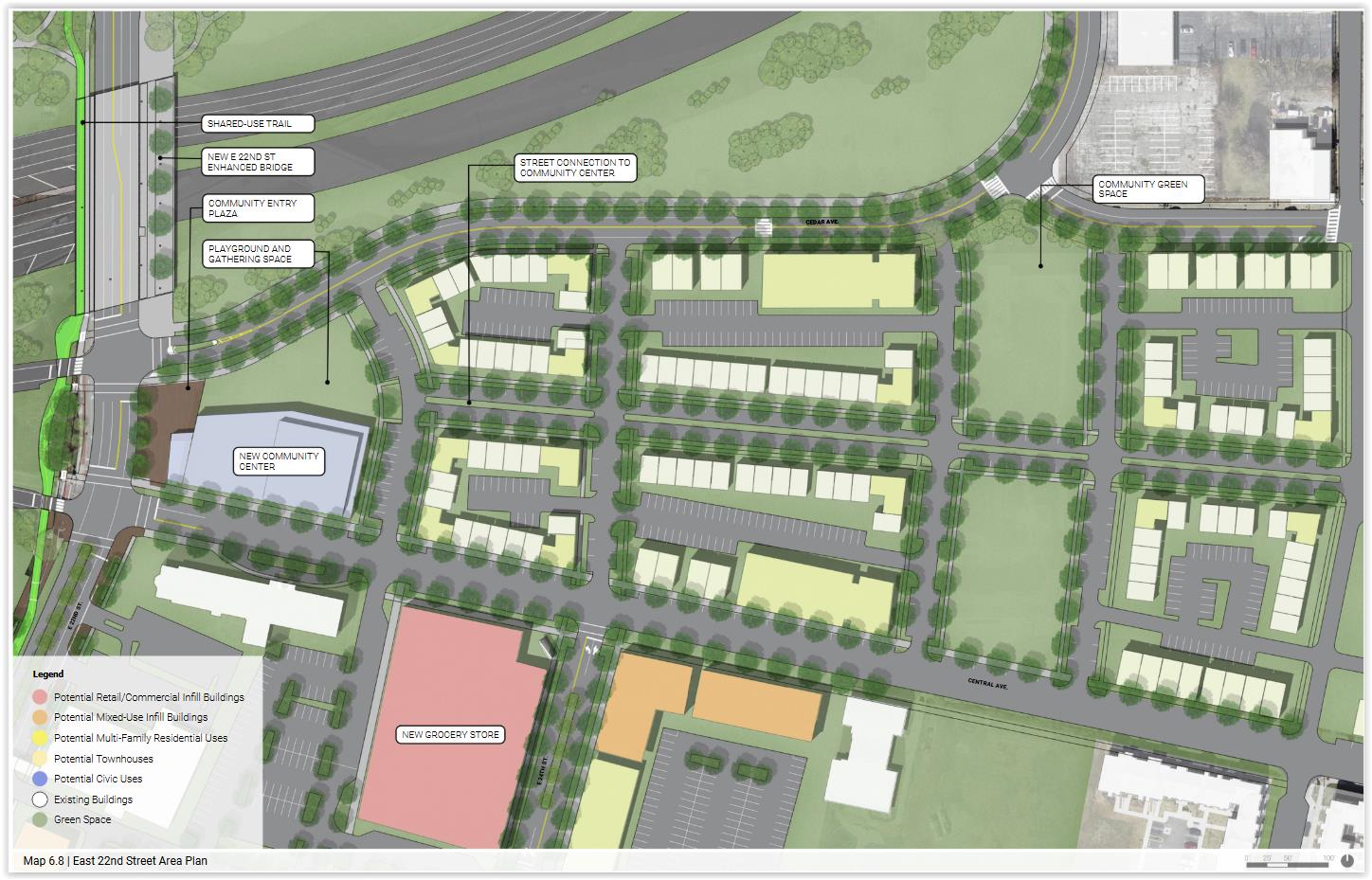
One of the largest single pieces of land in play in the Campus District is the 1937-built Olde Cedar, one of the nation’s oldest public housing projects. It is proposed to be demolished and replaced with a new, mixed-income community of up to 900 units, including a restored street grid. At the bottom, the red building is a new Goodwill grocery store and nonprofit Opportunity Center (Campus District).
In the fall of 2025, the Campus District Inc. community development organization released a 10-year masterplan for this area which generally includes lands within five blocks of either side of East 22nd Street, around the east side of downtown from Lakeside Avenue south to Community College Avenue.
Campus District Executive Director Mark Lammon told NEOtrans that the masterplan offers a guide as to how this 50-plus-acre swath at the southern part of the district could be redeveloped.
Proposed is a multimodal corridor along East 22nd, featuring a project called The Campus Trail. Along that trail, Lammon and the district’s planning team of Designing Local Ltd. and Civic Uplift LLC, both of Columbus, identified an ambitious housing goal based on building 1,000 new units in 10 years.
“While building 1,000 housing units in 10 years is a broad and ambitious goal, building roughly 100 housing units per year can be achieved through steady progress with projects of various sizes,” the masterplan noted.
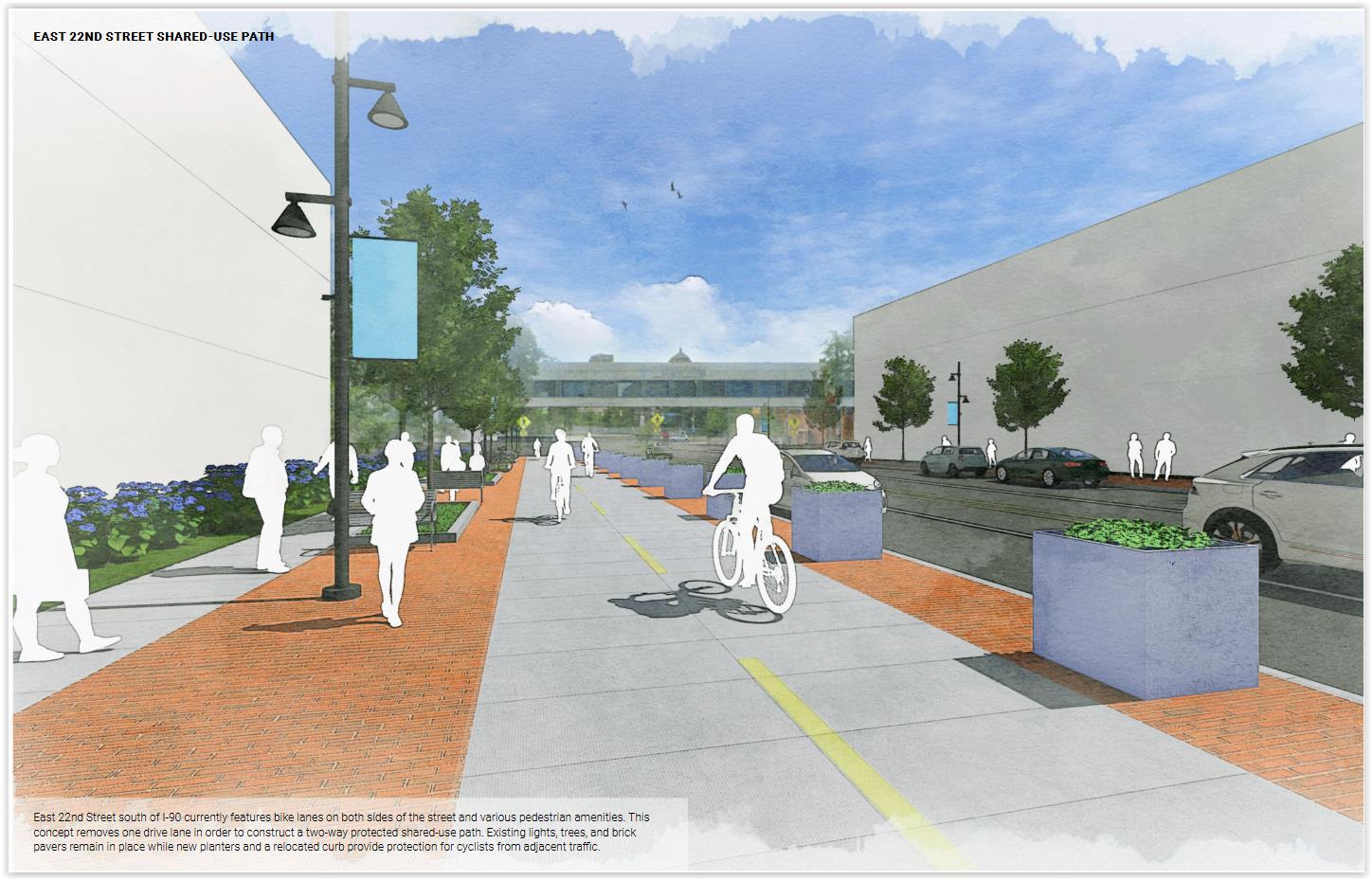
The Campus Trail along East 22nd Street is designed to be a multimodal corridor whose width and public realms will continue uninterrupted over Interstate 90 to create a seamless connection between the Central neighborhood and downtown (Campus District).
“Some larger projects may provide several hundred housing units on one site, while smaller projects of 2-10 units can incrementally fulfill demand for a variety of housing types,” the plan added. NEOtrans recently reported that the redevelopment of the Olde Cedar public housing complex could involve up to 900 units by itself, albeit in phases.
Redeveloping Olde Cedar, one of the nation’s oldest public housing projects built in 1937, would eliminate 21 buildings with 550 mostly occupied, subsidized housing units that would have to be replaced with at least as many apartments, townhomes and flats.
That replacement is now getting underway. On Thursday, the Central East Design Review Committee recommended that the full Planning Commission approve conceptual plans for Olde Cedar Phase 1 at Quincy, a new-construction, 62-unit housing development at Quincy Avenue at East 46th Street.
The Finch Group (TFG) Housing Resources is the developer and CMHA owns the 3.8 acres of land, once the site of Carver Park’s A&B Blocks, built in 1943 and demolished in 2022.
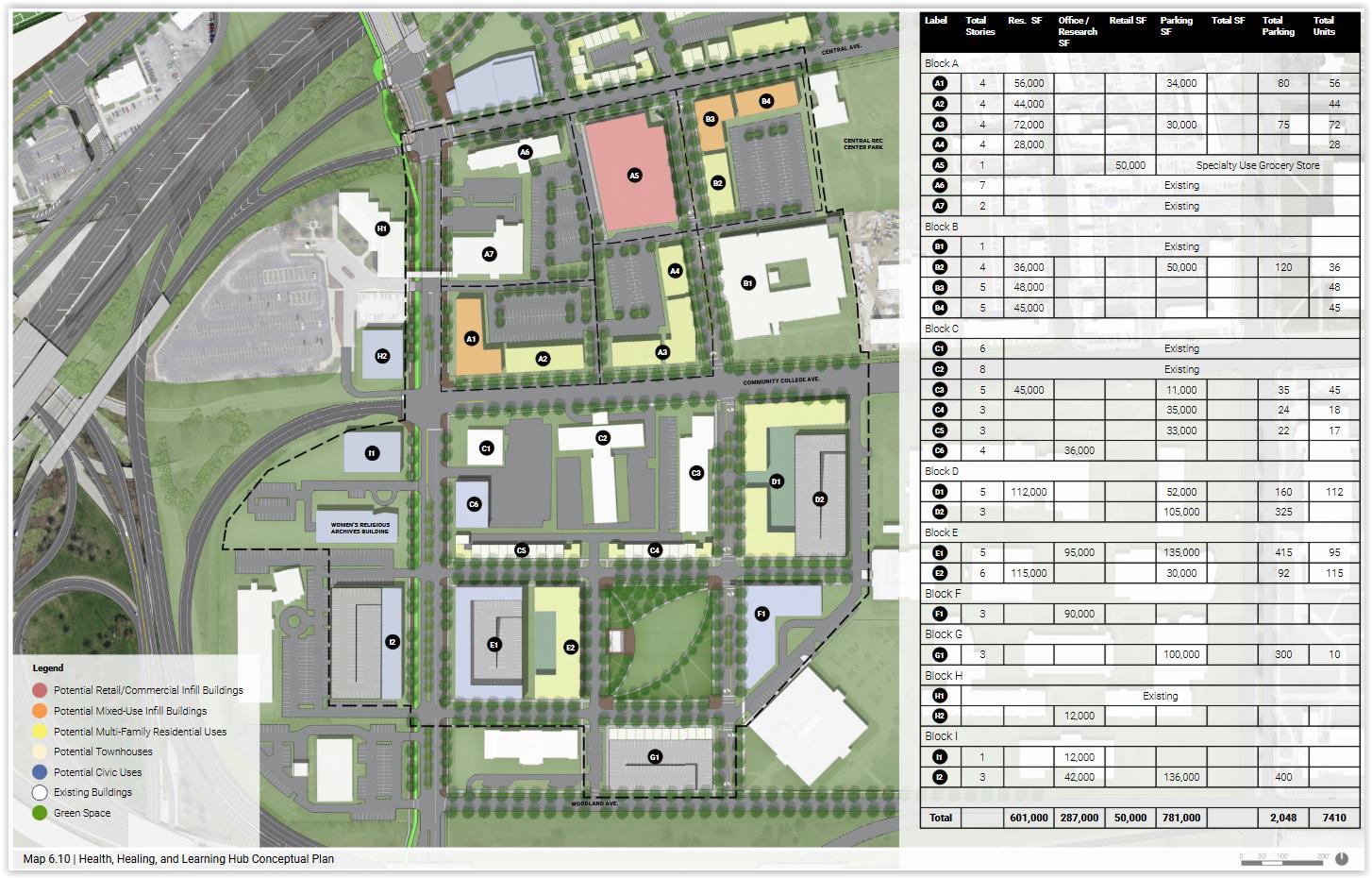
Proposed land uses where St. Vincent Medical Center stood until recently, at top, and the remaining lands to the south which include outpatient services rebranded as St. Vincent Charity Community Health Center plus housing, offices, parking and green spaces. If up to $35 million can be raised, the Goodwill grocery store and Opportunity Center shown in red will be built (Campus District).
Building the new, mixed-income flats and townhomes will allow CMHA to demolish portions of Olde Cedar, and replace them block by block with new housing units that also will be mixed income.
The effort falls under a deconcentration of poverty initiative by CMHA and the federal Department of Housing and Urban Development (HUD). CMHA identified Olde Cedar as a property where the average income falls below a HUD-prescribed formula.
So on Feb. 3, the CMHA Board passed a resolution authorizing staff to enter into a Master Development Agreement with Western Reserve Revitalization and Management Company, Inc. and TFG Housing Resources, LLC to create a Rental Assistance Demonstration (RAD) conversion and investment plan for Olde Cedar.
The Western Reserve Revitalization and Management Company is a non-profit subsidiary of CMHA that is responsible for key development initiatives that improve public housing opportunities across Cuyahoga County.
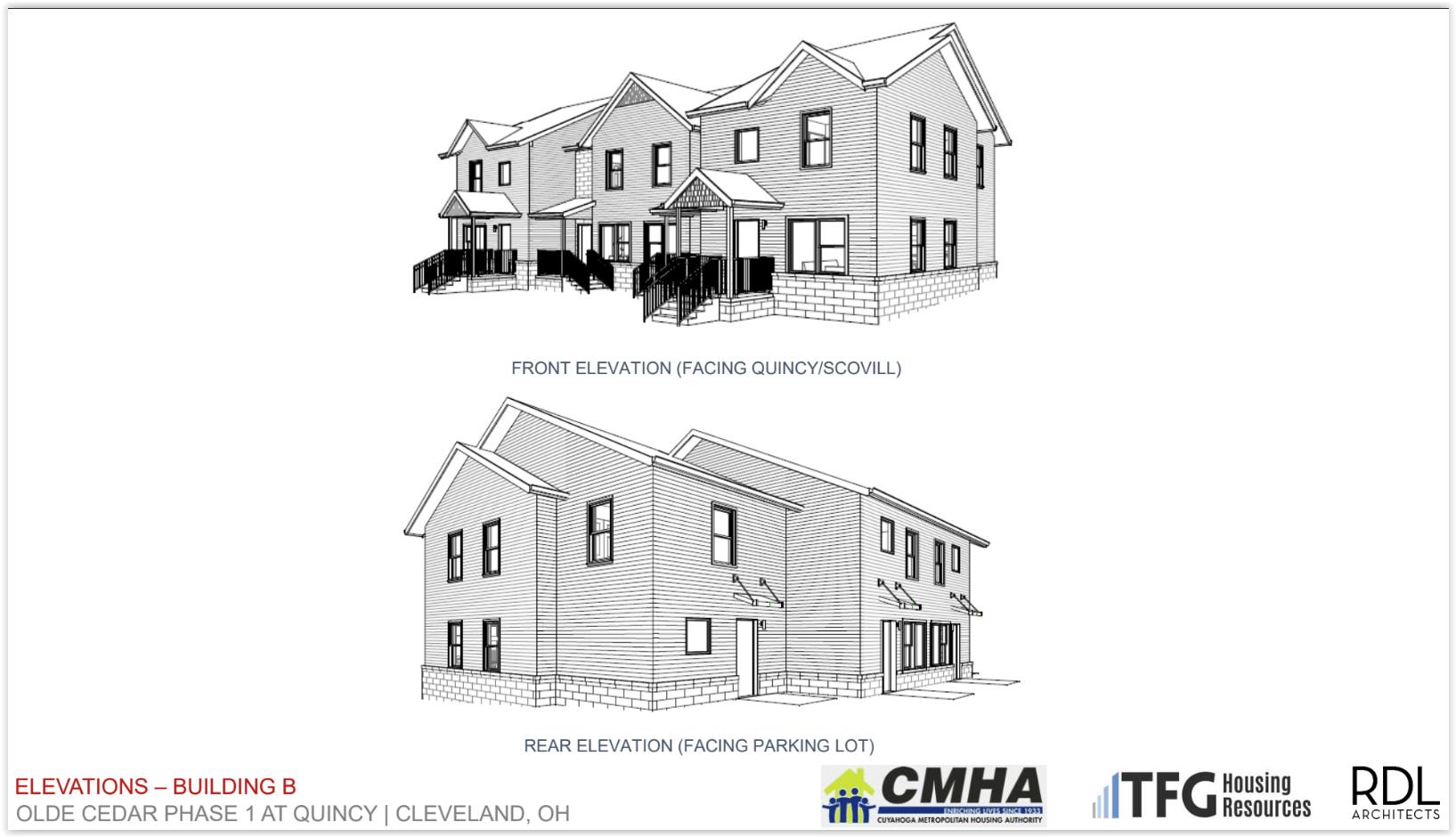
An example of architectural styles planned to offer mixed-income housing on Quincy Avenue in the Central neighborhood so the redevelopment of Olde Cedar on Central Avenue can begin (RDL).
The RAD allows CMHA to convert public housing units to long-term Section 8 contracts, enabling them to leverage private and public financing for repairs, rehabilitation, or modernization. This tool facilitates investment in aging properties and ensures long-term affordability and resident stability, CMHA says.
Cumberland Development Inc. CEO Richard Pace, a member of the Central East Design Review Committee, supported the conceptual design for Olde Cedar Phase 1 at Quincy. But he doesn’t support the demolition of Olde Cedar.
“They seem to have a thoughtful approach (with the new development) to extend Scovill (Avenue) and Unwin (Road) to recreate the street grid and provide community space,” Pace said. “But I hope they don’t tear Olde Cedar down. They’re solid masonry structures that can be refurbished as a mixed-income development.”
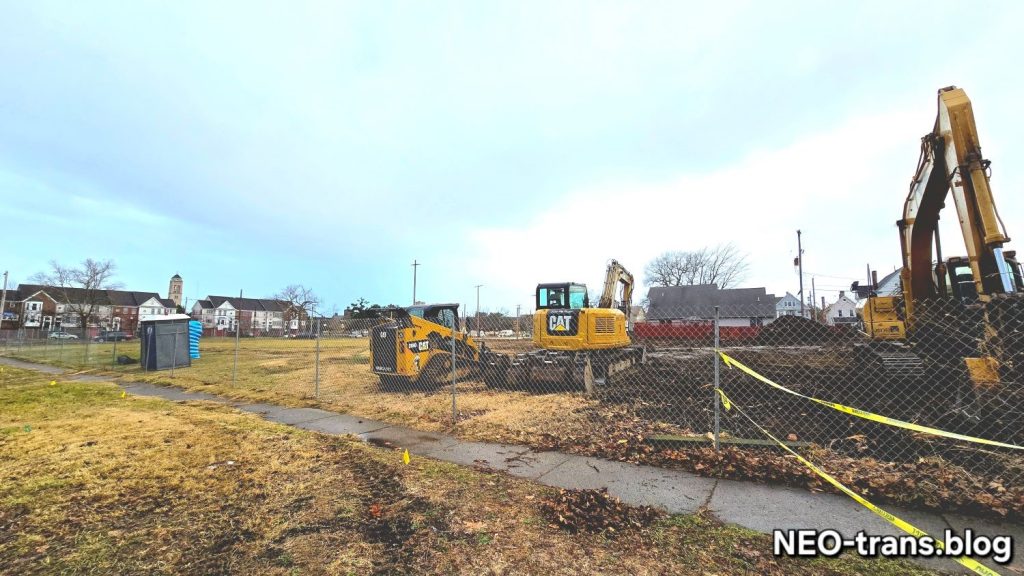
Just west of Olde Cedar, demolition and clean-up of the old Cuyahoga County Juvenile Justice Center site is proceeding, after efforts to save the complex failed. The 4.4-acre site will be used for construction staging during the Ohio Department of Transportation’s (ODOT) Innerbelt-Central Interchange modernization project.
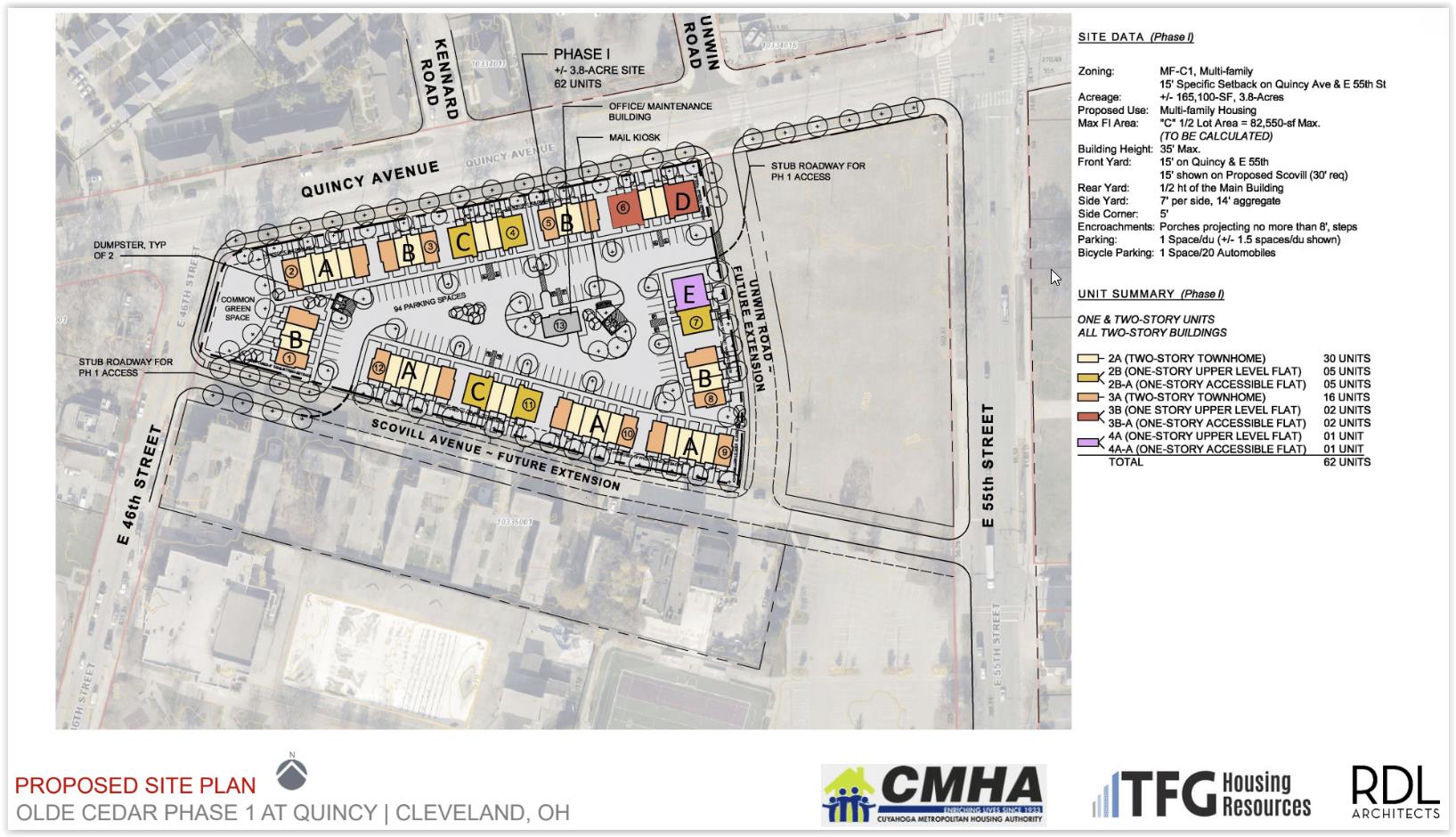
Site plan for building 62 homes in Olde Cedar Phase 1 at Quincy including extending Scovill Avenue and Unwin Road. A follow-on phase is likely to be built at right (RDL).
That $320 million, six-year reconstruction effort will include a new, widened East 22nd bridge over Interstate 90 that accommodates The Campus Trail and public art, to better reconnect the Central neighborhood to downtown.
Even before the highway project is done, the old Juvenile Justice Center site could host a coming phase of the Olde Cedar replacement project. And Campus District’s masterplan wants to see a community center built at the corner of Central Avenue and East 22nd, next to the Campus Trail.
One of the survey findings from the Campus District masterplan was that area residents felt a grocery store was the neighborhood’s biggest missing piece. So a Goodwill grocery store and nonprofit Opportunity Center was proposed in July on the site of the demolished St. Vincent Charity Medical Center.
A feature that was in the masterplan — a soccer stadium and supportive development replacing Cleveland State University’s (CSU) Wolstein Center arena — may have to be rethought. Mayor Justin Bibb said downtown can’t support two soccer stadiums so he continued his support for Cleveland Soccer Group’s Gateway South stadium plan.
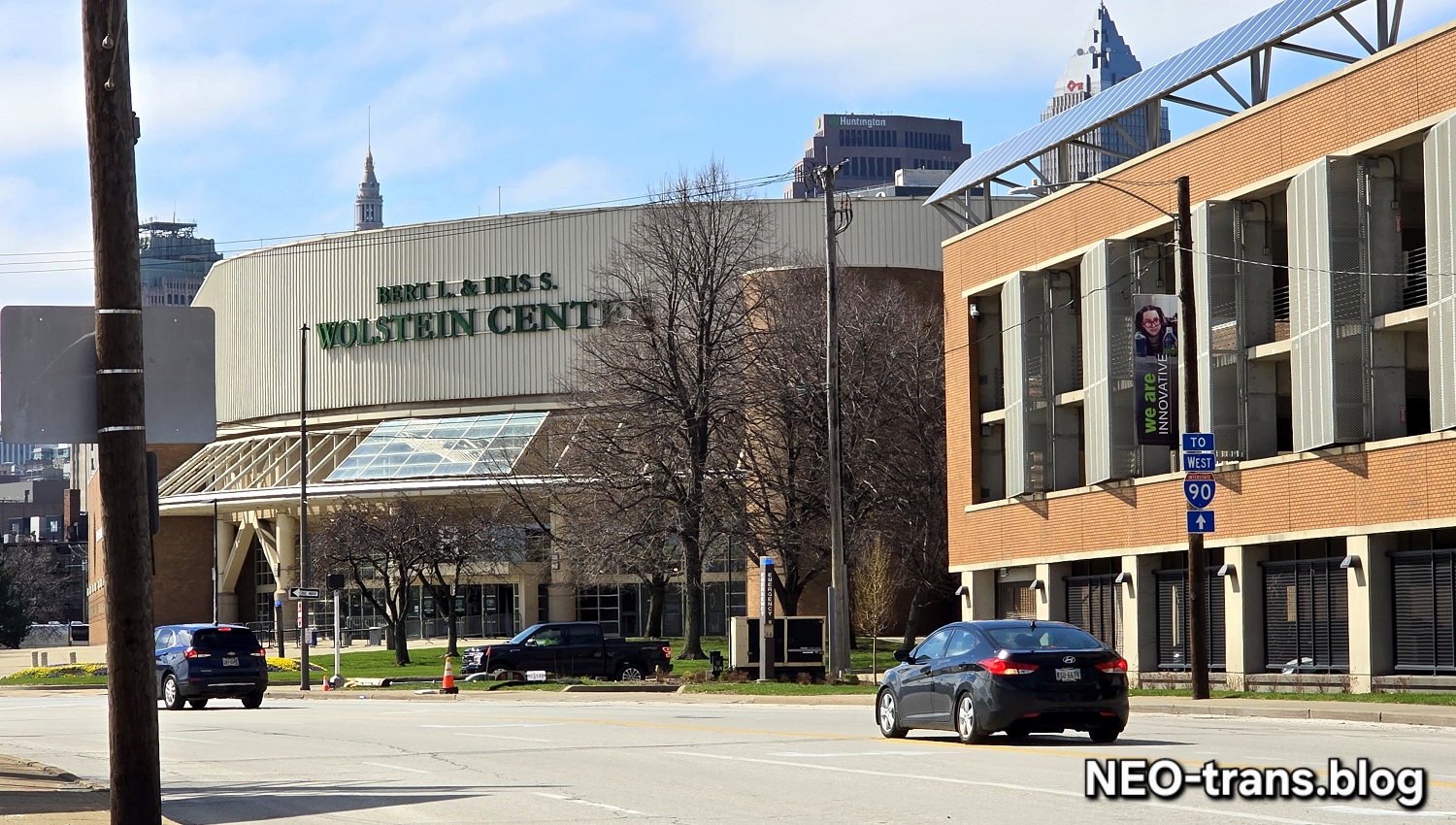
A soccer stadium and supportive development was planned at the site of Cleveland State University’s Wolstein Center arena. With that plan apparently dead, the arena may be demolished without a new use identified to activate its nearly 10-acre site next to downtown (NEOtrans).
As a result, CSU put the soccer stadium idea on indefinite hold, and began its own masterplanning process for the campus. The university appears to be leaning toward renovating and expanding Woodling Gym for basketball and other athletic programs now hosted at Wolstein.
Another recent development that emerged after the Campus District’s masterplan was released was the possibility that Central Cadillac could relocate its car dealership to Broadview Heights, along with other Ken Ganley dealerships from North Olmsted.
In 2017, Ganley acquired the Central Cadillac business from the Porter family which owned Central for 75 years. Frank Porter Jr. continues to own the land through Porter Properties CLE Ltd.
Porter Properties’ land holdings measure 4.45 acres north of Carnegie, east of the Inner Belt. But the dealership, which has been on Carnegie since 1949, has reduced its footprint in recent years.
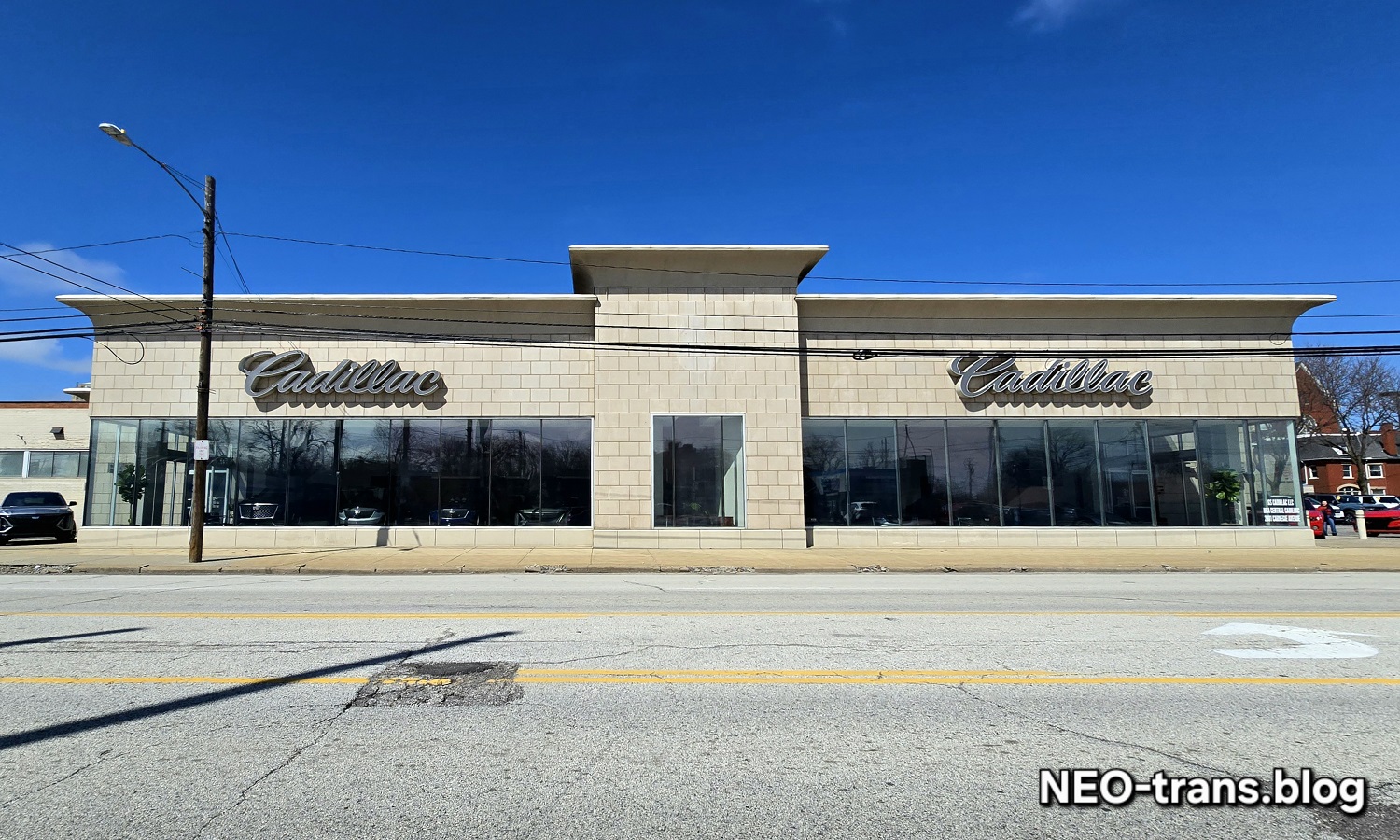
Standing on Carnegie Avenue west of East 30th Street since 1949 is Central Cadillac. But the dealership may relocate to suburban Broadview Heights, leaving another multi-acre gap in the Campus District (NEOtrans).
South of Carnegie, a company called Grasslot Investments LLC bought 1 acre of Porter Properties’ land in 2023 for $500,000, Cuyahoga County records show. A principal at Grasslot is William Wiley, medical director at the Cleveland Eye Clinic which has a location next door, 2740 Carnegie. He owns that 1.5-acre property, too.
NEOtrans asked Wiley if an expansion of the clinic might be in the works, possibly involving its parent, Beachwood-based Midwest Vision Partners, which has more than 70 eye care clinics from Chicagoland east to Western Pennsylvania. But Wiley isn’t ready to say what it is.
“Yes, Grasslot Investments did acquire property in that area,” he told NEOtrans. “However, we’re still in the early planning phases and aren’t ready to share specific details about our development plans at this time.”
END