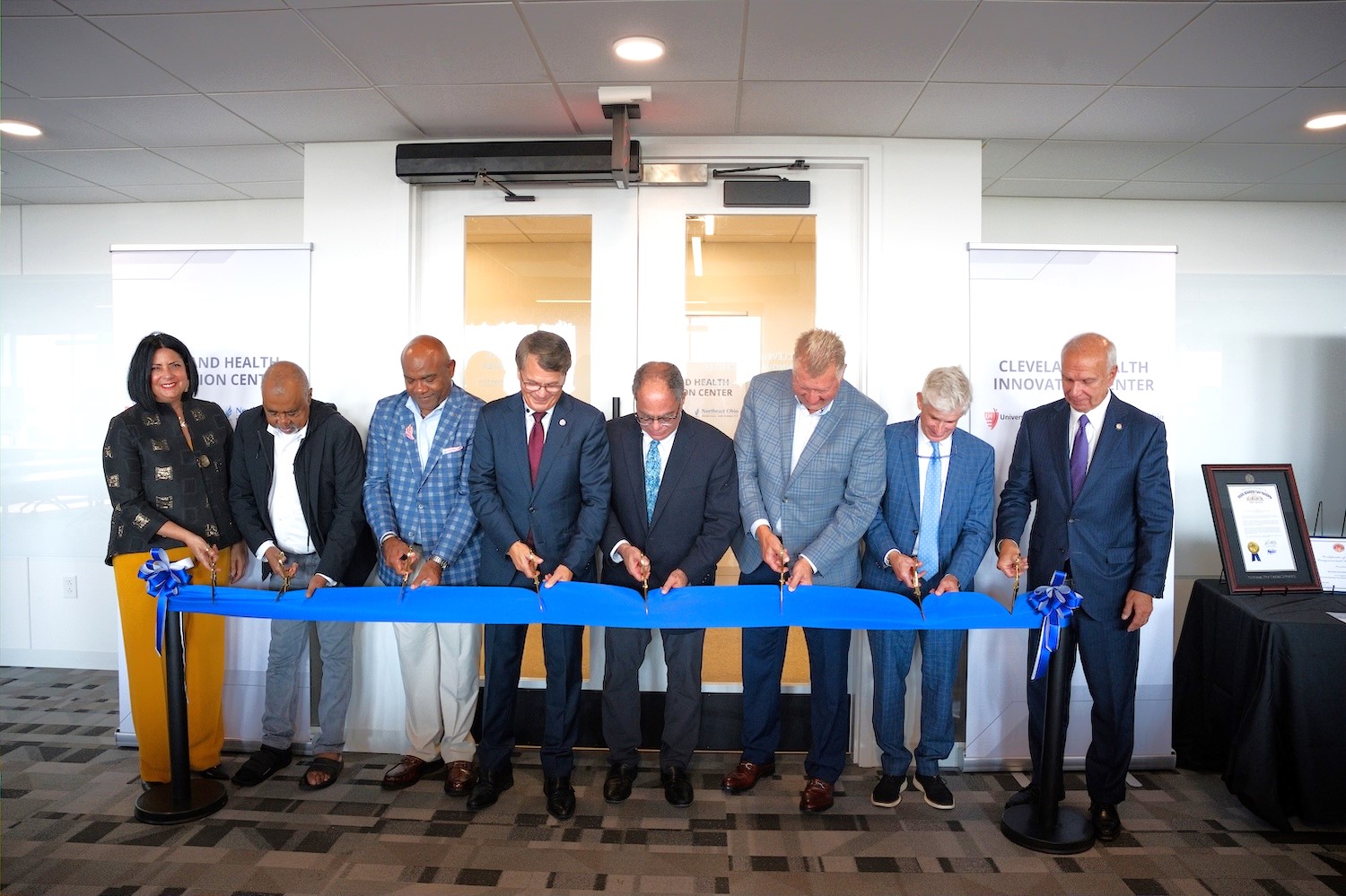
Officials from the Northeast Ohio Medical University, University Hospitals, Cleveland Foundation and other civic leaders brandished scissors to cut the ribbon on NEOMED-UH’s Cleveland Health Innovation Center at the Cleveland Foundation’s Warren E. Anderson MidTown Collaboration Center (Photo by Andrea Hallgren). CLICK IMAGES TO ENLARGE THEM.
Partnership with UH offers first Cleveland site

Northeast Ohio Medical University (NEOMED) and University Hospitals (UH) joined with community leaders, partners, educators and health care professionals yesterday to celebrate the opening of NEOMED’s first Cleveland location.
The event was an open house and ribbon-cutting ceremony marking the official opening of the NEOMED-UH Cleveland Health Innovation Center at the Cleveland Foundation’s Warren E. Anderson MidTown Collaboration Center, 1974 E. 66th St., in Cleveland’s Hough neighborhood.
NEOMED was founded in 1973 by Kent State University, University of Akron, and Youngstown State University to develop a medical school at a location that was central to all three institutions — at Rootstown in Portage County. It later gained affiliations with Cleveland State University and Hiram College.
Until now, its presence in Cleveland, a healthcare powerhouse, has been minimal. That changed yesterday after a $2.5 million investment by NEOMED and UH to renovate and retrofit an 8,000-square-foot space at the three-story, 95,000-square-foot center that opened in May 2025.
NEOtrans broke the story in February about NEOMED’s planned expansion into the MidTown Health Tech Corridor — an area central to the Cleveland Foundation’s vision for economic growth, innovation and community transformation. The foundation led the development of the collaboration center.
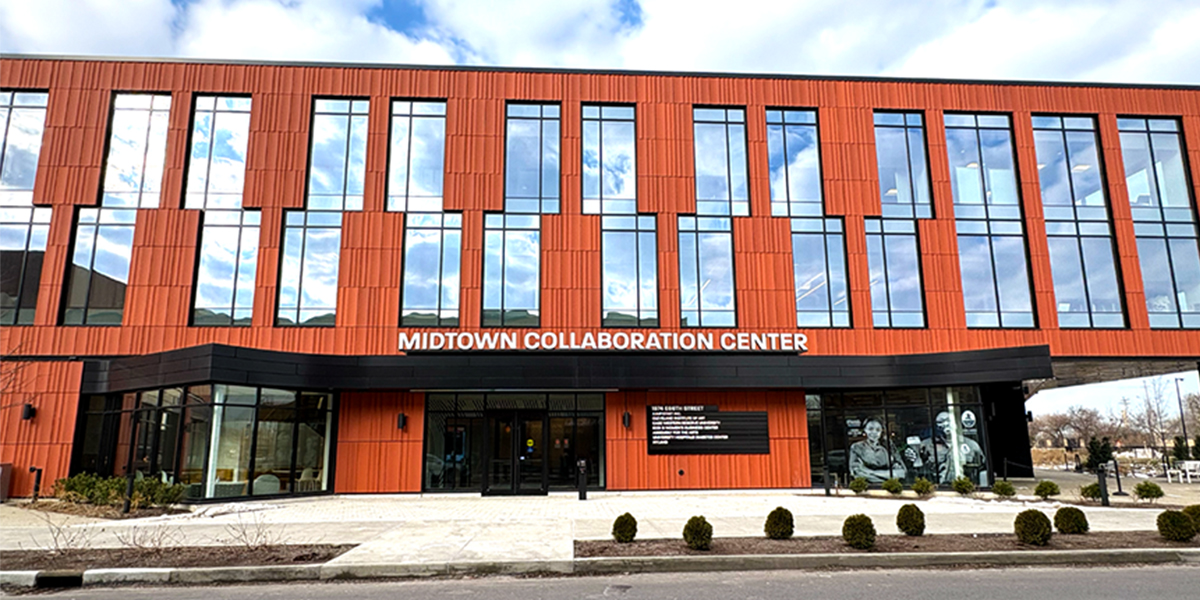
The Cleveland Foundation’s Warren E. Anderson MidTown Collaboration Center on Euclid Avenue at East 66th Street has a wide variety of tenants. NEOMED is only its latest that continues to support innovations in Cleveland’s HealthTech Corridor (Tonya Strong-Charles).
“NEOMED’s presence at the MidTown Collaboration Center represents a bold step forward in connecting medical innovation with community impact,” said NEOMED President John Langell in a written statement.
“By embedding our programs and partnerships in the heart of Cleveland, we are accelerating the pathway from idea to implementation — and ensuring that those innovations improve lives across the region,” he added.
NEOMED’s space at the MCC will serve as a regional engine for translating discovery into real-world health impact. It will anchor the expansion of NEOvations Bench to Bedside, the university’s nationally recognized medical innovation and commercialization program.
It will also serve as the home to strategic partnerships with University Hospitals, including collaborative initiatives advancing artificial intelligence in health care and improving maternal and child health outcomes.
“Many of our students complete clinical training in Greater Cleveland, and many NEOMED alumni serve these communities,” Langell explained. “The MidTown Collaboration Center strengthens these connections and amplifies our shared commitment to advancing health access.”
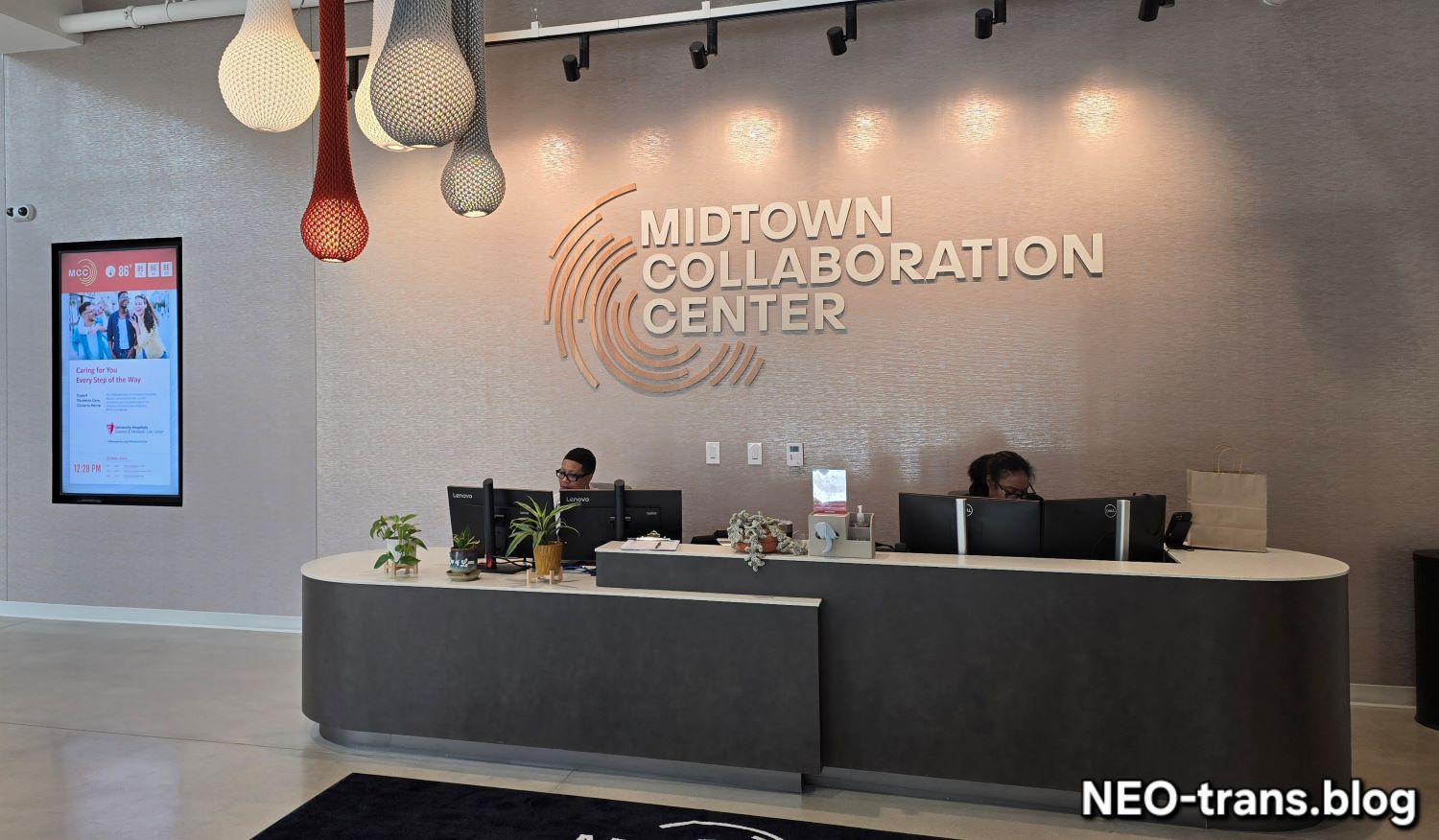
The MidTown Collaboration Center in Cleveland’s Hough neighborhood is a modern, active and welcoming place for innovations. And now it has gained the NEOMED-UH Cleveland Health Innovation Center (NEOtrans).
NEOMED has four colleges — in medicine, pharmacy, dentistry and graduate studies — and offers Doctor of Medicine, Doctor of Pharmacy and Doctor of Dental Surgery degrees, as well as master’s and doctoral degrees.
Its enrollment in the fall of 2025 was 1,032 students. The university has an academic staff of 96 and an administration staff of 404 people, according to recent data.
Yesterday’s event showcased the new center’s role as a hub for collaboration, innovation and community engagement, bringing together academic, clinical and community partners to address the evolving health needs of Northeast Ohio.
Guests toured the facility, met with representatives from NEOMED and University Hospitals, and learned more about initiatives designed to advance health innovation, education, workforce development and community impact.
Other tenants at the MidTown Collaboration Center are Case Western’s Population Health Research Center, University Hospital’s Diabetes Research Center, the Cleveland Institute of Art’s Media Lab, Hyland Software Training Center, JumpStart offices, ECDI-SBA Lending Center, Black Frog Brewery and Pearl’s Kitchen.
END