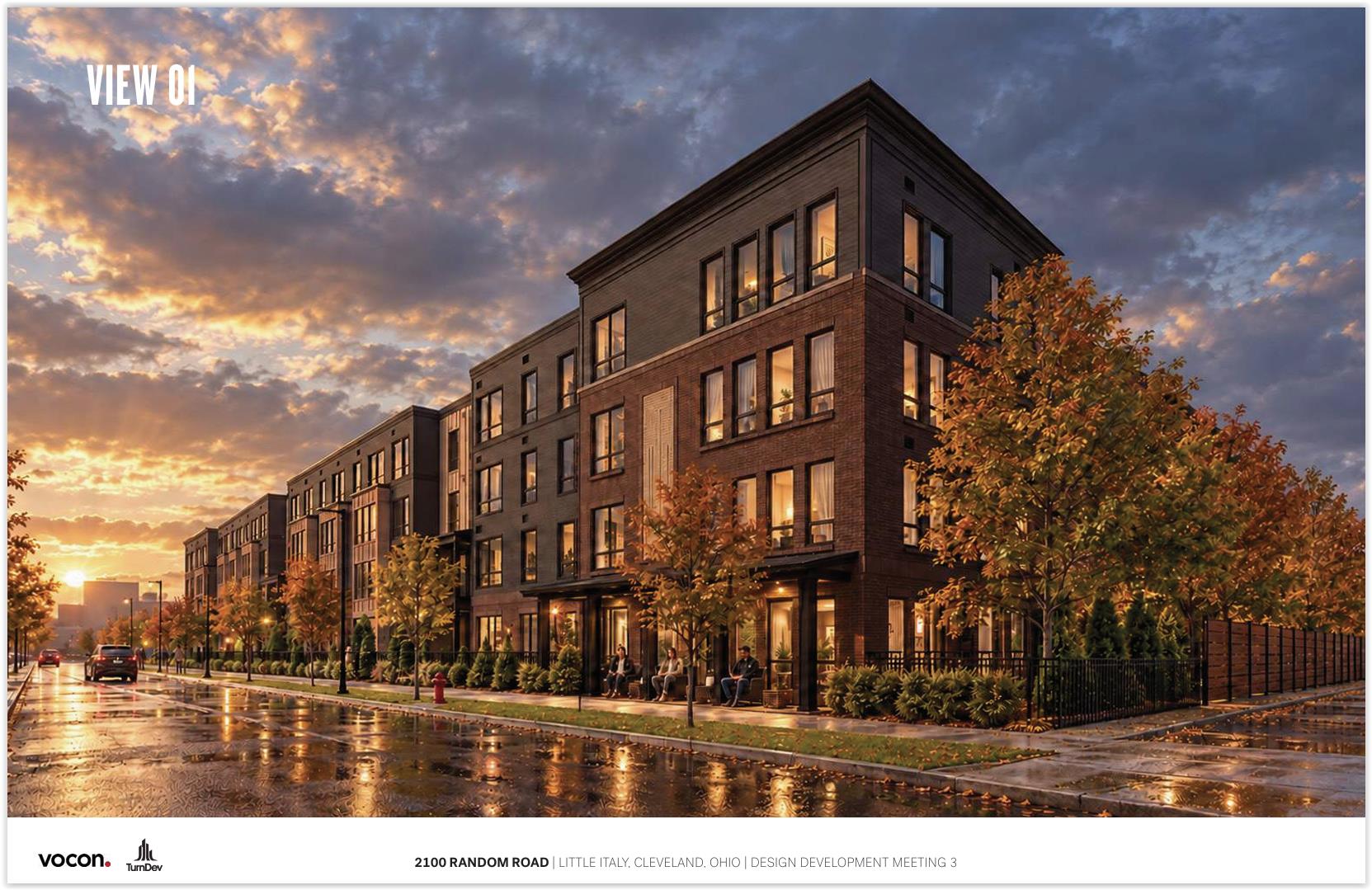
A 119-unit apartment building, planned on Random Road in Cleveland’s Little Italy neighborhood, is just beginning its journey through the city’s design-review process. So these early conceptual renderings may be modified in the coming weeks and months (Vocon). CLICK IMAGES TO ENLARGE THEM.
Residents have opportunities to give input
One of the largest development sites left in Cleveland’s Little Italy neighborhood has a new plan for its reuse and NEOtrans is first to publish images of what the proposed new project could look like. The project would satisfy housing demand from strong job growth in neighboring University Circle.
Residents will have multiple opportunities starting next week to provide ideas to shape plans for the site at 2100 Random Rd. that historically has hosted Singer Steel Inc., Ohio Cut Stone Company, and now district parking.
Proposed to replace the structures remaining from those past uses is a market-rate, 119-unit apartment building whose working title is simply its street address. Those plans are about to make their way through the city’s design-review process.
Although there have been two community meetings so far, things start to get more serious Oct. 20 when schematic plans are presented by developer TurnDev of Beachwood and project architect Vocon Partners LLC of Cleveland at the city’s Northeast Design Review Advisory Committee.
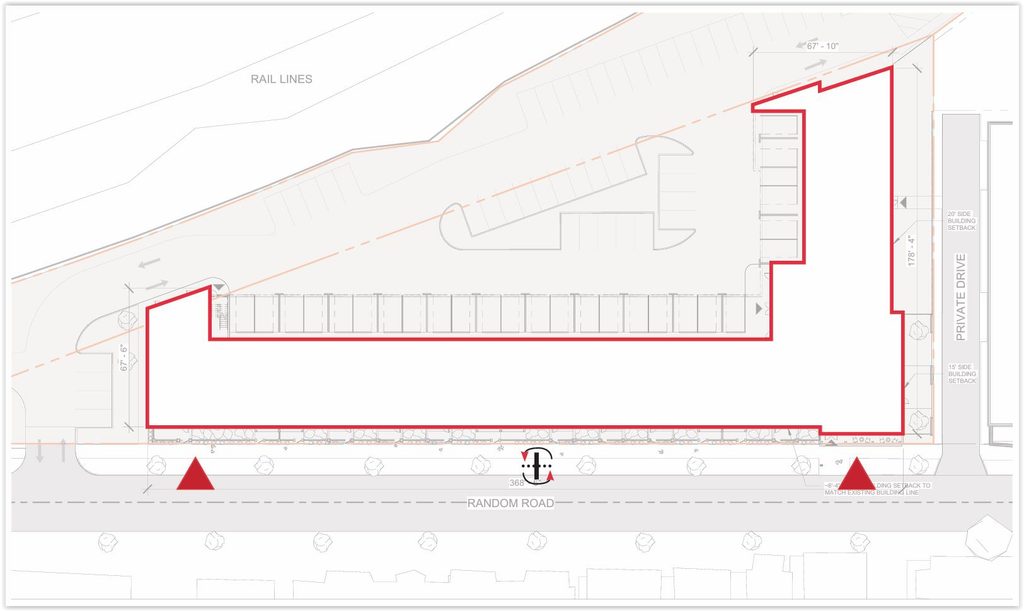
While this graphic is intended to show with red arrows the proposed location of features honoring the site’s history in carving the sandstone Guardians of Traffic pylons on the Lorain-Carnegie Hope Memorial Bridge, it also acts as a site plan (Vocon).
Public comments may be e-mailed in advance to landmarks@clevelandohio.gov and a link to observe the meeting online may be requested. If an e-mail is received before 12 noon on Oct. 18, it can be included as part of the Oct. 20 meeting’s public record.
Additionally, the Little Italy Redevelopment Corp. is scheduled to host a public meeting about the project at 6 p.m. Oct. 21 at the offices of the Northern Ohio Italian American Foundation, 12018 Mayfield Rd.
Comments from these community meetings will be compiled and presented to the city’s Landmarks office prior to the Landmarks Commission reviewing the project’s designs. Landmarks Commission has jurisdiction over this project because Little Italy is a city-designated historic district.
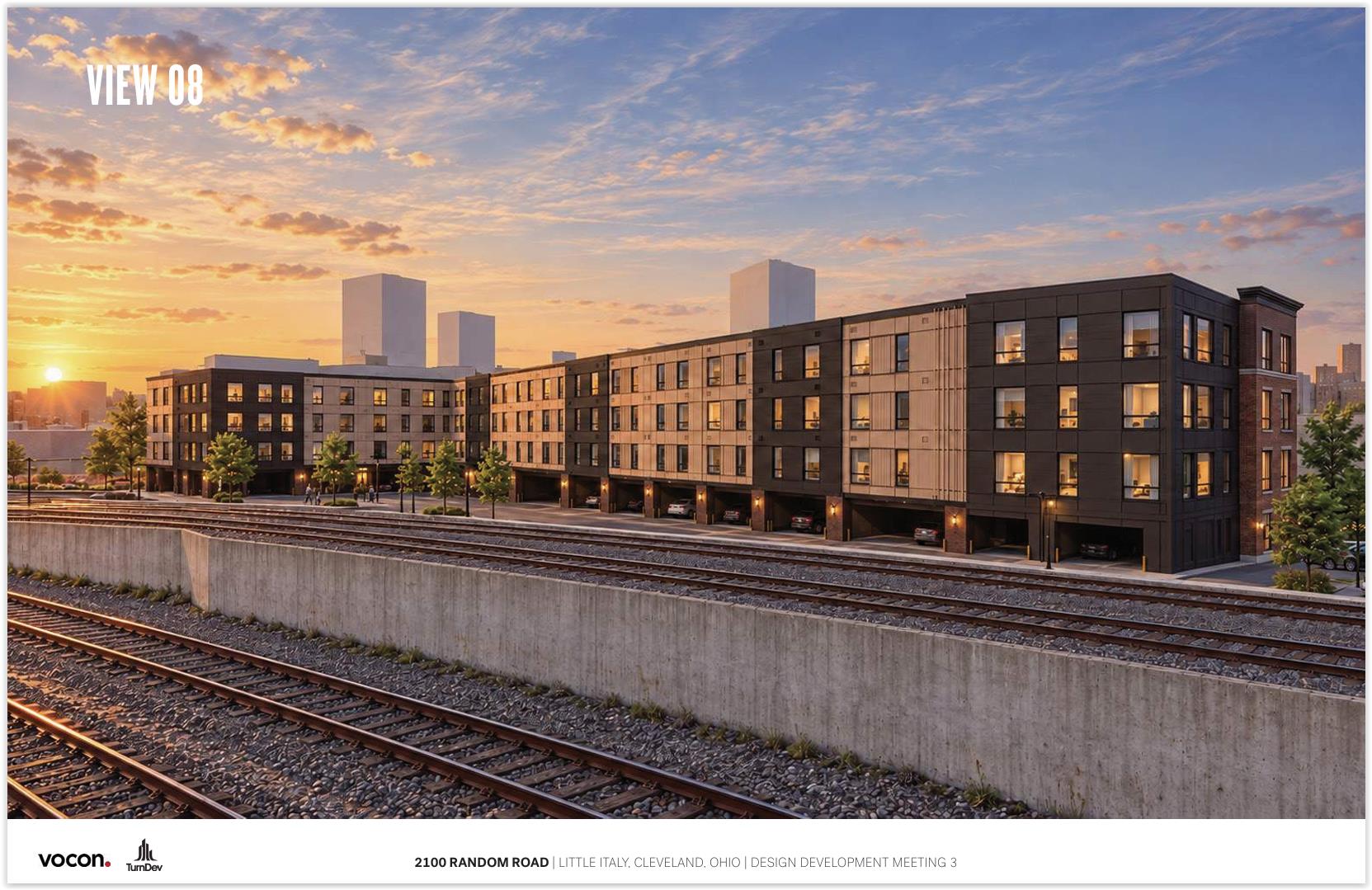
This rendering shows one of the site’s unique features — its proximity to the briefly elevated light-rail transit Red Line which serves as partial sound barrier to the parallel and busy freight tracks. Curiously, it also shows several high-rise towers in the background near Mayfield Road that do not exist and likely never will (Vocon).
Plans for the project were submitted Oct. 13 to the city’s Building Department for a zoning review including its proposed uses, heights, setbacks, density and more.
The new, four-story, L-shaped apartment building is proposed to measure 118,570 square feet, stand 46 feet high and have a street frontage of about 368 feet, plans show.
Also included were several design features that gave a nod to the property’s historic use by Ohio Cut Stone. More than 20 of its Italian-immigrant stonemasons carved in 1932 the Lorain-Carnegie Hope Memorial Bridge’s Guardians of Traffic pylons at the Random Road site.
The development team requests to demolish the surviving skeletal frame and roof of the former steel plant which has about 330 feet of street frontage. Singer Steel vacated the building in 1994 for a larger facility in Streetsboro in Portage County.
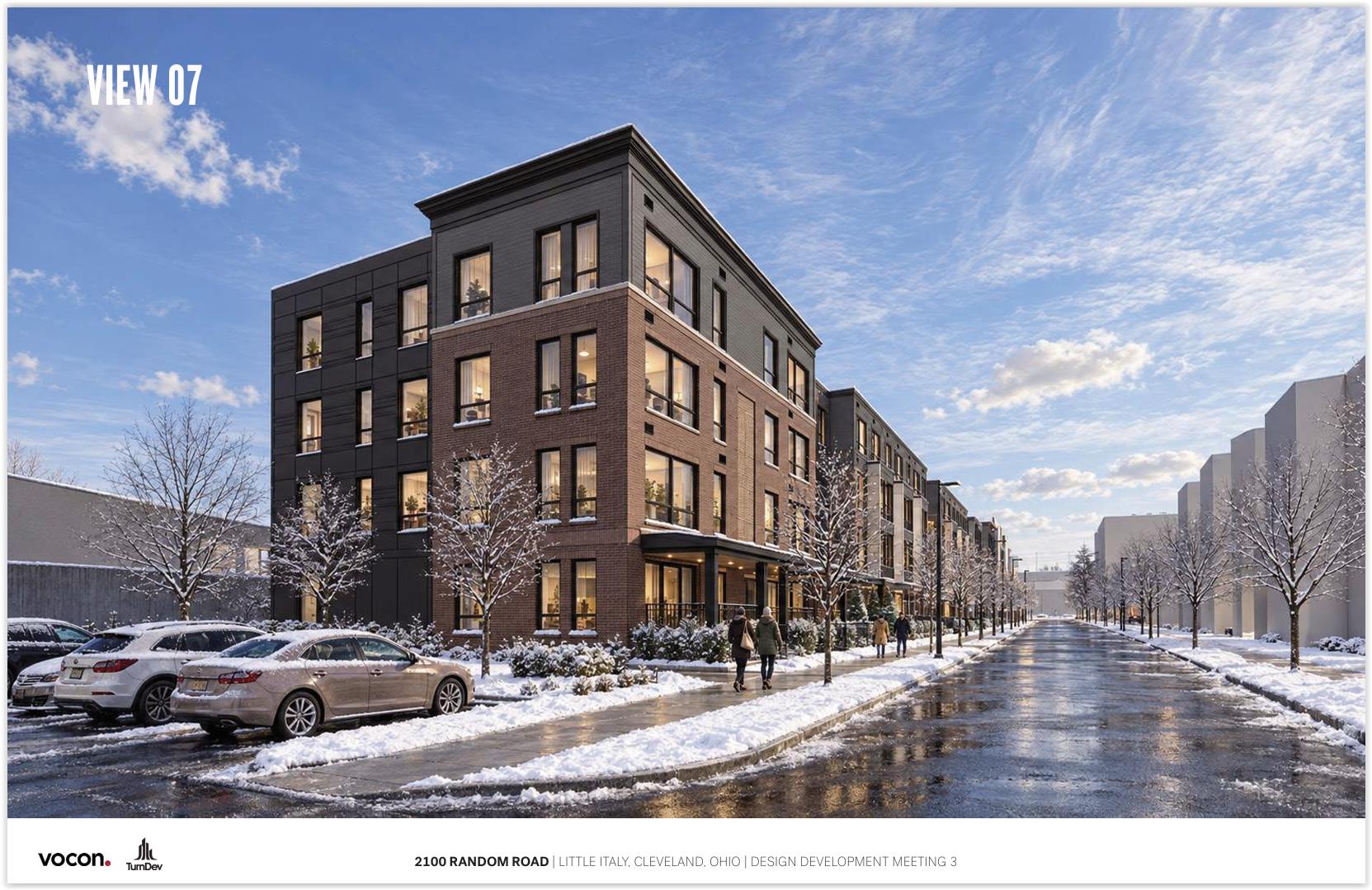
Looking north on Random Road, one of two skinny ends of the proposed new apartment building is seen here along with some of the 46 uncovered spaces for the development (Vocon).
Within and next to its skeletal structure are roughly 80 permit-only parking spaces used by University Hospitals during the day and as a valet lot in the evenings and weekends.
The most recent plans do not specifically name how many public and private parking spaces will be provided. But it appears from several resources that the total public and private parking could total 123 spaces.
Parking spaces visible in the site plans suggest there will be at least 73 private parking stalls for residents of the new apartment building — 27 covered spaces under the building and 46 spaces uncovered.
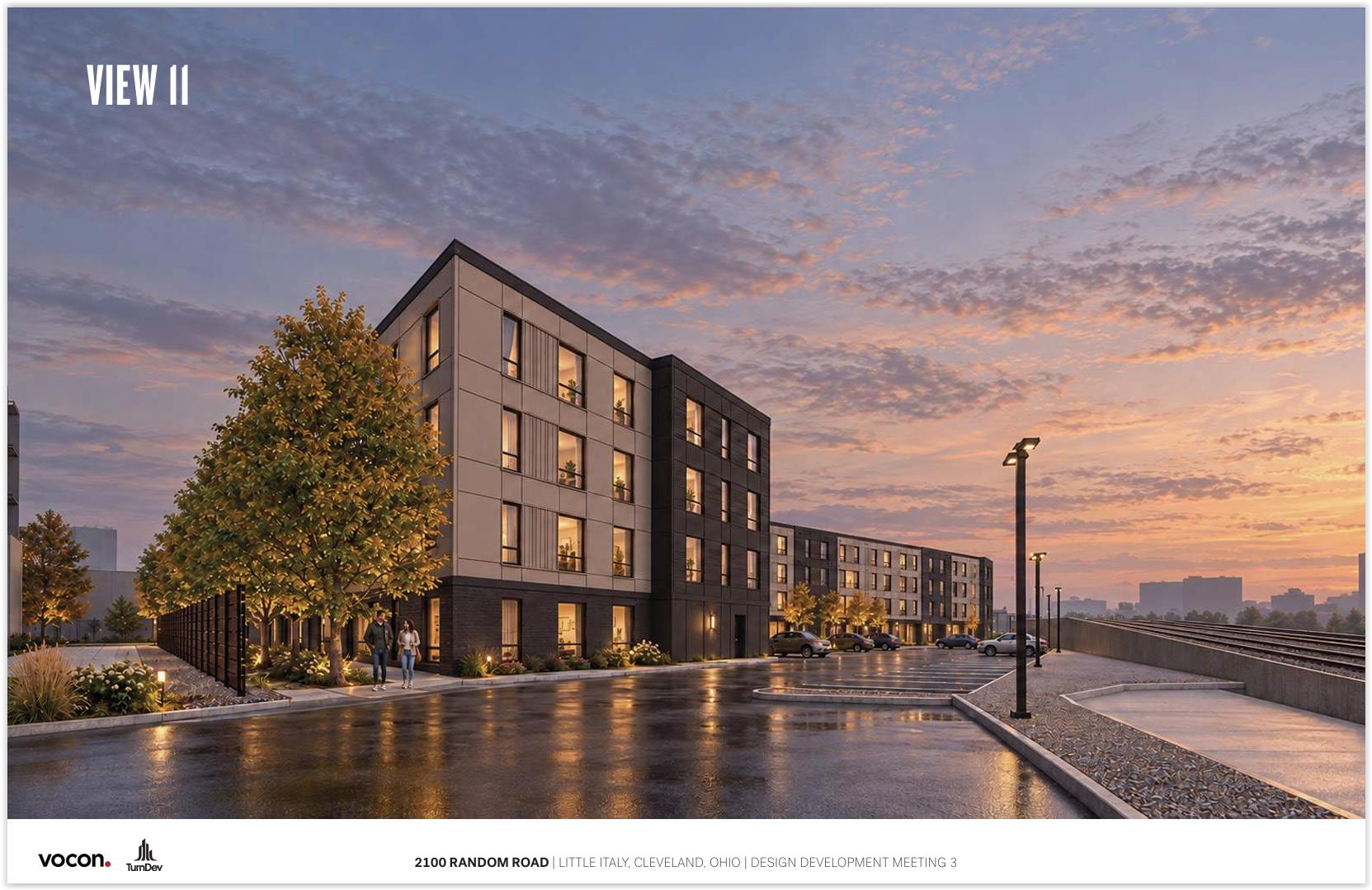
At the northwest end of 2100 Random Road is this south-looking view with a landscaped buffer at left from the Random Road Lofts and, at right, the light-rail transit Red Line (Vocon).
But in September 2025, nine months after TurnDev acquired the 1.22-acre former Singer Steel property, TurnDev added 1.58 acres of former railroad property next to the Red Line rapid transit from Mayfield Road to Cornell Road.
An undetermined amount of that former railroad property will be repurposed with public parking. In April, TurnDev spokesman Jon Pinney told NEOtrans the firm bought the former railroad land to provide the public parking, estimated at about 50 spaces according to a prior city permit application.
He didn’t respond this week, prior to publication of this article, to a NEOtrans request seeking clarification on the amount of public and private parking.
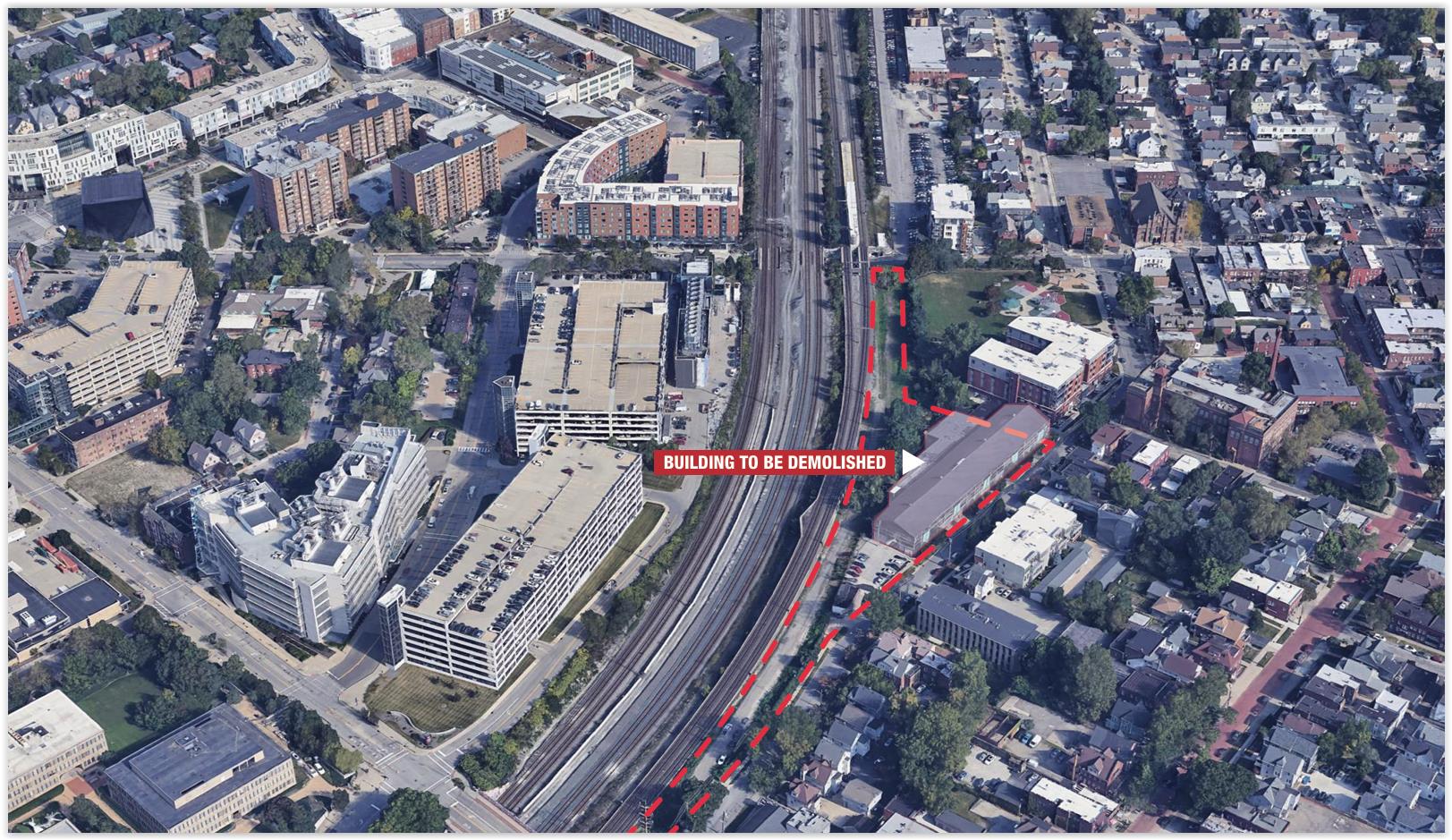
An aerial view of the development site as it exists today including the to-be-demolished ex-Singer Steel building that serves as a parking lot. Some of the land outlined in red dashes, especially near Cornell Road at the bottom, could provide public parking (Vocon).
Little Italy resident Christopher Giancola developed his own presentation to serve as his public comment to the development team’s submittal to the city.
In it, he urged more and larger patios and balconies, a brick-and-steel architectural identity, a recessed top floor with private terraces, inclusion of about five for-sale townhomes, and a ground-floor retail space.
“The objective is to create a development where residents can remain through different stages of life and contribute to Little Italy’s long-term residential stability,” Giancola wrote.
END