The high-rise The Artisan apartments is about to be joined by another 24-story tower on the lot where the construction fencing is going up. Constructing it is the same development team as The Artisan which leased out in one year despite top-of-the-market rents. It’s the next crane-inducing construction project in booming University Circle (Google). CLICK IMAGES TO ENLARGE THEM.
UC & environs continue to rack up big wins
Construction of high-rise apartment towers are indicative of more than just strength in a housing market. It’s often indicative of strengths of employment and amenities in the immediate vicinity, supported by a walkable setting.
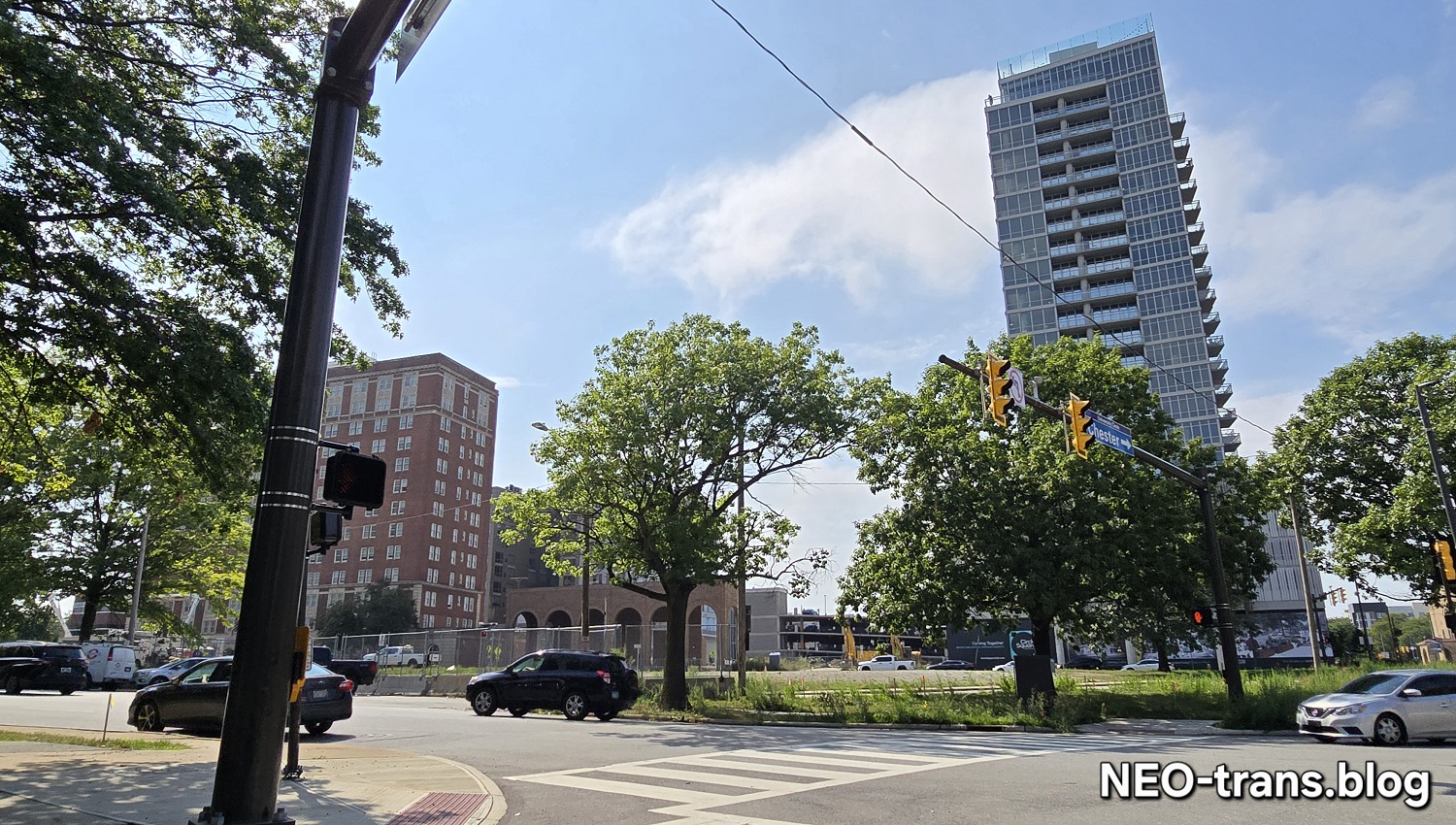
So it is with University Circle’s latest high rise — East Stokes, 10700 Chester Ave. Crews have started working under a permit issued by the city last week to prepare the roughly 1.8-acre parcel for construction. That plat was assembled last week and filed with the county so a second 24-story apartment tower could be built next to the first, the Artisan, 10600 Chester.
There’s more construction coming. Permits were requested last week to build the $60 million Iris S. and Bert L. Wolstein Center, 11100 Euclid Ave. The three-story conference and classroom facility will add to amenities at University Hospitals’ (UH) Cleveland Medical Center. But there are also growing pains.
UH’s Cleveland center is operating at nearly 98 percent capacity and seeks to expand by demolishing much of the East 115th neighborhood north of Cornell Road. However, its lack of a site plan likely only delayed action by the city to allow UH’s expansion in one of the few places in University Circle where it can.
More permits are being sought, lately for two large, new parking garages totaling $170 million, 4,000 spaces and 1.3 million square feet. A visitors’ garage will rise at 10681 Carnegie Ave. and an employees’ deck will be built at 8501 Carnegie Ave. Like East Stokes, they will require tower cranes to build them.
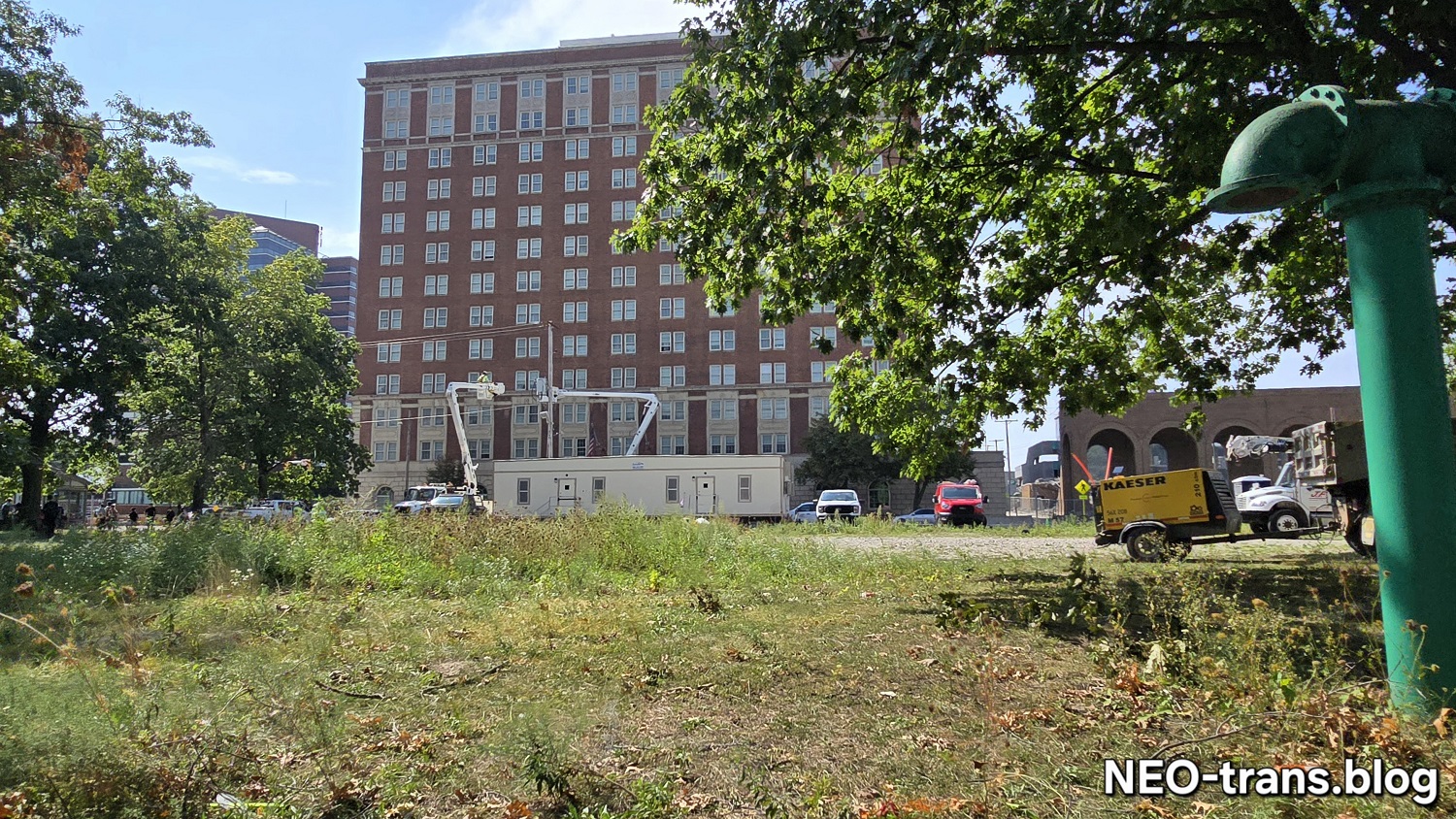
At the site of the coming East Stokes tower, a construction trailer is on-site and was getting connected with electricity earlier this week. In the background is the historic Fenway Hall Apartments and, at right, the facade of the former MLK Branch Library. The arched facade will also be coming down, to be replaced with a retail/parking podium on the west side of Stokes Boulevard (NEOtrans).
Meanwhile, the Clinic is getting ready to expand its emergency department, 9105 Cedar Ave., for $230 million. It requires demolishing six nearby structures to relocate parking lots for the three-story, 130,000-square-foot expansion.
That is just one slide-puzzle Clinic officials are attempting to solve. Another one is the creation of space for one or more bed towers where its aging, constrained Central Utility Plant stands on East 90th Street just south of Euclid Ave.
To do that requires moving the utility plant where its police station and Mellen Center, 1950 E. 89th St., now stand. The Mellen Center will move into the new, $1.1 billion Neurological Building due to open in a few months on Carnegie. The police station will move into a reconfigured former Rite Aid, 10090 Chester.
Those are actions now underway by just two of University Circle-area employers. Granted, those are both large entities. Cleveland Clinic is Ohio’s largest and University Hospitals is the eighth-largest employer in the state.
And thanks to them, their growth, their spinoffs and supportive entities, plus other, unrelated firms, the greater University Circle area is about to surpass Downtown Cleveland as the state’s largest employment hub — if it hasn’t already. The reason is that most workers at the Cleveland campuses of Clinic and UH work on-site, not remote or even hybrid.
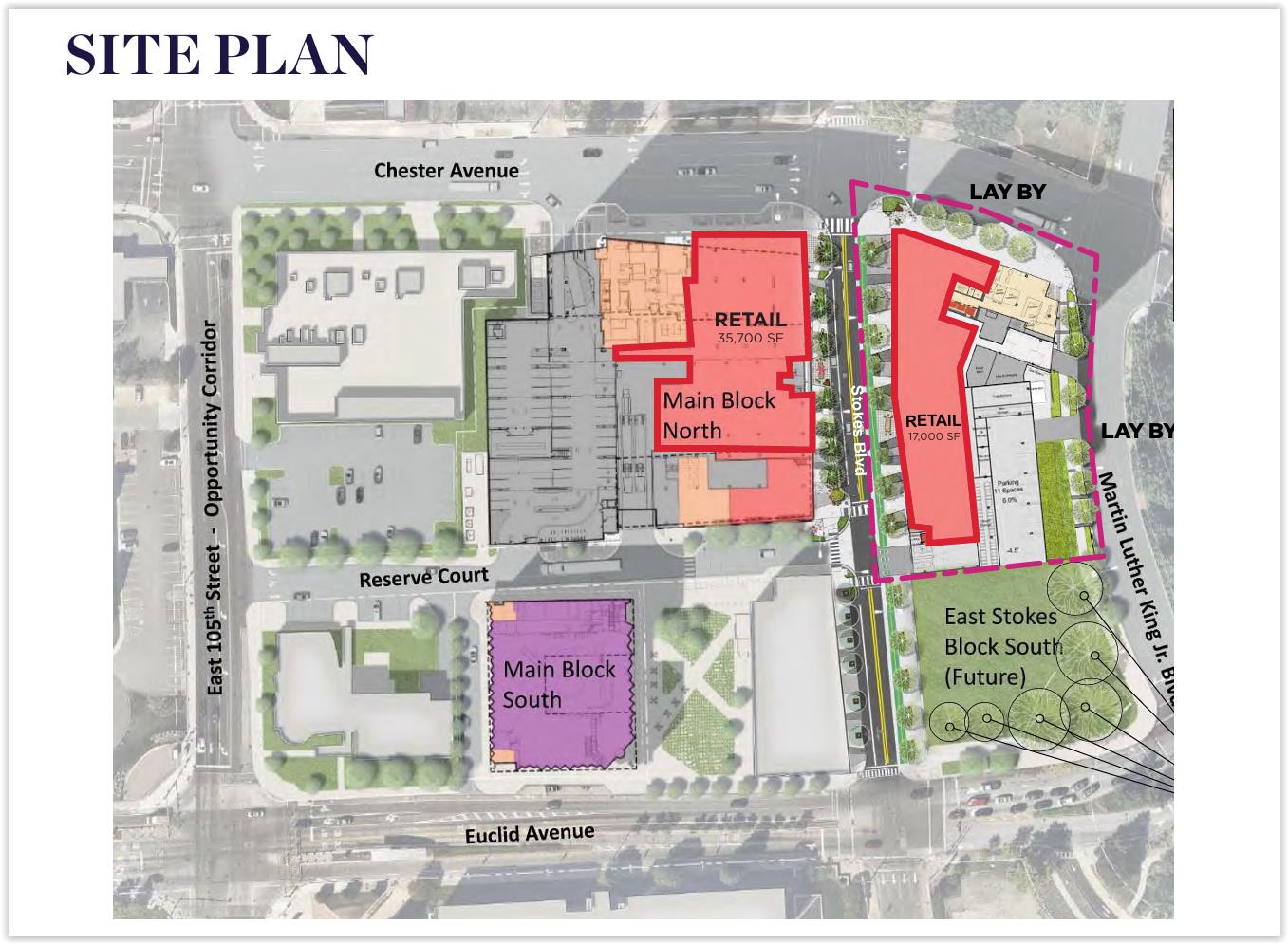
Circle Square’s site plan shows the site of the now-under construction East Stokes tower outlined with a dashed purple line. To the left is Main Block North, The Artisan tower, below which is where a retail/parking podium will be built for a future hotel. Main Block South is Library Lofts/MLK Branch Library and the future East Stokes Block South is reserved for a future office building (CRESCO).
The same cannot be said for the state’s largest downtowns where only 50-70 percent of their claimed workforces are in the office on a given day. So while Downtown Cleveland claims 100,000 workers, Downtown Columbus 92,000 and Downtown Cincinnati 88,000, the in-office workforce is much less.
But when University Circle Inc. claims UC and its surroundings, which include the eastern Fairfax and southern Hough neighborhoods, plus the adjacent parts of neighboring Cleveland Heights and East Cleveland, has more than 82,000 workers, nearly all of those people are likely at their workplaces.
Then there are institutions of higher learning. While many colleges and universities are slowing in their growth or even seeing declining enrollment, Case Western Reserve University (CWRU) is the nation’s fastest-growing research university within the elite Association of American Universities.
Its popularity has surged due to demand for its biomedical engineering, data science and medical tracks. CWRU enrollment was up to 12,400 last year, compared to 9,300 in 2000-01.
That growth is likely to continue given its imminent completion of the $300 million Interdisciplinary Science and Engineering Building and its success in winning the $160 million National Science Foundation grant. UH also won big just this week, securing the largest federal grant in its history.
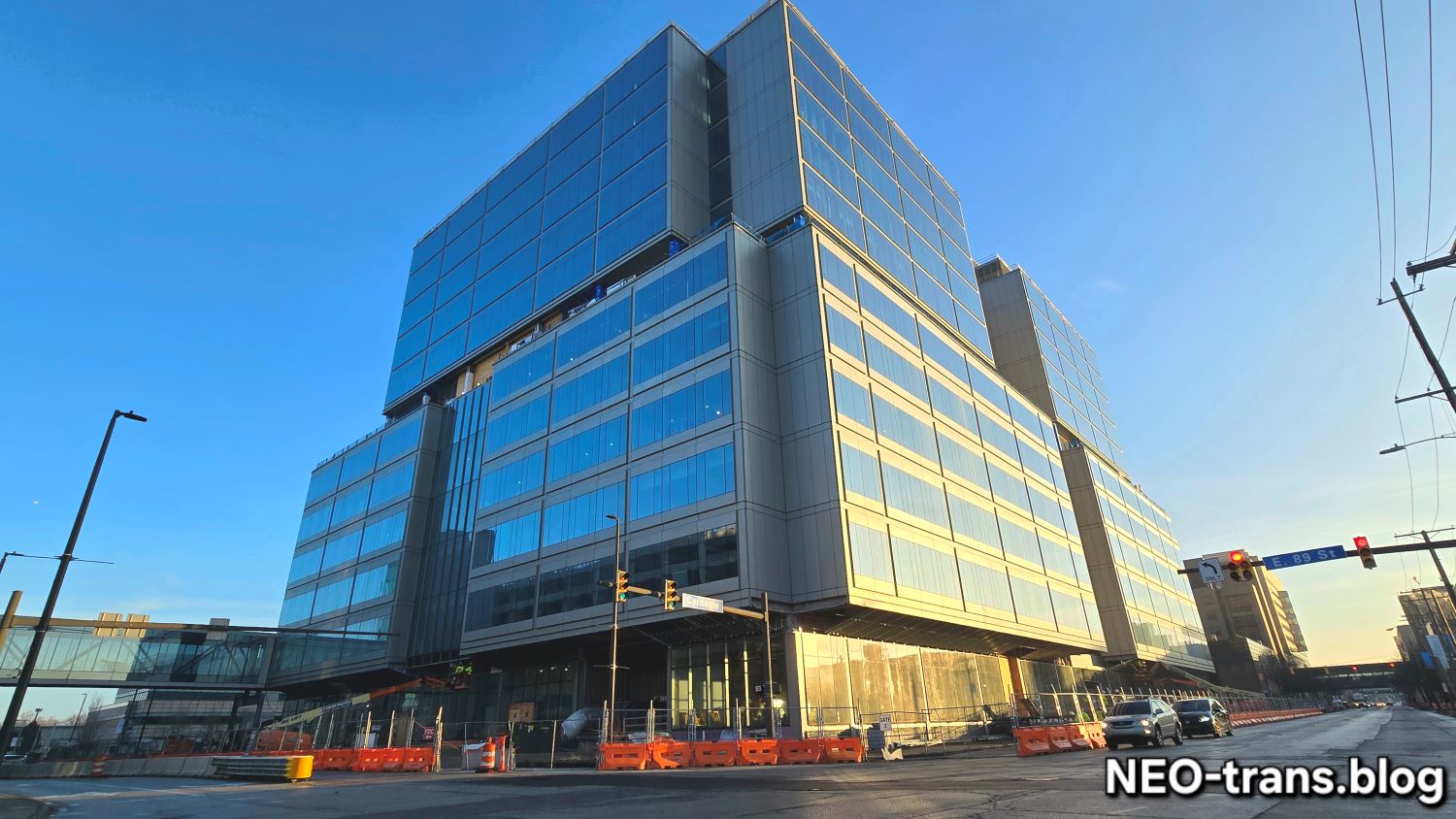
Cleveland Clinic’s new 1-million-square-foot Neurological Building on Carnegie Avenue will add thousands of new employees when it opens in early 2027 (NEOtrans).
All that winning and growth is attracting attention. Miami University just opened a local outpost at the CedarTech office building, 10900 Carnegie Ave., so its students can work as quantum-computing interns for the Cleveland Clinic.
It’s part of a groundbreaking partnership with the Oxford, OH-based university. The partnership resulted in the creation of the Ohio Institute for Quantum Computing, intended to position Ohio as the global epicenter of quantum computing innovation. Miami University wasn’t alone.
The Northeast Ohio Medical University (NEOMED) opened its first-ever Cleveland location in partnership with UH. NEOMED’s Cleveland Health Innovation Center opened last month at the Cleveland Foundation’s Warren E. Anderson MidTown Collaboration Center, 1974 E. 66th St., in Cleveland’s Hough neighborhood.
Work is progressing at Canon Healthcare USA’s new headquarters, involving a retrofit of the former IBM Explorys building at 10500 Cedar. The project represents a $33.65 million investment. But while development booms elsewhere in University Circle, the south side of it along East 105th Street seems to have slowed.
More than a decade ago, this was branded as the future New Economy Neighborhood, to be filled with research centers, labs and even some light manufacturing in place of condemned houses and vacated land. Today, only Explorys/Canon in in evidence; the public-sector property acquisitions here have slowed if not stopped. UCI was contacted for more information but has yet to respond.
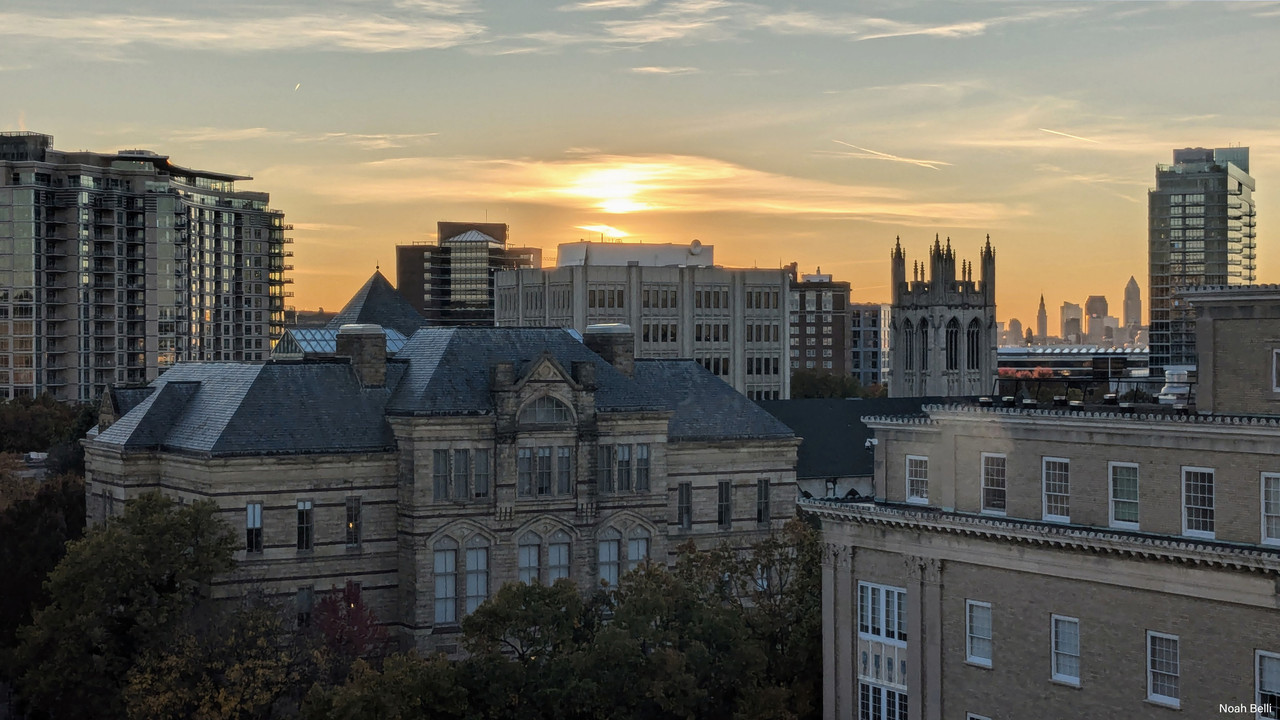
University Circle has become a second downtown for Cleveland, but may already be larger than it or any other employment hub in Ohio in terms of its daily employment presence (Noah Belli).
Still, there’s enough else going on to generate excitement. And all of that activity is drawing spin-off residential development like East Stokes. In fact, the amount of private investment — not just institutional investment — is satisfying to those who helped get University Circle here.
Among them was Chris Ronayne. Before he was elected Cuyahoga County Executive in 2022, he was president of University Circle Inc. from 2005-21. He said UCI was created in 1957 to be a land bank for the densely developed district, to buy and hold land to allow its institutions, employers and spin-offs to grow.
Many of those properties were temporarily used as parking lots until suitors stepped up to acquire and develop them. They included UH on East 115th, the Centric mixed-use development, 1999 Circle Dr. at Mayfield Road, the 20-story One University Circle, 10730 Euclid, or Skyline on Stokes, 2132 Stokes Blvd.
“We (UCI) got going on nine strategic investment sites where our goal was to add housing units,” Ronayne told NEOtrans. “We only replaced cars and we added people. Between those efforts plus the owners of private sites like Circle Square, we’ve been able to populate University Circle with 5,000 residents and added significant amounts of all-day vibrancy.”
Ronayne also served as director of the Cleveland City Planning Commission from 2002-04, and was succeeded over the coming decade by the commission’s then-assistant director, Robert Brown. A 1973 graduate of CWRU, Brown joined Cleveland’s planning department in 1985.
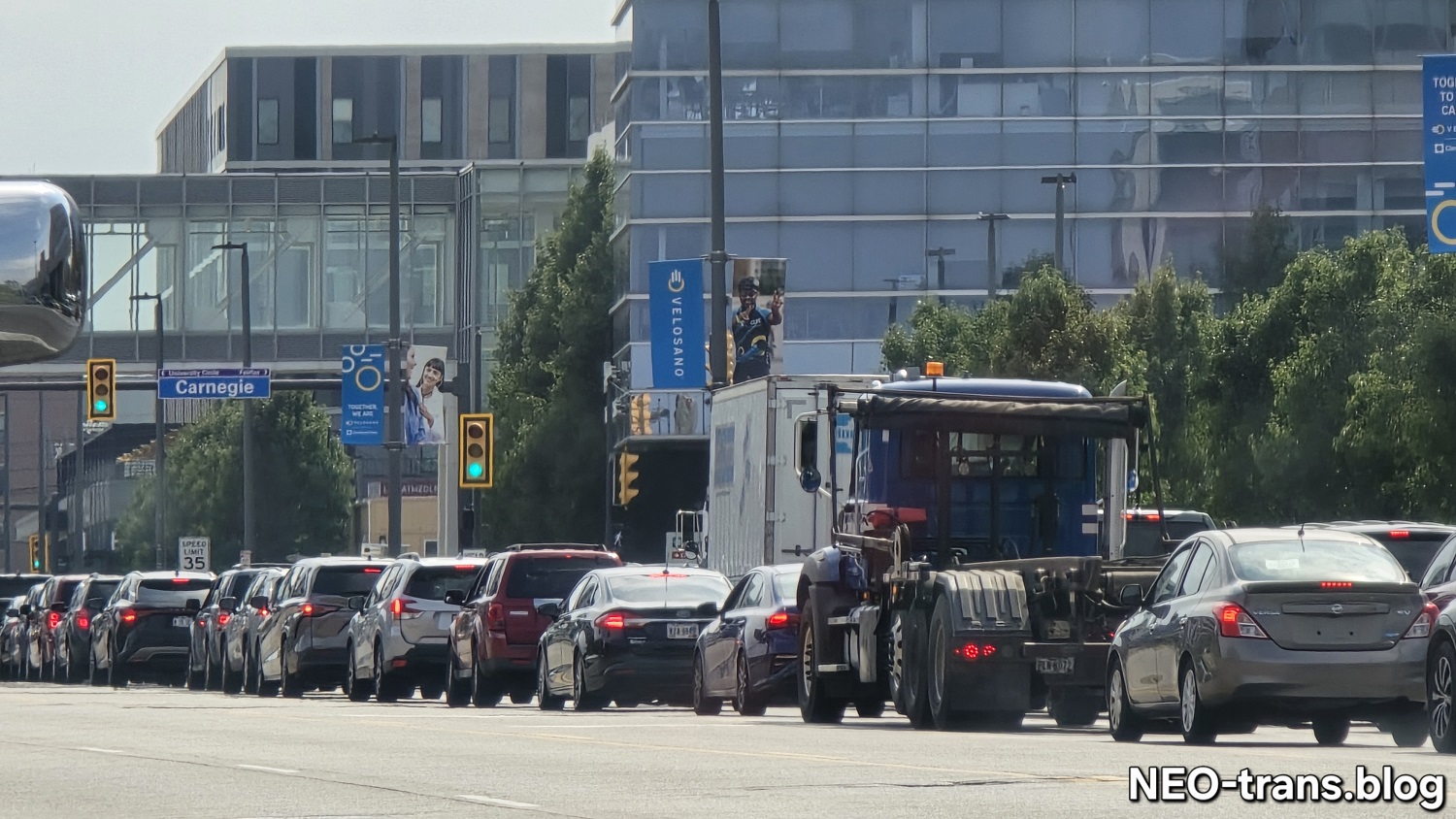
Traffic in and near University Circle doesn’t appear to be choking off growth. Instead it seems to be attracting residential development from the district’s workforce who want to live in a walkable district so they don’t have to deal with the traffic on a daily basis (NEOtrans).
Back then, University Circle had seen better days. The change since then has been remarkable. Even since his 10-year leadership of the planning department ended a dozen years ago, he is still amazed at the amount of public and, especially, private investment.
“During all the decades I worked as a city planner in Cleveland there was relatively little new private housing development in University Circle, despite the presence of CWRU, University Hospitals and the district’s many world-class museums and institutions,” he said. “In recent years, however, housing development in University Circle has been booming.”
The addition of jobs is only part of the story, he believes. Brown cited a younger, more environmentally conscious market of renters. He considered them more willing to support and promote neighborhoods that are diverse, racially and economically.
Childless households are growing in number, be they senior empty-nesters, young professionals or others. They represent more than 70 percent of the region’s housing market. And even among households with children, there are more opportunities for them today in the City of Cleveland.
“The growth of specialized public schools in Cleveland have given households with school-age children more options to live in the City of Cleveland than there were in past decades,” Brown said.
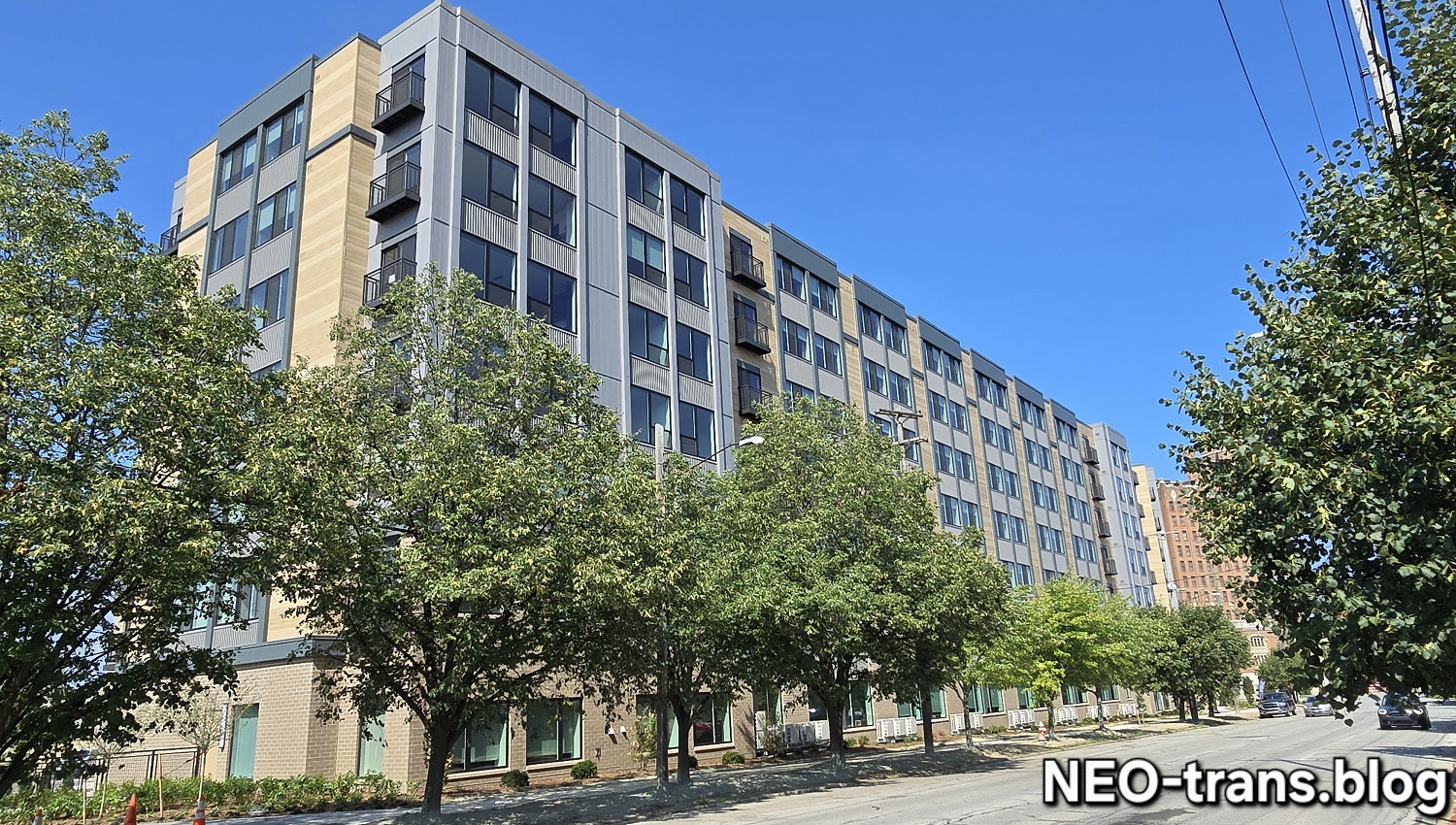
This seven-story apartment and half-dozen townhomes used to be a parking lot owned by University Circle Inc. The was sold and replaced by 263 housing units (NEOtrans).
The residential growth is supporting retail growth as well. Back at Circle Square, the mixed-use district that has produced The Artisan apartments, Library Lofts/MLK Branch Library, and now the East Stokes tower, new retail development may be emerging here soon.
The ground floor of East Stokes will have 17,682 square feet of retail space, stopped with a 315-space, four-level parking garage, topped again by 281 apartments. But across a narrowed, streetscaped Stokes Boulevard will be more retail, said Alex Smith, vice president of Cushman & Wakefield | CRESCO Real Estate.
Circle Square’s development team, led Cleveland-based UC City Center LLC and PCP Flow, are also planning to build up to 35,960 contiguous square feet of retail on the west side of Stokes as an expansion of the Artistan with ground-floor retail topped by parking. That retail/parking structure will serve as a podium for a future hotel.
“The proposed expansion of the Artisan retail space is speculative at this point but is in response to market demand and a critical component of the vibrant, walkable district that the development team is creating with Circle Square,” Smith said.
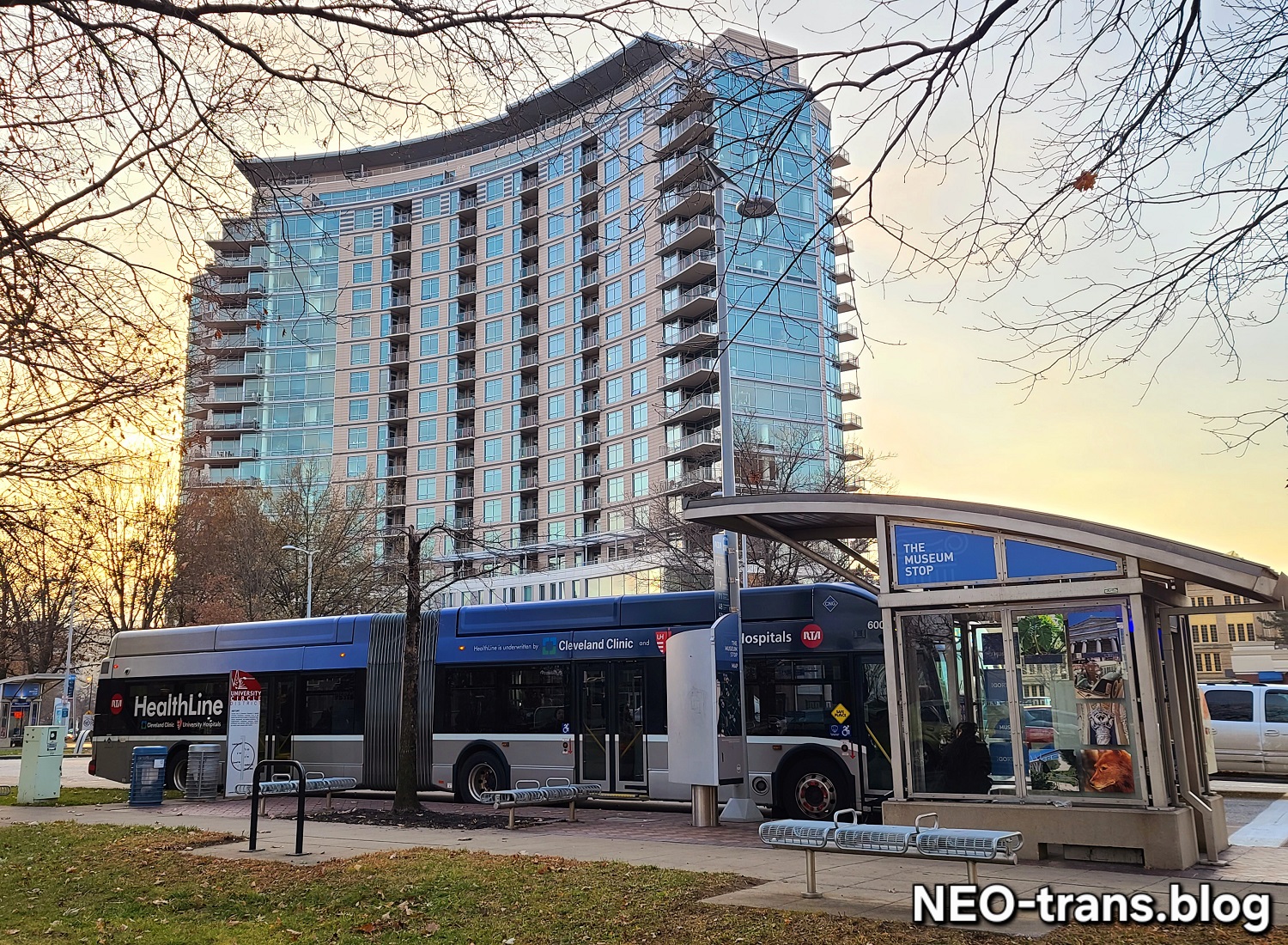
The 2018-built, 20-story, One University Circle apartment tower was briefly the tallest building in the district until The Artisan overtook it several years later. This site was also an underutilized lot owned by University Circle Inc. (NEOtrans).
He said that, given the continued residential and employment growth in University Circle and consequentially, the retail demand, there’s an inventory shortage for retailers to capitalize on the growth.
“We’re in early conversations with several users for the anchor and small-shop spaces and expect continued demand as construction progresses,” Smith explained.
While growing car traffic congestion remains a concern in University Circle, Ronayne said developments like Circle Square are actually a response to it as they allow workers to walk, bike or take transit to work and leave the car at home.
“University Circle was built as a multimodal place,” Ronayne said. “I don’t look at that (traffic) as a destriment. I view that as a uniquely vibrant place and developments like Circle Square have contributed to it. I’m thrilled with the outcome.”
END