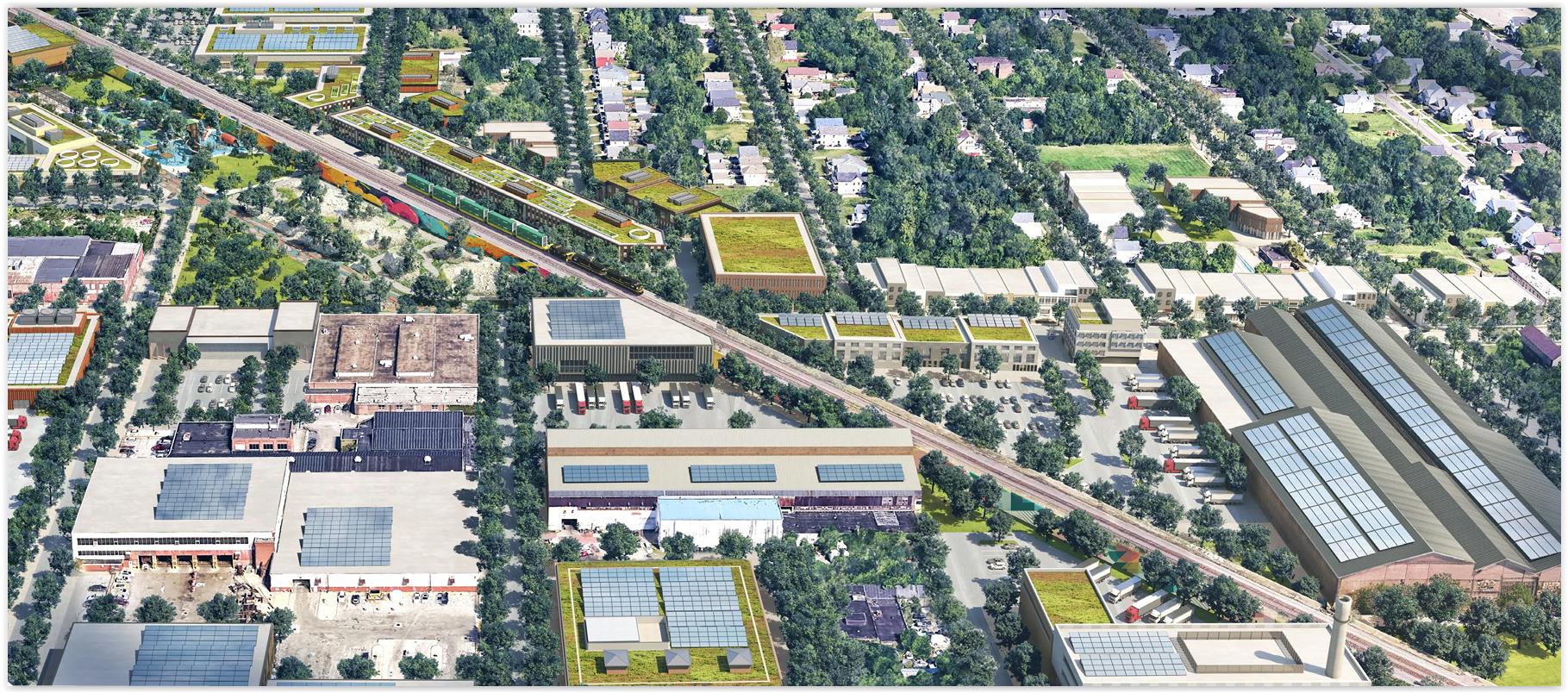
The Midline Business District for Cleveland’s near-East Side was announced earlier this year but a development master plan for that 200-acre area has been in the works for even longer. The nonprofit Site Readiness for Good Jobs Fund is seeking City Planning Commission approval of the masterplan, a conceptual outcome of which is shown here (SRF). CLICK IMAGES TO ENLARGE THEM.
2,500+ jobs, 1.5M sq ft envisioned at 21 sites
A master plan for guiding commercial, residential and recreational development for the recently announced Midline Business District envisions more than 2,500 good-paying jobs among 1.5 million square feet of development at up at 21 sites on the city’s near-East Side.
The plan was produced by local and national planning and design firms at the request of the Site Readiness for Good Jobs Fund (SRF) and an affiliated steering committee to determine how best to redevelop one of the city’s largest blank slates.
The nonprofit SRF was created three years ago by Mayor Justin Bibb’s administration in partnership with the Cuyahoga Land Bank to acquire, clear and assemble underutilized lands for redevelopment.
While the SRF works citywide, the need for job-ready sites is especially acute within a few hundred meters of the elevated Norfolk Southern railroad line amid streets like Euclid, Carnegie, Cedar, Central, Quincy, East 79th, Woodland, and Opportunity Corridor.
More than 200 acres of land is owned by the Site Readiness Fund or affiliates in the Midline Business District. How that much land is developed would have consequences and/or benefits for decades to come. The masterplan is intended to maximize the benefit and minimize the consequence (SRF).
Alongside the still-busy tracks was a corridor once jammed with manufacturers. Today, this stretch of Midtown, Hough, Central, Fairfax and Kinsman is filled with many ruins of Cleveland’s industrial past.
“This intertwined history of industry, rail, neighborhood life, and culture in Cleveland’s near-East Side neighborhoods provides an important foundation for the Midline’s next chapter — one that seeks to reconnect employment and investment with the communities that have long surrounded this corridor,” the masterplan reported.
That’s especially true in a 200-acre swath of brownfields from the intersection of Euclid Avenue and East 55th Street in Midtown south to the Opportunity Corridor Boulevard in the Kinsman neighborhood.
The Midline’s area of interest is actually much larger — totaling more than 350 acres. But approximately 150 acres are currently occupied by active businesses that will remain in place and be supported with local investment guided by the masterplan.
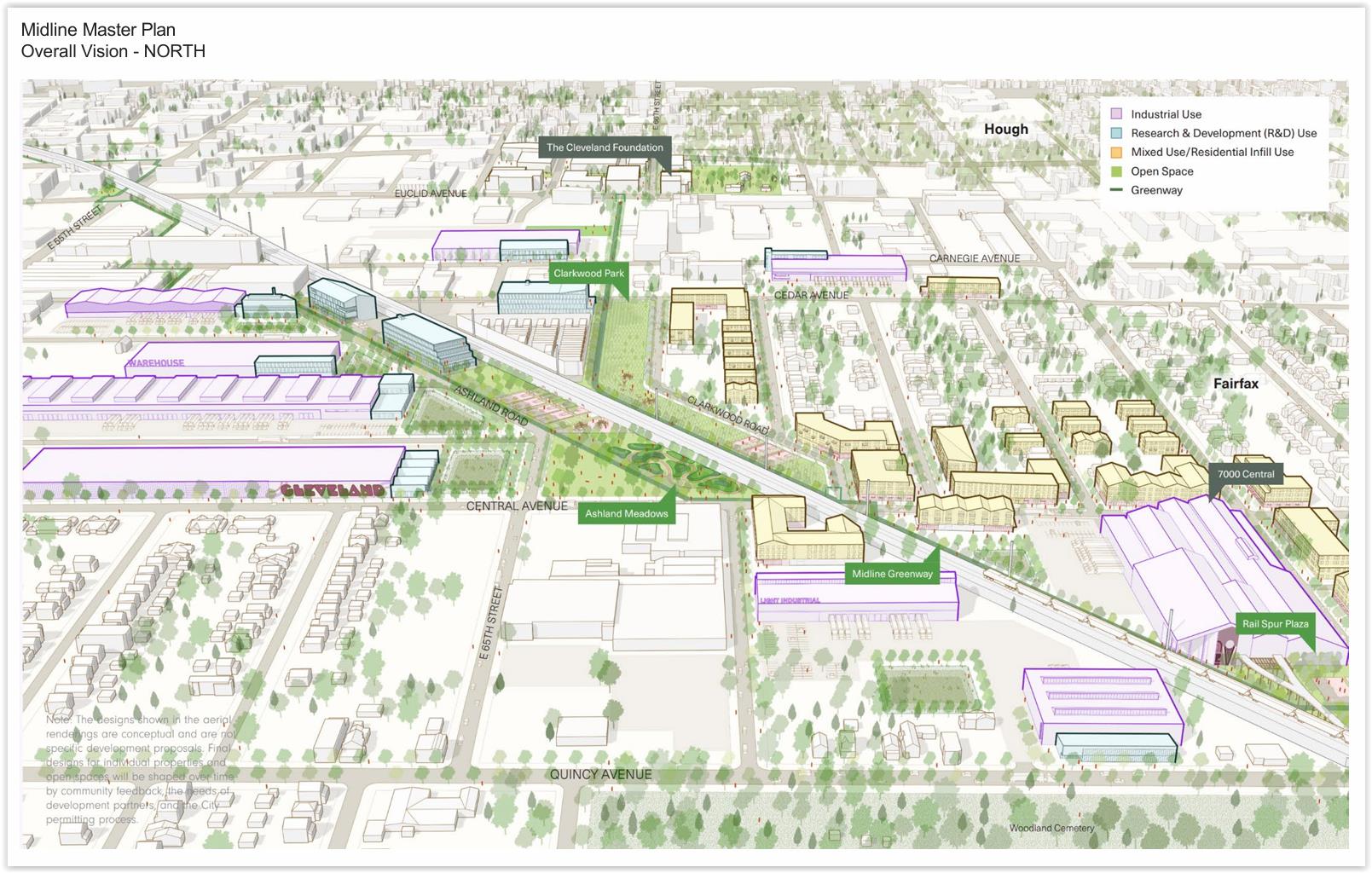
From north to central to south, the masterplan provides three birdseye views of what a fully built-out Midline could look like if redeveloped according to the emerging new plan. This is at the north end of the Midline, looking north from above Quincy Avenue (SRF).
Needing even larger investment is the 200-acre swath. There, many employers — Westinghouse, TRW, Wellman-Seaver-Morgan, Van Dorn Iron, and more — closed in the late-20th century and left devastation behind for the community to deal with.
“The Midline aims to repair economic and environmental harms — decades in the making — by reclaiming polluted land to create a thriving employment district connected by a vibrant greenway trail and public spaces,” the masterplan notes.
Complicating their re-use are polluted, empty factories that have to be razed and/or cleaned up, legal liens untangled, or mysterious owners found. It’s a task that no private investor would tackle when large, clean and green lands could be developed much more easily at the outer fringes of suburbia.
So the SRF and a steering committee are working to make the Midline competitive with the exurbs. Comprising the Midline Steering Committee are neighbors and faith leadership, and representatives from the City of Cleveland, Burten Bell Carr, Fairfax Renaissance, Midtown Cleveland, and others.
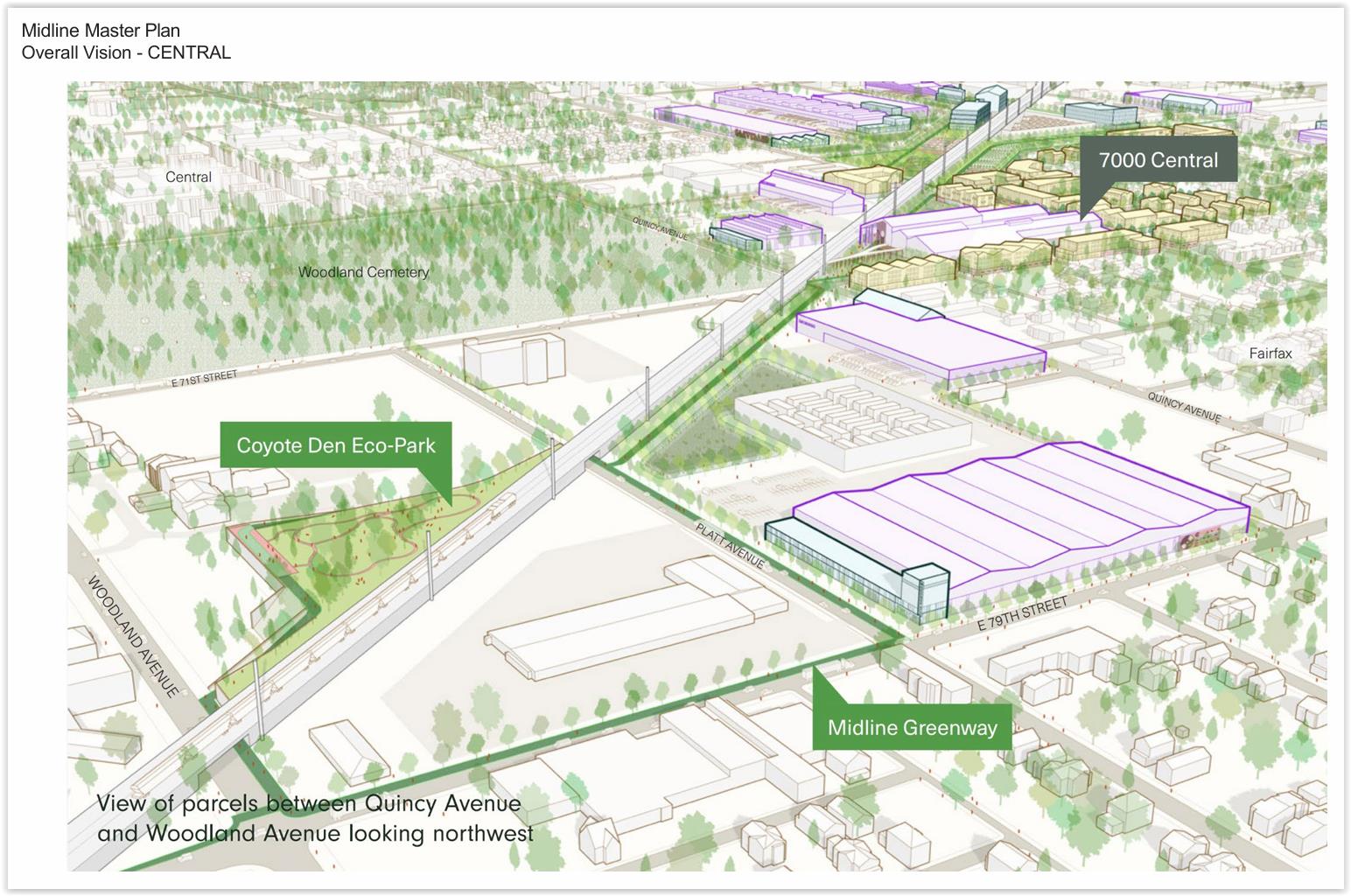
In the Central section of the Midline, looking northwest, the Site Readiness Fund would offer public spaces to complement the job-producing lands with offices for new light-industries facing major streets (SRF).
The question is, how could the Midline be redeveloped and public investments focused in to maximize the benefit to the community? That’s where the masterplan comes in.
SRF contracted with Cleveland-based LAND studio, Merritt Chase of Pittsburgh, and Utile of Boston to come up with a research-based vision. And this Friday it will seek input and support from the City Planning Commission to influence future development plans.
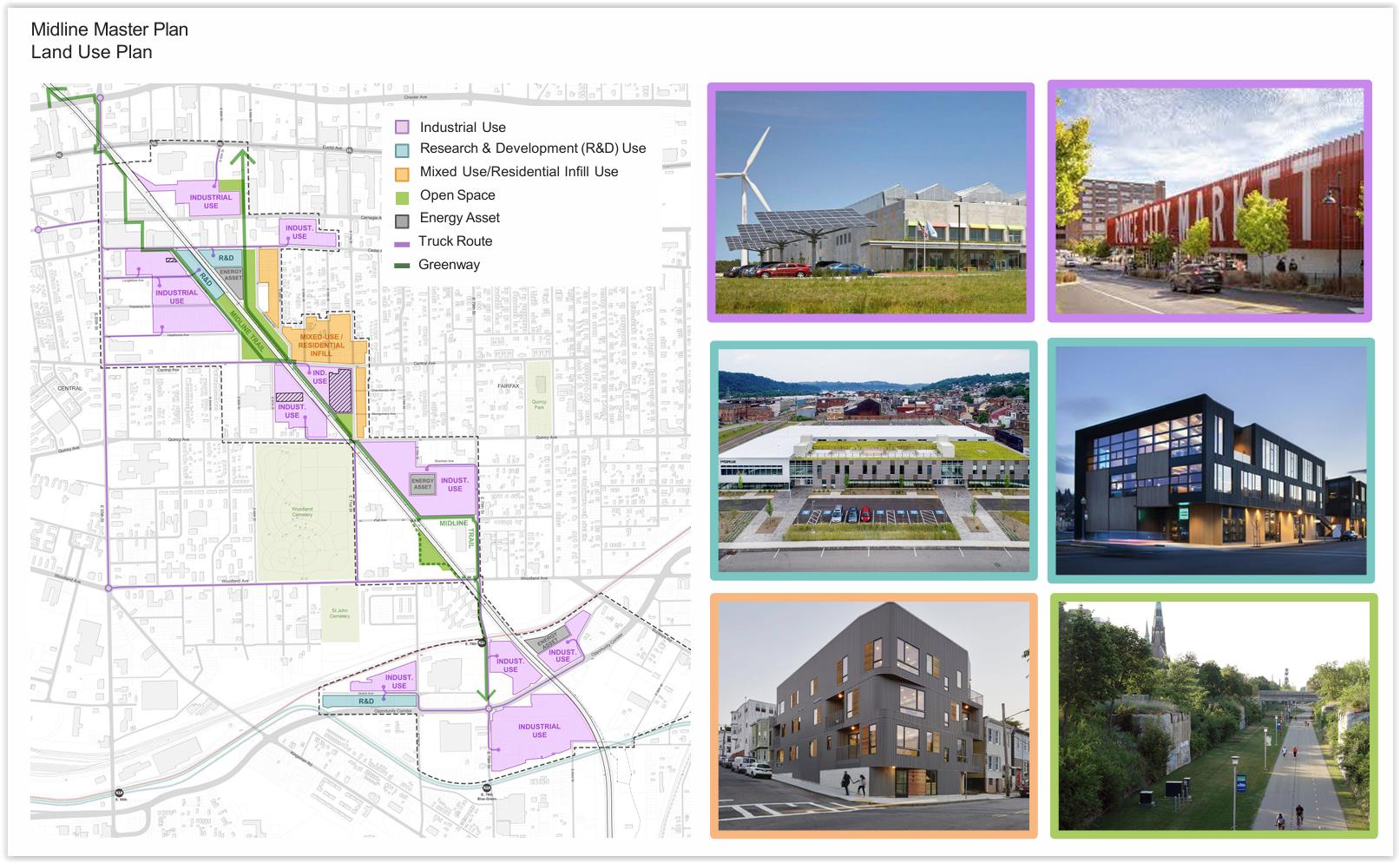
In addition to the desired number of jobs and square feet of new, marketable commercial space, the plan encourages to creation of more than 2 miles of all-purpose trails called the Midline Greenway and at least 10 acres of open, public spaces. The trails will link jobs to transit routes and residential areas.
Furthermore, the plan identifies sites that may be best suited to industrial use, research and development, mixed uses including residential, open spaces, and locations for energy assets including electric substations, solar panels and wind turbines.
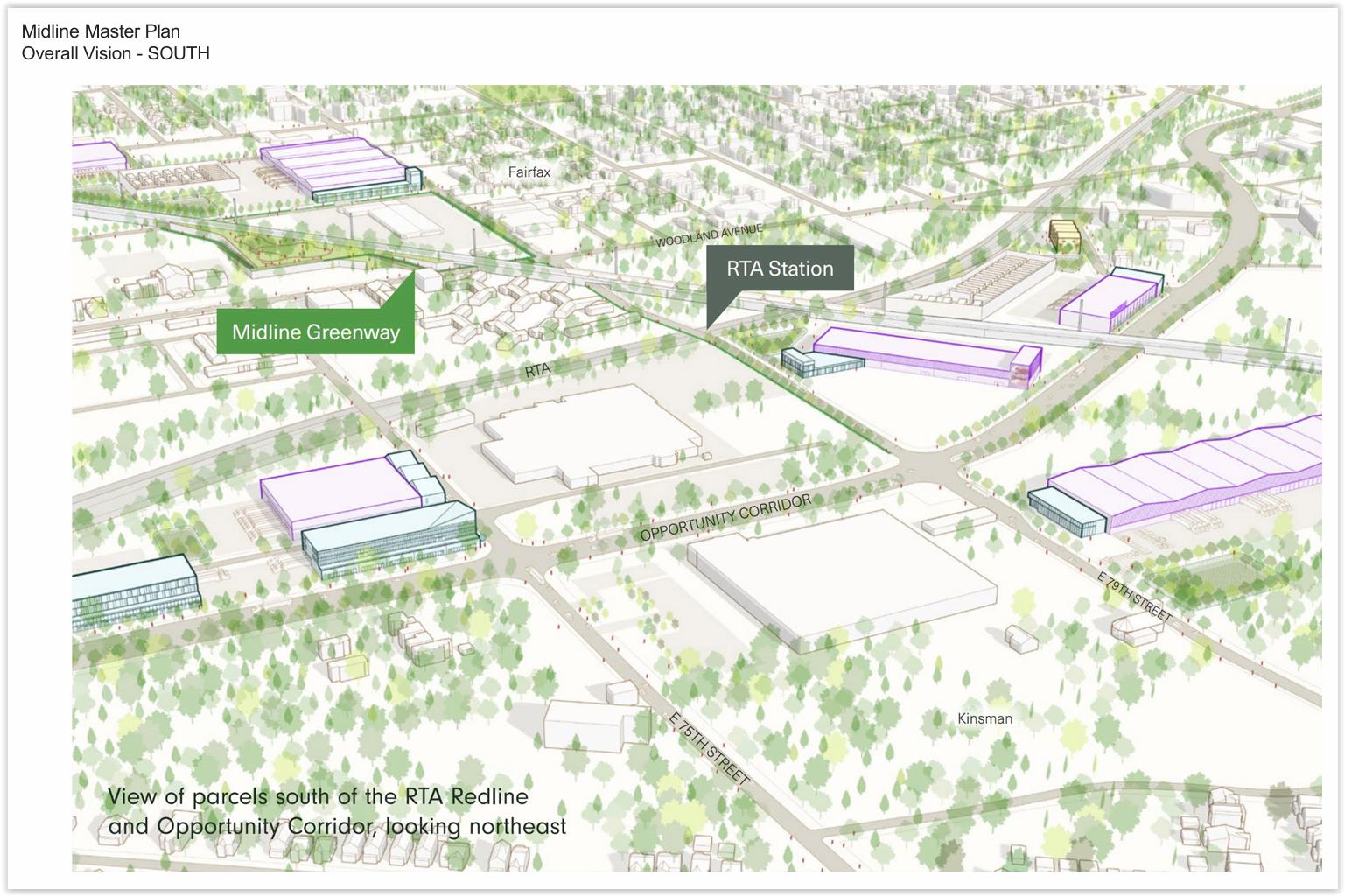
At the south end of the Midline District, along the Opportunity Corridor, several major sites exist for new employers amid public spaces and leveraging stormwater management as a visual amenity. This view looks northeast (SRF).
The plan provides guidance on what could be the most community-beneficial ways to orient new commercial structures, such as placing factory or warehouse offices next to sidewalks of major streets with the manufacturing or inventory storage activities behind. It also designated potential truck routes.
Those guidelines, supporting a new form-based zoning code that’s being introduced neighborhood-by-neighborhood, would “create a consistent street wall and streetscape across the district as opposed to parcel-by-parcel customization,” the plan explains.
The goal of those guideline is to “Prioritize active human-centered uses close to and facing public streets,” it adds. Examples of those uses are as lobbies, offices, and accessory retail.
The orientation and form of new buildings would buffer industrial uses from existing residential areas as well as to better integrate the new Midline Greenway with added setbacks, enhanced landscapes, and building design.
END