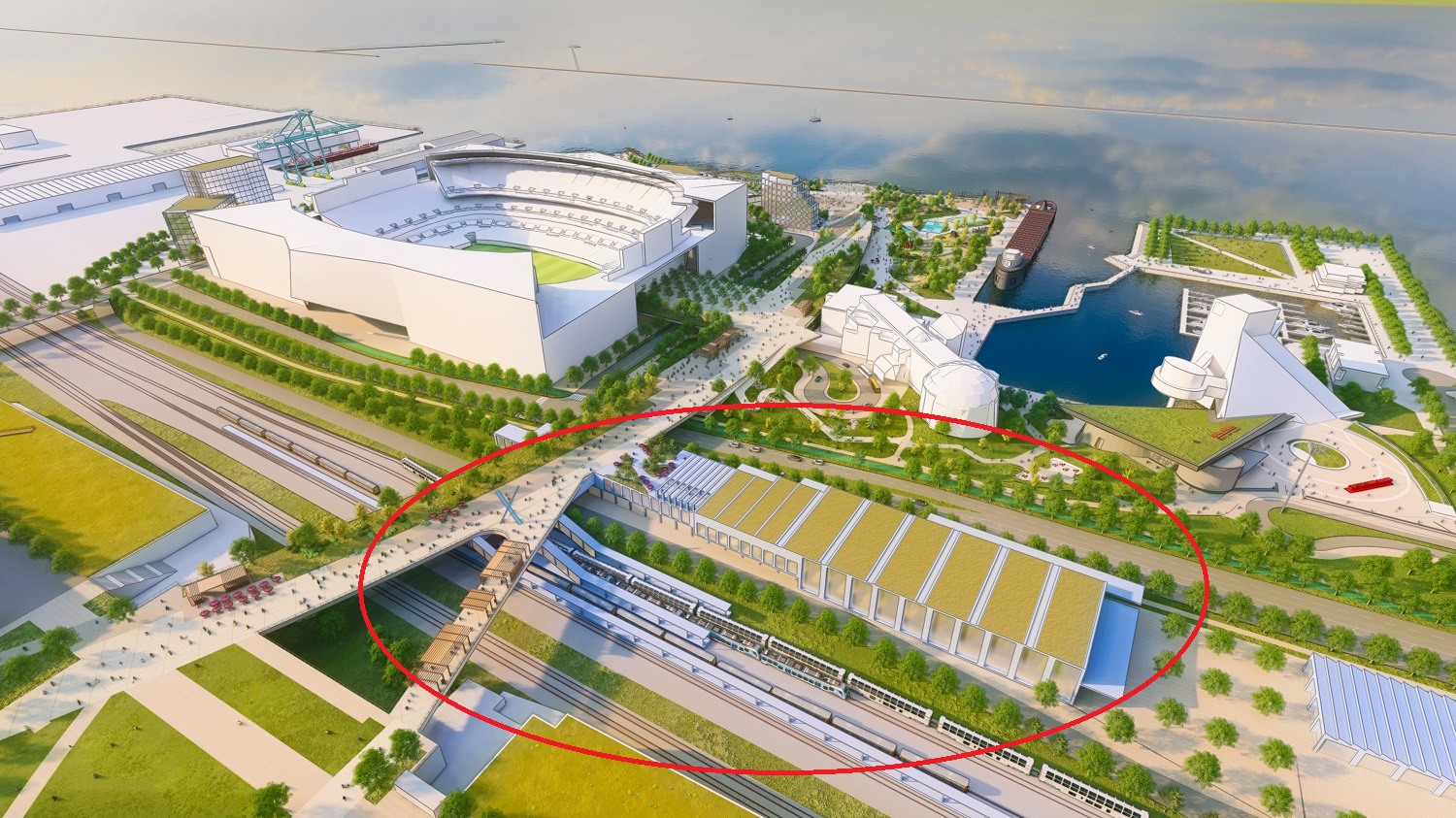
Circled in red is the potential location of and facilities for a new multimodal transportation center on the Downtown Cleveland lakefront for bus and rail services plus an extended port access roadway. The goal is to advance planning to a 30 percent level of design so that the city will know how much funding will be needed to finalize the design and build it (FO). CLICK IMAGES TO ENLARGE THEM.
Extended Port Access Roadway design included

Improving access to a re-envisioned Downtown Cleveland lakefront by more than just driving has been a focus of the city’s lakefront master-planning process. But the details on how that could be done so far have been vague and conceptual. That will change as a result of a $960,000 federal grant awarded this week to the city.
The funding from the U.S. Department of Transportation (USDOT) will support the $1.2 million North Coast Connector Multimodal Hub Area Study. The city of Cleveland is providing $240,000 to the planning work.
This work will produce construction-ready plans for a transit center that could unite three facilities into one — the Waterfront Line light-rail stations built in the late-1990s at West 3rd and East 9th streets as well as the 1976-built Amtrak intercity passenger rail station.
It could also produce designs for a parking structure plus pedestrian and bike linkages with the North Coast Connector “Land Bridge” over the railroad tracks, linking downtown and the lakefront. The lakefront masterplan shows the multimodal station measuring 150,000 square feet which would be enough parking for 500 cars.
It will also fund plans for the second phase extension of the Port Access Roadway from West 3rd Street to beyond East 9th Street. The first phase of this roadway is included in the already funded construction of the conversion of the Shoreway highway into a multimodal, landscaped boulevard with intersections at West 3rd and East 9th streets.
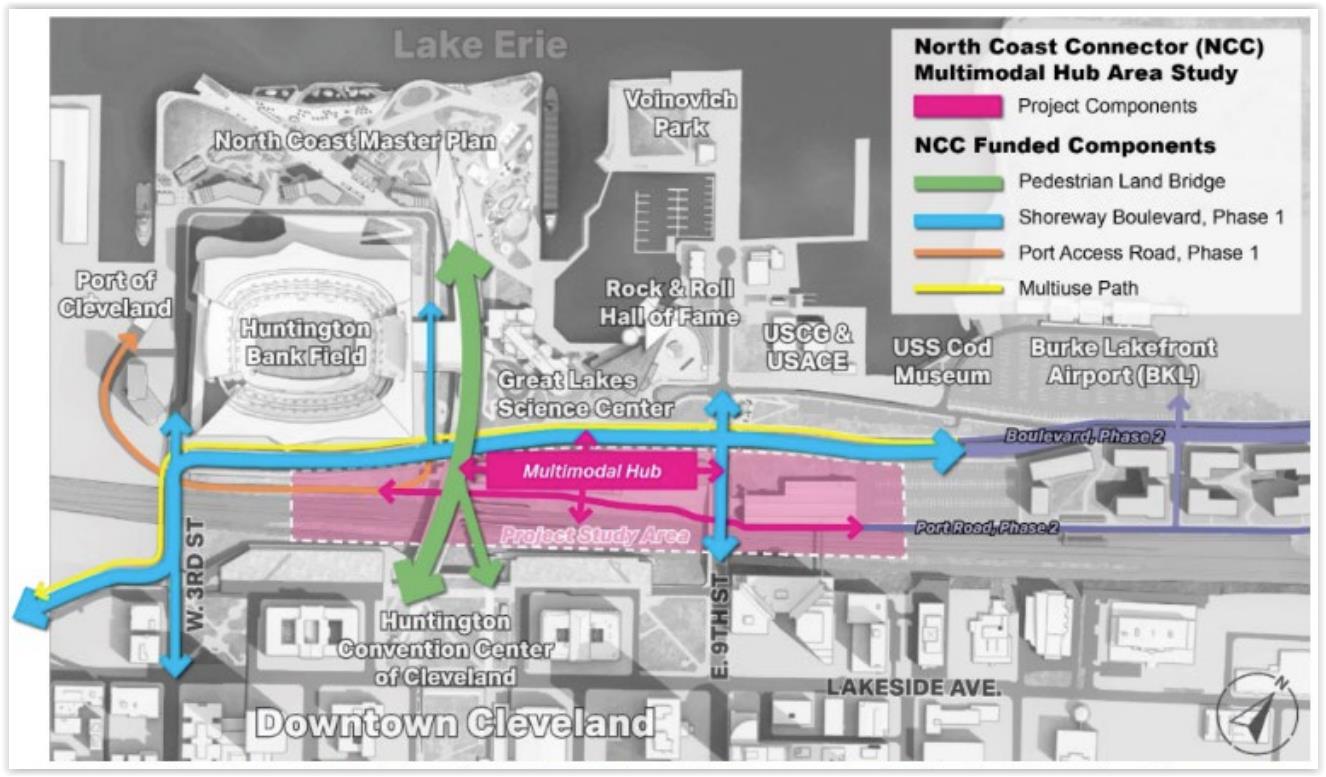
The affected area of the North Coast Connector Multimodal Hub Area Study is shown in light pink while the actual transit center will likely be located in the dark pink area (USDOT).
Congresswoman Shontel Brown (D-11 of Warrensville Heights) today announced the federal funding award. The funds are coming from the USDOT’s Better Utilizing Investments to Leverage Development (BUILD) program, a competitive grant program funded by the Bipartisan Infrastructure Law, which Brown voted for in 2021.
“The momentum behind our downtown lakefront continues to grow by the day,” Brown said in a written statement. “This is more than a transportation study, it is about charting a more connected and innovative downtown Cleveland.”
“The North Coast Connector Multimodal Hub Area Study will lay the groundwork for a transportation network that brings people together, fuels economic opportunity, and better integrates rail, bus, bike, pedestrian and freight systems,” she said. “I’m proud to partner with Mayor (Justin) Bibb and the city of Cleveland to help deliver this investment for Northeast Ohio.”
The city is coordinating with various partners including the Greater Cleveland Regional Transit Authority (GCRTA), Amtrak, Port of Cleveland and others to develop a strategic, multi-agency vision for a centralized multimodal transportation hub.
“Momentum is building around our lakefront, and this federal grant is the latest proof,” Bibb said. “This investment brings us one step closer to connecting people to our greatest natural asset.”
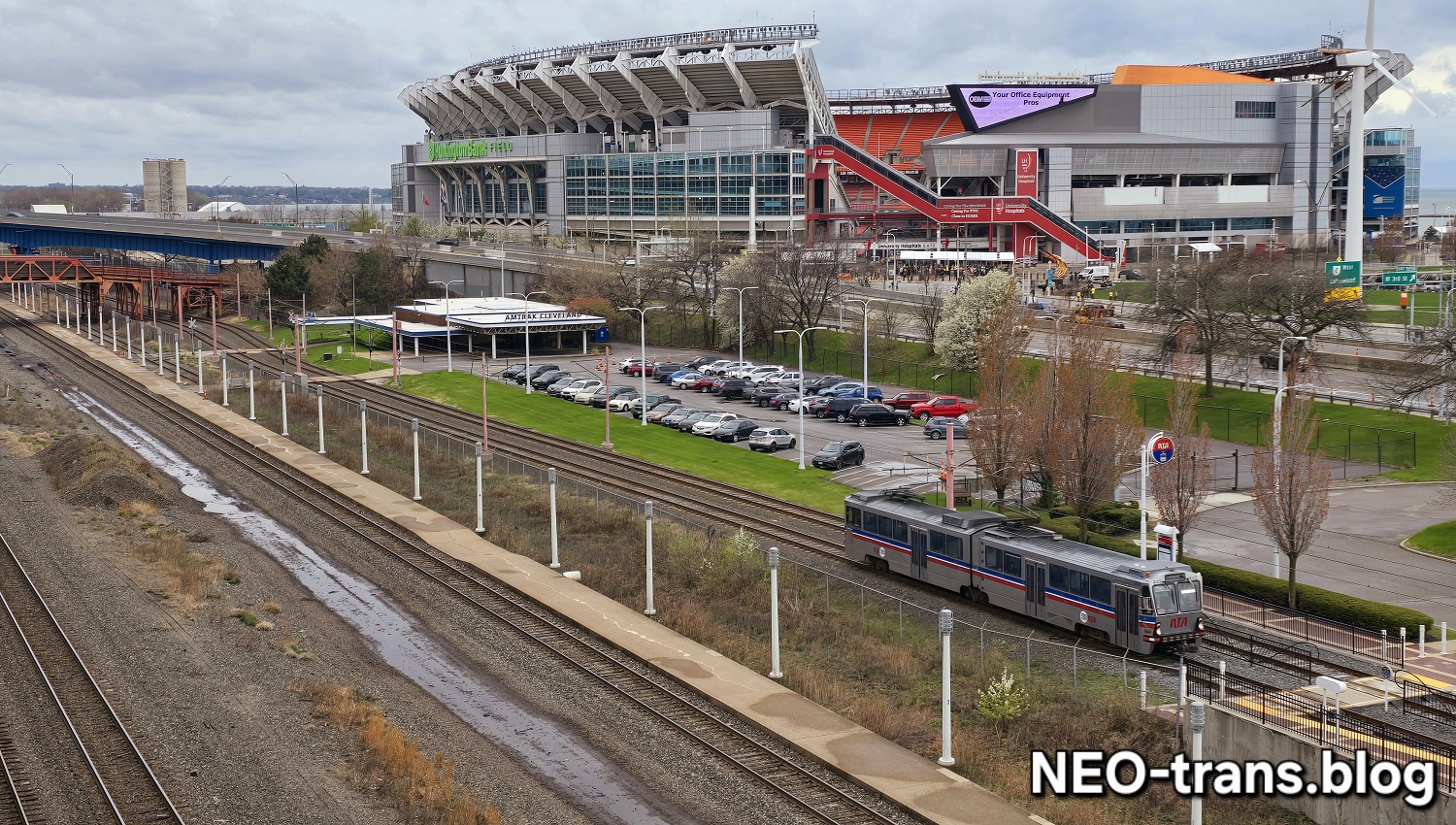
This is the potential site of the multimodal transportation center. A weekends-only Waterfront Line train is arriving the North Coast station at East 9th Street after having just passed the Amtrak station which is active only at night. In the background is Huntington Bank Field whose 22 acres of land is part of the city’s 50-acre lakefront offer to developers to repurpose (NEOtrans).
“We’re grateful to our federal partners for believing in our vision and we will continue to drive this work to fruition,” he added. “This is the Cleveland Era — and the future is happening on our lakefront.”
Last week, the city issued a request for qualifications from prospective developers who may seek to repurpose 50 acres of lakefront land, including 22 acres on which Huntington Bank Field sets. The Cleveland Browns’ lease of that stadium ends after the 2028 football season.
Cost of the city’s lakefront plan — reconstruction of the Shoreway highway into a boulevard, new Land Bridge over the railroad tracks and boulevard plus new access roads, sidewalks, bike paths and streetscaping — is estimated at $450 million.
Of that, $284 million is already committed. The city has $130 million in federal grants, $20 million in state grants, and $134 million in local matching dollars from a Shore-to-Core-to-Shore tax-increment financing district. There are also significant federal dollars from several USDOT pots of money available for multimodal stations.
Cleveland is Amtrak’s busiest train station in Ohio with 58,930 boardings in 2024, a 20.8 percent increase over 2023. But it has just four trains a day, all scheduled to stop here between the hours of 2 a.m. and 6 a.m. on their nightly runs between Chicago and the East Coast.
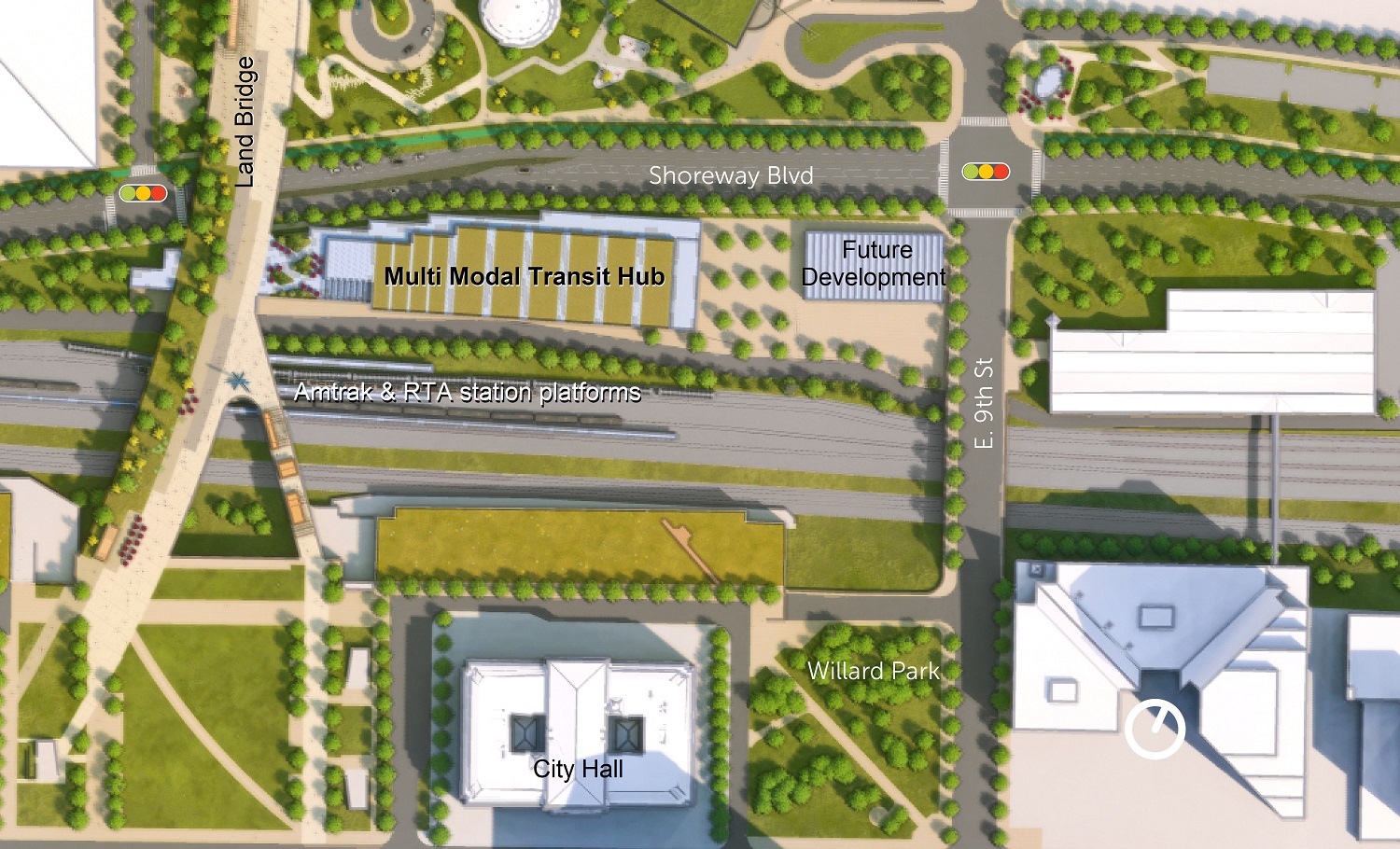
Conceptual plans for the multimodal transportation center as they appear in the city’s lakefront master plan (FO).
Cleveland’s Amtrak ridership pales to comparably sized cities in nearby states that sponsor more frequent, daytime Amtrak services. In 2024, Pittsburgh had 136,816 boardings, Buffalo’s two stations boarded 177,976 passengers, St. Louis had 368,097 boardings and Milwaukee 543,323.
The Ohio Rail Development Commission is advancing studies of two potential passenger rail service expansions that could dramatically increase passenger service and boardings here. One route would link Cleveland, Columbus, Dayton and Cincinnati and the other would connect Cleveland, Toledo and Detroit.
Operator interest isn’t limited to the national passenger railroad Amtrak. Also showing interest is Brightline, part of a conglomerate that also develops real estate around rail stations. It is expanding 79-125 mph service in Florida and is building a 200-mph route between Las Vegas and suburban Los Angeles.
It isn’t clear yet whether the multimodal station will be designed to accommodate bus services to make it easier for people to travel throughout Northeast Ohio and across the country without a car. One out of five Cleveland households have no car and more must share one car.
Downtown Cleveland is served by Akron Metro RTA, Laketran, Portage Area RTA and Stark Area RTA buses. But there is no centralized, easily identifiable, climate-protected transfer location among those bus services.
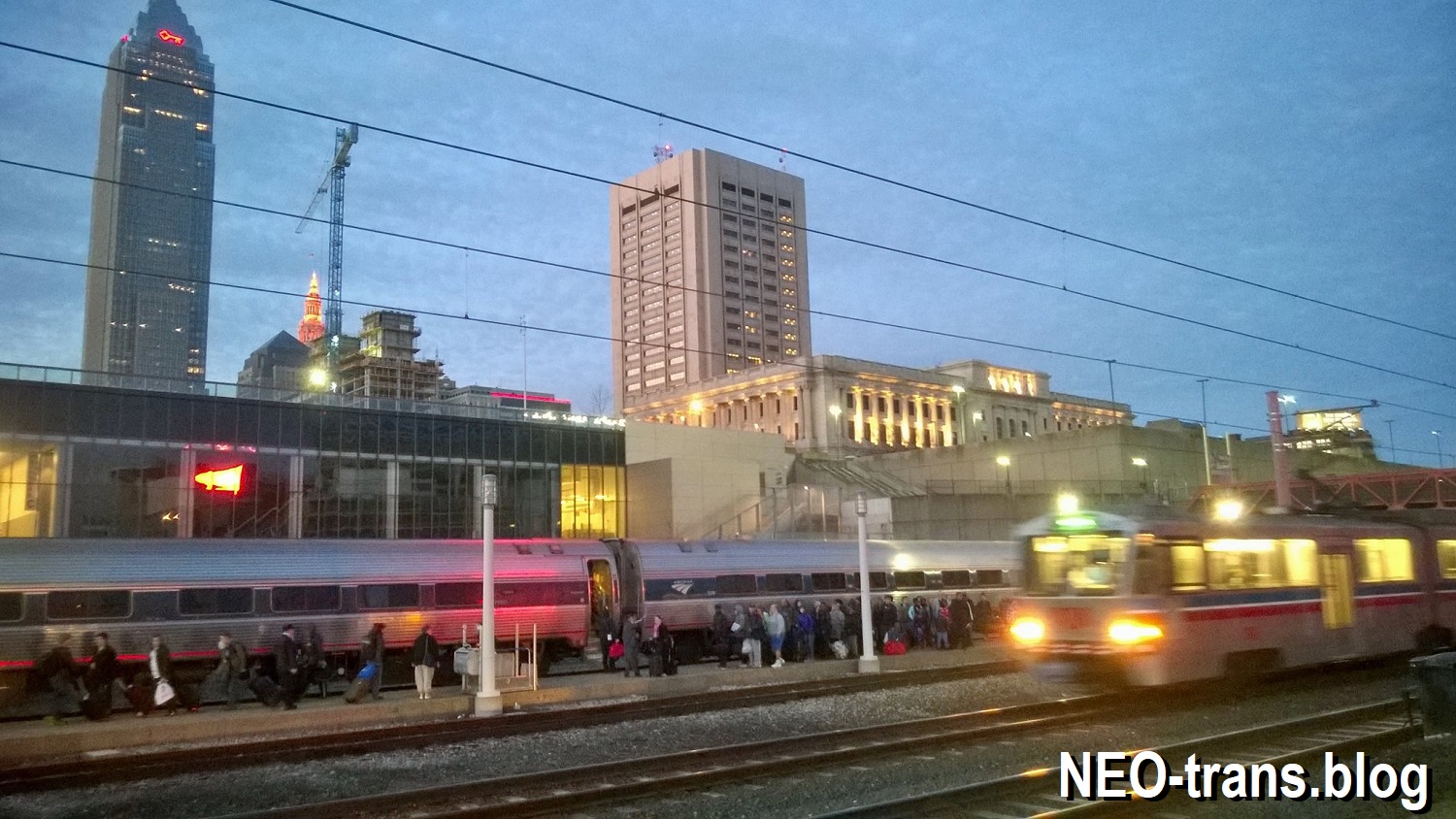
If Amtrak operated on daytime schedules and the Waterfront Line operated during the week, transfers between local and intercity trains would be possible. Greyhound, Barons Bus and transit routes into surrounding counties do operate more often and in daytime, but may not be part of the scope of the pending multimodal study (NEOtrans).
And while Greyhound and Barons Bus serve intercity travel, their bus station is relocating from downtown to the Brookpark GCRTA Rapid station in the coming weeks. The new station is near the Cleveland Browns’ new stadium site which could make access to the bus station difficult on stadium event days.
This is the third USDOT grant the city has received for the North Coast Connector project and associated features including the Downtown Boulevard Project. In January 2025, Cleveland was awarded $69.3 million and in October 2024 it was awarded $59.7 million. The funds survived scrutiny by the incoming Trump Administration.
Final design work is underway by Osborn Engineering of Cleveland. Construction contractors are to be hired in 2026. Demolition of the existing Shoreway bridge over West 3rd and the lakefront railroad tracks and follow-on construction work is scheduled to start in 2027. Construction should take about three years to complete.
GCRTA’s Waterfront Line station at West 3rd may be demolished early on in the project to accommodate construction of a new, widened West 3rd bridge over the railroad track, a new boulevard east of West 3rd and the first phase of the Port Access Road at a new location below West 3rd.
The planning funded today will design the second phase of the Port Access Road, extending it east into what is now South Marginal Road’s underpass below East 9th. At full buildout, the Port Access Road is intended to provide a dedicated cargo route between the Port of Cleveland and the Interstate highway system.
END