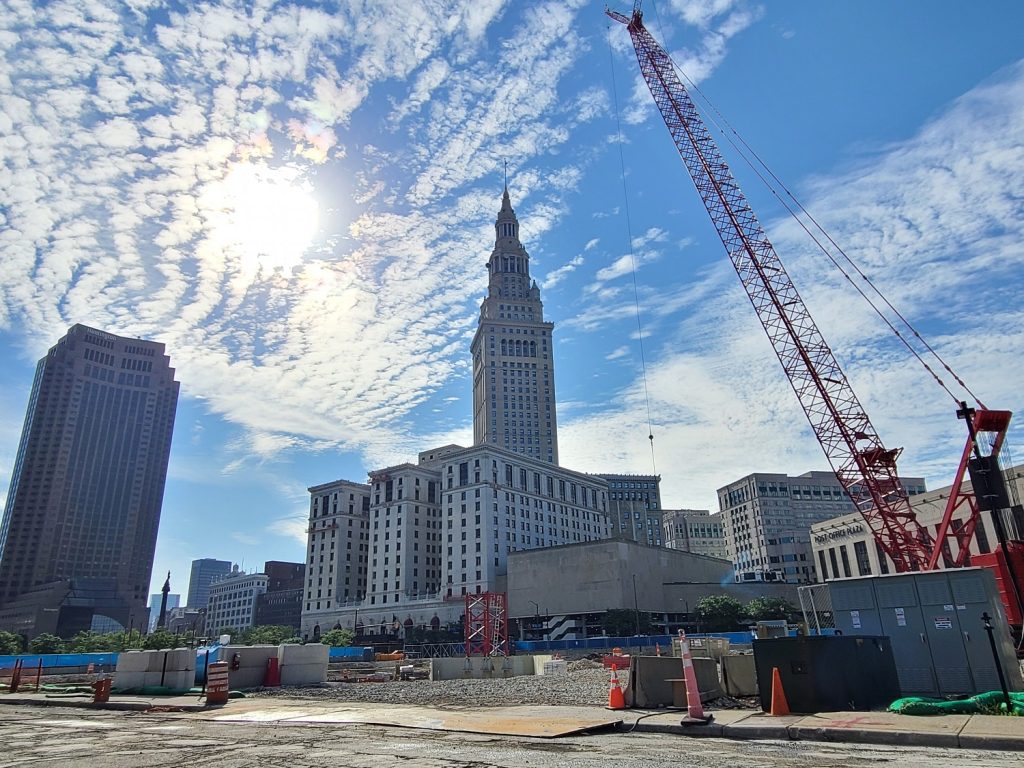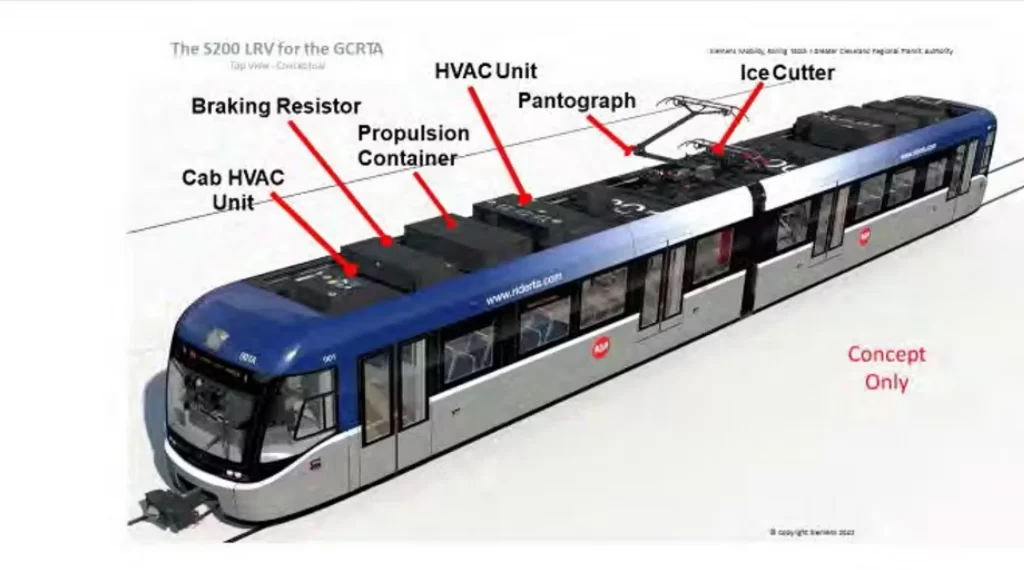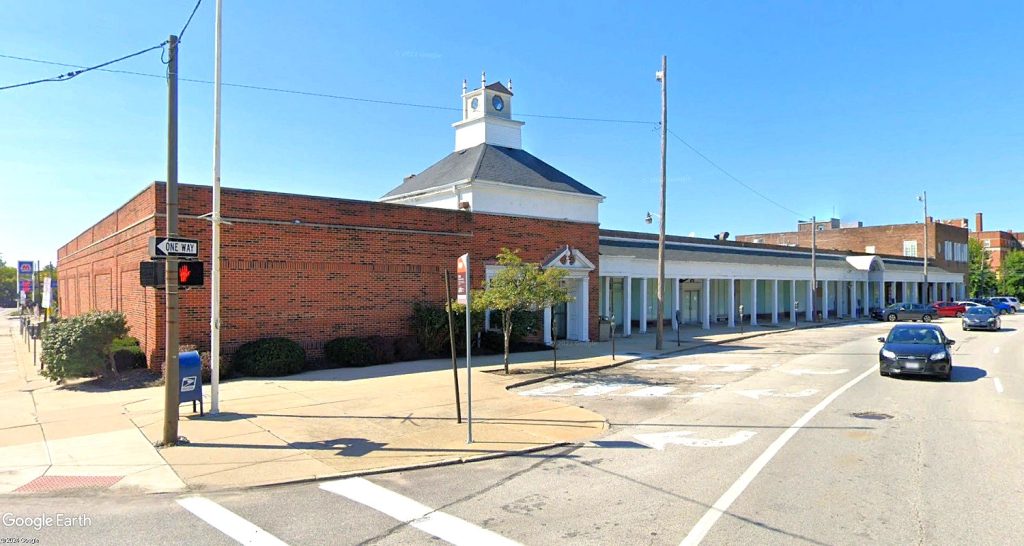
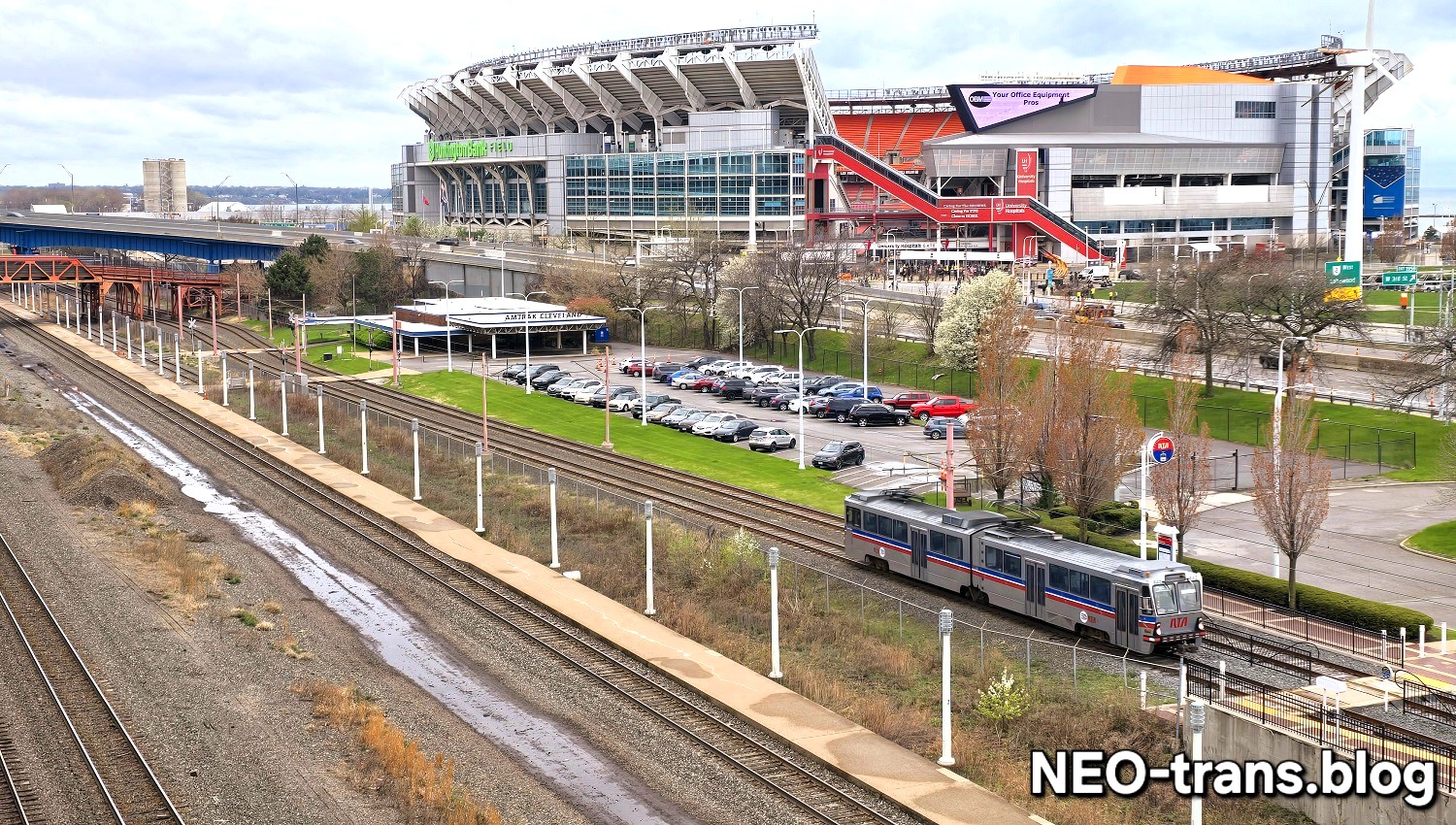
Many people might see two undeveloped rail stations, a highway barrier and an endangered stadium. Planners with vision see a canvas on which Downtown Cleveland’s lakefront access and development can be vastly improved to energize this mostly languid part of the urban core (NEOtrans). CLICK IMAGES TO ENLARGE THEM.
Unite all intercity, regional transit assets at one site
A COMMENTARY
Greater Clevelanders have often lamented the large number of downtown lakefront redevelopment plans that have come and gone without producing much, if anything — other than more paper. Sadly, so have the large number of plans for a downtown intermodal transportation hub. They’ve sparked as much as a match in a vacuum would.
This week, city of Cleveland officials learned they have a new chance to strike one while there’s political fuel surrounding it. The U.S. Department of Transportation (USDOT) awarded $960,000 to the $1.2 million North Coast Connector Multimodal Hub Area Study. The city and its partners are providing the remainder.
It appears the driver this time around is to consolidate two Waterfront Line light-rail stations (at West 3rd and East 9th streets) into one, to get them out of the way of the new Shoreway boulevard.
And we might as well combine the new light-rail station with a more modern Amtrak station too while we’re at it. The current, 1976-built Amtrak station has been serving railroad travelers longer than did Cleveland Union Terminal, below its namesake Terminal Tower, from 1930-1977.
Let’s hope the multimodal hub has a broader goal and a better motivation behind it than just combing rail stations to get them out of the way of a road project. Recent precedents don’t offer much hope, though.
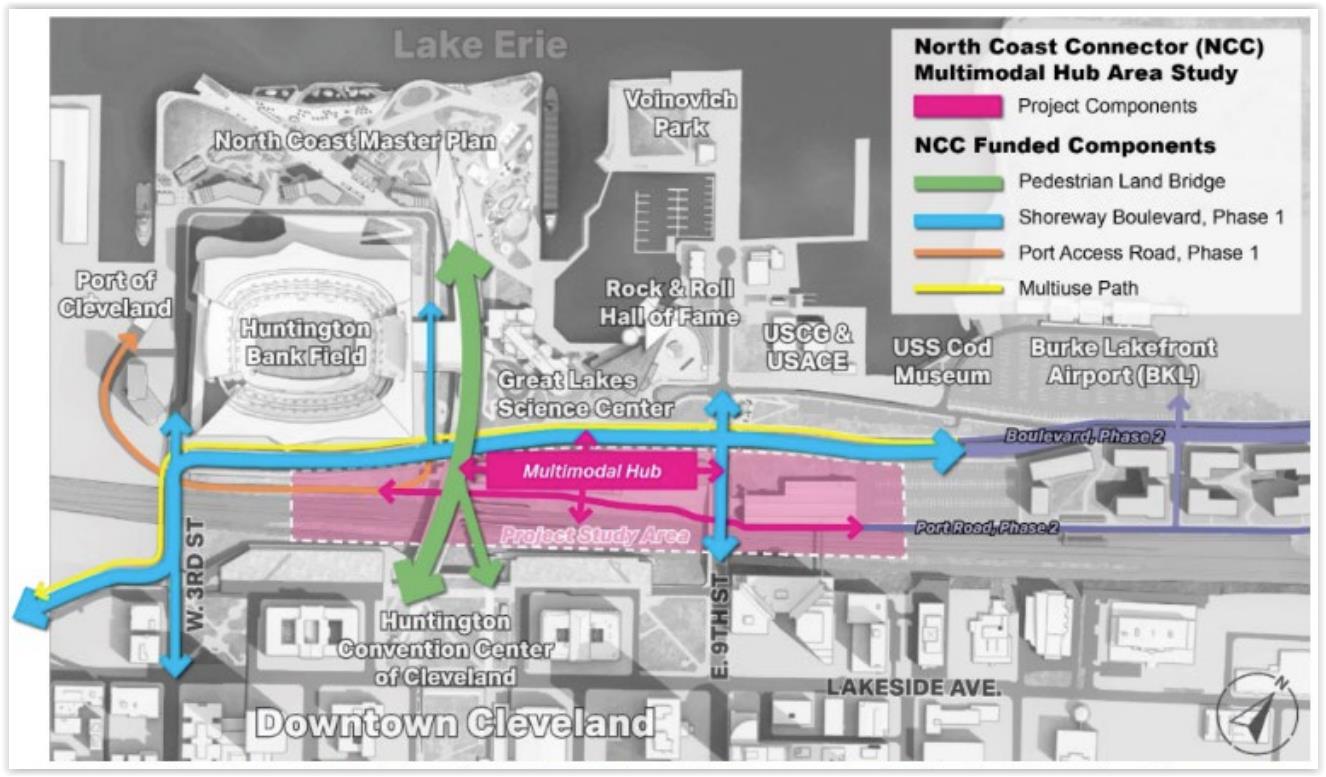
The area in light pink is the study area for the newly funded North Coast Connector Multimodal Hub Area Study, based on the location and use of existing railroad tracks as well as surrounding land uses (USDOT).
The last match was struck while such political fuel for it had drained away. It was in 2016, and city officials wanted one for the wrong reasons — to get the Greyhound station out of the way of Geis Company’s planned redevelopment north of the lands north of Playhouse Square.
Fred Geis told Mayor Frank Jackson that the area north of Playhouse Square was a void of activity downtown. He wanted the Greyhound station gone and didn’t care where.
Apparently neither did the city, at first. City officials proposed to build a modular Greyhound station at the far east end of the Municipal Parking Lot which was the pedestrian and public transportation equivalent of Siberia.
In full disclosure, I was executive director of All Aboard Ohio at the time, until 2019, and had been working for several years with cities along the Northern Ohio Amtrak route to develop multimodal transportation centers that united Greyhound, Amtrak and local transit under the same roof in each community.
The rationale was to help overcome the fact that each of those modes of transportation in places like Toledo, Sandusky, Elyria and Cleveland by themselves weren’t exactly robustly represented.
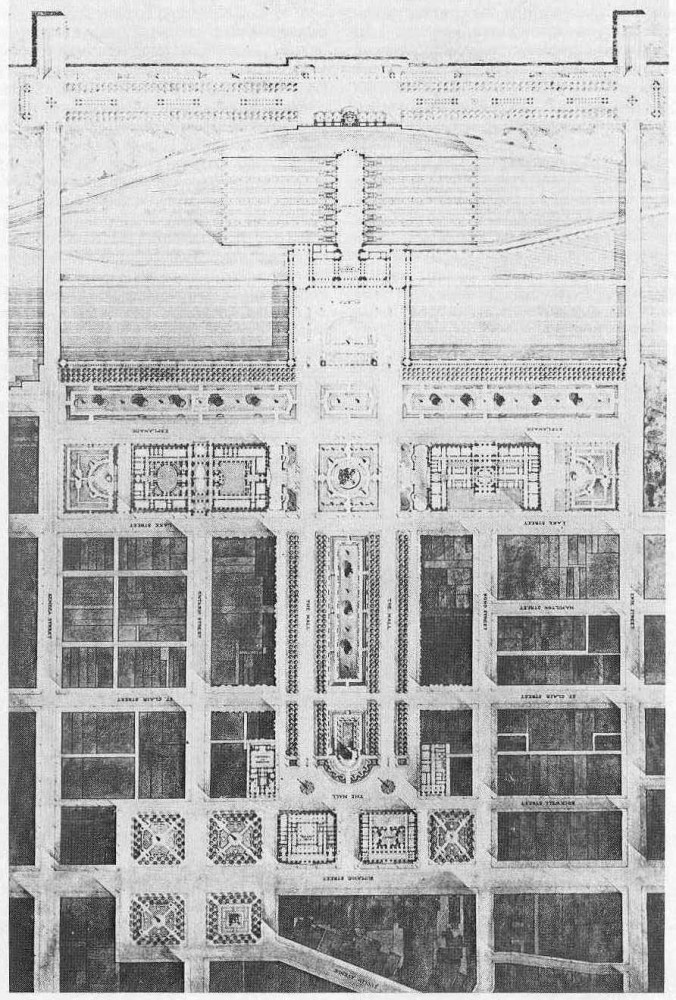
In 1903, the Cleveland Group Plan by famed architect Daniel Burnham proposed the downtown malls bracketed by a new Cuyahoga County courthouse and Cleveland City Hall topped by a new Union Station. But the Union Station ended up on Public Square and the extension of the malls over the railroad tracks never happened. But it still can and should (file).
But when combined at the same station, they provided round-the-clock transportation options at one location with improved connectivity and accessibility for students, elderly, low-income, disabled or just people who didn’t want to be forced to drive everywhere.
The Northern Ohio city with the most disconnected ingredients to bring together is the only city hasn’t — Cleveland. Not only does Downtown Cleveland have Greyhound, Barons Bus, Amtrak and Greater Cleveland Regional Transit Authority (GCRTA) buses and trains, it has weekday transit services to Greater Cleveland’s collar counties.
Laketran, Akron Metro Regional Transit Authority (RTA), Stark Area RTA, Portage Area RTA provide direct bus services to places like Painesville, Mentor, Willoughby, Fairlawn, Akron, Streetsboro, Kent and Canton — most of which have no Greyhound service and none have Amtrak service.
So city officials commissioned a study in 2016 and created a vision for a multimodal transit center that linked Amtrak, Greyhound plus GCRTA buses and light-rail trains. The number of annual boardings on buses and trains by uniting all of those modes in one location was estimated by All Aboard Ohio at up to 762,500. Last year, attendance at Huntington Bank Field was 831,751 people.
The boardings data included a 25 percent increase in ridership among all modes just by offering connections at a safe, convenient, comfortable station facility. It was an experience shared by then-GCRTA General Manager Joe Calabrese in his previous role as GM of the Syracuse, NY transit agency, which had also built a downtown multimodal station called the Walsh Regional Transportation Center.
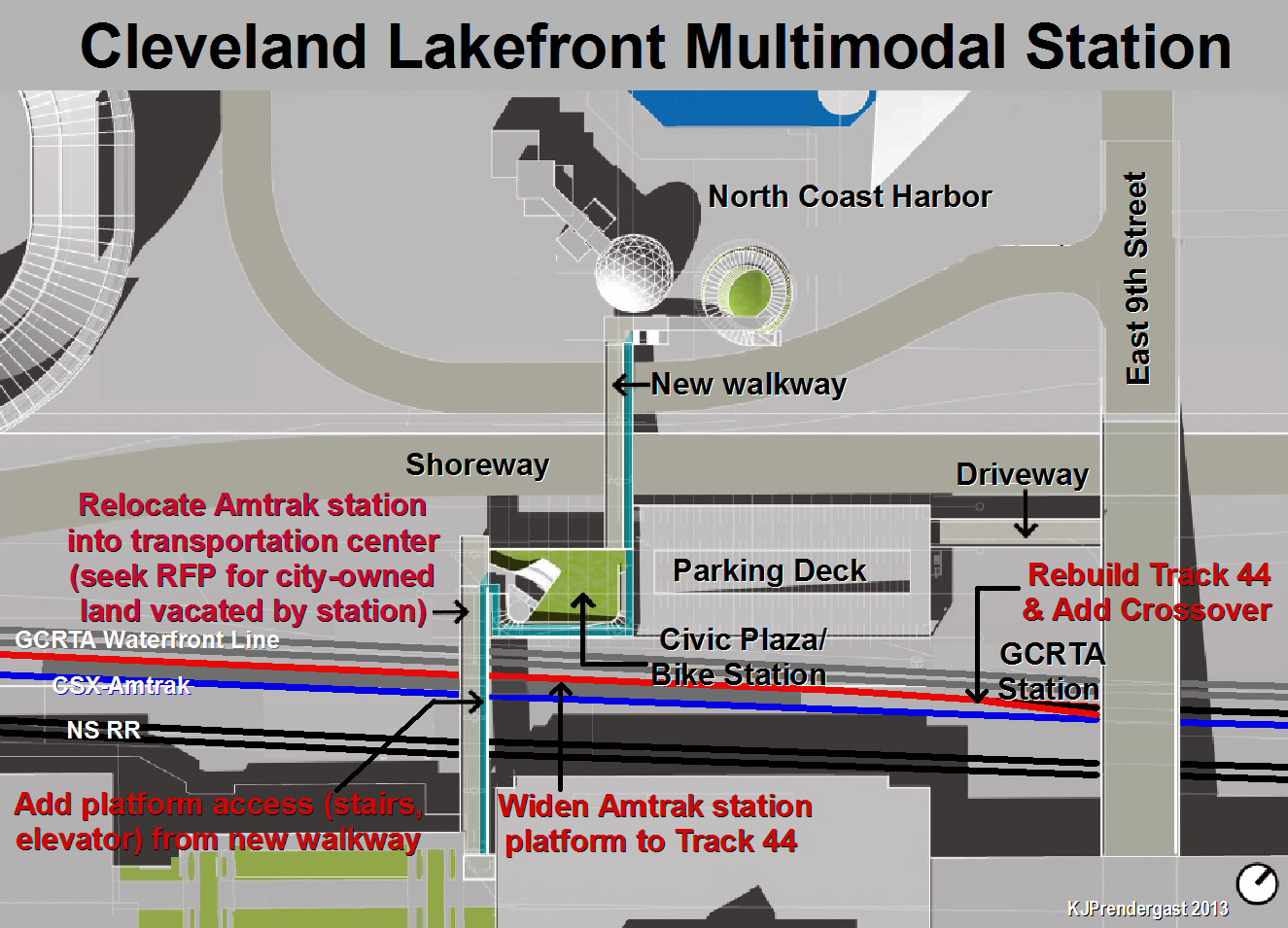
In 2013, Cleveland sought to add more parking on the lakefront and a pedestrian walkway over the tracks. So they were dressed up as a multimodal transportation hub to win federal funding. But the U.S. Department of Transportation saw through the window dressing and rejected the city’s two attempts at a grant application for it. This image was labeled to clarify what was proposed (City of Cleveland).
City planners came up with a cool concept. It was a far better gateway to Cleveland than the previous version conjured only a couple years earlier — merely a parking garage with a waiting room attached to it.
But by the time the last Cleveland multimodal station plan was done, Geis lost interest in developing north of Playhouse Square and so the city lost interest in relocating Greyhound.
Since then, Greyhound has lost interest in serving its customers. It would rather put unsheltered bus stops in locations closer to highway interchanges or bus garages than near pedestrian-friendly commercial districts and/or local transit access.
Compared to some isolated curbside stops in Ohio, the new Cleveland station due to open next month at the Brookpark GCRTA rapid transit station isn’t as awful. But there are no restaurants or retail nearby, aside from a hookah bar.
And soon, the new, enclosed Huntington Bank Field is going to cause more problems for Greyhound and Barons Bus travelers than it will for people flying in and out of Hopkins International Airport. At least the planes won’t be delayed by stadium event traffic.
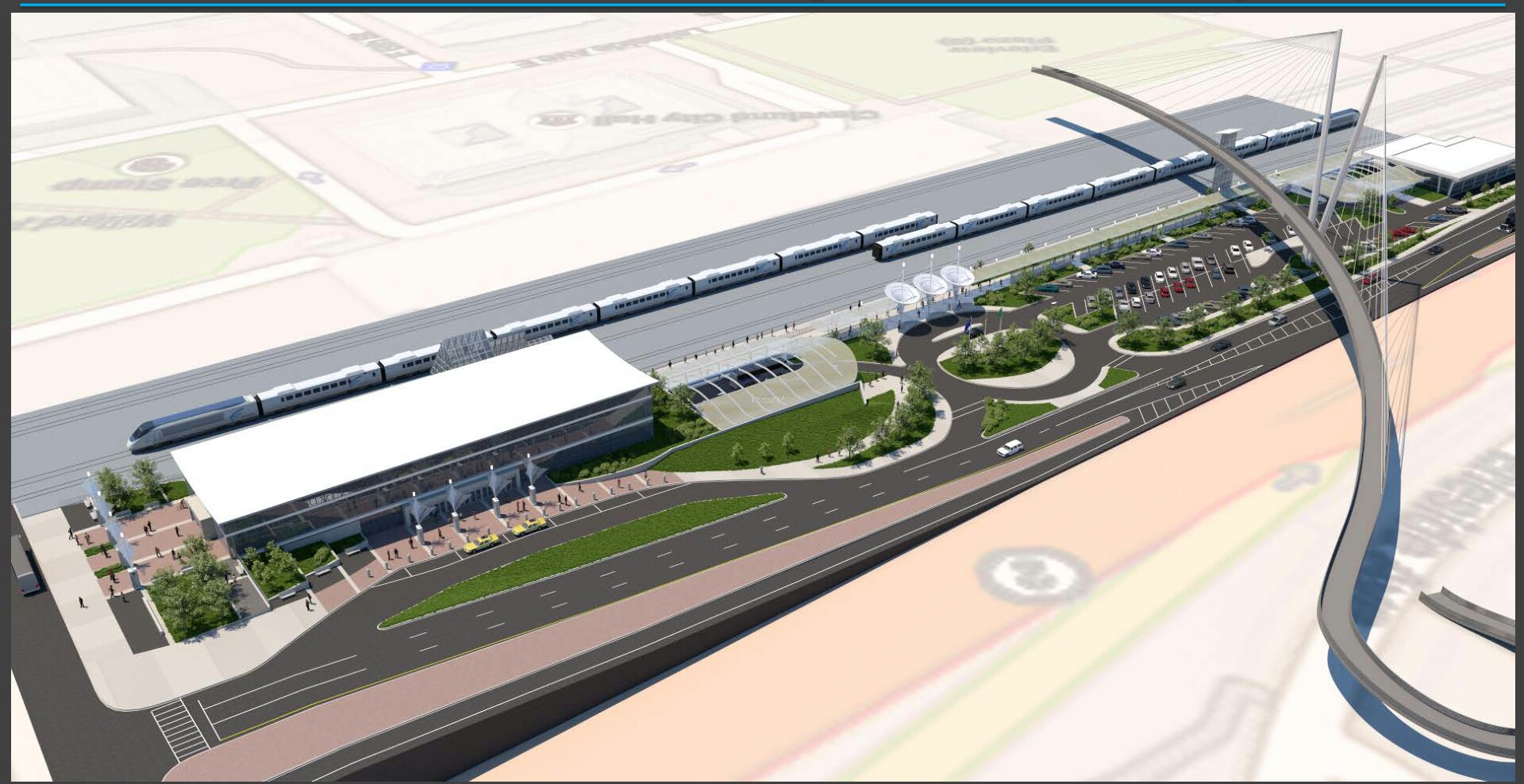
A more elegant concept for a lakefront multimodal transportation center was developed in the late 2010s, with a Greyhound station at lower left on East 9th Street and a renovated Amtrak station along the Shoreway below a proposed, cable-stayed trail over the tracks. Pretty as it was, it still left its modal features disconnected and unattractive six months out of the year (WSP).
In fact, the stadium situation has changed a lot of assumptions and factors shaping Downtown Cleveland’s lakefront redevelopment efforts. The fact that it will no longer be there in just a few short years is already causing the city to reassess lakefront land uses.
That reassessment has already started with a request for qualifications of prospective developers and their ideas for 50 acres of city-owned lakefront land, including the current stadium site.
Potential users for the existing or rebuilt lakefront stadium are few and far between. Local soccer interests aren’t interested. It’s hard to imagine who else might be, although the city is keeping that option open.
Hopefully city officials are also keeping the option open of how the proposed North Coast Connector Land Bridge will be designed. The graceful, arcing, outdoors-only bridge is an attractive piece of art. But its functionality is limited, especially in the city’s winter months when the lakefront is blasted by icy winds.
Since the lakefront master plan was created two years ago, the subtraction of Huntington Bank Field will be taken into account. So should the addition of events to be relocated from the International Exposition (I-X) Center to downtown’s Huntington Convention Center of Cleveland.
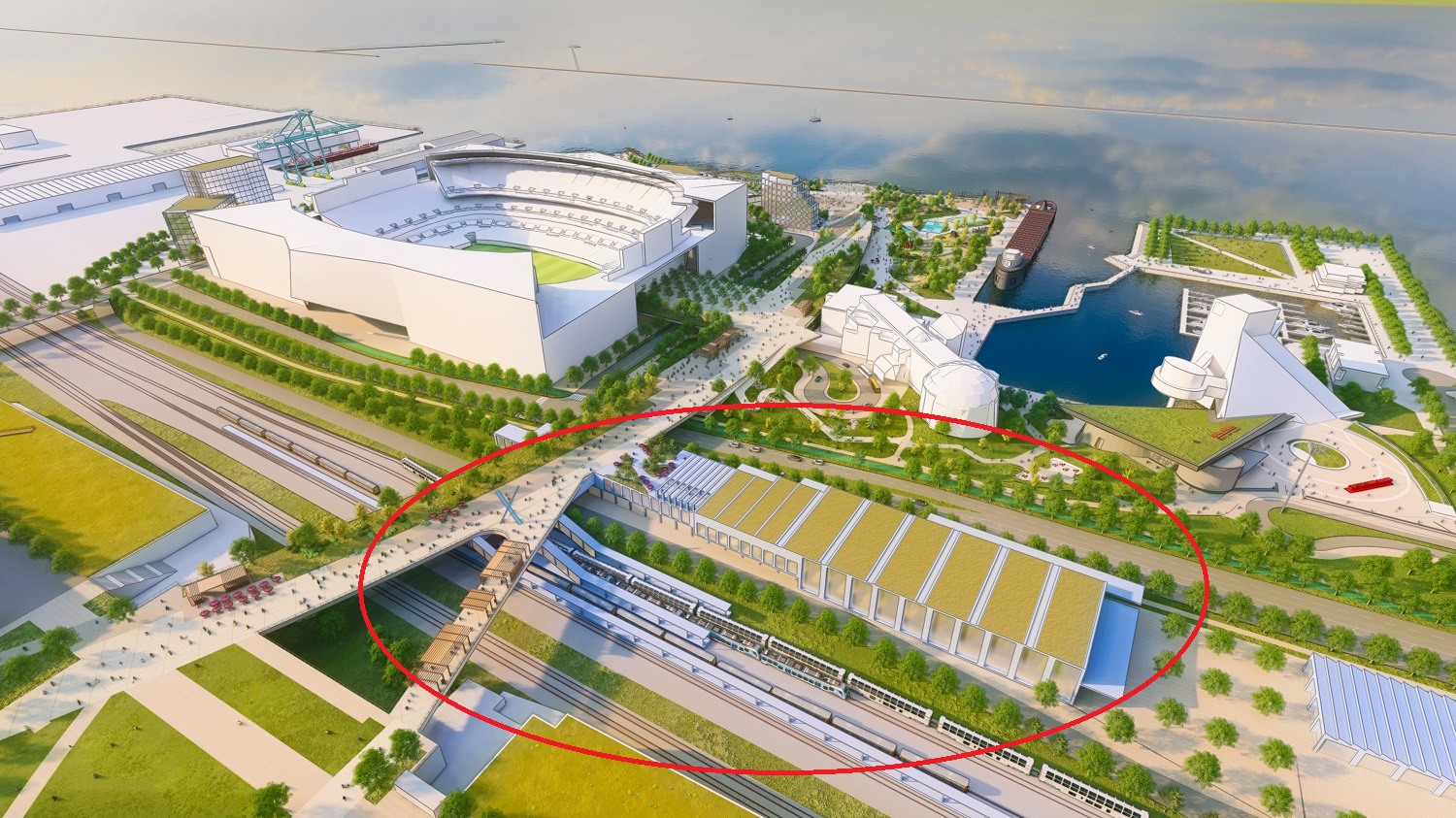
Cleveland’s latest lakefront master plan included a new concept for a multimodal transportation center. It replaces two Waterfront Line light-rail station at East 9th and West 3rd streets with a single facility that combines an Amtrak station and the enduring parking garage with a skinny land bridge intended to not block views from the convention center’s ballrooms. But with the stadium gone, ballrooms can be relocated and the land bridge redesigned (FO).
Annual attendance at the I-X Center is at least double what Huntington Bank Field has drawn. Fitting that activity into the existing, already busy convention center is going to be difficult. That’s not surprising considering Columbus and Cincinnati offer larger convention facilities than does Cleveland.
There has been talk of further expanding the convention center before the I-X Center opted to redevelop its exhibition space, reportedly for a data center. Nearly two years ago, one rumor was to expand the convention center westward onto the current Justice Center site and convert or replace the courthouse tower with a 1,000-room hotel.
While that rumor hasn’t sorted itself out yet with a long-overdue decision on where to build the Consolidated Courthouse, the North Coast Connector Multimodal Hub Area Study might help.
One of the reasons why the Land Bridge was proposed to be so skinny was so that it didn’t block the sacrosanct lakefront views from the convention center’s ballrooms. That needn’t be a concern anymore with Huntington Bank Field gone.
Instead, build the multimodal hub as part of a climate-protected pedestrian concourse over the tracks with a green roof that acts as an extension of the Group Plan Malls. The concourse could be lined with cafes and other retail given the millions of people who would visit the adjacent facilities each year.
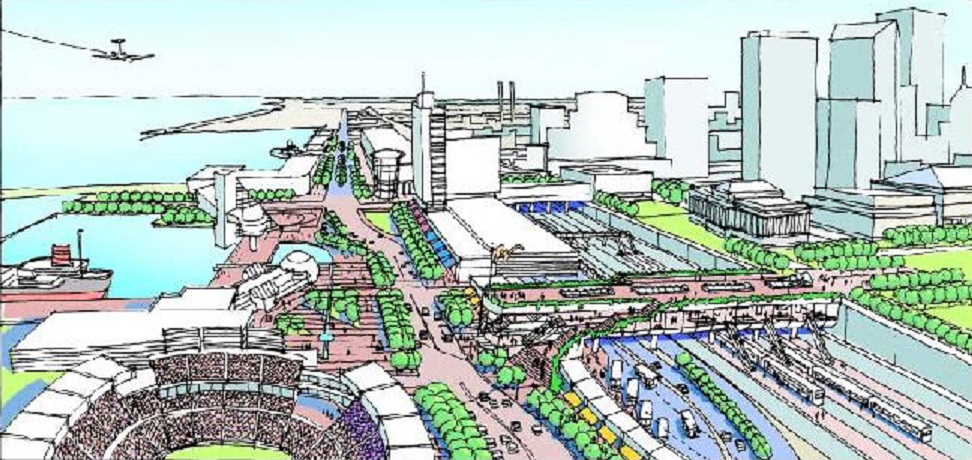
A year-round, multi-purpose, multimodal transportation hub was proposed in the late 1990s by Greater Cleveland Regional Transit Authority consultant WSP that designed the hub to serve Amtrak trains, commuter trains, transit buses and light-rail trains, Greyhound, convention buses. No hub design since the 1903 Group Plan has offered so much year-round connectivity to as many users as this (WSP).
At the north end, the concourse would access the relocated, enlarged convention center ballrooms that would have an even better view of the lakefront, having been moved closer to it. Maybe even an indoor ferris wheel could be offered as part of it, like the one that was at the I-X Center.
For that matter, maybe a 400,000-square-foot exhibition space like the I-X Center’s could be built here as well. Its footprint would take up less than half of the current stadium site.
Such a year-round linkage would help boost access and mobility by connecting all modes of local, regional and intercity public transportation under one roof.
It would boost pedestrian activity at the lakefront. And it would enable convention business to expand in new and different directions, including year-round access to the attractions at North Coast Harbor.
One would hope that these are the opportunities being sought by the North Coast Connector Multimodal Hub Area Study. The study’s planning team could do a lot more than just design a parking garage with a waiting room or to get light-rail stations out of the way of a road project.
END