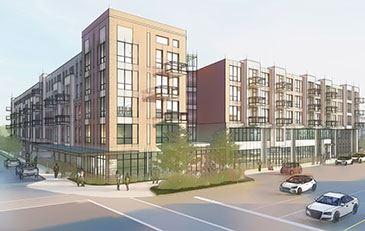
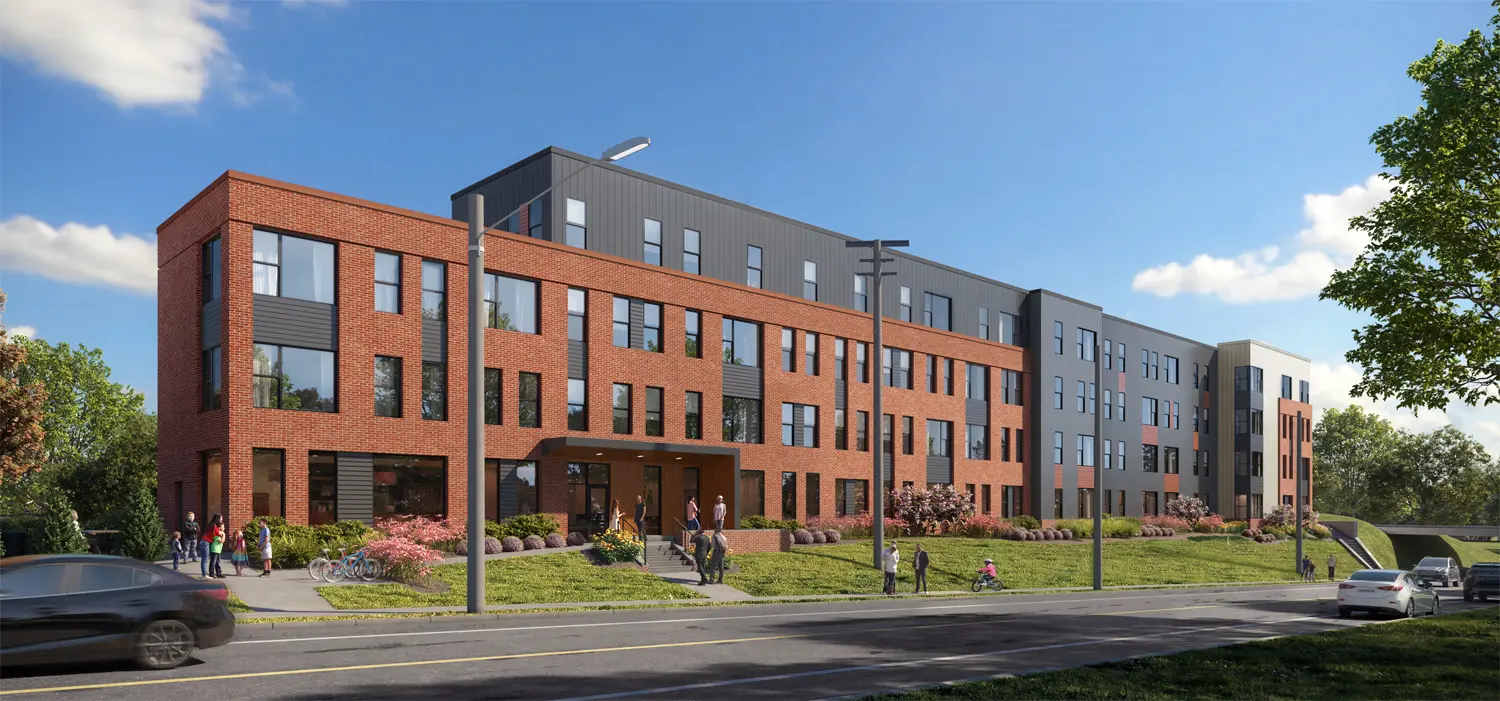
With additional financial support in place, financing is near to closing for the Depot on Detroit apartments, just west of the West Boulevard-Cudell transit station on Cleveland’s West Side (City Architecture). CLICK IMAGES TO ENLARGE THEM.
Depot on Detroit financing almost set
Like any new large new development with multiple sources of public and private financing, Depot on Detroit is taking a long time to get rolling. But at long last, there is a light at the end of the tunnel and it isn’t a train.
The trains run next to the aptly named Depot on Detroit. It will be built on 1.3 acres of land that was sold by the Greater Cleveland Regional Transit Authority (GCRTA) to a development partnership led by Flaherty & Collins Development, LLC of Indianapolis and a local nonprofit Northwest Neighborhoods Community Development Corp.
The now-vacant development site is just west of GCRTA’s West Boulevard-Cudell rapid transit station which is served by the Airport-Downtown-Windermere Red Line trains and several bus lines. It is located at 10300 Detroit Ave. in Cleveland’s Edgewater-Cudell neighborhood.
There, the development team, organized as Depot Detroit LP, plans to construct a $19.2 million, four-story apartment with 60 units that are affordable to families earning 30-60 percent of Cleveland’s area median household income of $39,187 in 2023.
There has been a lot of progress behind the scenes since NEOtrans last reported on this development almost 11 months ago. Some of it became public just last week.
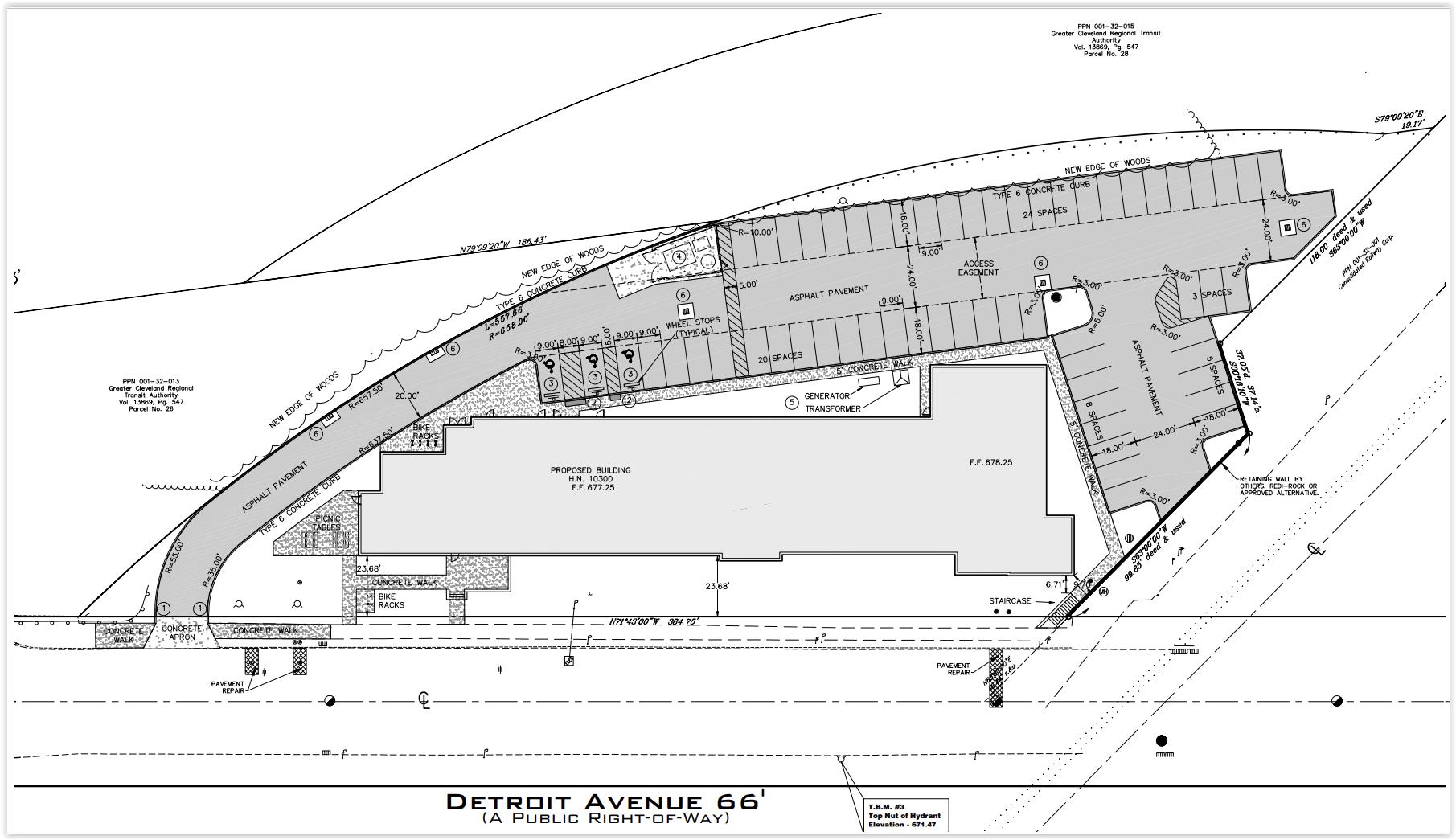
Site plan for the Depot on Detroit apartments showing a driveway and parking lot on the north side of the building, next to the curving Red Line transit tracks (City Architecture).
On Nov. 20, the board of the Ohio Housing Finance Agency (OHFA) approved a $1.75 million Housing Development Loan for the project. And it previously awarded a highly coveted and competitive reservation of 9 percent Low-Income Housing Tax Credits (LIHTC) from OHFA in 2023.
The LIHTC can subsidize about 70 percent of the construction cost, which will allow apartments at Depot on Detroit to be offered at more affordable rents of as low as $399 per month for a 627-square-foot one-bedroom apartment.
At the other end of the scale, a 1,111-square-foot, two-bedroom apartment is proposed to be offered for as little as $1,203 per month, according to a 2023 project summary.
The development will provide a community room with kitchenette, TV, and computers, a fitness center, and on-site parking in a surface lot. No ground-floor commercial space or other public use is planned with this development.
“Northwest Neighborhoods is pleased to see this important step forward for the Depot on Detroit project,” said the CDC’s Executive Director Bridget Kent Márquez in an e-mail to NEOtrans. “Our team and the team at Flaherty & Collins continue to work to bringing the project closer to becoming a reality.”
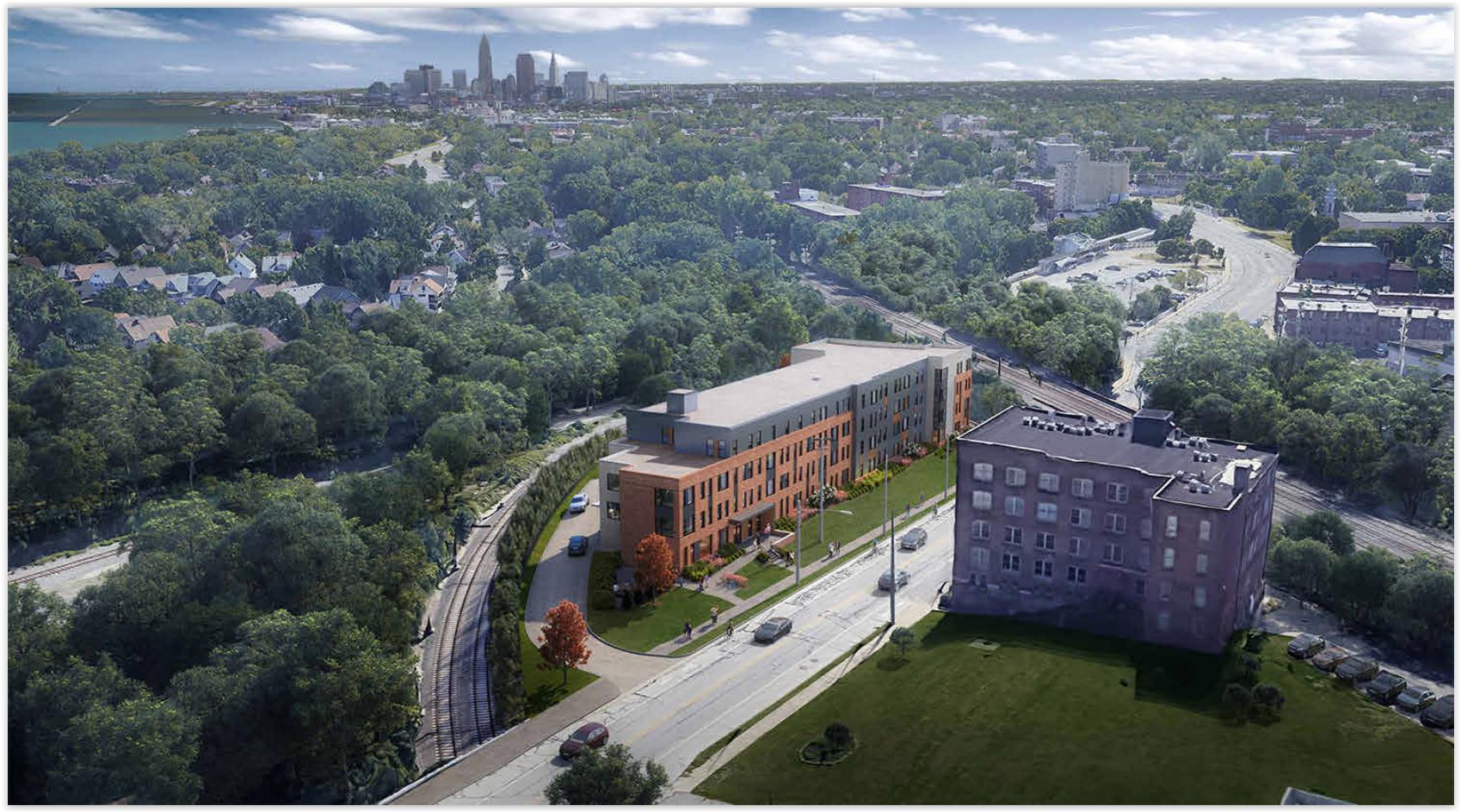
Location of the Depot on Detroit apartments in relation to the train station to the right and above, as well as to Downtown Cleveland in the distance (City Architecture).
“As with any development of this scale, the precise construction timeline will be finalized as the financial closing is complete,” she continued. “We’re glad to continue supporting this important transit-oriented, affordable housing development.”
Márquez was not yet able to provide a groundbreaking date or even a specific date for Depot on Detroit’s financing to close, however, given the funding complexities associated with the project.
“The goal is to have financial closing soon, but exact timing is still being finalized as there are many moving parts,” she said.
HOME funds were awarded earlier this year to this project in the amount of $1,464,330 from the City of Cleveland and $500,000 from Cuyahoga County. HOME funds are a federal block grant from the U.S. Department of Housing and Urban Development.
Although GCRTA’s board approved selling its property to the development partnership last January, it hasn’t transferred yet. The sale price for the land is $150,000.
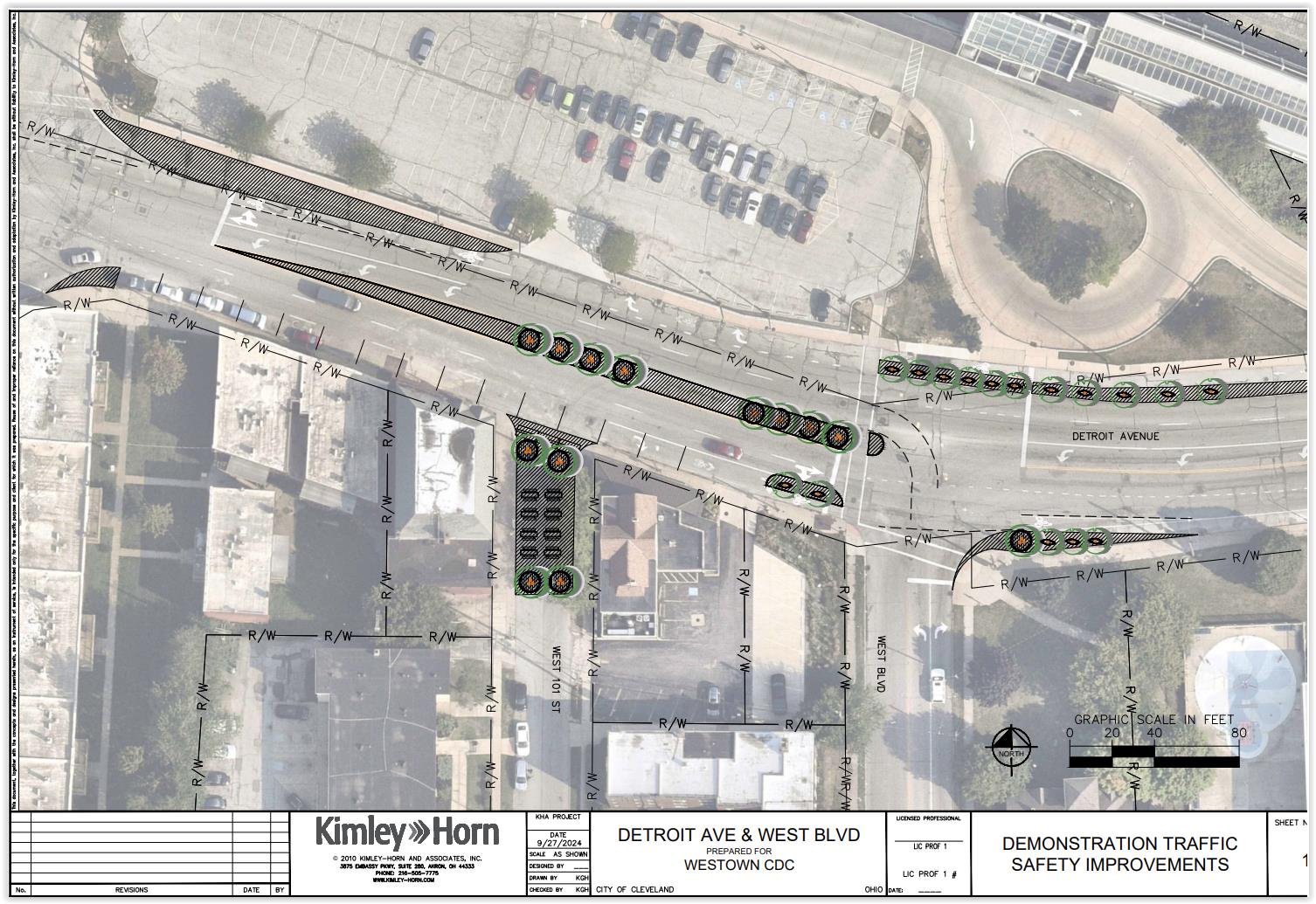
Proposed improvements to Detroit Avenue past the West Boulevard-Cudell rail station have yet to be funded. However, another study is being considered by the transit authority instead (Kimley-Horn).
Last month, GCRTA worked with Cuyahoga County on replatting a parcel map of its properties so a single property can be transferred to the partnership. When the sale closes, the property will transfer.
There also have been plans to provide traffic calming on Detroit Avenue past the train station to make it safer for people when they’re walking or biking. That could include narrowing the street from seven lanes to four.
The train station is located in the Westown Community Development Corp.’s (WCDC) service area. WCDC Executive Director Rose Zitiello has called the situation “death-defying” for pedestrians.
While there were no project-specific references to this location in the city’s Cleveland Moves plan issued in April to improve pedestrian and bicycle safety, there were conceptual designs for improved safety measures that could be applied in any location deemed unsafe for people.
GCRTA is also seeking $100,000 from the Northeast Ohio Areawide Coordinating Agency to conduct a Pathways to Transit study to improve First-Last Mile Connections to 19 of its rail stations including the West Boulevard-Cudell station.
END