
The proposed Cleveland soccer stadium in the Gateway South District offers branding, sponsorship and marketing opportunities that Rock Entertainment Group will help realize (CSG). CLICK IMAGES TO ENLARGE THEM.
Building on World Cup’s momentum
Cleveland Soccer Group (CSG) today announced that Rock Entertainment Group (REG) – the organization behind the Cleveland Cavaliers, Rocket Arena and Cleveland’s incoming WNBA franchise – will lead the naming rights and entitlement sales process for South Gateway Stadium, CSG’s planned 10,000-seat venue on the south side of downtown Cleveland.
“Cleveland has a real opportunity to create more year-round experiences that bring fans, businesses and communities together as part of the region’s growing sports and entertainment ecosystem,” said Chris Presson, senior vice president of Business Operations, Rock Entertainment Group, in a written statement.
“We look forward to working with Cleveland Soccer Group and a future founding partner to establish a venue that reflects Northeast Ohio’s passion for sports while contributing to the continued growth and vibrancy of downtown,” he added.
Expanding Cleveland’s sports hub
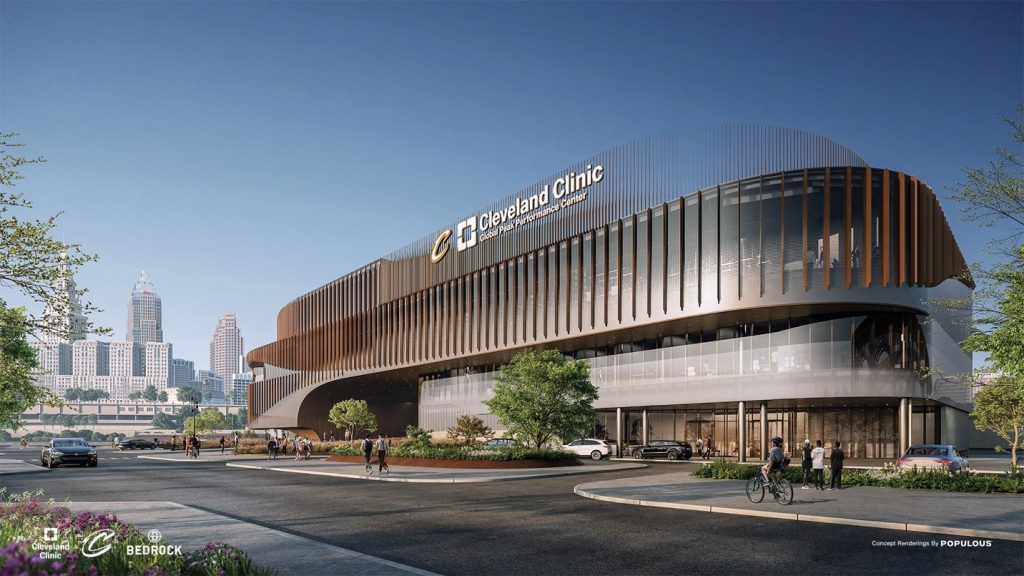
South Gateway Stadium will sit next to Cleveland’s most concentrated stretch of sports and entertainment real estate. It’s adjacent to Bedrock’s 35-acre Riverfront development, home to the Cleveland Cavaliers’ 210,000-square-foot Cleveland Clinic Global Peak Performance Center and a planned 6,200-capacity outdoor amphitheater in partnership with Rock Entertainment Group and Live Nation.
The soccer stadium site sits within eyeshot of Progressive Field and Rocket Arena, along the flight path of the Goodyear Blimp on game days, and next to the Innerbelt Bridge and Orange Avenue corridor, literal gateways that funnel millions of people into downtown Cleveland each year.
The site is inside a neighborhood that attracts millions of visits annually, at the intersection of every major road and light-rail transit line that brings Northeast Ohio into the city center.

The soccer stadium is next to Interstate 90 which sees more than 150,000 vehicles on it each day. Plus the site will likely be seen from the Goodyear blimp during televised broadcasts of events at Gateway’s facilities (CSG).
And in partnership with Cleveland Metroparks, CSG plans to build a public park around the stadium that ties directly into the regional trail network – extending downtown’s reach south and giving the stadium district a front door that’s active well beyond matchdays.
Built for more than two clubs
South Gateway Stadium is to be the home venue for the city’s two professional soccer teams: Forest City Cleveland (MLS NEXT Pro) and Cleveland Astra (WPSL Pro). But the stadium isn’t being built around two tenants; it’s being built around a gap in the market.
CSG is requesting a $19.9 million state grant for a nearly $80 million, 10,000-seat soccer stadium on 14 acres of land on East 9th Street Extension south of Interstate 90. Much of the site is owned by the Ohio Department of Transportation. The Cleveland Metroparks has an option to buy the land, but be paid by CSG.
Cleveland currently does not have a venue of this size and caliber built for this purpose, and demand is already lining up to fill it. NEOtrans broke the story that a competing soccer stadium at Cleveland State University was dropped. More than 34 soccer matches a year are envisioned for Forest City Cleveland and Cleveland Astra.
Plus, the stadium has signed letters of intent with St. Ignatius, St. Edward High School and the Cleveland Metropolitan School District, alongside professional men’s and women’s lacrosse and rugby.
Add in the potential of youth sports, tennis tournaments, national collegiate championships and community programming, and the calendar fills in fast – a conservative 65+ events and 400,000+ visitors to downtown Cleveland every year, and a new venue that strengthens the region’s hand in bidding for national events the city just couldn’t ask to host before.

There will also be multiple sponsorship opportunities inside a new Cleveland soccer stadium for people of all ages, but especially young people to develop brand loyalty (CSG).
Soccer’s momentum and soccer’s audience
The 2026 FIFA Men’s World Cup made the moment: the USA vs. Belgium Round of 16 match drew a combined average of 50.1 million viewers across English- and Spanish-language broadcasts, according to Nielsen. It was the most-watched soccer telecast in U.S. history, surpassing any non-NFL sporting event on U.S. television in decades.
What that moment leaves behind is an audience marketers have been chasing for decades. Soccer’s U.S. fanbase skews young, multicultural and digitally native, spans language and international ties in a way few other sports do.
There are also opportunities for creating brand loyalty. And since it’s a growing audience, not a mature one, which means a founding partner isn’t buying into an established market, but getting there first, local soccer leaders say.
“The World Cup is putting soccer at the center of the national sports conversation and is bringing millions of new fans into the game as we speak,” said CSG co-founder and CEO Michael Murphy.
“South Gateway Stadium is how that momentum becomes permanent in Cleveland: a year-round home for two professional clubs in the middle of a downtown that is being rebuilt around it,” he continued.
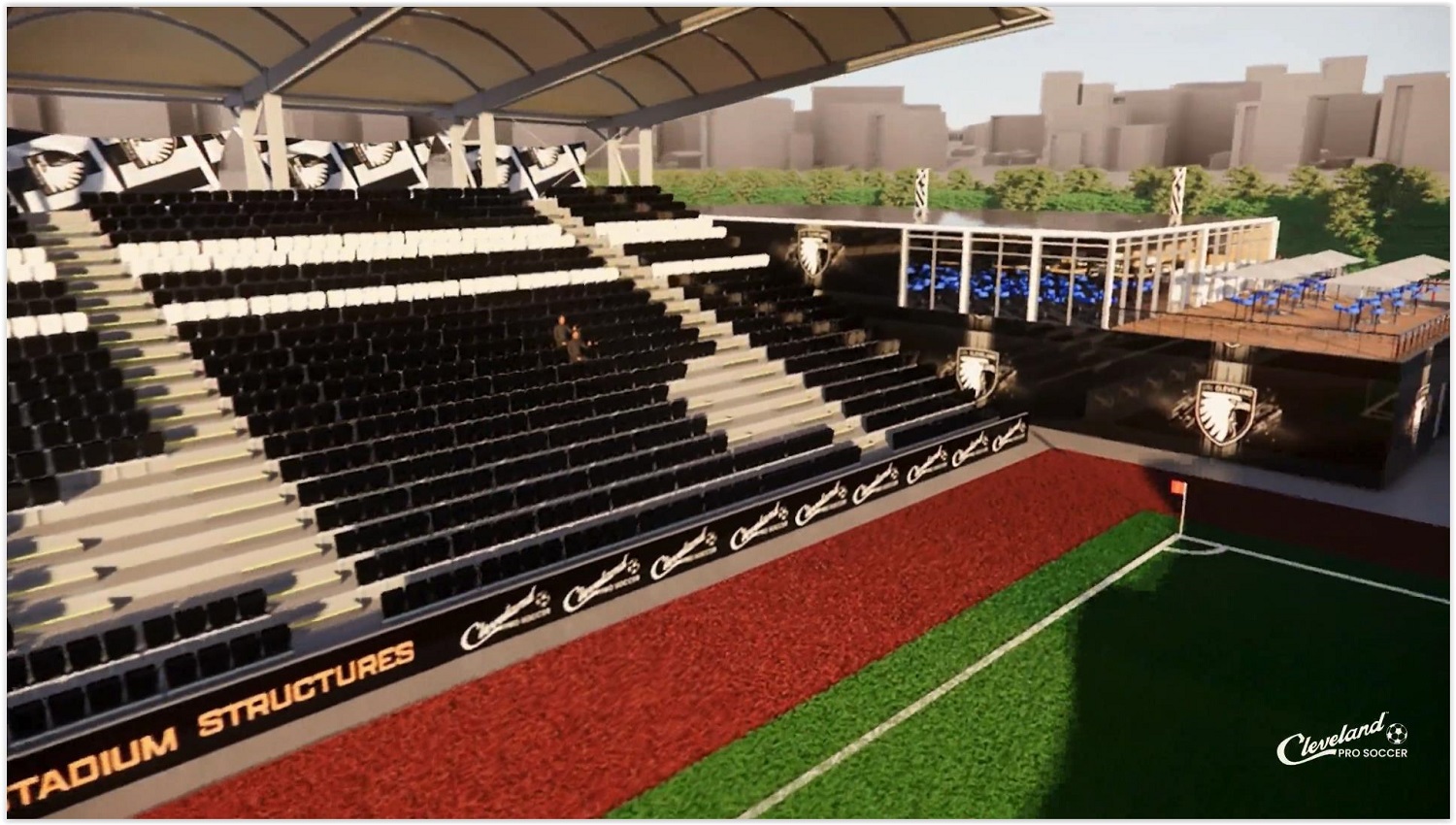
There will be multiple panelized locations for advertising throughout the Cleveland soccer stadium including naming rights for the stadium itself (CSG).
The Men’s World Cup has been a preview, not a peak, Murphy said. Soccer will continue to build steam across next year’s Women’s World Cup, the 2028 Olympics and then, in 2031, when the Women’s World Cup returns to U.S. soil. It’s a run of generational events projected to bring millions of new fans into the sport year after year.
Cleveland is the largest metro area in the country without a professional soccer stadium or one under construction. CSG is seeking for the The South Gateway Stadium is a founding partner’s opportunity to get in ahead of that cycle, at the leading edge of generational growth across soccer and women’s sports alike.
With Cleveland Astra, a professional women’s club, as a lead tenant, the stadium is also an opportunity for a founding partner to build momentum for women’s sports, not just soccer broadly.
“For the right partner, this is a multi-faceted platform that will get stronger for decades,” said Murphy.
END