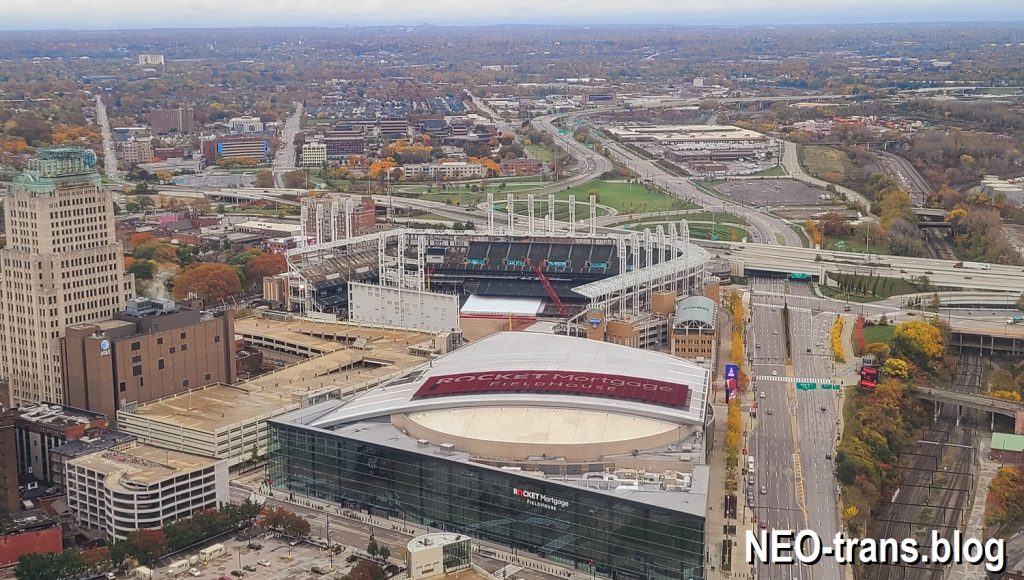

This East 115th Street residential neighborhood in Cleveland’s University Circle will stick around a little longer but could eventually succumb to the expansion of University Hospitals’ Main Campus based on feedback from a city design review panel (NEOtrans). CLICK IMAGES TO ENLARGE THEM.
UH said it would respect city’s decision
The historic East 115th Street residential neighborhood in Cleveland’s University Circle may have gotten a stay of execution today thanks to a city design-review panel. But that doesn’t mean people are going to start moving back into any of the homes or apartments soon — if ever.
The Central East Design Review Committee of the City Planning Commission voted unanimously to table a request by University Hospitals to demolish 12 homes it owns along East 115th Street between Mayfield and Cornell roads in a first phase.
In a later phase, it would come back to the city for approvals to raze two larger buildings it owns — the vacant, 99-year-old, 44-unit Fayne Apartments, 2085 Cornell plus the 100-year-old Foley Building, 2061 Cornell. The latter was converted by UH from apartments to medical offices.
But when UH and its consulting team told the city it would replace those structures with two parking lots surrounded by landscaping and greenspace, that’s when the committee, in a non-legally binding action, tabled further action.
Committee members told UH it would not consider the demolitions unless UH returned with a building plan that offered higher and better uses than those it was proposing to demolish. Members didn’t consider the parking lots and landscaping to be a higher and better use.
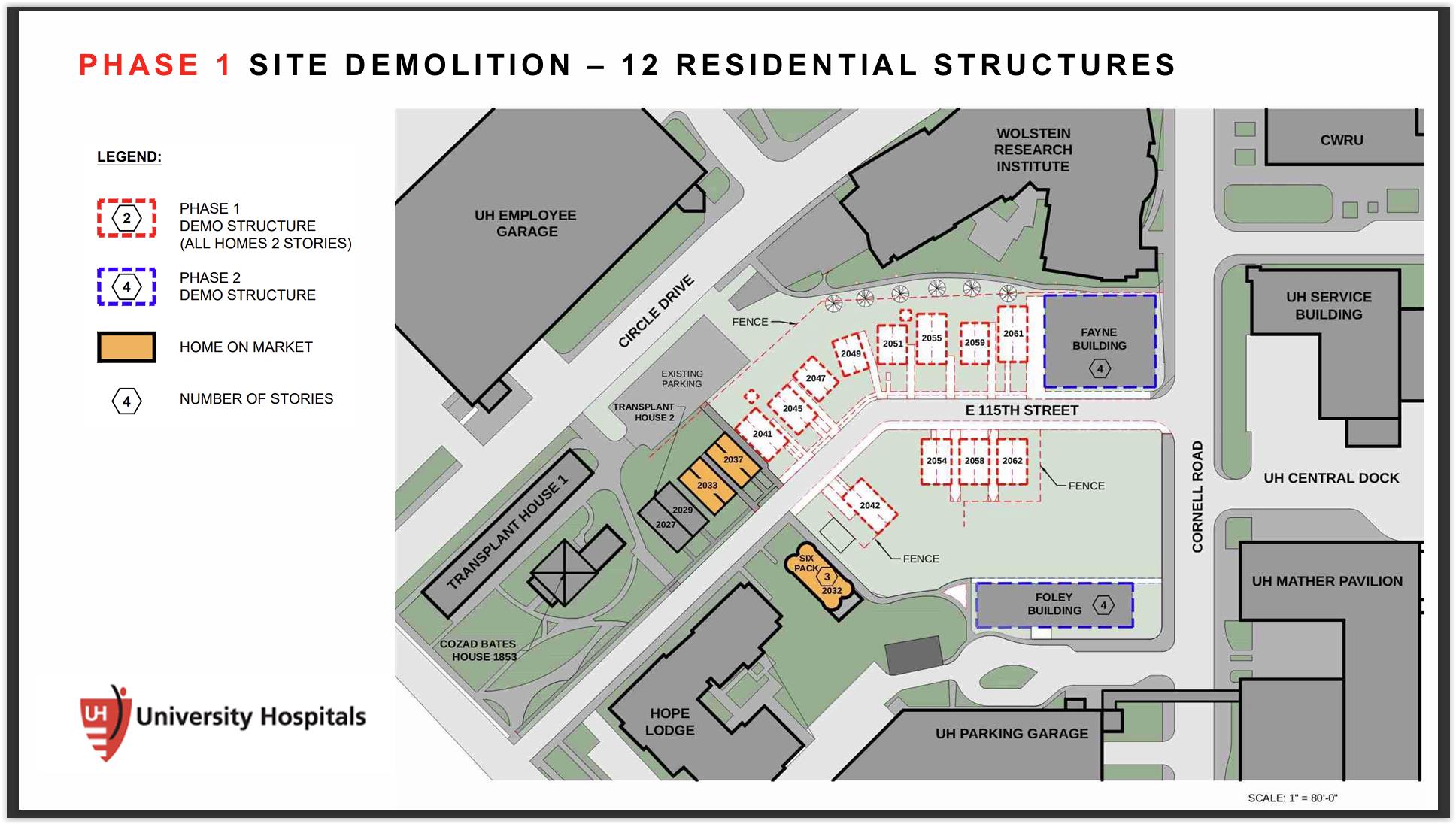
University Hospital officials requested approval for this first phase of demolitions –12 houses along East 115th Street. It also put up for sale three other residential structures and intends to demolish two historic buildings along Cornell Road as part of a second phase (UH).
The action is not legally binding because the neighborhood-level committee is an advisory panel. It makes recommendations to the citywide design-review committee whose decisions are legally binding.
If UH decides to disregard the Central East Design Review Committee’s action, it could submit a demolition request directly to the citywide panel, said Central East Region Neighborhood Planner Kenya Gray, in response to a question by the panel’s Chair Chris Trotta at today’s meeting.
Trotta is also president and CEO of levelHEADS which is an architectural consultant to UH on this demolition application. he did not vote on this matter today but managed the meeting during this topic’s discussions.
“I have to balance between being chairman here and being an applicant,” Trotta said.
The citywide panel could follow the recommendation of the neighborhood-level committee or act on its own discretion, Gray said. Historically it has done both on a case-by-case basis but it would take into account the neighborhood-level committee’s action, he added.
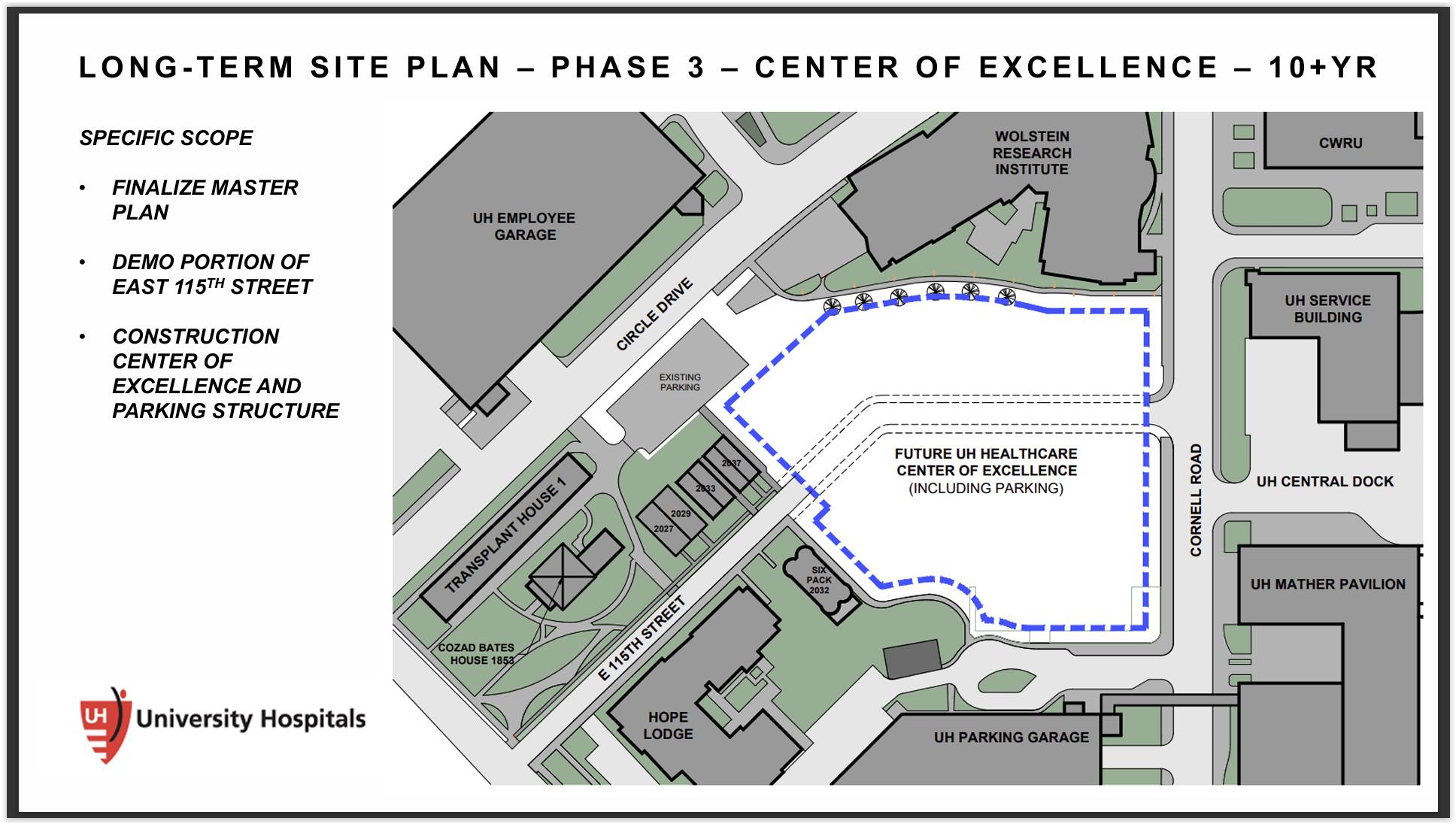
After all of the homes and buildings are demolished, University Hospitals could someday build a Healthcare Center of Excellence building in their place. But the lack of a plan for such a structure, beyond a blue-dashed outline, discouraged a city committee from approving or even rejecting the demolitions (UH).
After the committee voted to table the demolition request, UH Cleveland Medical Center President Stathis Antoniades told the committee’s members he would respect their advice but asked them to respect what is UH’s mission and what it is not.
“I’m sorry we were not able to articulate with you the thoughtfulness that we have put into this process,” Antoniades said. “We will work to determine next steps.”
He said UH’s Cleveland Medical Center was extremely busy in providing patient care and needs more space. He estimated its existing hospital facilities are currently running at about 95-98 percent of their capacity.
“We do know that we need to expand,” he added. “We cannot forgo the only expansion opportunity we have which is these parcels on East 115th Street.”
Antoniades and other UH officials at the meeting said they do not have a current building plan for the East 115th demolition site. They have an older one and it would take a longer time to produce a new one.

This page from University Hospitals’ presentation today shows residential structures it owns on the north half of East 115th Street and what it plans to do with them. Of the seven structures, UH plans to keep one — called the Transplant House. It plans to sell three others including the brick Six Pack apartment building. And it plans to raze three houses on the northern half of East 115th — plus nine more on the southern half (UH).
UH officials said they had begun formulating a main campus masterplan in 2019. But when COVID-19 hit the USA a year later, it never presented the masterplan for approval by UH’s board or its relevant management committees, let alone by the City Planning Commission.
In that plan, as well as in a prior UH- and city-approved masterplan from 2005, a Healthcare Center of Excellence building plus a parking garage was proposed to be built where those houses, buildings and the southern half of East 115th itself exist today.
“Making decisions like this without a current masterplan is very difficult,” said committee member Dick Pace, CEO of Cumberland Development. “You know what the masterplan is but we don’t.”
UH has owned the houses since the mid-1980s and leased them to University Circle Inc. so it could maintain them and rent them out. But its last lease expired in 2022 without being renewed.
UH turned off utilities in the East 115th houses four years ago and vacated the Fayne Apartments, causing each to fall into disrepair. UH officials said UCI was responsible for maintaining the properties until 2022. UCI says it expended nearly $1 million from 2000-2020 to maintain all 16 UH-owned buildings.
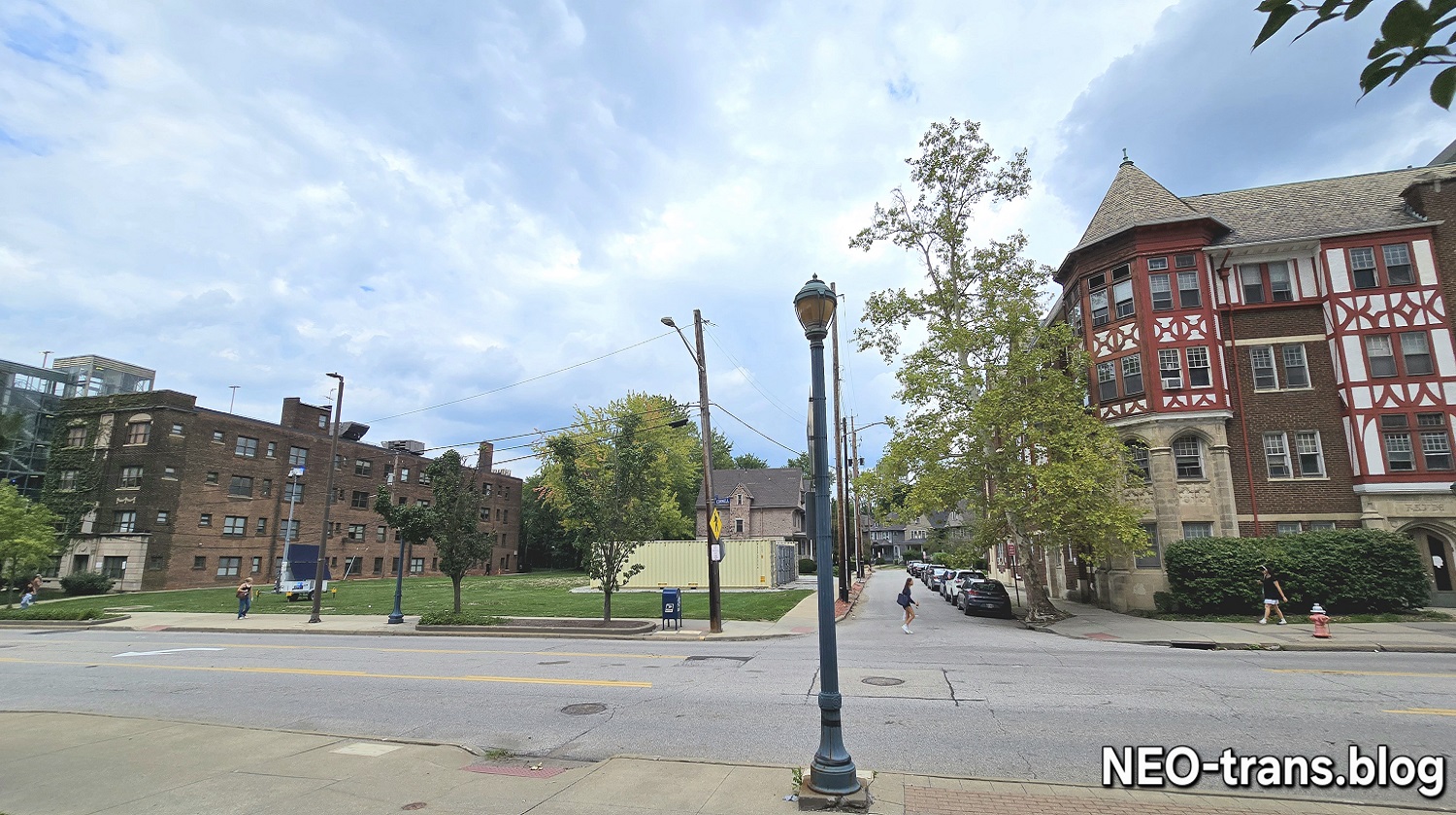
From Cornell Road, nearly all of the structures to be demolished can be seen, from the brick Foley Building at left, to the Fayne Apartments at the right, to East 115th Street and its homes in between (NEOtrans).
“We did our best to keep them in reasonable condition,” said Matt Provolt, UCI’s director of planning and design. He said UCI supports a fair process for UH’s plan to be considered by the City. “We recognize the need for land to provide more health care to the community.”
Committee members urged UH to turn the utilities back on in the houses, and lease the homes or sell them so they could be renovated. They said that the hot housing market around University Circle would support that.
Antoniades said the health care system’s mission is to provide medical care, not housing. Yet it is putting on the market two of the East 115th houses along with a brick “six pack” six-unit apartment building nearer to the north end of the street.
“Putting grass or parking there doesn’t further your mission to expand,” Pace responded. “I think there are other options that you haven’t considered. I don’t find that (parking lots) an acceptable trade-off. If you’re proposing a higher and better use such as a medical building, that would be reasonable trade-off.”
END