
The planned new Huntington Bank Field is close enough to Cleveland Hopkins International Airport, seen at left, that it initially resulted in a denial of a building permit for the large, new structure. Today, the permit was approved (HKS). CLICK IMAGES TO ENLARGE THEM.
Airport officials object to permit, cite safety

After initially denying approval, the Ohio Department of Transportation (ODOT) today reversed course and approved a permit for construction of the new, enclosed Huntington Bank Field in Brook Park near Cleveland Hopkins International Airport.
This approval follows what ODOT officials said was a comprehensive review and a detailed analysis by ODOT’s third-party aviation consultant, according to a statement released by ODOT.
The consultant, Federal Airways & Airspace Inc. of Indian Harbour Beach, FL, reportedly reviewed additional information submitted by both the City of Cleveland Department of Port Control and Clyde & Co., attorneys for the Haslam Sports Group. That information was posted online by ODOT.
An affiliate of the Haslam Sports Group, Primacy Development LLC, plans to build a $2.4 billion all-purpose stadium that would be the new home of the Cleveland Browns National Football League franchise. Haslam Sports Group owns the football team.
Plus, Primacy envisions constructing $1.2 billion worth of mixed-use development next to it — hotels, shops, restaurants, apartments, office and additional entertainment venues. In June, Primacy acquired nearly 180 acres of land near the airport used by hundreds of commercial airliners per day.

The highest structure on the proposed new, enclosed Huntington Bank Field in suburban Brook Park is estimated to be 221 feet above ground which ODOT-Aviation initially said was 58 feet too tall for aircraft navigation (HKS).
In a story broken by NEOtrans last month, ODOT’s Office of Aviation notified Clyde & Co. that the proposed stadium structure was “determined to be an obstruction to air navigation,” an Aug. 1 letter stated.
ODOT said the new 221-foot-tall Huntington Bank Field, despite being constructed from a foundation dug 80 feet below the surface of the surrounding land, would extend up into this air navigation zone by 58 feet.
But Federal Airways & Airspace determined that, based on all information, construction of the proposed building would not change current flight operations at Cleveland Hopkins International Airport.
Applying sound aeronautical principles, ODOT officials said, the consultant found that “the proposed stadium would have no adverse effect on the safety and efficient use of the aeronautical environment.”
Therefore, the consultant recommended approval of the issuance of a permit with waiver of obstruction standards. ODOT Director Pamela Boratyn said she agreed with that recommendation.
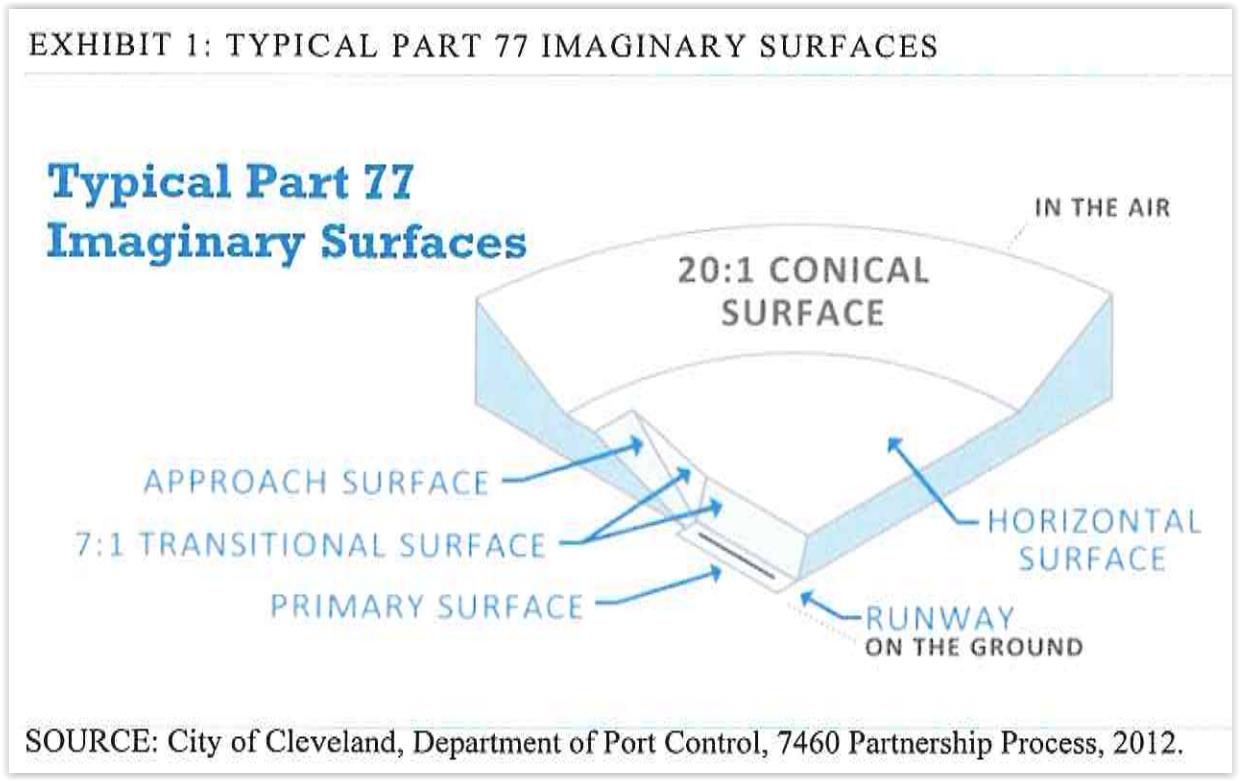
Cleveland’s Department of Port Control, which owns and operates Hopkins Airport just west of the proposed stadium, supplied this graphic to ODOT-Aviation to show “surfaces” that aircraft must stay above when approaching and exiting airport air navigation “cones” (DPC).
“All along our goal has been to ensure that all concerns were heard and addressed and a resolution could be found,” said Boratyn in a written statement.
Concerns expressed by the city’s Department of Port Control (DPC), which owns and operates Hopkins Airport, apparently were not being heeded by ODOT, the city said in a Sept. 12 letter to ODOT’s chief legal counsel.
“The Department of Port Control anticipates and expects support at the local, state and federal levels to ensure CLE’s airspace remains safe, efficient and protected for both those in the air and on the ground,” wrote Dennis Kramer, acting director of Port Control.
“The information provided in this letter – and much more – provides the basis for the Director of Port Control’s conclusions that the construction project as currently proposed is inconsistent with the safe and efficient operations of the airport,” he added.
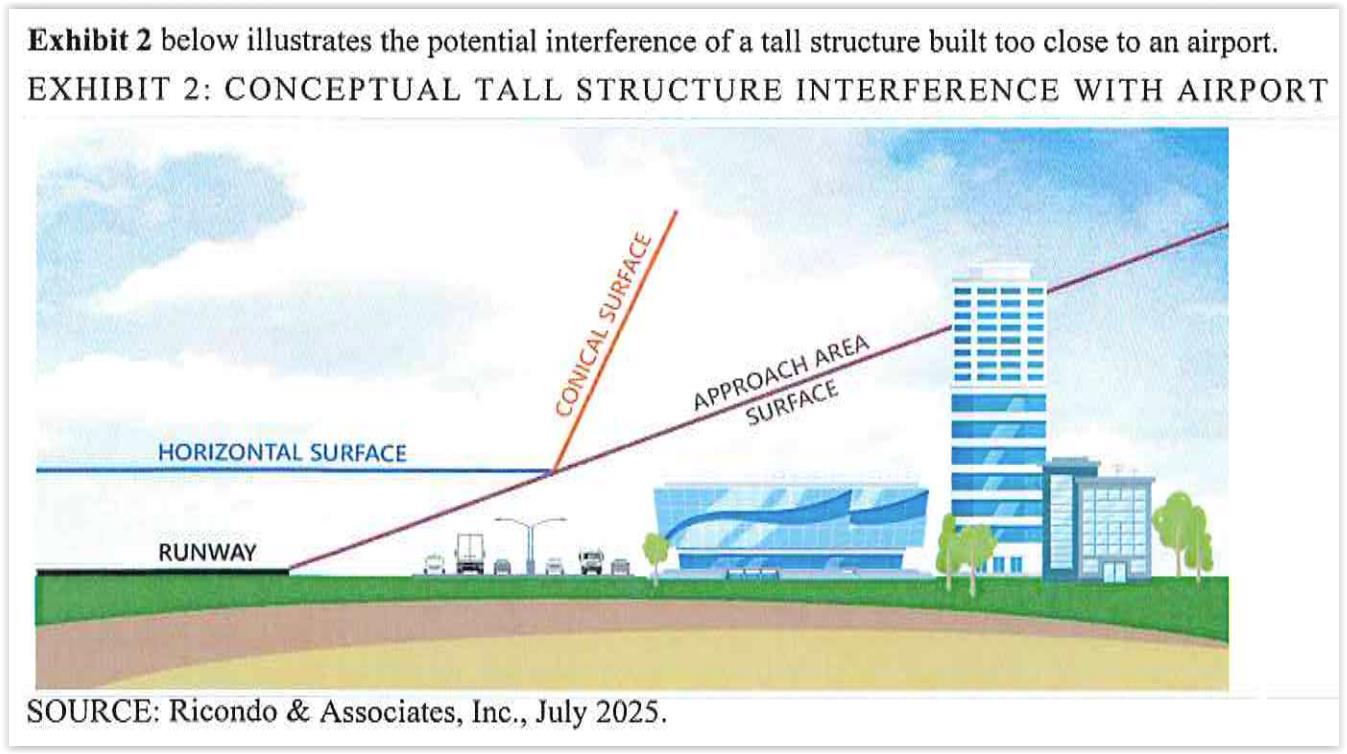
Another graphic shared by the City of Cleveland’s Department of Port Control with ODOT-Aviation shows a side view of the previous graphic and what it looks like when structures are built into air navigations surfaces near an airport (Ricondo).
“As more project details are emerging, DPC will provide you with additional facts relating to other concerns that relate to airport airport efficiency and oрperations,” Kramer said.
“Our aviation consultants were surprised by ODOT’s letter (from Aug. 1), which is flatly at odds with the FAA’s careful analyses and determinations resulting from well over a year of in-depth work, ,” said
Haslam Sports Group spokesperson Peter John-Baptiste said his company’s aviation consultants were surprised by ODOT’ original denial in Aug 1, which is was at odds with the Federal Aviation Administration’s year-long analysis. ODOT can then accept or reject that analysis when deciding a construction permit.
“(FAA) found our proposed stadium poses no airspace hazards,” John-Baptiste said, adding that several other existing structures nearby exceed the stadium’s proposed height.
END