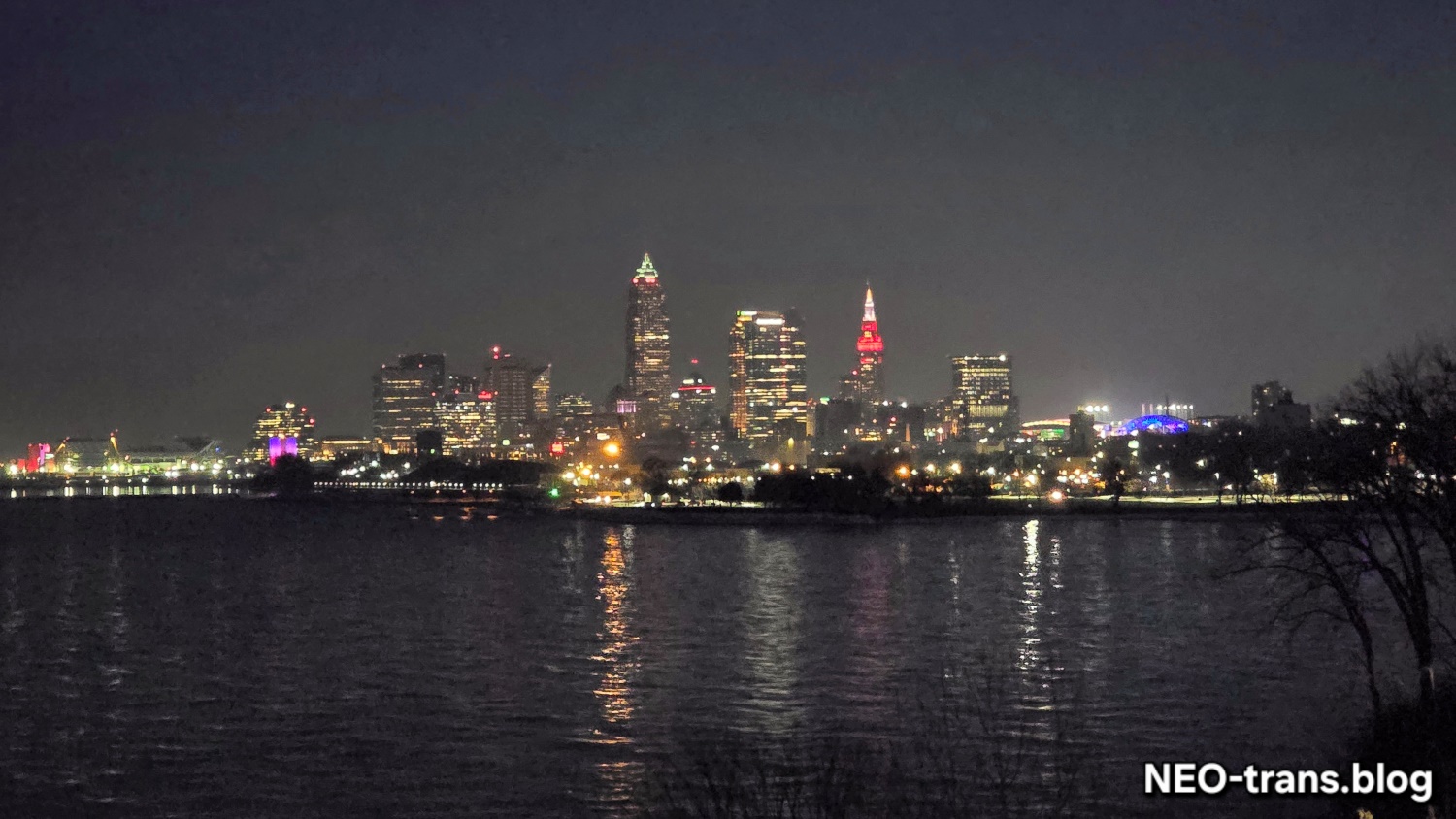
As Cleveland sheds 2025 for 2026, many of the development stories are unfolding along its waterfronts (NEOtrans). CLICK IMAGES TO ENLARGE THEM.
Ushering in new riverfront, lakefront developments
A $1.1 billion Neurological Institute on Cleveland Clinic’s Main Campus will be structurally completed. Downtown’s new 616-foot-tall Sherwin-Williams headquarters tower, part of the coatings company’s $860 million “Building Our Future” initiative, will see its ribbon cut. And construction is due to start on the Haslam Sports Group’s $2.4 billion enclosed stadium in Brook Park.
But those 2026 headlines may be overshadowed by more frequent, compelling stories about what’s to become of Cleveland’s two waterfronts — the Cuyahoga River and Lake Erie. They’re the focus of Mayor Justin Bibb’s Shore-to-Core-to-Shore initiative.
When Cleveland celebrates its 230th birthday in July, it will likely do so on one or both of the two waterfronts with which Cleveland is blessed. That’s 230 summers after Gen. Moses Cleaveland surveyed the place where the two waters met and predicted “The child is now born that may live to see that place as large as Old Windham” in Connecticut (population 2,700 in 1790).
That prediction was surpassed many times over, as Cleveland roared past 100,000 population by the time an 80-year-old born in 1796 died in 1876. One can hope that the goals set for its waterfronts in 2026 are also surpassed in the next few decades.
In the waning days of 2025, we learned that the North Coast Waterfront Development Corp. (NCWDC) hired DiGeronimo Development, an experienced master developer to oversee 50 acres of the city’s lakefront lands including the current site of Huntington Bank Field.
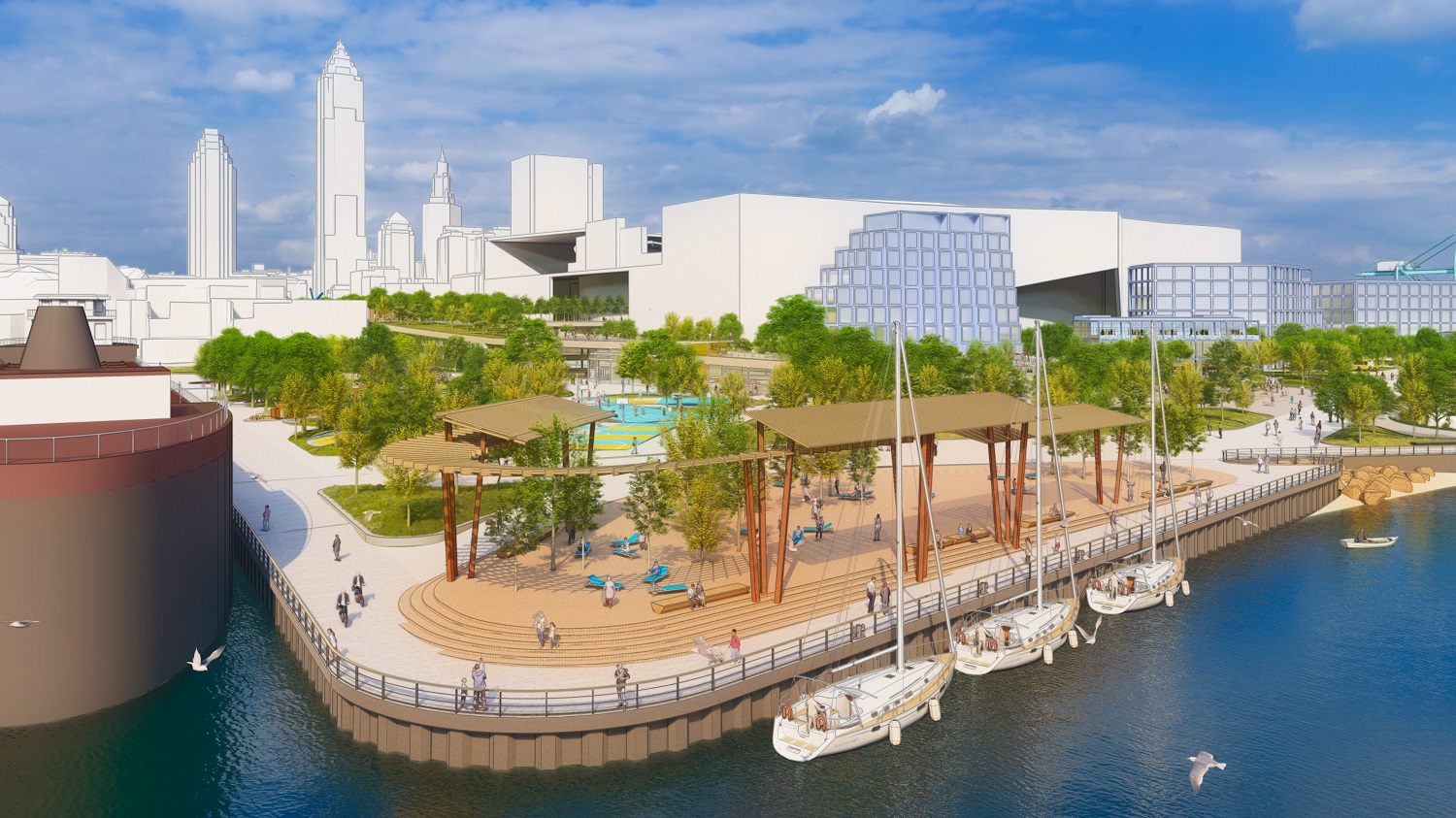
Downtown Cleveland’s lakefront will see an updated plan created in 2026 now that Huntington Bank Field will no longer be a part of it. In this view, seen from next to the Steamship William G. Mather Museum at left, plans for public amenities next to Lake Erie may remain but development beyond it may be envisioned differently (FO).
DiGeronimo has been overseeing the Valor Acres redevelopment of the former Veterans Administration Hospital site in suburban Brecksville. That nearly 200-acre setting now includes Sherwin-Williams’ 600,000-square-foot Morikis Global Technology Center, plus residences, shops and hotel.
It’s also building District 46 — an expansion of the Cleveland Browns’ CrossCountry Mortgage Campus in Berea with residential, hotel, medical center and community sporting and recreation facilities.
Early in 2026, a firm will be hired to help NCWDC and DiGeronimo expand on the plans James Corner Field Operations mapped out in recent years for the 40+ acres surrounding Huntington Bank Field. By the end of the year, it is hoped that a final plan for a lakefront makeover, including the 25-acre site of the to-be-demolished stadium, will be done.
Alongside that, detailed planning for the North Coast Connector landbridge and a multimodal transit center are likely to get underway in 2026. Completing those are essential for such infrastructure projects to be eligible for more state and federal construction funding.
Significant funding is already in place to start lakefront infrastructure work. Committed is about $364 million — $130 million in federal grants, $20 million in state grants, and $134 million in local matching dollars from the city’s Shore-to-Core-to-Shore tax-increment financing district. The Haslam Sports Group is providing at least $80 million.
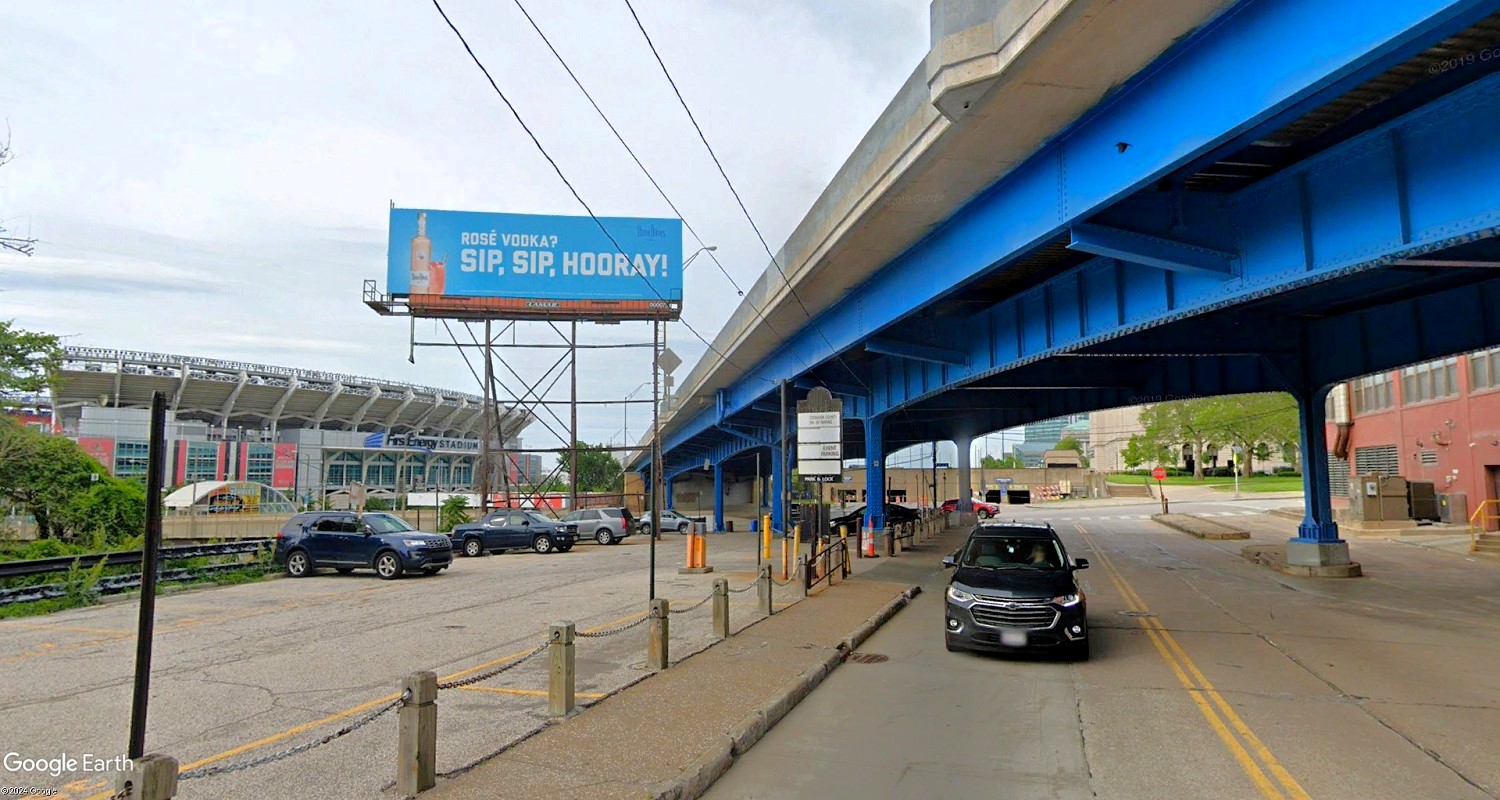
Two imposing barriers between Downtown Cleveland and the lakefront are due to be removed by the end of this decade — Huntington Bank Field, left, and the elevated Shoreway over the railroad tracks, West 3rd Street and Summit Avenue. The Shoreway no longer meets modern highway design standards and will be converted to an at-grade boulevard (Google).
More than $1 billion of public and private investment is contemplated here to create land uses and programming to draw more than 800,000 people per year and create more than $30 million in economic benefits to Downtown Cleveland per year. That is what is needed for downtown to offset the loss of the Browns.
“Without the stadium, we’re talking about the need for a new street grid,” said NCWDC Executive Director Scott Skinner. “It’s a neighborhood more than just one 25-acre site with a park.”
“There does need to be substantial vertical development there, both housing, hospitality as well as entertainment and recreation to mitigate the economic impact loss of the Browns moving,” he added. “That will be part of the masterplan.”
The presence of Burke Lakefront Airport just to the east is not a significant limiting factor, Skinner said. To the north of the stadium, buildings constructed near where the Steamship William G. Mather Museum is docked will be limited to about five stories. Waterfront buildings can gradually rise to the west to as much as 15 stories near the Port of Cleveland.
But the current site of the stadium and lands southward are outside of Burke’s flightpath, Skinner explained. In other words, the sky’s the limit there. Then again, a whole lot more is possible without Burke in the picture.
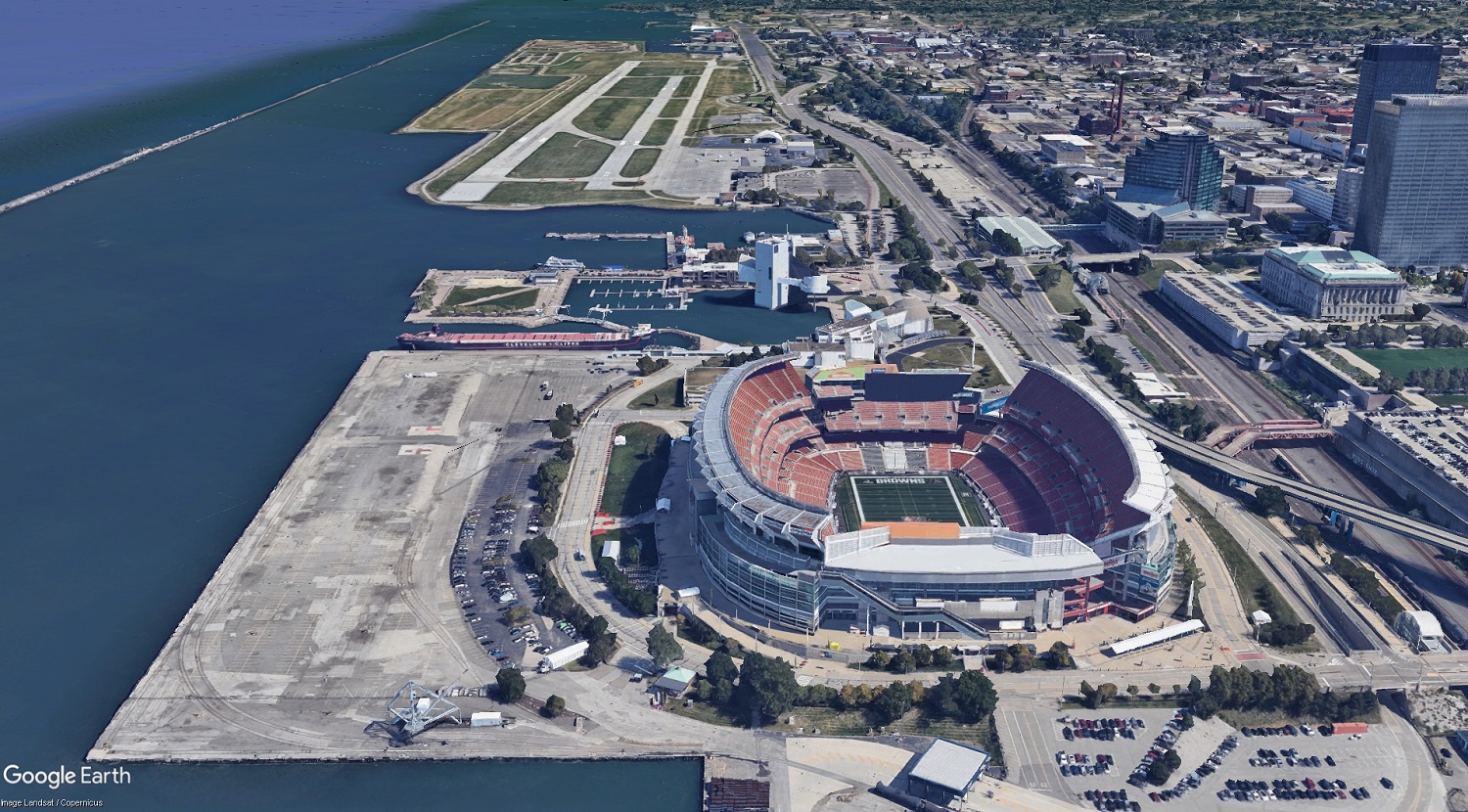
Two major lakefront target areas for potential redevelopment are seen here. In the foreground is the area, including the current Huntington Bank Field site, where the North Coast Waterfront Development Corp. and its master developer DiGeronimo Development intend to focus their energies in 2026. In the background is Burke Lakefront Airport which may be next (Google).
Bibb and Cuyahoga County Executive Chris Ronayne are urging Congress to pass a law that directs the Federal Aviation Administration to close the 450-acre Burke Lakefront Airport. We’ll likely hear a lot more about this in 2026 and some ideas of what could replace Burke — parks/recreation, development and more.
Even our air show could continue without Burke, just as Chicago’s has continued without Meigs Field on its lakefront. There, the airshow is based out of the Gary/Chicago International Airport, with planes flying 19 miles each way to the downtown waterfront and back. Cuyahoga County Airport is just 10 miles from Burke.
That’s a lot of waterfront happenings, and we haven’t even gotten to Cleveland’s other waterfront yet. The transformation of the once-heavily industrial lands along the Cuyahoga River and the improvement of the once-flammable waters within it is one of Cleveland’s greatest stories of rebirth.
“In the not-too-distant future, the rebirth of Cleveland’s Flats will be a case study in post-industrial urban revitalization,” said Michael Collier, director of brand content at the Greater Cleveland Partnership, the region’s chamber of commerce. “The transformation along a short stretch of the Cuyahoga River in just the past few years has been remarkable.”

A visual summary of the many developments happening along the Cuyahoga River in and near Downtown Cleveland. North is to the left in this view (GCP).
He summarized on social media some of the projects recently completed, underway or planned:
- The $63 million Cleveland Milling Co. redevelopment and the broader Cleveland Metroparks public access improvements on the Columbus Road Peninsula, which will link planned and existing riverfront assets;
- The 22-acre, roughly $35 million development of Canal Basin Park, envisioned by people like Tim Donovan, longtime executive director of Canalway Partners, who passed away in August;
- Irishtown Bend Park, a 25-acre waterfront green space and a key connector to regional trail systems and the Cuyahoga Valley National Park;
- Scranton Peninsula, where a new neighborhood of 600+ apartments and townhomes has risen on the site of a former Republic Steel plant. Next up may be a future Great Lakes Brewing Company expansion;
- Guardian Bluffs, the four-acre former site of Epic Steel adjacent to the Scranton Peninsula, which just hit the market for multi-family development;
- The Cleveland Clinic Global Peak Performance Center, a 210,000-square-foot. state-of-the-art training facility that will serve as the new home and practice facility of the Cleveland Cavaliers;
- Bedrock’s $3.5 billion riverfront master plan, a key component of Bibb’s Shore-to-Core-to-Shore initiative, which will reimagine 35 acres of underutilized land and link Downtown Cleveland with its two waterfronts.
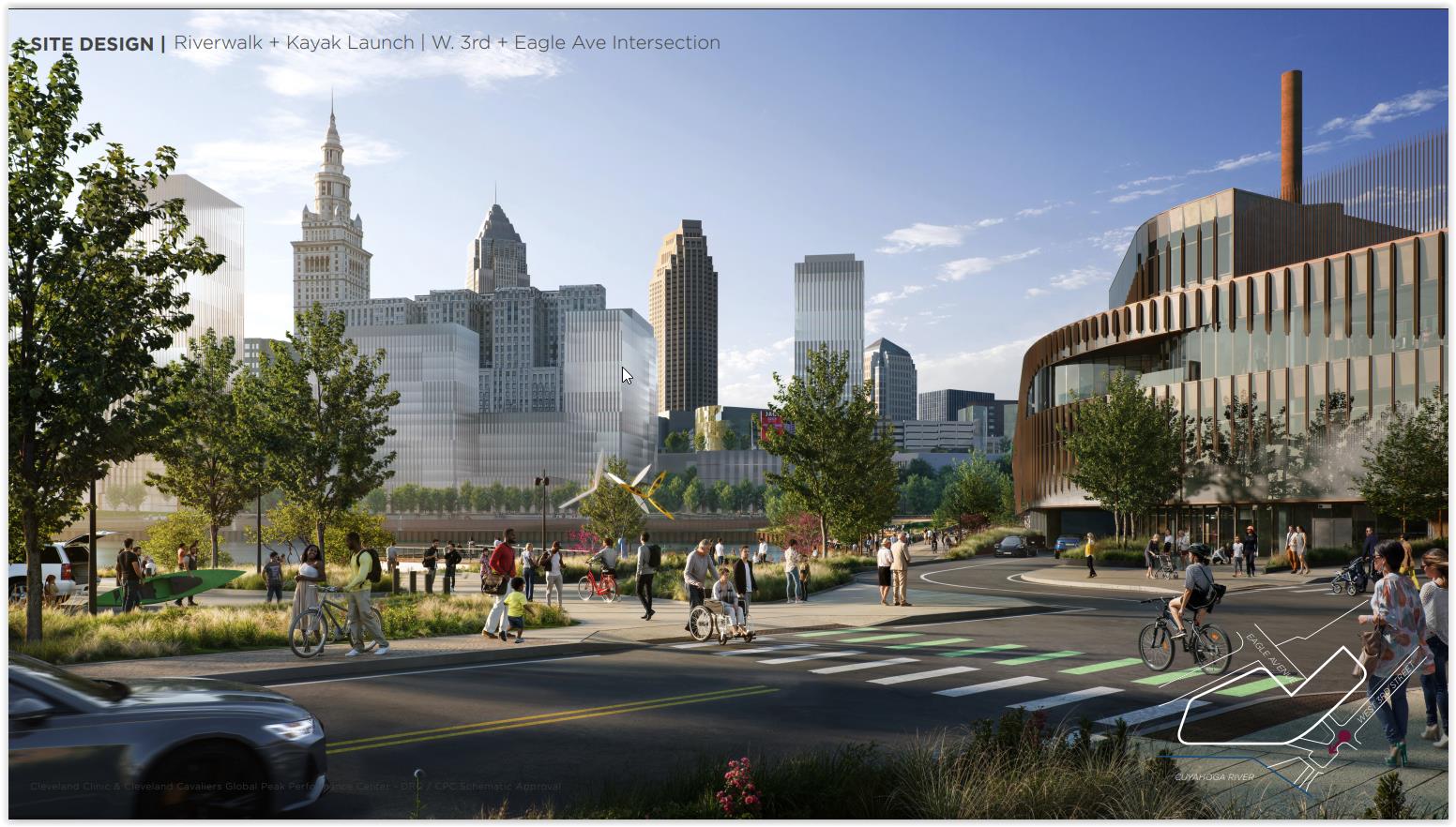
The new Cleveland Clinic Global Peak Performance Center, right, is in advanced construction and due to be completed in 2026. But it is just one of many riverfront stories we’re likely to hear about in the coming year. Others could include updates on Bedrock’s proposed glassy towers in the background (MKSK).
Bedrock officials have recently revealed that their outreach to other developers is yielding emerging partnerships at a faster pace than they had hoped. The riverfront was originally planned to be completed in phases over two to three decades. Company executives now believe they can deliver it within 5-10 years.
In other words, look for more news in 2026 on what some of those next steps will be, including a nearly $500 million Rock and Roll Land development — a planned theater and 17-story hotel atop structured parking. Sources also say an office building, branded apartments and more riverfront recreation are near to being announced.
“A truly world-class transformation of our riverfront is currently underway, and it’s happening just as our century-long effort to reclaim the lakefront is seeing tangible progress,” Collier added. “The pace and grand scale of change was only made possible by public investment, private development, and long-term strategic planning.”
“That alignment and collaborative spirit is what made us into the city we are today, and it’s what will make us the city we aspire to be,” he added.
END