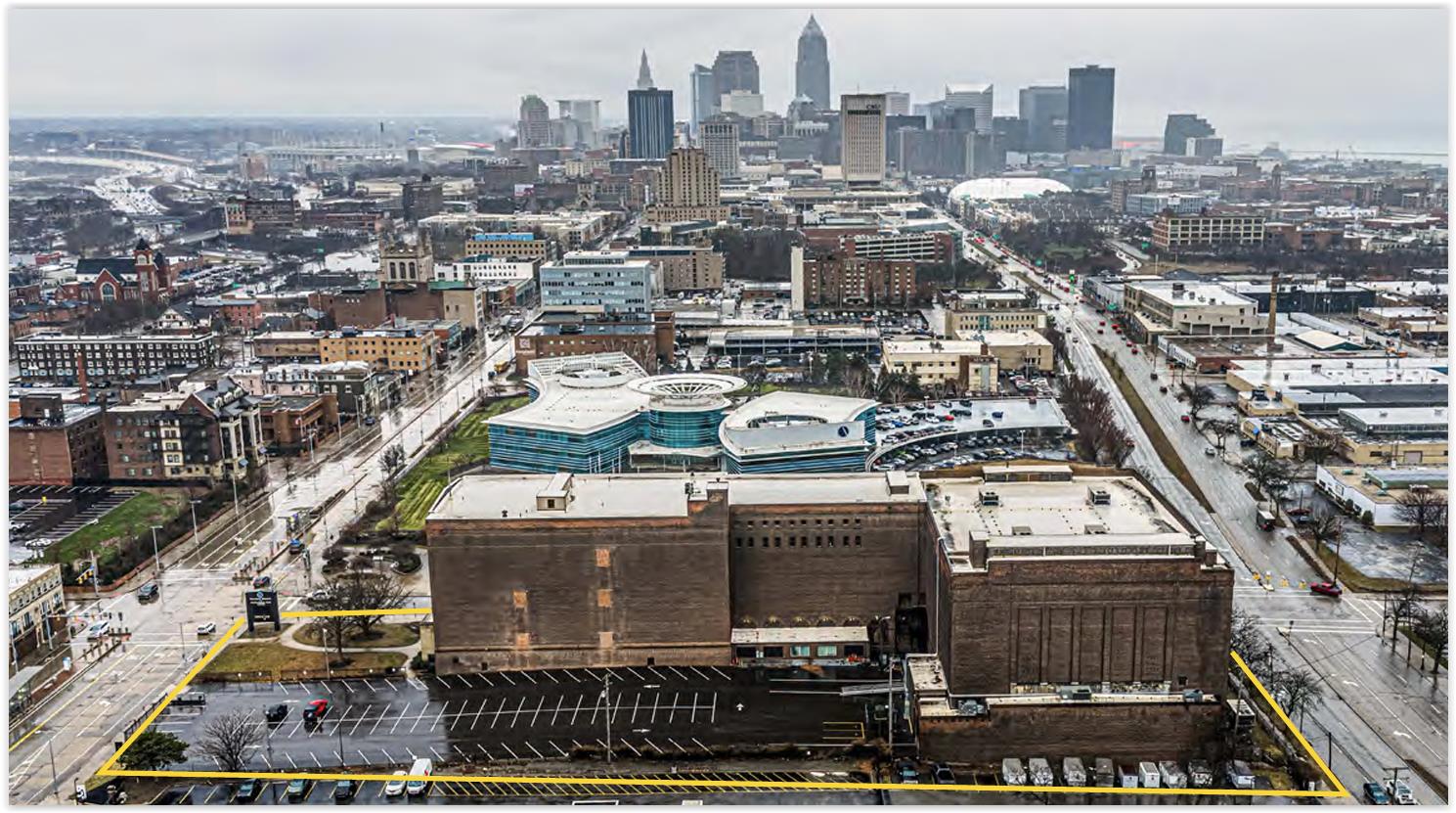
Located just east of Downtown Cleveland, the former Masonic Hall was recently renovated by TempleLive as a performing arts venue but plans for further development didn’t pan out. Now the property outlined yellow is for sale (Newmark). CLICK IMAGES TO ENLARGE THEM.
Performing arts biz takes hard shift

Although much of the former Masonic Temple, 3615 Euclid Ave., was significantly renovated in the past decade, even larger development plans for the historic landmark property didn’t pan out. And now the owner is putting the property up for sale.
Fort Smith, AR-based owner Beaty Capital Group (BCG), doing business here as TempleLive Cleveland LLC and later as Masonic Holding LLC, has fallen on hard times.
In September 2025, it closed its Cleveland location, set in the city’s Midtown neighborhood, as well as several other former Masonic auditoriums the company had purchased and operated in other cities around the country.
TempleLive began in 2014 when BCG acquired a Masonic Temple in downtown Fort Smith. It acquired the Cleveland temple in 2017 for $725,000, according to Cuyahoga County property records.
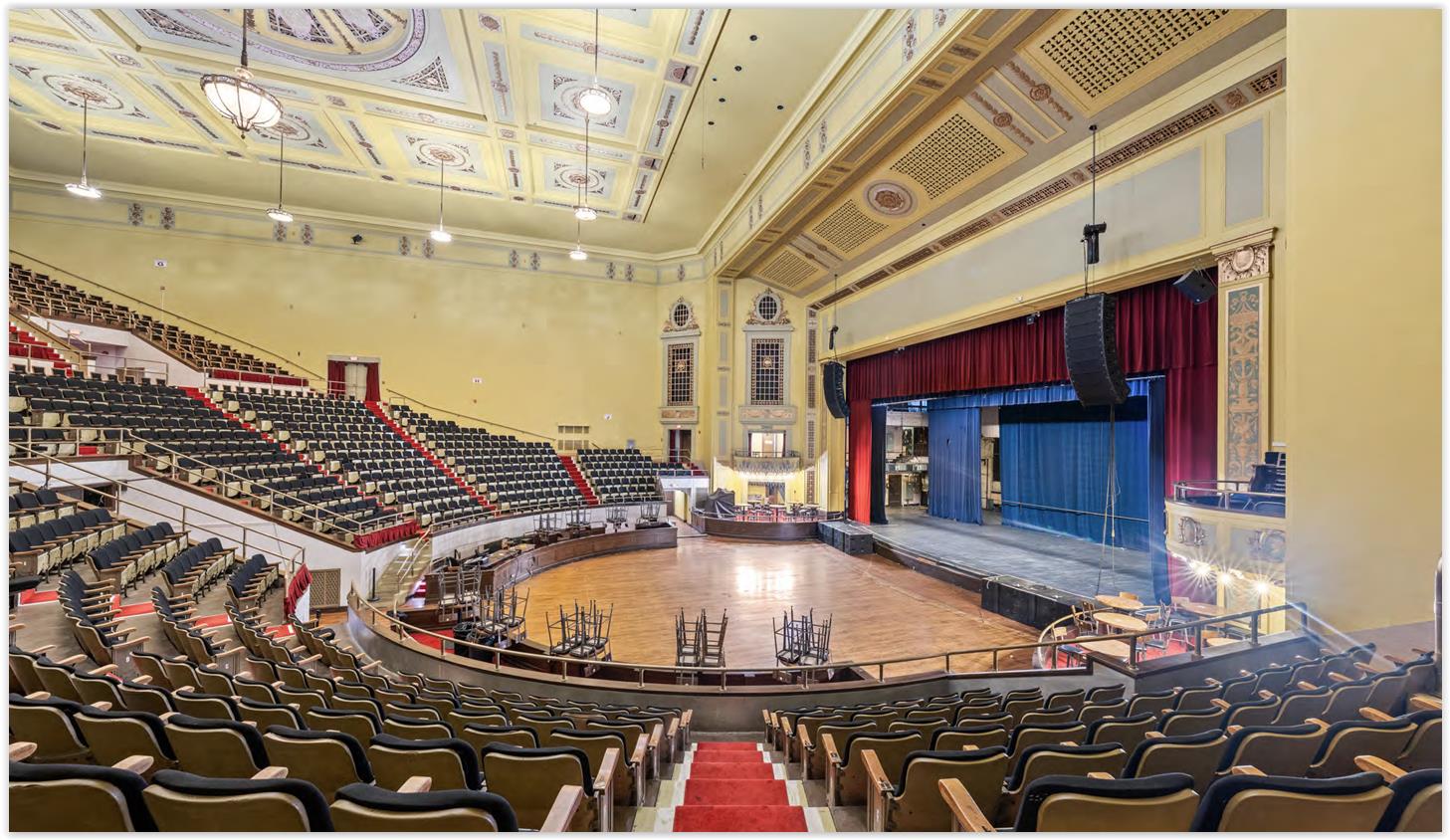
The Main Theater at Cleveland’s former Masonic Temple has a capacity for 2,500 people with 1,980 seated. But it’s not the only large venue in this complex (Newmark).
The 220,000-square-foot Romanesque Revival complex, comprised of several buildings and venues, was constructed from 1918-21 by the The Ancient Accepted Scottish Rite Valley of Cleveland.
The Masonic Temple was added to the National Register of Historic Places in 2001 and is also a city of Cleveland landmark. Its architect was the Cleveland firm Hubbell & Benes.
No asking price for the property is published by global real estate broker Newmark Group Inc. in its marketing materials for the complex. The county last year listed its appraised value of the buildings and the 1.5 acres of land at $711,800 for tax purposes.
In 2018 and again in 2024, TempleLive invested a total of $8.6 million into the historic property with another $10 million in planned renovations that never happened. Several large rooms in the tower saw interior demolition start but wasn’t finished.
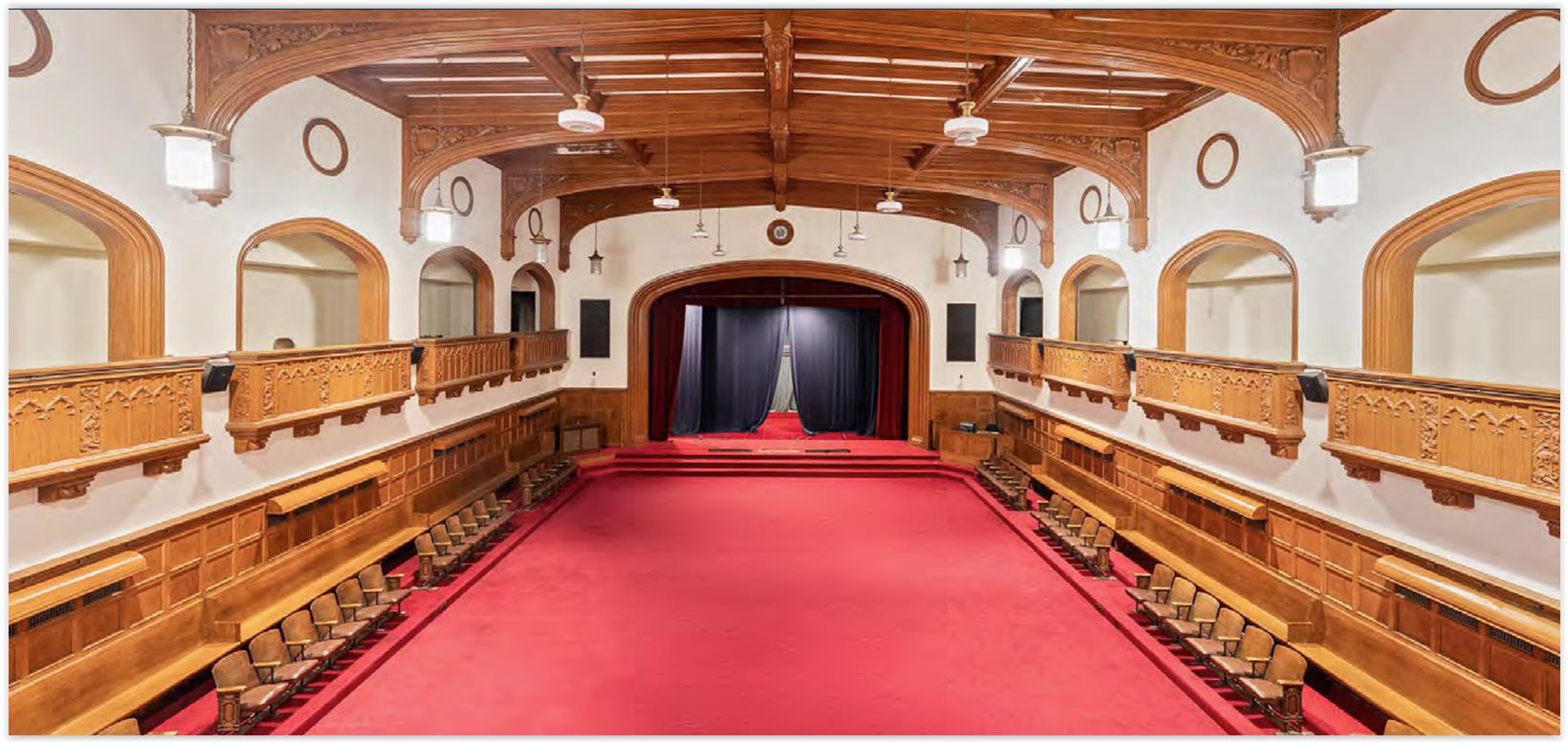
The well-appointed Asylum Room was among the accommodations at the Masonic Temple for The Ancient Accepted Scottish Rite Valley of Cleveland and later the Masons’ Grand Lodge of Ohio and the Freemasons (Newmark).
And, prior to the COVID-19 pandemic, BCG planned to invest $60 million to build a 19-story Dream Hotel with an attached parking garage. That project was canceled after the pandemic, too.
“The owner invested quite a bit of money to make a concert venue, but has decided to go in a different direction,” said Terry Coyne, executive vice chairman of Newmark’s Cleveland office.
At its Cleveland, Fort Smith, Peoria, IL and Wichita, KS auditoriums, TempleLive hosted live music performances, comedy shows and other events. But the venues were shut down during the COVID pandemic starting in 2020. By the time the emergency lifted, the business had changed.
In an interview last September in Talk Business & Politics BCG CEO Lance Beaty said small and independent venues were at a financial disadvantage because of the consolidation in ticketing, venue ownership and the agencies who represent artists.
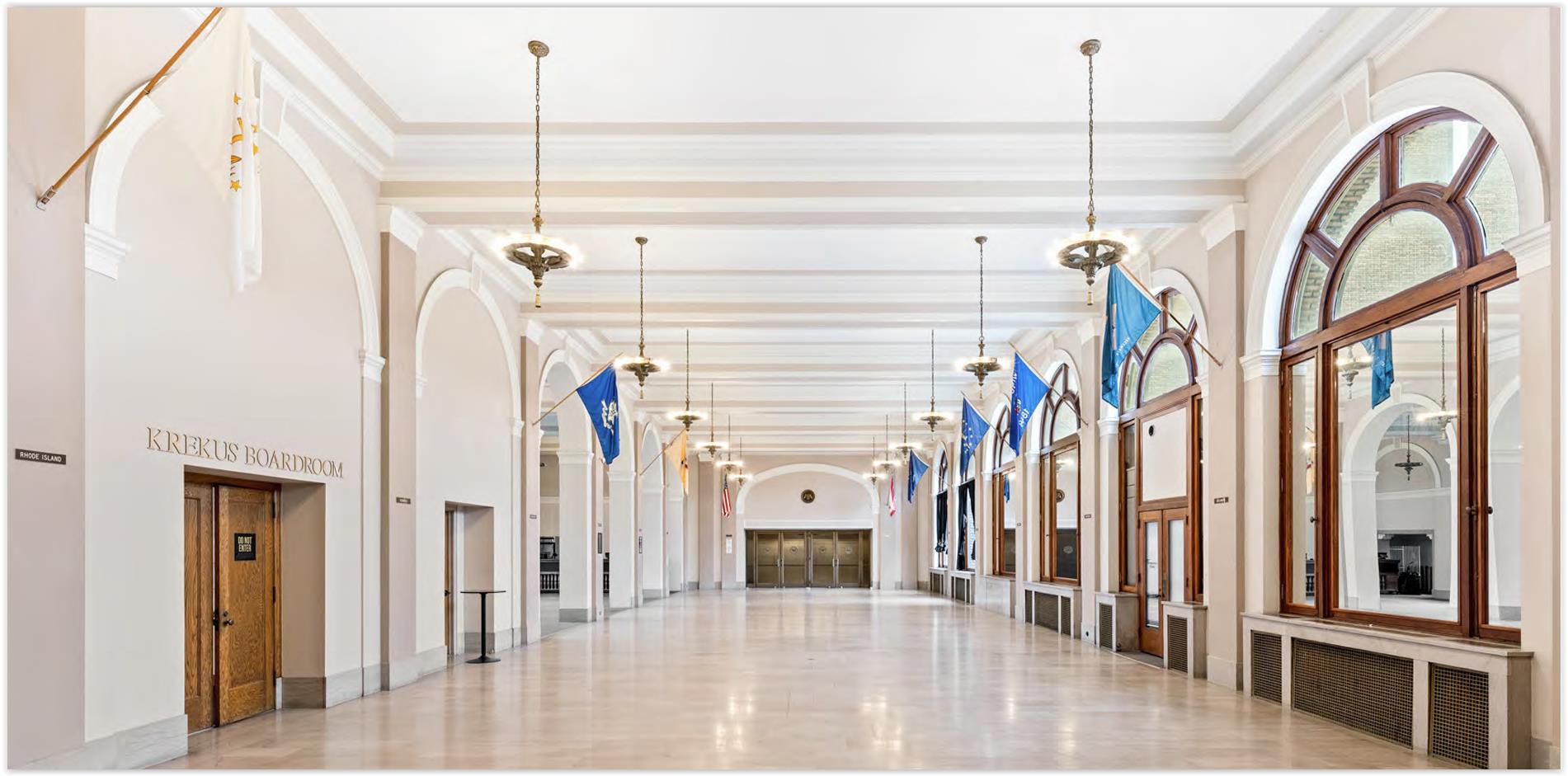
The Hall of Flags isn’t just an impressive hallway at the Masonic Temple. It also can serve as an event venue for up to 853 people (Newmark).
“We are simply an outsider in an insider’s business,” Beaty said in that interview. “No matter how much money you throw at it or how creative you think you are, if you’re not on the inside, you’re not in.”
The former Cleveland Masonic Temple has several venues within the complex. The largest is the Main Theater which has a capacity for 2,500 people with 1,980 seated, complete with concession stands and a grand staircase. Alongside are updated green rooms and backstage areas.
Also in the temple is the Asylum Room, which looks like a smaller version of the House of Commons complete with rich woodwork. It has a capacity for 500 persons and 400 seated, Newmark noted. Next to it is the 250-person Jester’s Lounge.
A large multi-purpose/banquet room and mezzanine can accommodate another 1,264 people, while the Grand Foyer and Hall of Flags can assemble 853 visitors. Plus there are office spaces and the unfinished, spacious tower rooms.
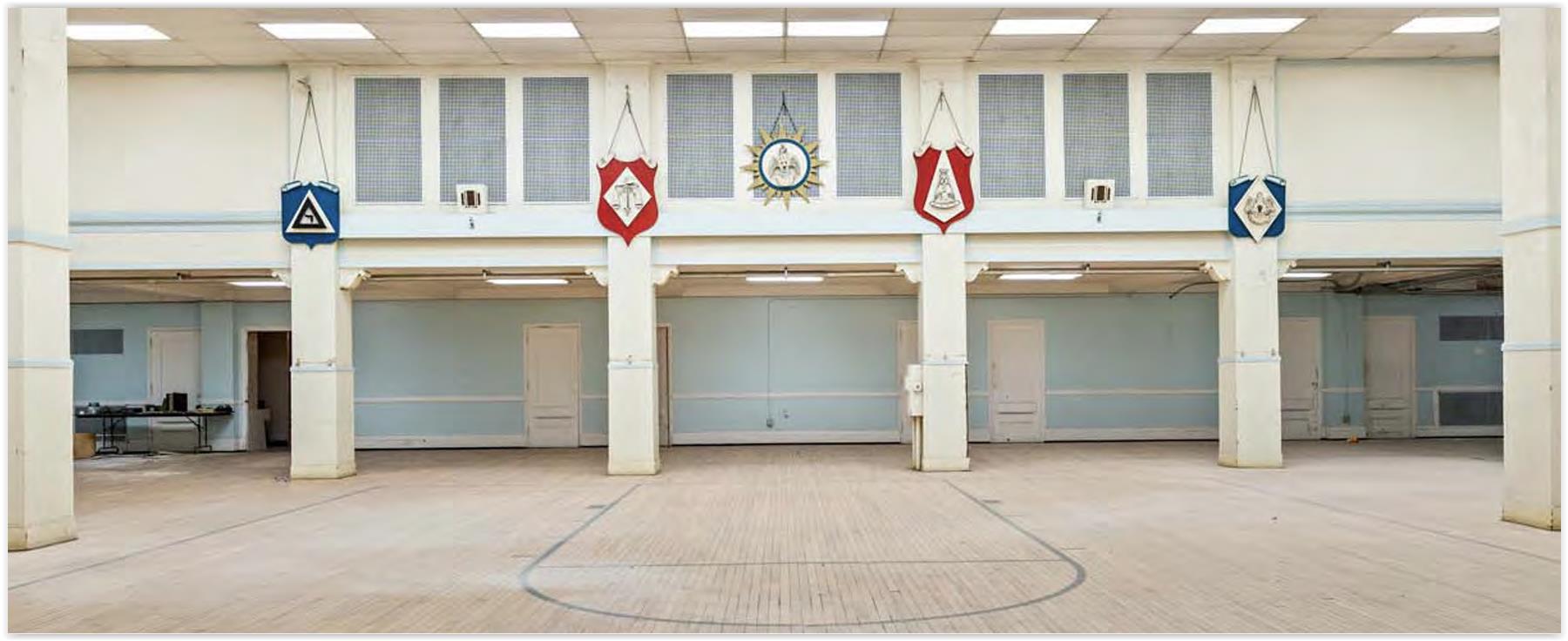
A general purpose/banquet room, while not as luxurious as the other venues in the temple, is nonetheless large. This photo doesn’t do justice the size of the room which includes a large mezzanine (Newmark).
“The property offers strong potential for continued entertainment use or redevelopment into luxury residential, hospitality or mixed-use space,” Newmark’s marketing materials suggest.
The site is located just east of Playhouse Square and near the Cleveland State University campus. The Masonic Temple’s first major tenant was the Cleveland Orchestra in 1918 which played there regularly until 1931 when Severance Hall opened.
Even after Severance opened, the orchestra occasionally performed at the temple due to its renowned acoustics. Its musicians preferred to be recorded there for the orchestra’s commercial record sales.
The Masonic Temple has a history of incomplete visions. In the early 1920s, a 24-story Cleveland Masonic Memorial Building was proposed for the corner of Euclid and East 36th Street. The office tower was never built.
END