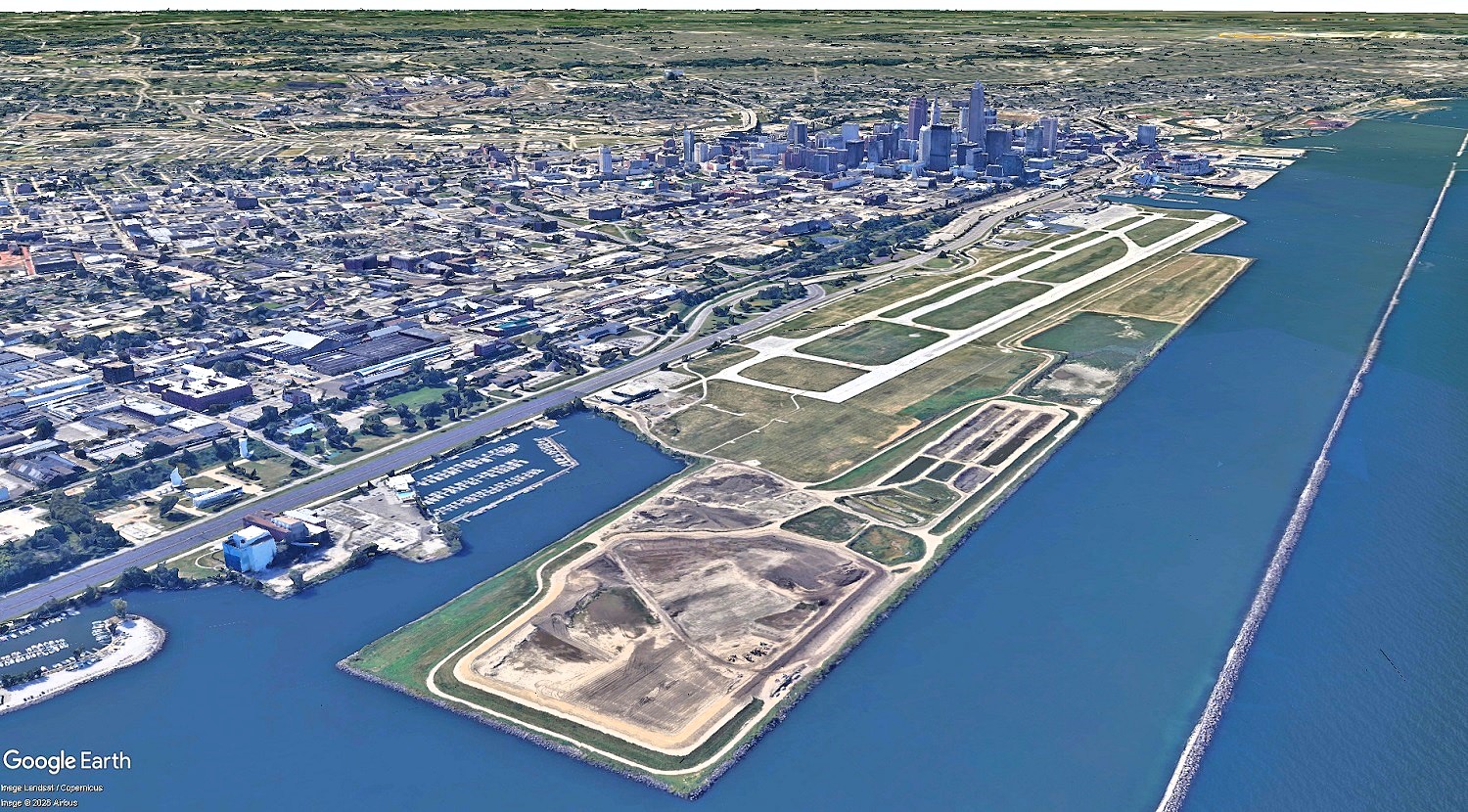
Burke Lakefront Airport could be repurposed into a lakefront recreation area offered with several design options offering differing amenities in different locations on the huge, 400-acre site (Google). CLICK IMAGES TO ENLARGE THEM.
Economic growth predicted from airport conversion

The City of Cleveland and the North Coast Waterfront Development Corporation (NCWDC) today released plan options and economic impact findings for a recreation-focused, low-density redevelopment concept for Burke Lakefront Airport.
The analysis, conducted by ESI Solutions, evaluates two conceptual redevelopment scenarios. The two scenarios, which city officials emphasized are not the final plan, were released to generate more public feedback on them.
Depending on which option is selected and how many different features are ultimately built into it, the construction cost could range from $480 million to $844 million. Annual operating costs of $21.4 million to $21.9 million are forecast, covering personnel expenses, facility maintenance, utilities, and other costs.
The report shows that Burke’s redevelopment could generate over $600 million in one-time economic impact from construction and more than $2.5 million in annual tax revenue — over five times its current contribution, generating an opportunity to transform this lakefront site into a major asset for the Cleveland and the region.
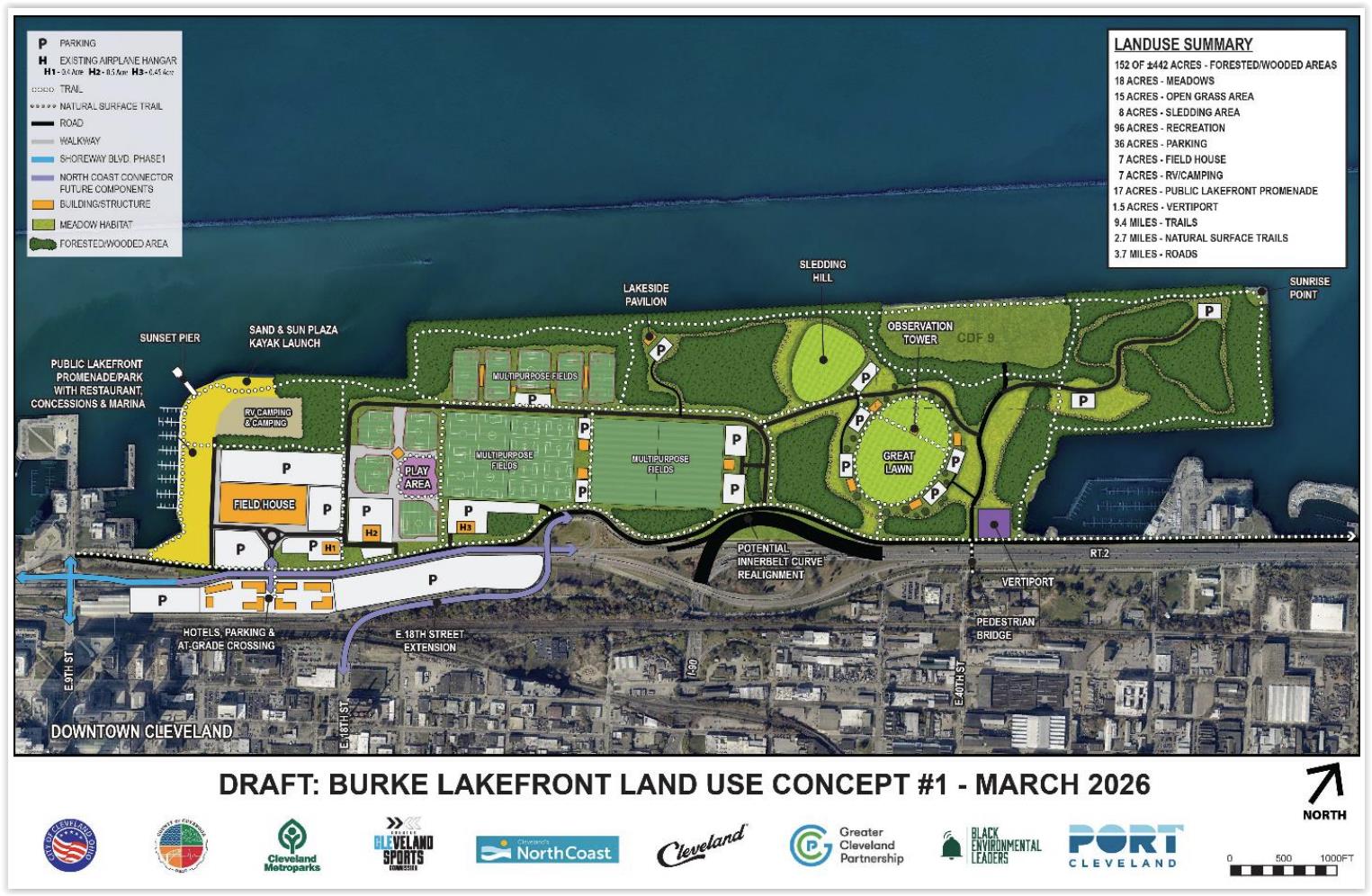
Design option 1 for the redevelopment of Burke Lakefront Airport (City of Cleveland, NCWDC).
“Today’s announcement builds on decades of research, all pointing to one clear conclusion: Cleveland has a tangible opportunity to lead the region by setting a new standard for lakefront development,” said Cleveland Mayor Justin Bibb in a written statement.
Bibb, Cuyahoga County Executive Chris Ronayne and other civic and business leaders in the region have been lobbying Congress and the Federal Aviation Administration (FAA) for permission to close Burke, which is a federally designated reliever airport. Other airports may have to be enhanced for the FAA to justify closing Burke.
The airport is underutilized and considered by the city to be superfluous when there are several other potential primary reliever airports for general aviation. Burke last year cost the city $1.7 million more in expenses than it generated in revenues, a loss that is expected to grow, the report said.
“This is our moment to reimagine the lakefront by delivering accessible, high-impact investment that drives economic growth and creates sustainable opportunities reaching beyond downtown to every neighborhood,” Bibb added.
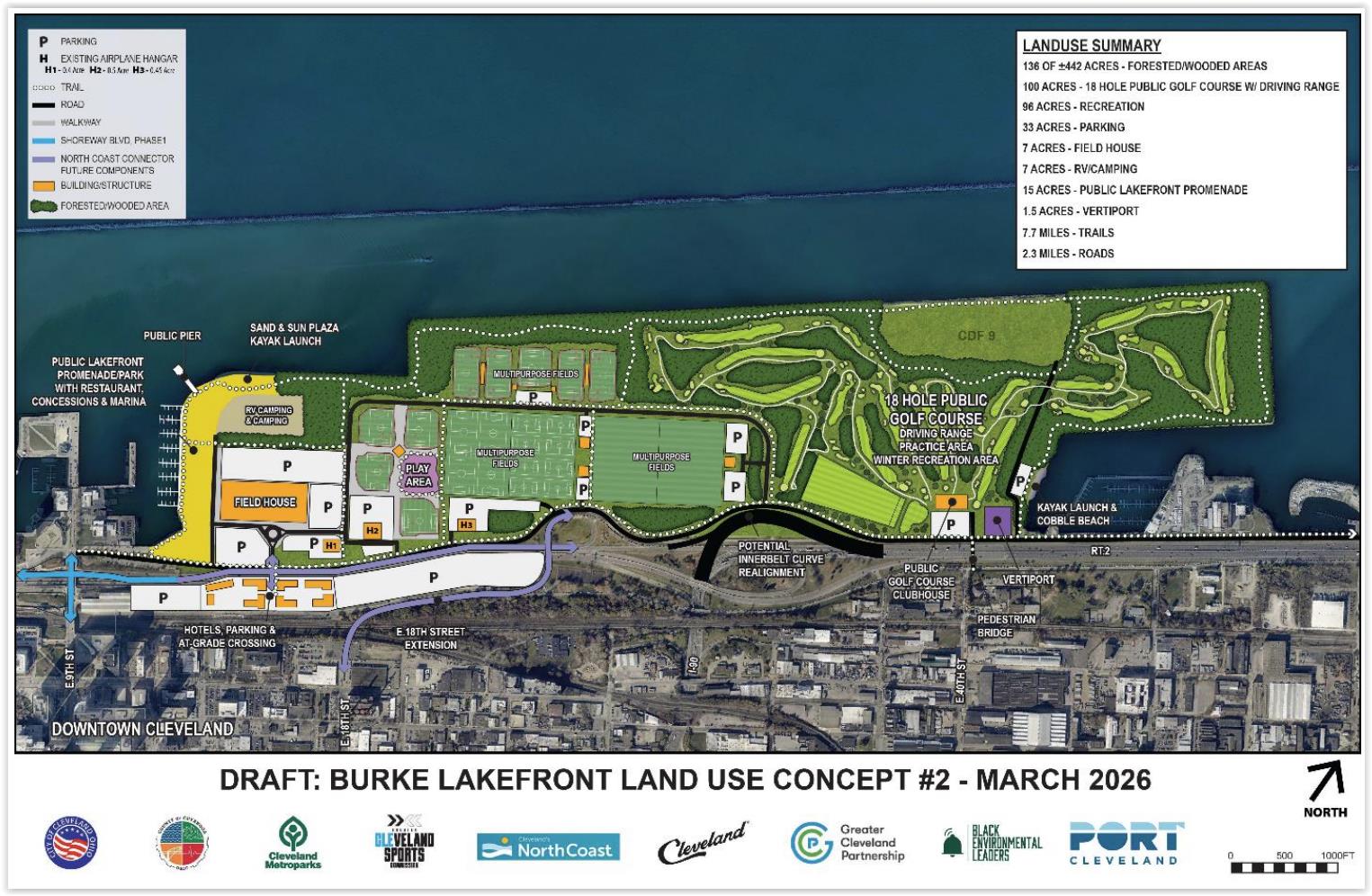
Design option 2 for the redevelopment of Burke Lakefront Airport (City of Cleveland, NCWDC).
This analysis is an exercise to determine if the land that Burke currently resides on could be redeveloped with financeable uses that drive significantly more economic impact to the city while increasing public access to the waterfront.
The concepts presented are intended to inspire meaningful community dialogue and shared visioning, city officials explained. Any development of Burke will incorporate significant engagement by the public, and an initial engagement effort is currently underway.
The potential uses studied include:
- Public promenade with restaurants and marina to provide public access to the waterfront on foot or via boat;
- Competitive youth sports and recreation facilities;;
- Hotels and RV camping grounds that will bring additional visitors to Cleveland to drive economic impact;
- 7-10 miles of public walking and biking paths;
- Vertiport to serve healthcare industry; and
- Public golf course with dual winter uses.
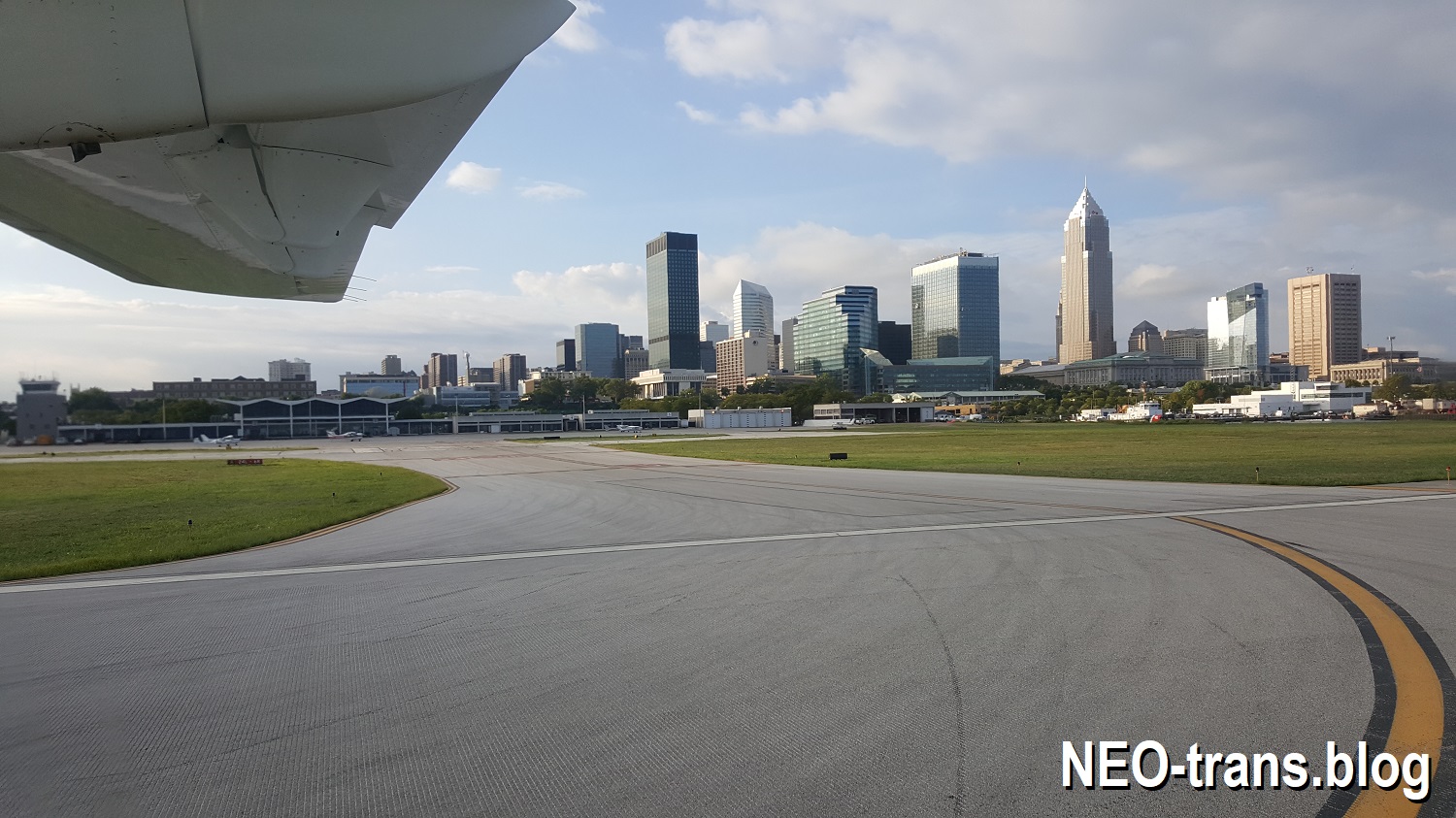
While Burke Lakefront Airport, one of the few in the nation next to a big-city downtown, has its benefits, the city says redeveloping offers even more. Some major downtown employers like Sherwin-Williams don’t use Burke. They keep their company planes at Hopkins International Airport (NEOtrans).
The addition of facilities for competitive youth sports and recreation is intended to fill a big gap in the availability of such services near the geographic center of Greater Cleveland. City officials said they would bring hundreds of families to Downtown Cleveland regularly while providing recreation space for Clevelanders.
A golf course near the center of Cleveland was also considered a glaring void. To offer year-round benefits, it would also serve as free winter recreation activation with cross-country skiing and/or public park space with other features like an observation tower, sledding hill, viewpoints and other open spaces.
“This work is grounded in real environmental and site conditions,” said Scott Skinner, president and executive director of NCWDC. “We’ve collectively spent decades studying this land.”
Those studies as well as ongoing public input shows that Burke’s large space, totaling 450 acres, would take a long time to develop with an urban-scale density of residential, retail and other mixed uses and possibly detract from redevelopment efforts already underway in existing city neighborhoods.
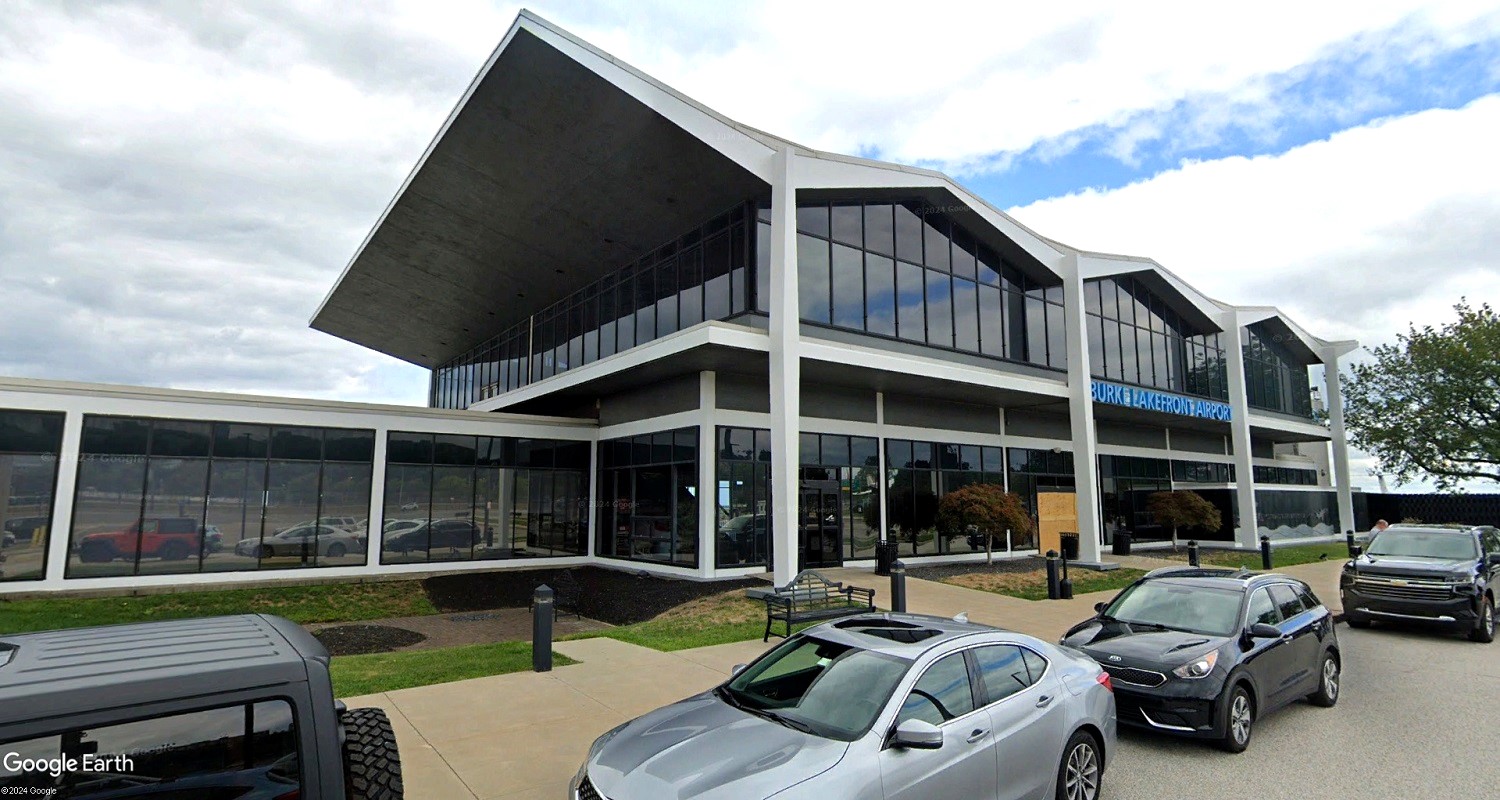
Burke Lakefront Airport has some features that no other reliever airport in Greater Cleveland can match, such as its large terminal building or having the longest and widest runways. But if one or more airport in the region can gain these features, it would make it easier for federal aviation officials to justify closing Burke (Google).
“What we heard consistently was a need to show what ‘low-density’ actually means in practice, and this study begins to answer that with realistic, buildable concepts,” Skinner added.
NCWDC led the report analysis in collaboration with the Black Environmental Leaders Association, City of Cleveland, Cleveland Metroparks, Cuyahoga County, Destination Cleveland, Greater Cleveland Partnership, Greater Cleveland Sports Commission, and Port of Cleveland.
The city and NCWDC emphasize that the concepts released today are not final and are intended to inform public discussion as part of an ongoing collaboration between the City and Cleveland City Council.
A community engagement process is currently underway, including surveys and neighborhood meetings, with additional opportunities for input planned. City Council will discuss the findings at a hearing scheduled for April 15.
END