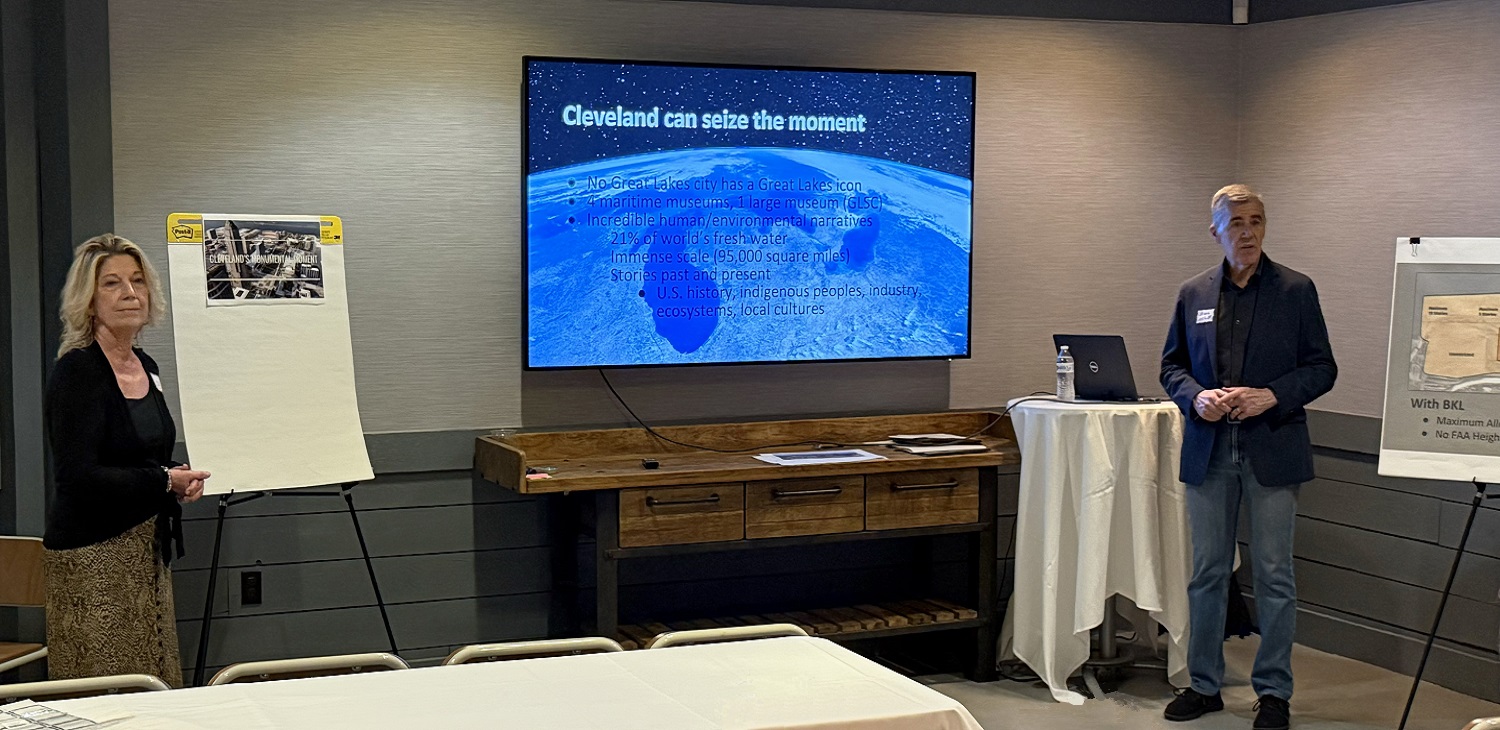
Judy McGlinchy, left, and Craig Astler presented “monumental” ideas for redeveloping Downtown Cleveland’s North Coast Harbor at a public meeting last week at Merwin’s Wharf in the Flats (Paul Heney). CLICK IMAGES TO ENLARGE THEM.
Advocates seek iconic feature in plan
A GUEST COLUMN
With the Cleveland Browns leaving the city for Brook Park in the next few years, plans for what’s next on the lakefront are heating up. Architectural firm MVRDV, based in Rotterdam, Netherlands, is expected to unveil an update of the entire lakefront plans in the next month or two, on behalf of the nonprofit North Coast Waterfront Development Corporation.
But several well-connected local citizens are speaking up, saying that the plans need to include a monumental centerpiece. They are pushing for city leaders to think bold and construct a metaphorical “Lighthouse of the Great Lakes.” The three bring bona fides to the idea.
Craig Astler is a retired advertising and PR executive — and former president of the Cleveland Waterfront Coalition, which created the North Coast Harbor and related developments that we know today. Judy McGlinchy is a senior associate at Bostwick Design Partnership and Ryan Scavnicky is a professor in Marywood University’s School of Architecture.
Thinking big
“This is obviously a generational opportunity for the city of Cleveland, that probably won’t happen again for decades, if longer,” said Astler. “We’re really at a crossroads, and with so much land opening up on the lakefront, that’s consequential — and it is going to change what people think of as downtown Cleveland.”
“It’s a huge responsibility and opportunity to get it right, to get something that’s compelling for people to come down on a regular basis and to gain a greater appreciation for what Cleveland’s waterfront means to the to the city and to its residents,” he added. “Our feeling is that it’s going to take something truly dramatic and even iconic to change the narrative.”
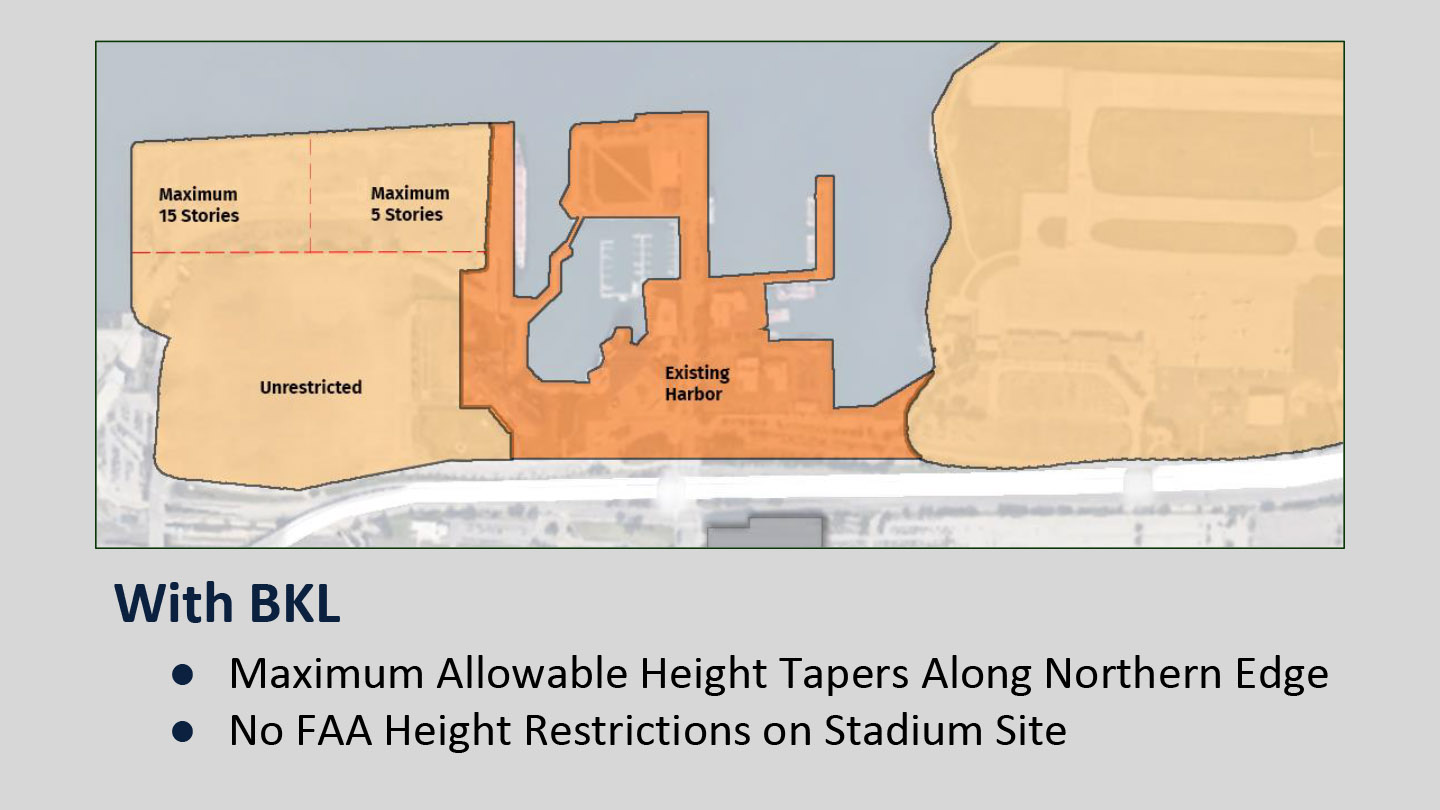
Building tall on Downtown Cleveland’s lakefront has its restrictions due to the presence of Burke Lakefront Airport at right (contributed).
Astler said their vision focuses on Cleveland’s place on the Great Lakes and would allow visitors and residents to learn and reflect on the city’s history, connection to the water, and environmental issues — and its ultimate successes in cleaning up the river and lake.
He said that when he was president of the Cleveland Waterfront Coalition, he received a journeyman’s education in urban development and urban planning, but also learned what a waterfront really means to a city. “It’s precious. It’s a precious resource because it’s so limited,” he said.
McGlinchy grew up near Amherst and Vermilion and recalled how she could ride her bike all the way to the lake. “The lake was always a part of my life. I was always on my brother’s boat. We just adore our Lake Erie,” she said.
When she moved to Cleveland after college, she heard about the Cleveland Waterfront Coalition and got involved.
“[I thought] this is a group I want to get involved with because that’s when they were starting to focus on taking the parking lot and turning it into the Inner Harbor. As a young architect, it was a thrill to work on something like that and be a part of it,” she explained.
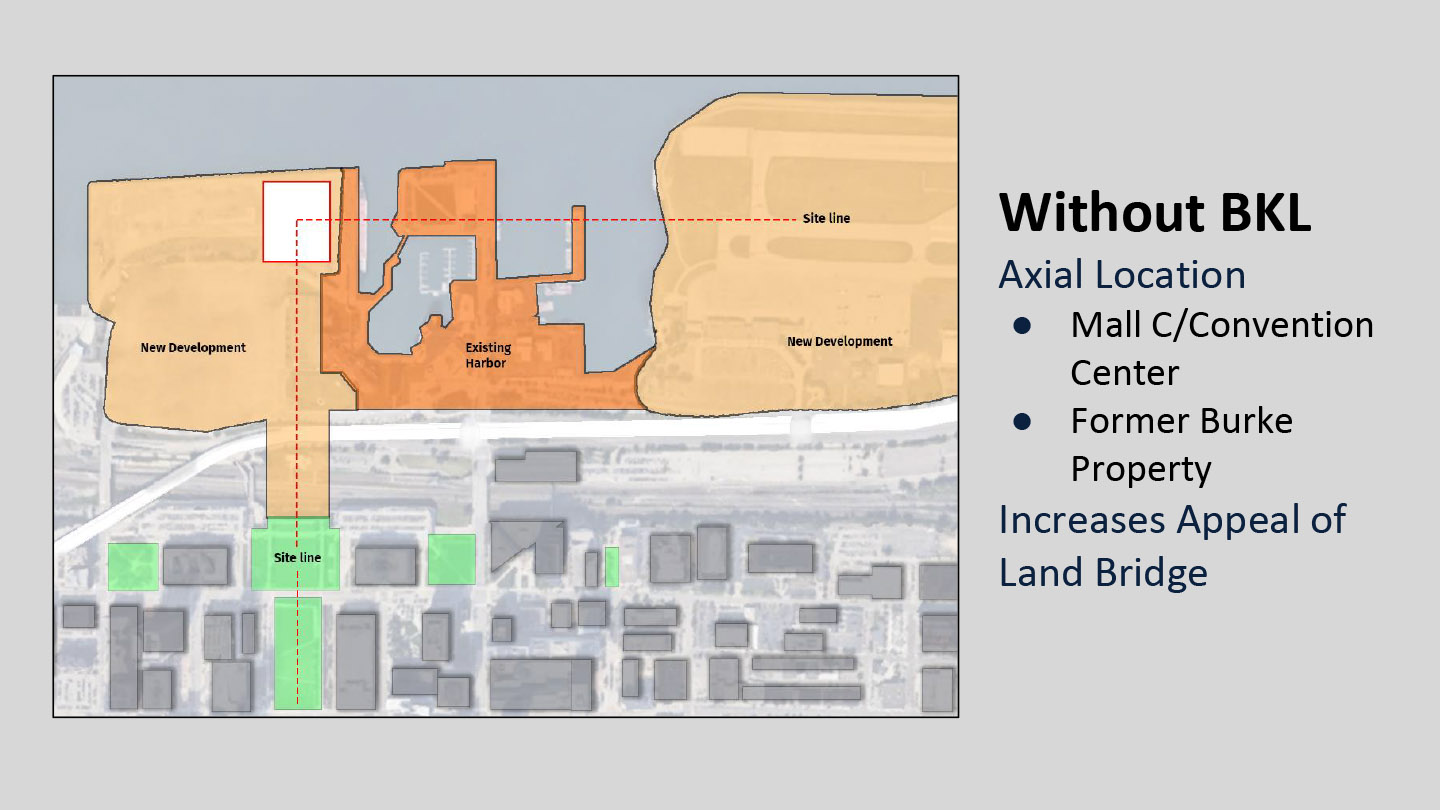
Without Burke Lakefront Airport, however, the sky is the limit for Downtown Cleveland’s lakefront (contributed).
Now, she said, as an adult having traveled to many cities, she sometimes sees a development or project and wonders why Cleveland doesn’t have something similar.
“From Martin Luther King Jr. Boulevard to the Cuyahoga River and beyond to the west, we really need to work on our waterfront,” said McGlinchy. “When this piece of land popped up, I thought, ‘We have to do something special with this.’”
Focus on the Great Lakes
Central to the idea for a monumental structure is that there is no manmade structure that is iconically connected to the Great Lakes, which holds 21 percent of the world’s fresh water and takes up an immense 95,000 square miles. Astler and McGlinchy feel like the time it right to seize the moment and build something before another city does.
“It’s very important to today’s young generations that sustainability and clean water are addressed. And we really want this this icon or this monument to be more than about Cleveland, but also about the Great Lakes in general — all the Great Lakes, how Lake Erie is a component of that, and how Cleveland is a huge component of that,” said McGlinchy.
While they don’t have their own proposal for an exact design, they do want the monument to feature an observation deck, perhaps a restaurant high above the city, and a world-class museum dedicated to the five Great Lakes, their history, ecology, and importance.
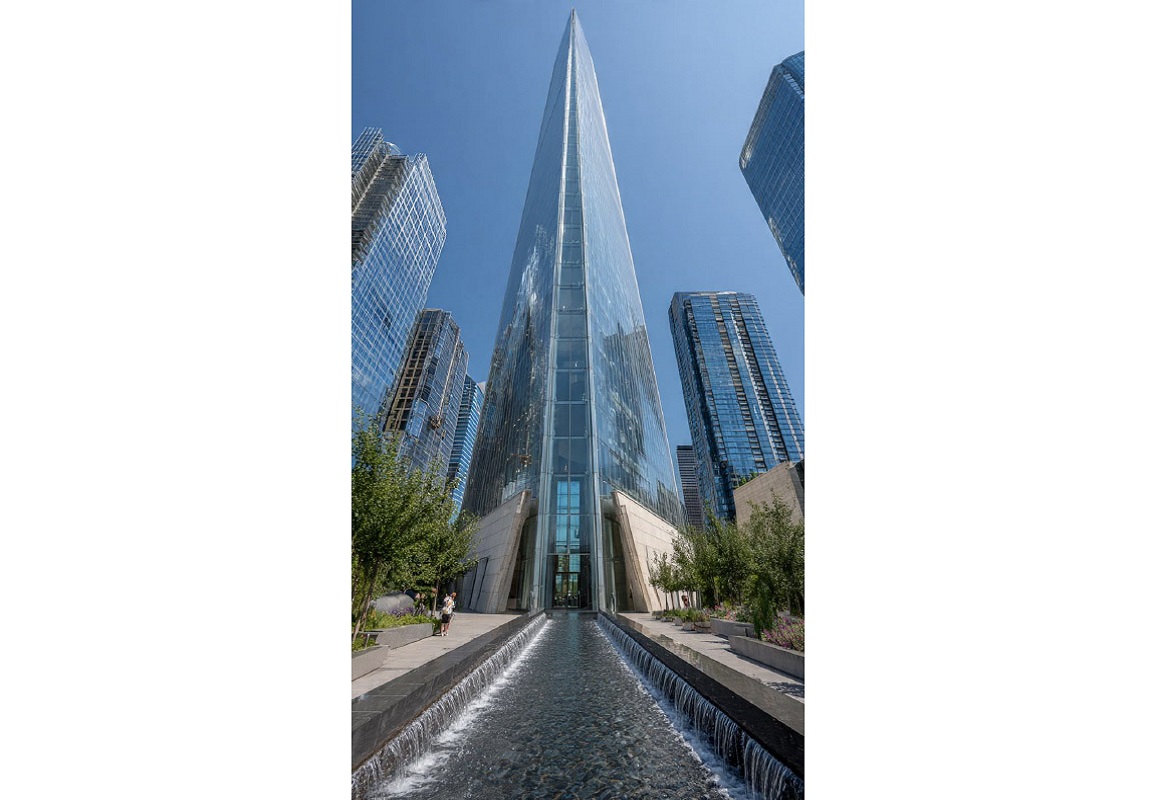
Downtown Lakefront monument concept 1 (contributed).
Cleveland’s history in polluting the Cuyahoga River and Lake Erie and the environmental turnaround here — not to mention the Cuyahoga River’s fire leading to the creation of things like the U.S. EPA, Earth Day, and the Clean Water Act — would be an inspirational story to tell, they said.
Astler and McGlinchy have quietly spoken to various leader and entities but felt that they needed some public input at this stage. They presented their concepts publicly for the first time to a gathering of citizens on Sept. 30 at Merwin’s Wharf in the Flats, and feedback from the crowd was overwhelmingly positive.
They showed several renderings, generated with AI, just to give a flavor of what is possible. Both noted that the monument should be bold and symbolic, provide transparency and reflection, and be dramatically lit at nighttime.
And water needs to be an integral element of the structure; one example showed five dramatically cantilevered floors extending from a central shaft, each dedicated to one of the lakes, with water flowing between each.
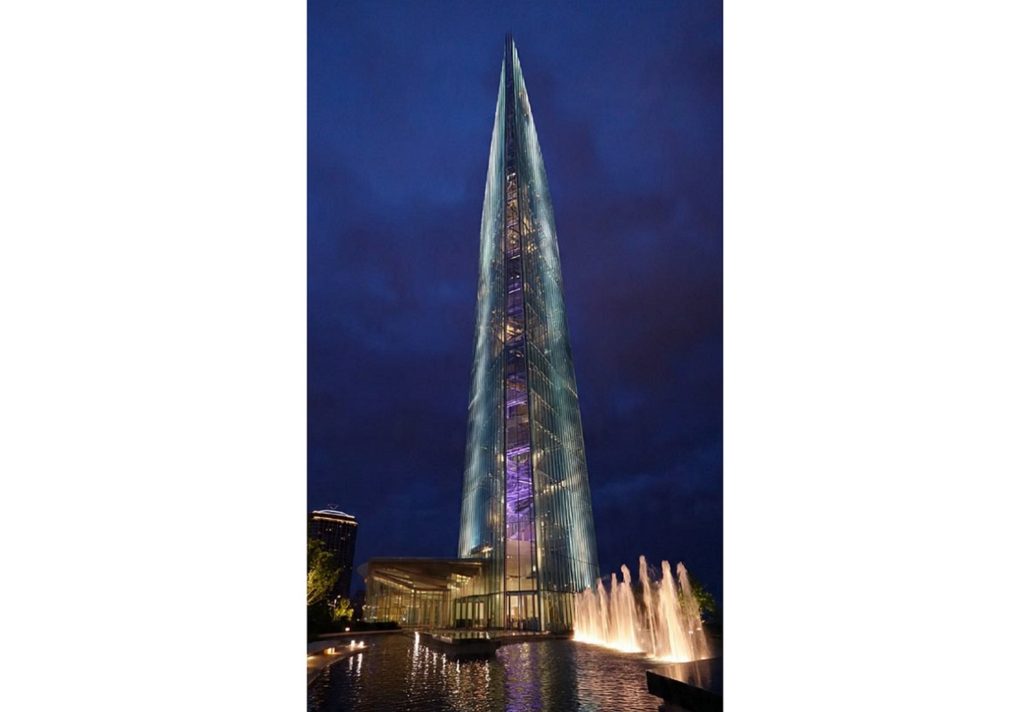
Downtown Lakefront monument concept 2 (contributed).
And while the questions of Burke Lakefront Airport’s future haven’t been fully answered yet, Astler and McGlinchy showed maps that indicated the southern portions of the lakefront land do not face a height restriction from the FAA, meaning that the project could soar into the Cleveland skyline.
They envision something at least 500-600 feet tall, if not higher, wanting visitors to have a new perspective on the city and lakeshore.
Economic engine
Part of their Sept. 30 presentation explained how globally iconic structures can be economic engines for cities, and they gave several examples:
- Seattle’s Space Needle cost $4.5 million in 1962 ($56 million today), is the centerpiece of Seattle Center with multiple museums, has more than 2 million visitors annually, and visitors spent $1.5 billion in 2024;
- The St. Louis Gateway Arch cost $13 million in 1965 ($138 million today), has a $572 million annual economic impact, boasts 2.4 million visitors, and provides $30.7 million in tax revenue;
- The CN Tower in Toronto cost $63 million in 1976 ($350 million today), sees more than 2 million visitors per year, brings in $316 million in annual revenue, and is the centerpiece of an $8 billion Toronto tourism industry;
- Millennium Park in Chicago, which is roughly half the acreage that Cleveland will have to redevelop, cost $490 million and features $78 million in annual tax revenue, as well as $11.1 billion in direct and indirect spinoff spending.
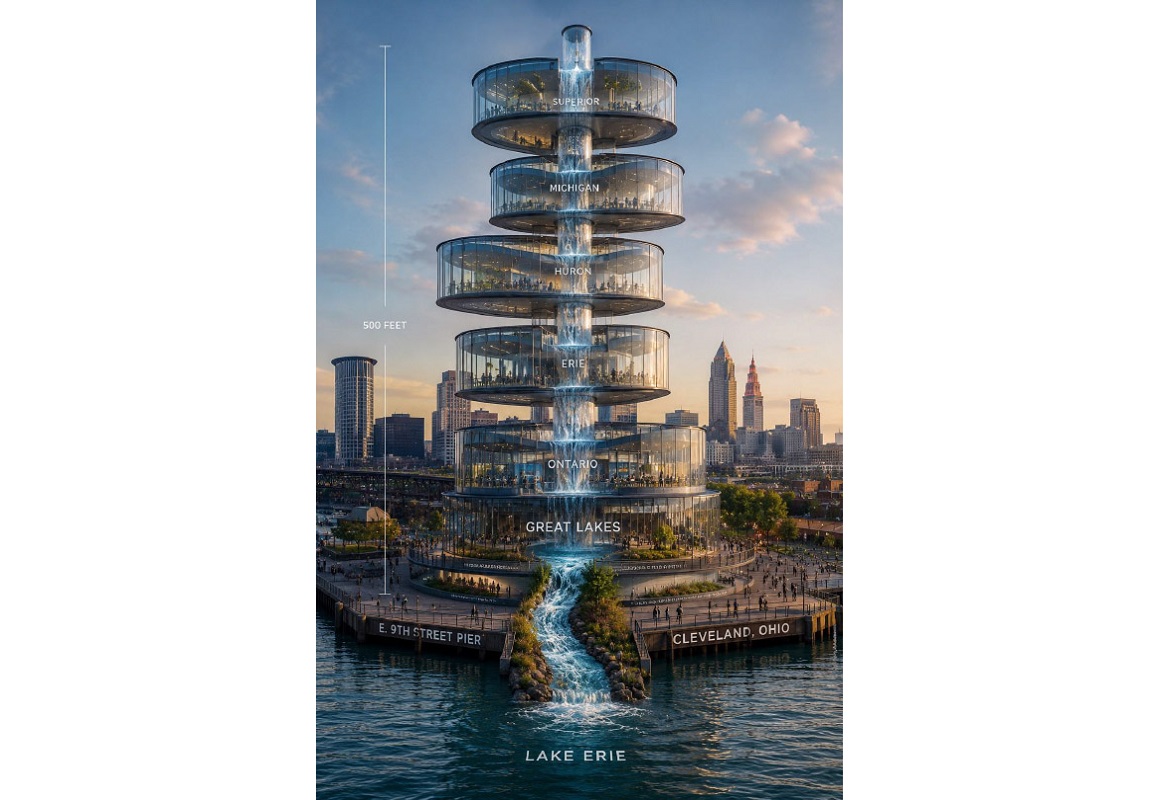
Downtown Lakefront monument concept 3 (contributed).
“From what research we’ve done, not just in the U.S. with the with the Gateway Arch and Seattle’s Space Needle, but other places around the world, is that typically this happens through a combination of a blend of different sources,” said Astler. “It might be philanthropic dollars, it might be corporate contributions, it might be corporate investment.”
He said it was important to note that this type of project would not rob needed community services.
“This does not come at the cost of neighborhoods, of schools, of roads, of health and human services, anything like that,” Astler said. “This goes on a different line in the ledger.”
“When you take on a project like this, it is truly a civic undertaking, and so you look at different sources,” he explained. “If anything, a government might guarantee a project, but they are not paying for it out of out of tax revenues.”
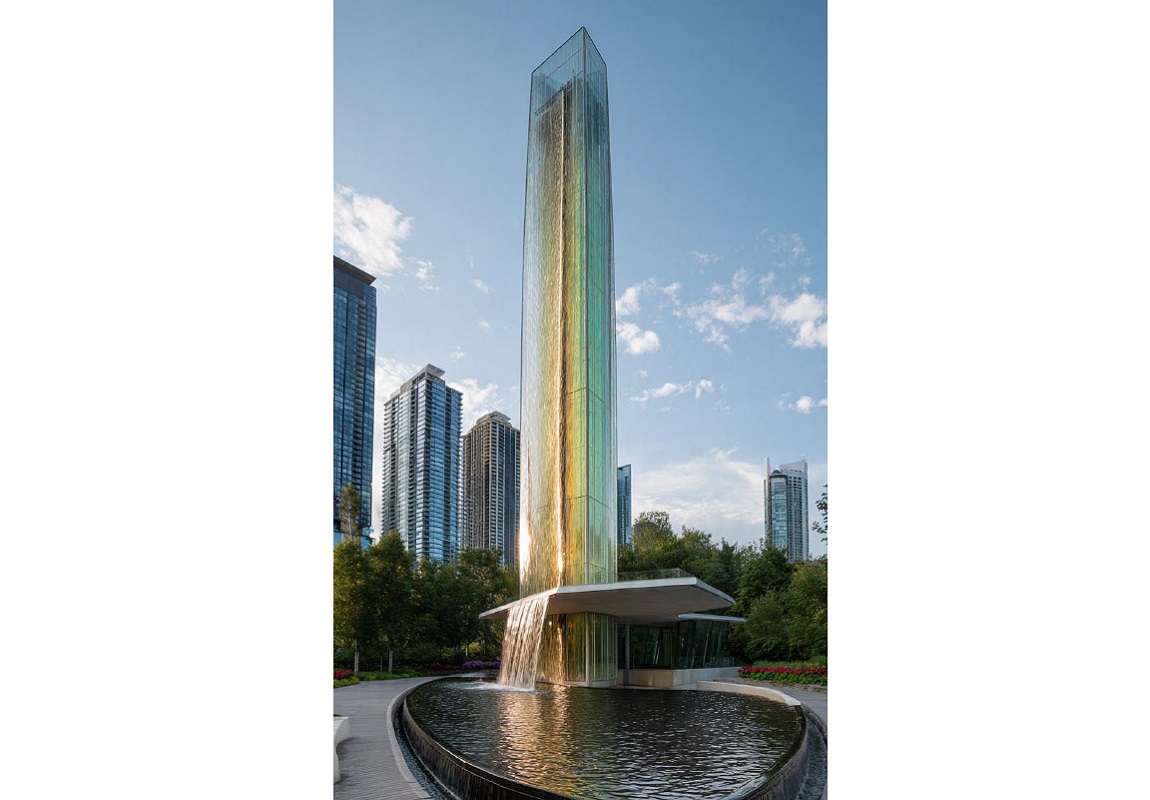
Downtown Lakefront monument concept 4 (contributed).
MVRDV’s aforementioned update of the lakefront plans is key in their minds. Ideally, McGlinchy said, they’d get this concept into the firm’s overall plan.
But as timing is short, they may have to pivot and focus more on pitching the idea to the public. Then the hope would be to build excitement — including in public feedback sessions on the lakefront plan — that would push leaders to include the monument.
“This is worthy of a design competition,” said McGlinchy. “This is something where the best of the best of the national and international firms should be encouraged to put their design efforts together. And I think we could come up with something really wonderful.”
“Especially because it’s environmental in nature, it’s not just a statue,” said Astler. “This is something that that makes a statement about our relationship to the environment. We’ve got the land and a place to do it. We have the opportunity.”
END