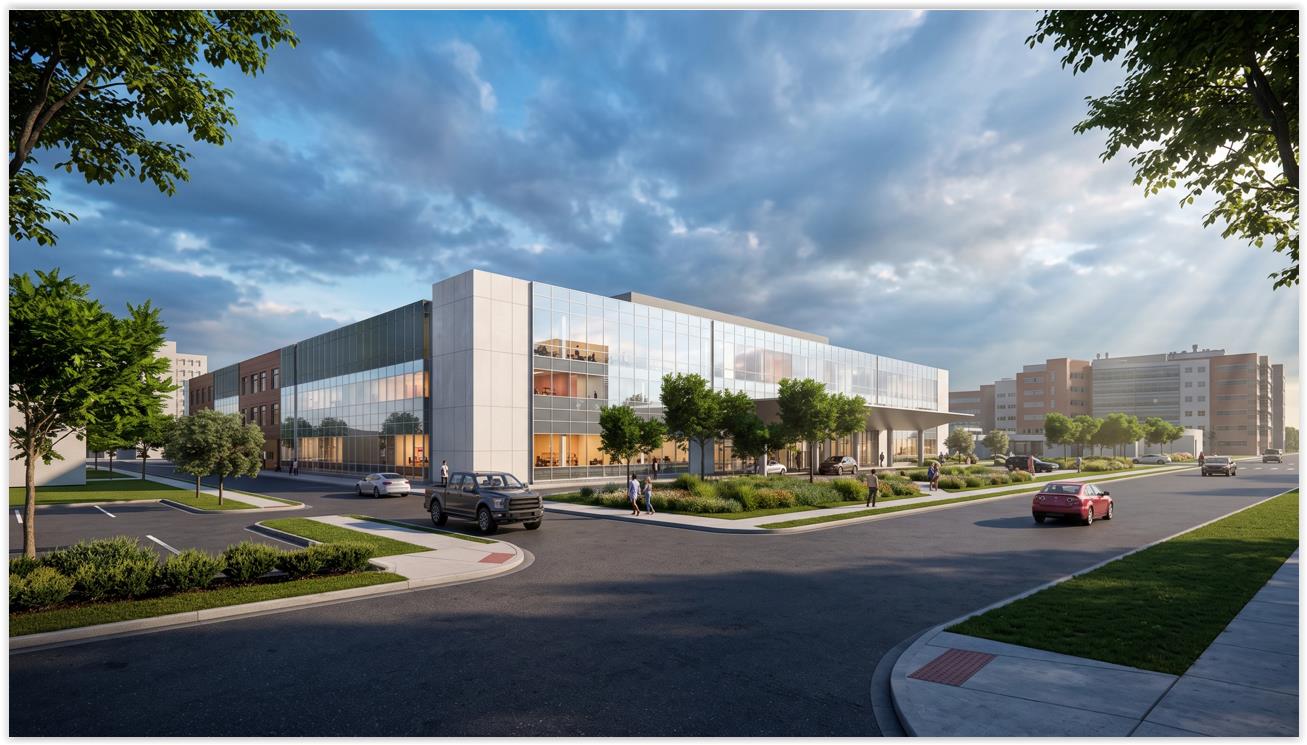
Cleveland Clinic’s to-be expanded Emergency Department on Cedar Avenue at East 90th Street in Cleveland’s Fairfax neighborhood will push out its parking to nearby blocks currently occupied by homes. The demolitions will start next week (Cleveland Clinic). CLICK IMAGES TO ENLARGE THEM.
Site prep work about to get started
Way back in the good old days of the early 2000s, $230 million would be enough money to afford building a landmark 50-plus-story skyscraper. Today, with inflation and a very specialized building to construct, that same amount of money will achieve a structure of far less scale.
But to the Cleveland Clinic Foundation, it considers its impending, expanded Emergency Department no less important. That structure is officially called the E Building in its alphabetic-coded identification system for its Main Campus buildings near University Circle.
Here, $230 million is the projected construction cost of the three-story-tall, 130,000-square-foot Emergency Department expansion at 9105 Cedar Ave., in Cleveland’s Fairfax neighborhood. That’s according to a permit application submitted Aug. 29 to the city’s Building Department.
Work is already getting underway. Trees were taken down and fencing has gone up prior to the demolitions of six structures for the relocation of most of the Emergency Department’s parking.
The reason is that the expansion will rip up all but 17 spaces of the E Building’s 112-space parking lot and reroute existing utilities, costing approximately $2.5 million. Another 13 spaces will be added along the vacated East 93rd Street north of Cedar.
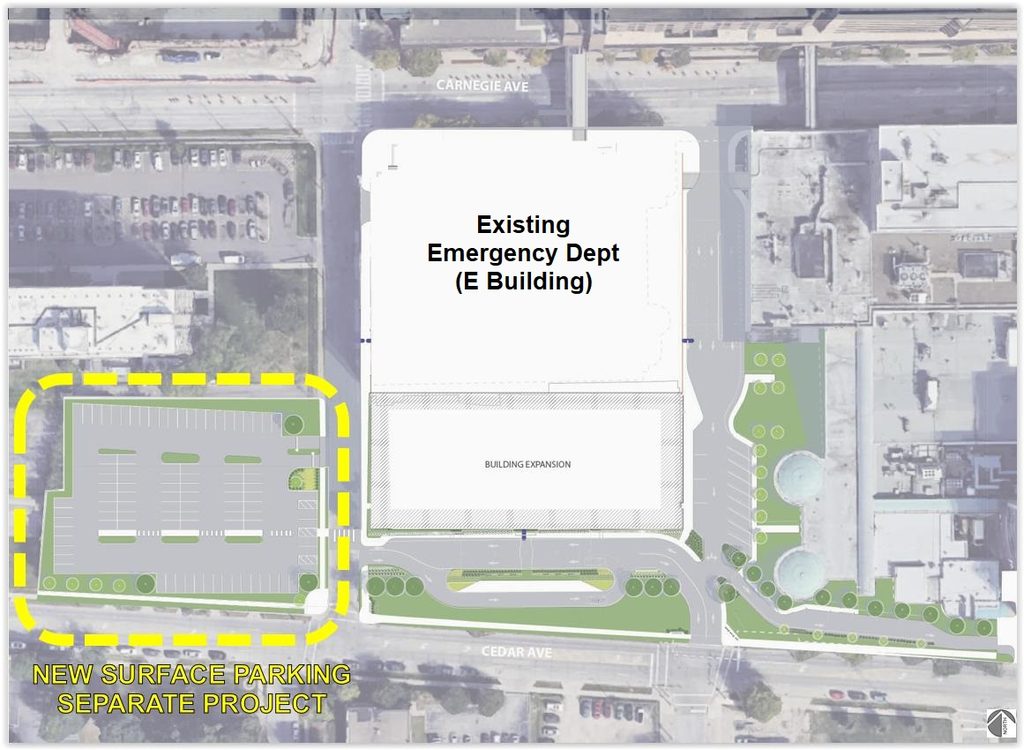
This updated site plan shows the E Building, its planned area of expansion and its surrounding areas and uses, present and future (Cleveland Clinic).
NEOtrans broke the story last month that the Clinic has acquired 1 acre of land, across East 90th Street from the Emergency Department and its parking area, so the Clinic can construct a roughly 140-space parking lot. It is one of several site-enabling package of projects for E Building’s expansion.
Among the property acquisitions was a land swap with Bikur Cholim, a faith-based medical support nonprofit that had just acquired the land for its planned $10 million Cleveland Comfort House. Thanks to the swap, that center now has a new location at Chester Avenue and East 93rd Street on which to build.
Crews will demolish five two-family residences — at 2116 and 2118 E. 90th and at 8921, 8927 and 8931 Cedar. The last two had commercial structures added on to their fronts including the former Doc & Lennie’s restaurant.
Demolition equipment may appear on-site as early as next week. B&B Wrecking & Excavating of Cleveland is carrying out most of the demolition work as a $183,000 site-enabling project. The demolition permits were approved at the end of August.
The sixth building to be demolished is a vacant, former Texaco gasoline and three-bay service station at 9300 Cedar and built in 1920 in the Spanish style. C&J Contractors Inc. of Cleveland is handling this nearly $34,000 job. A separate parking lot of undetermined size will be built here in the near future.
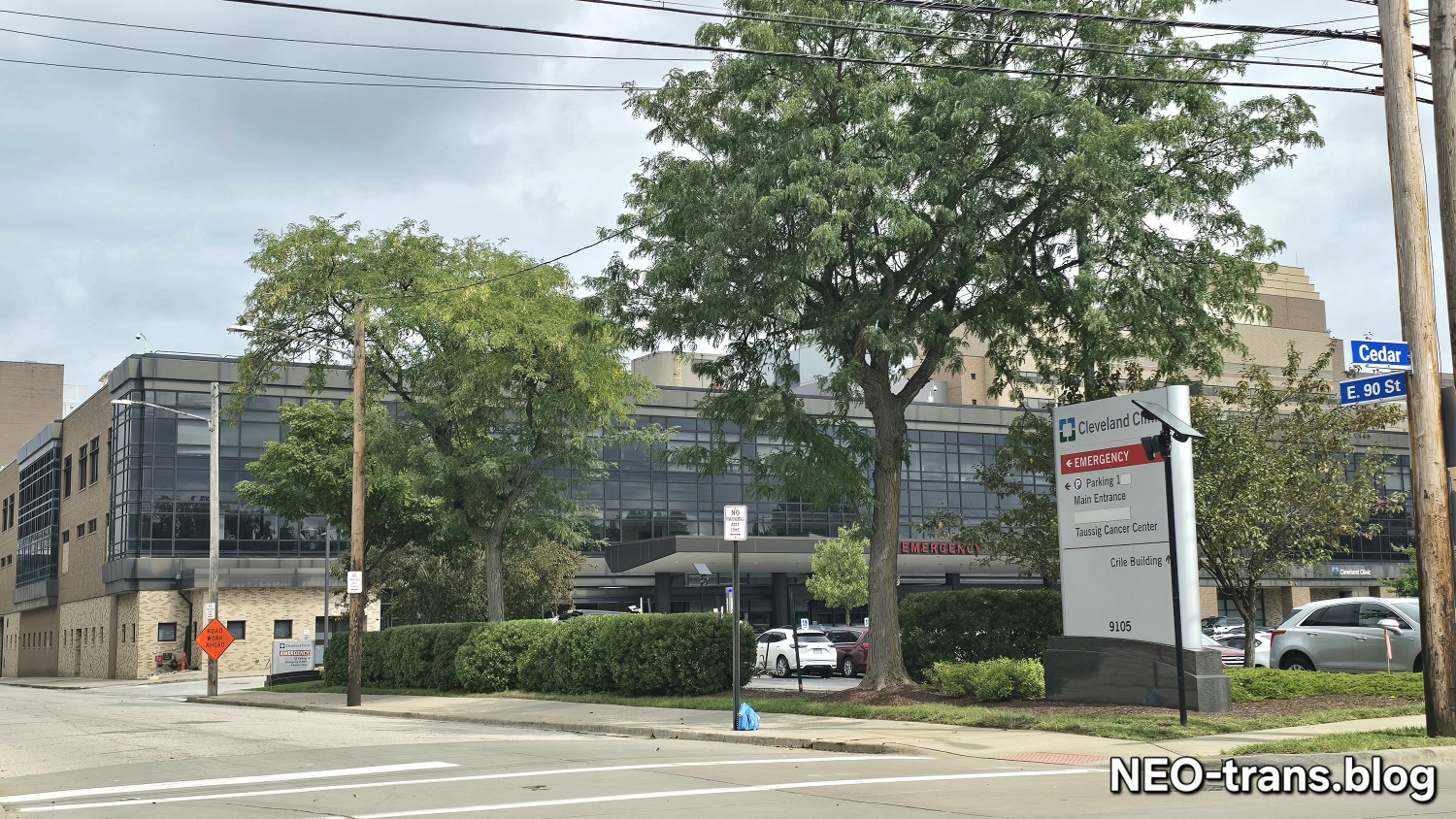
This is what the Cleveland Clinic’s E Building looks like now. Most of the parking lot at right will be erased so the Emergency Department can be expanded on to it. That means at least one new parking lot will be built, at left, across East 90th Street (NEOtrans).
Cost of acquiring the properties for the relocated parking lots is $935,000, a reduced figure thanks to the land swap with Bikur Cholim. Their spokesman praised the deal because it got for them a parcel twice as large and in a better location, he said.
Yet another site-enabling project is an interim, East 90th-side entrance for Emergency Department patients who self-present during construction. Cost is $250,000, according to plans submitted to the city.
A big chunk of the funding for the Clinic’s expanded Emergency Department is coming from a $50 million gift from the Jack, Joseph and Morton Mandel Supporting Foundation.
“We are deeply grateful to the Mandel Foundation for their partnership and support,” said Cleveland Clinic CEO and President Tom Mihaljevic in a written statement.
“The expansion of our emergency services will help us better care for patients with the most serious injuries, ensuring they receive the specialized treatment they need, when it matters most,” Mihaljevic added.
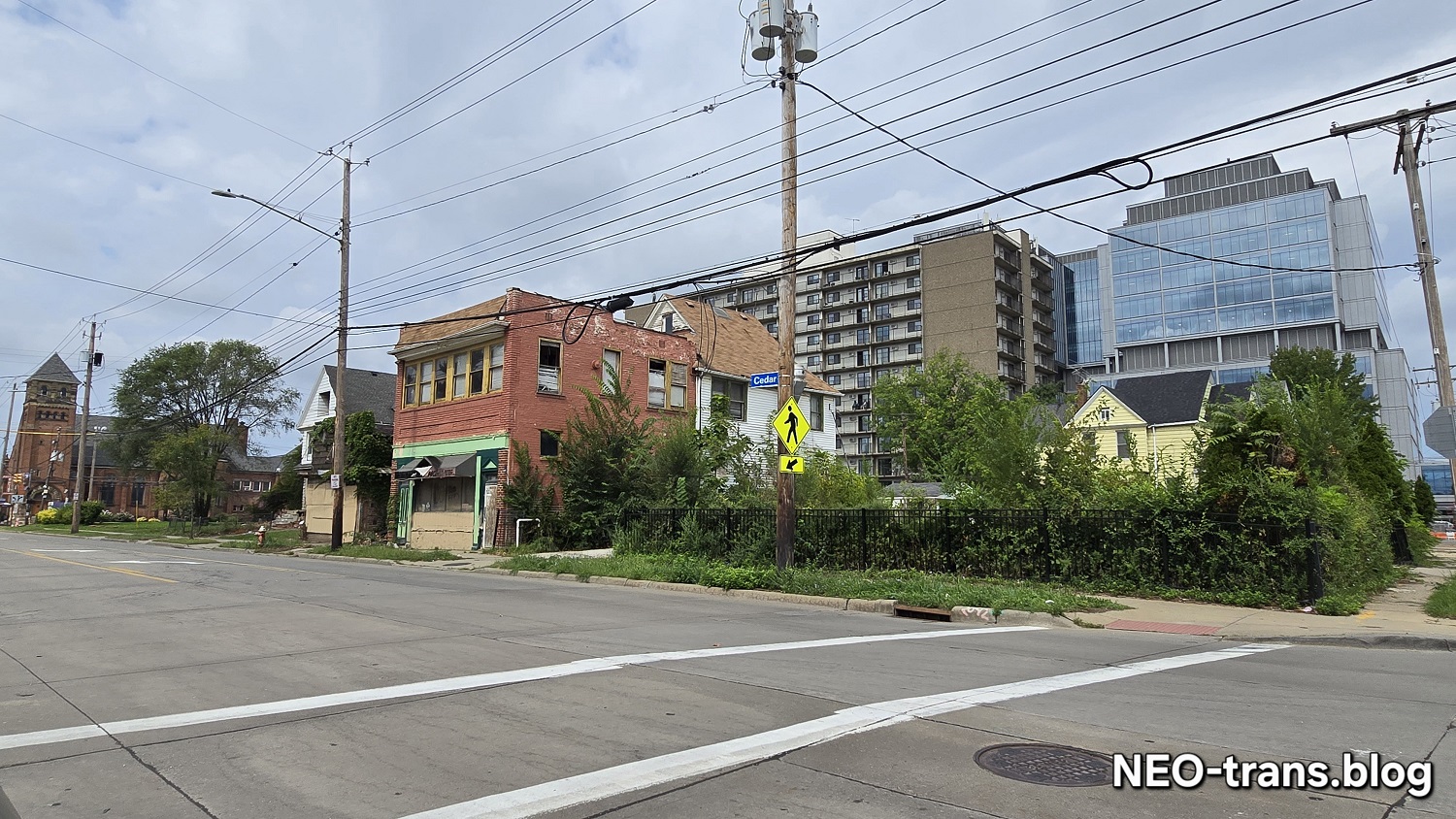
The northwest corner of Cedar Avenue and East 90th Street is going to look very different starting this month. Five structures, mostly two-family houses including two that were expanded with commercial fronts, will be demolished for the primary parking lot for the Cleveland’s Clinic’s expanded Emergency Department (NEOtrans).
Not to be ignored is the existing, 1994-built, 228,000-square-foot Building E, also called the Maria & Sam Miller Emergency Services Building. The About 23,500 square feet of it will be renovated, per plans submitted to the city by the Clinic’s Buildings and Design staff.
Renovations also involve “building-wide upgrades and replacement of various MEPT (mechanical, electrical, plumbing, and technology) systems and head-end equipment (that handles communication, data and information) within the existing E Building extending to areas outside of primary renovation areas,” the application noted.
The project will provide on the first floor of the expanded structure five trauma rooms, 20 emergency department treatment rooms, four resuscitation rooms, a triage area with 12 exam spaces, plus radiology (CT and X-Ray) facilities.
The second floor will have 11 operating rooms, a 33-bay post-anesthesia care unit (PACU), 16-bed inpatient observation unit, 13-bay observation/PACU flex unit and blood bank. An existing PACU and lab space will be renovated to create the flex unit.
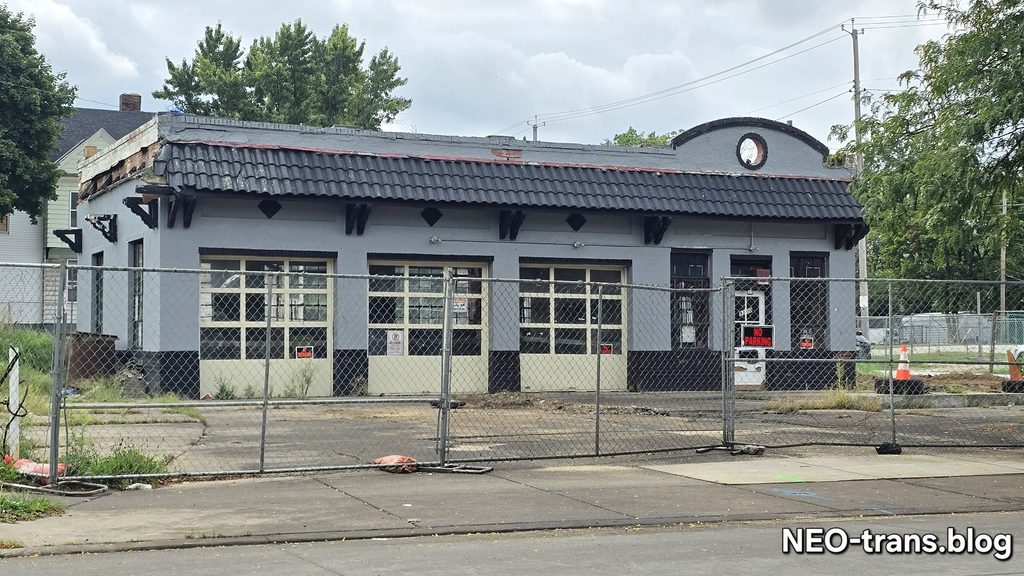
Fencing is already up around this unique, Spanish-styled Texaco gas and service station that was built in 1920 at the southeast corner of Cedar Avenue and East 93rd Street. It will be demolished for a future parking lot (NEOtrans).
On the third floor will be the emergency department’s staff support and administrative offices plus an enclosed mechanical space. Atop the third floor will be a mechanical penthouse and helipad vestibule. The helipad will remain atop the existing E Building.
“The expansion will significantly enhance emergency, surgical and critical care capabilities while improving patient flow, operational efficiency, and overall quality of care,” wrote Edward Matthew Paine, principal at Hasenstab Architects, Inc. of Cleveland in the permit application.
A goal of that enhanced care is so that the global health system can possibly secure a Level I trauma center designation from the American College of Surgeons. That’s the highest level trauma rating a hospital can have.
But that has been met with opposition from University Hospitals and MetroHealth Medical Center, both of which offer competing Level I trauma care facilities. The latter is updating its own Emergency Department at its main campus, south of downtown, but for a more modest $9 million.
END