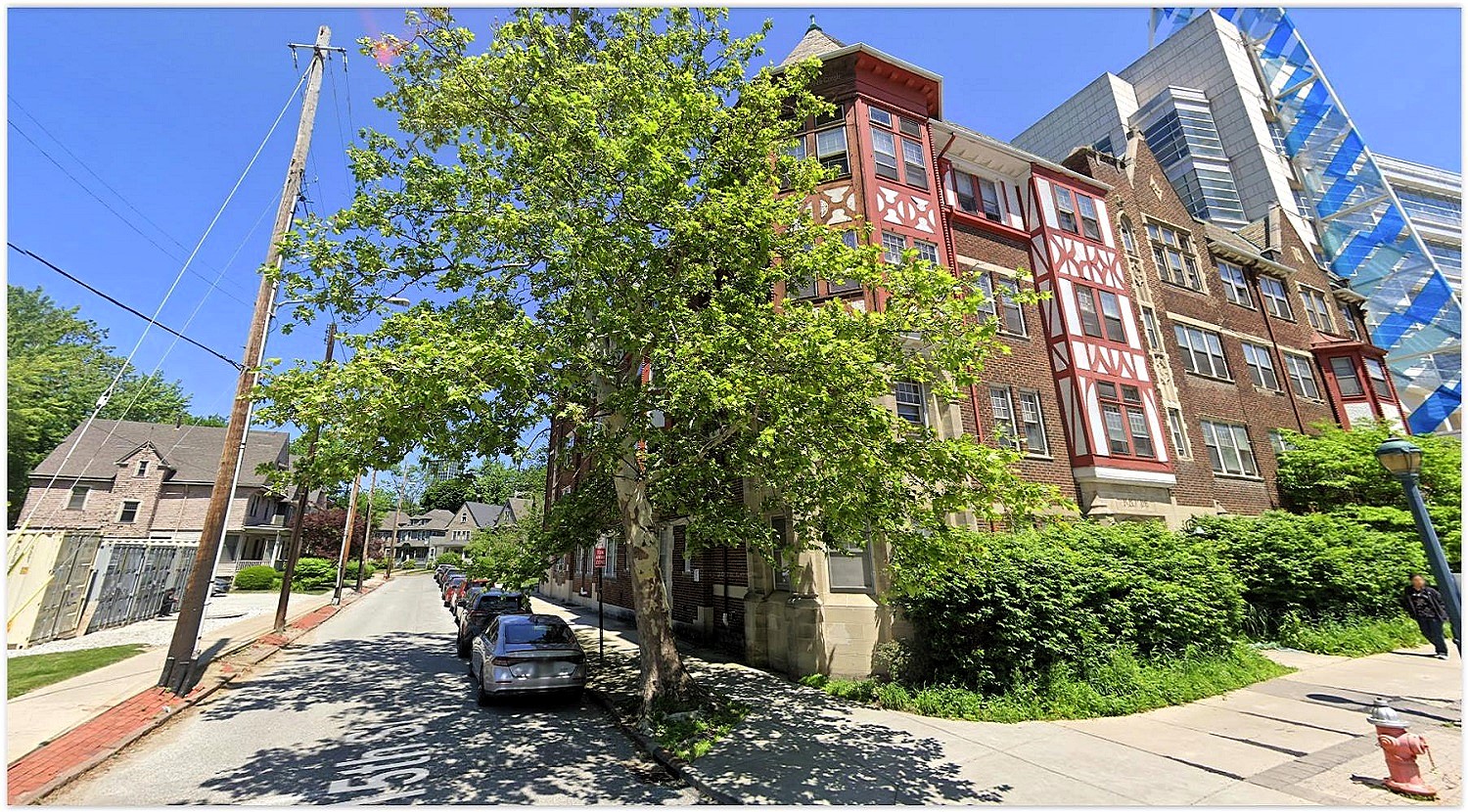
This view looking north on East 115th Street in University Circle could change dramatically once University Hospitals is given final permission to demolish houses in the background and the apartment building in the foreground for parking (Google). CLICK IMAGES TO ENLARGE THEM.
CWRU, UH seek to manage parking, growth
Two of Northeast Ohio’s prominent institutions are learning first-hand what it means to deal with growth in one of the state’s hottest job centers. While it’s a good problem to have, the ways of solving it require a look at transportation demand management strategies in a space-limited district.
Located next to two of Greater Cleveland Regional Transit Authority’s (GCRTA) Red Line rapid-transit stations, the two institutions have opted for pursuing additional parking projects that shuffle around and expand existing offerings.
On Friday, Case Western Reserve University (CWRU) and University Hospitals (UH) came to the Cleveland City Planning Commission with two separate demolition proposals that would accomplish this goal. Combined they would create hundreds of new spaces for University Circle patrons.
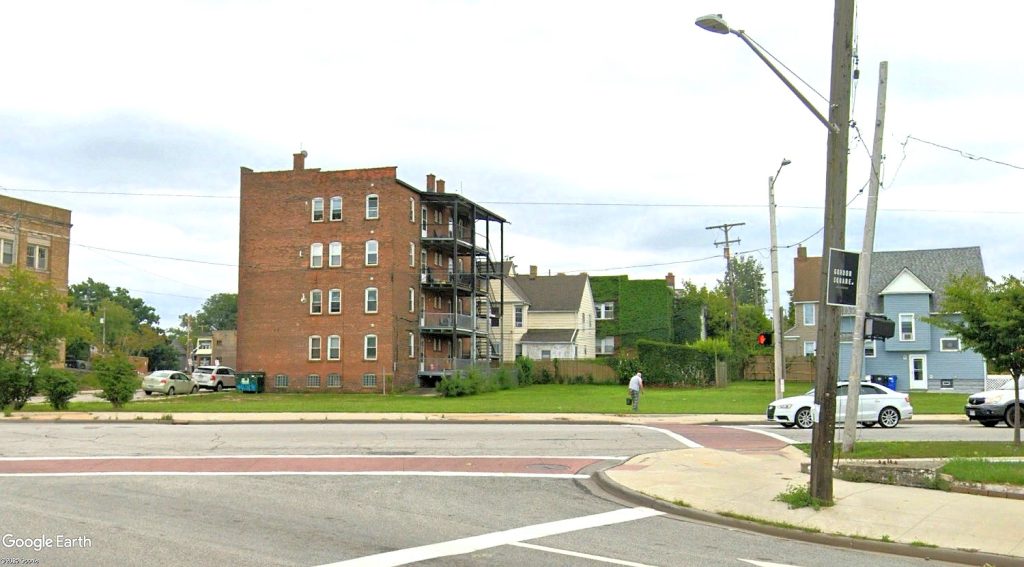
CWRU’s proposal sought demolition of the former Centers for Dialysis Care building at 11717 Euclid Ave. Since moving to 2155 Stokes Blvd. on the south side of University Circle in 2019, the old building has sat empty along highly trafficked corridor.
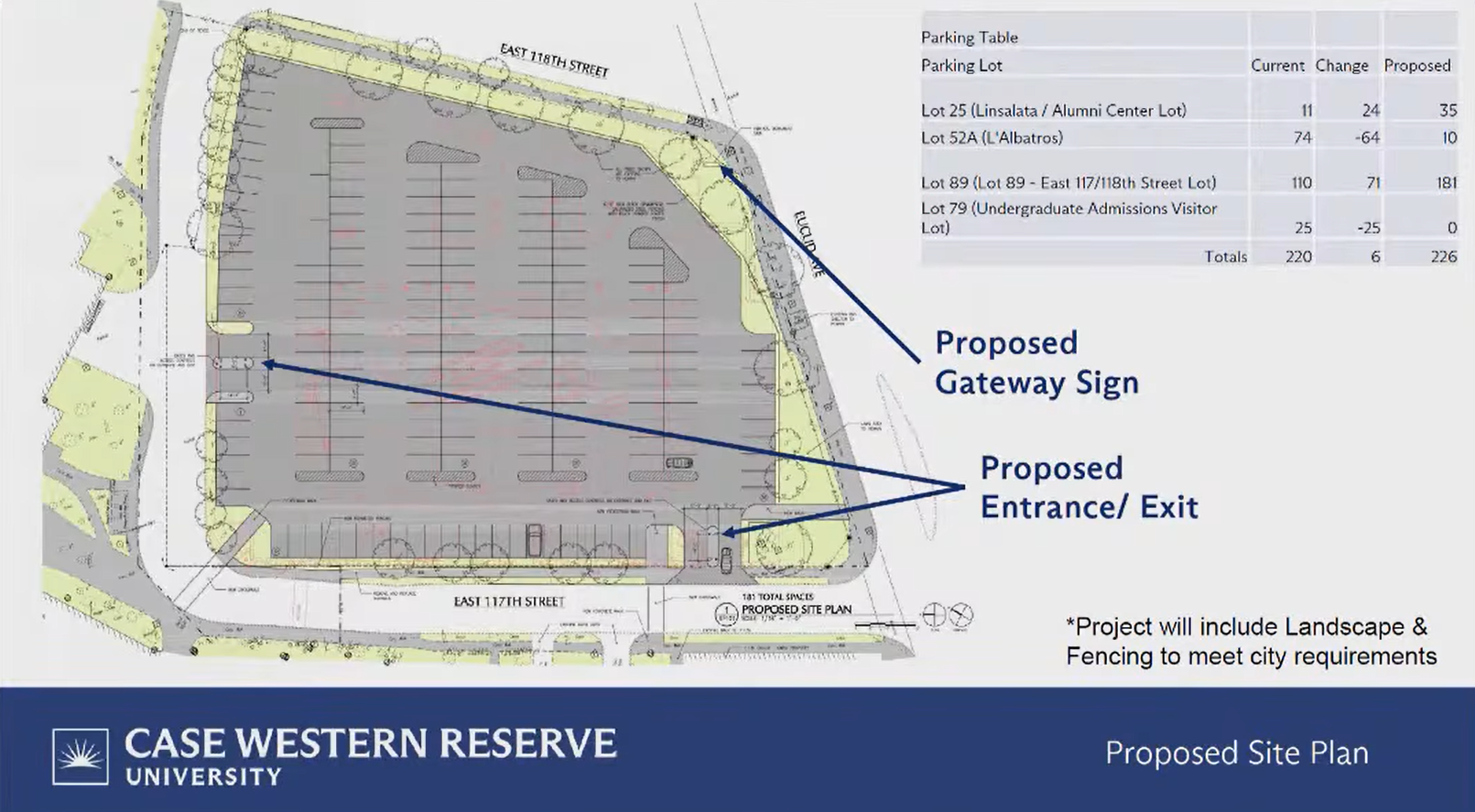
A site plan shows how the former Centers for Dialysis Care building at 11717 Euclid Ave would be demolished and replaced with parking (CWRU).
According to university representatives, the purpose of the demolition is to retain the existing 110 spaces and create additional parking that will replace capacity lost to the proposed Jack, Joseph and Morton Mandel Humanities Building on Bellflower Road. Announced in April 2026, that project is backed by a $125 million gift from Mandel Foundation.
The design review advisory committee and city planning staff both supported the demolition. Ultimately, the planning commission voted unanimously to approve it. Commission Vice Chair August Fluker requested that the university provide chargers for electric vehicles as part of their final plan.
The second demolition request was presented for final approval as well. University Hospitals — one of Ohio’s largest employers — sought approval to demolish 12 abandoned, historic houses on East 115th Street adjacent to the Wolstein Research Institute.
Capacity issues are common nowadays for most healthcare providers as the industry sees continued growth. For an area as densely-packed as University Circle, the options to grow are limited. Cleveland Clinic is experiencing growth pains too; it plans to build two large parking garages and raze structures for its growing Emergency Department.
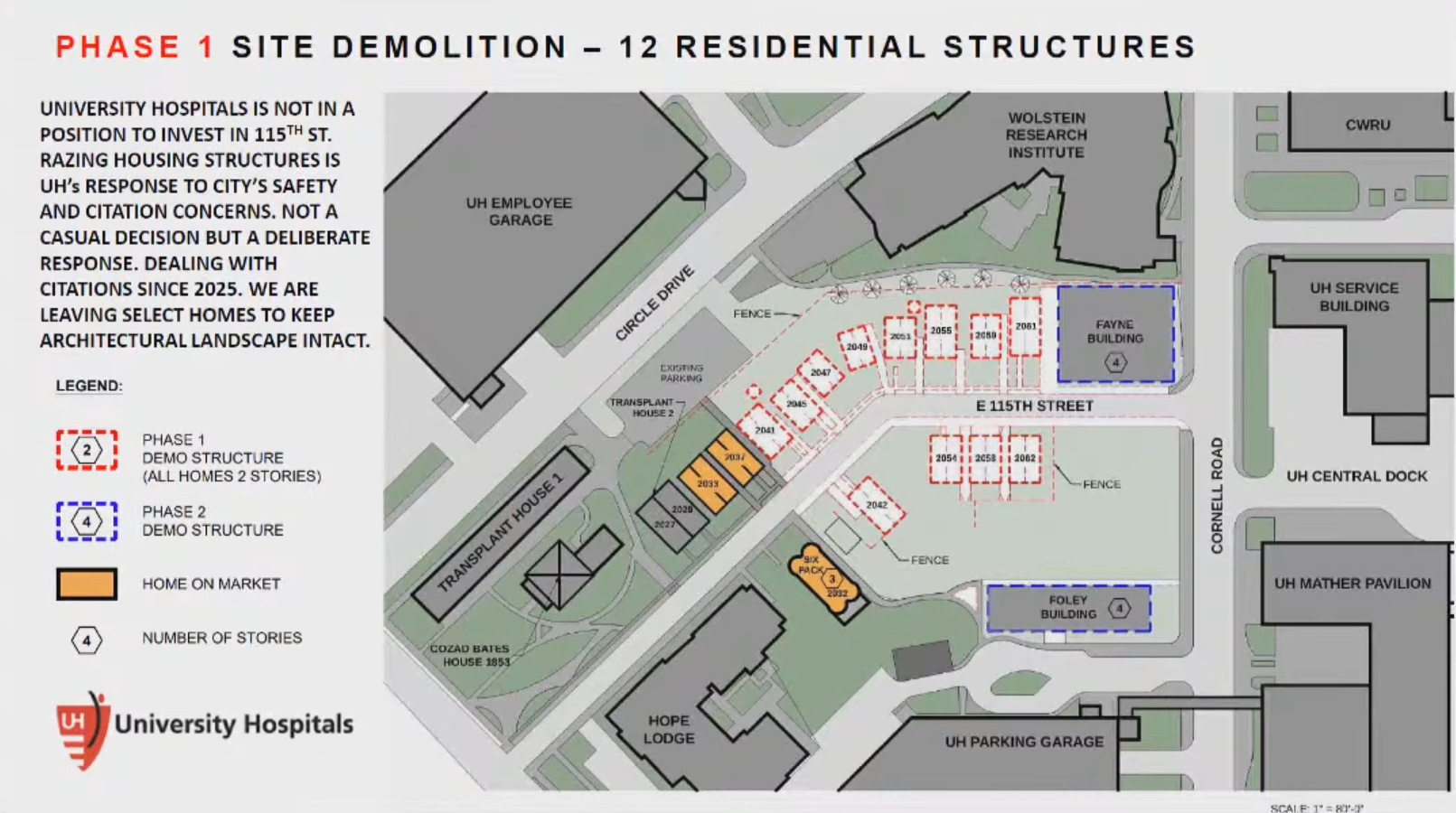
Outlines in red are the existing houses on E 115th that University Hospitals plans to demolish for temporary parking (University Hospitals, LevelHEADS).
“From the beginning, the intent was to always leverage this site as really the only expansion opportunity we have for the organization,” said Stathis Antoniades, president of UH’s Cleveland Medical Center.
University Circle Inc. (now University Circle Alliance) and UH previously partnered for decades to maintain and market the homes along East 115th. That partnership ended in 2022 however, and now the maintenance and upkeep of the homes is no longer within UH’s capabilities.
“[In 2022] We were still in the midst of a pandemic,” continued Antoniades. “Frankly, we were in a difficult situation financially; we lost hundreds of millions of dollars between 2022-2024 and we were not in a position to invest in these properties. We received citations from the City of Cleveland.”
The case was previously tabled at the local design review committee due to concerns about the demolitions negatively impacting the neighborhood. Neighborhood advocates argued that the homes could be saved and repurposed at risk of losing the architectural uniqueness of the street.
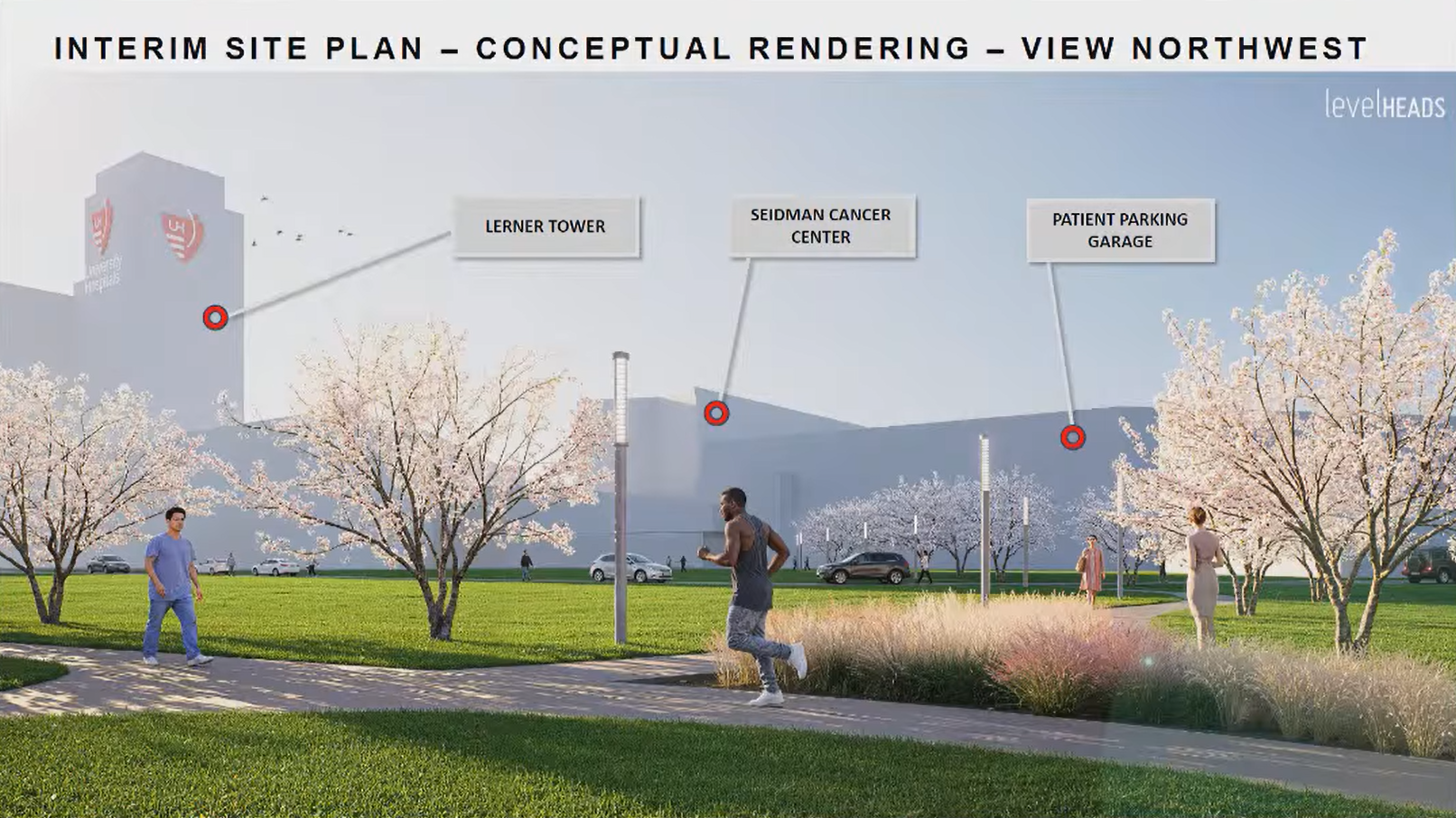
While the interim condition proposes temporary surface lots, UH plans to make several pedestrian path, lighting and landscaping improvements that would be permanent (University Hospitals, LevelHEADS).
Committee members told UH it would not consider the demolitions unless UH returned with a building plan that offered higher and better uses than those it was proposing to demolish.
As a compromise, UH agreed to leave four properties that were previously proposed for demolition intact on the northern end of the street due to their proximity to the Cozad Bates House and Hope Lodge.
According to architect of record Chris Trotta representing LevelHEADS, those homes will go to market to determine future demand. “What you’re seeing here is our best attempt to meet the community as close as we can meet them,” added Antoniades.
In the interim, two surface parking lots are proposed to replace the demolished homes. Also proposed are significant pedestrian improvements, including new walking paths connecting the various garages on Circle Drive to main campus.
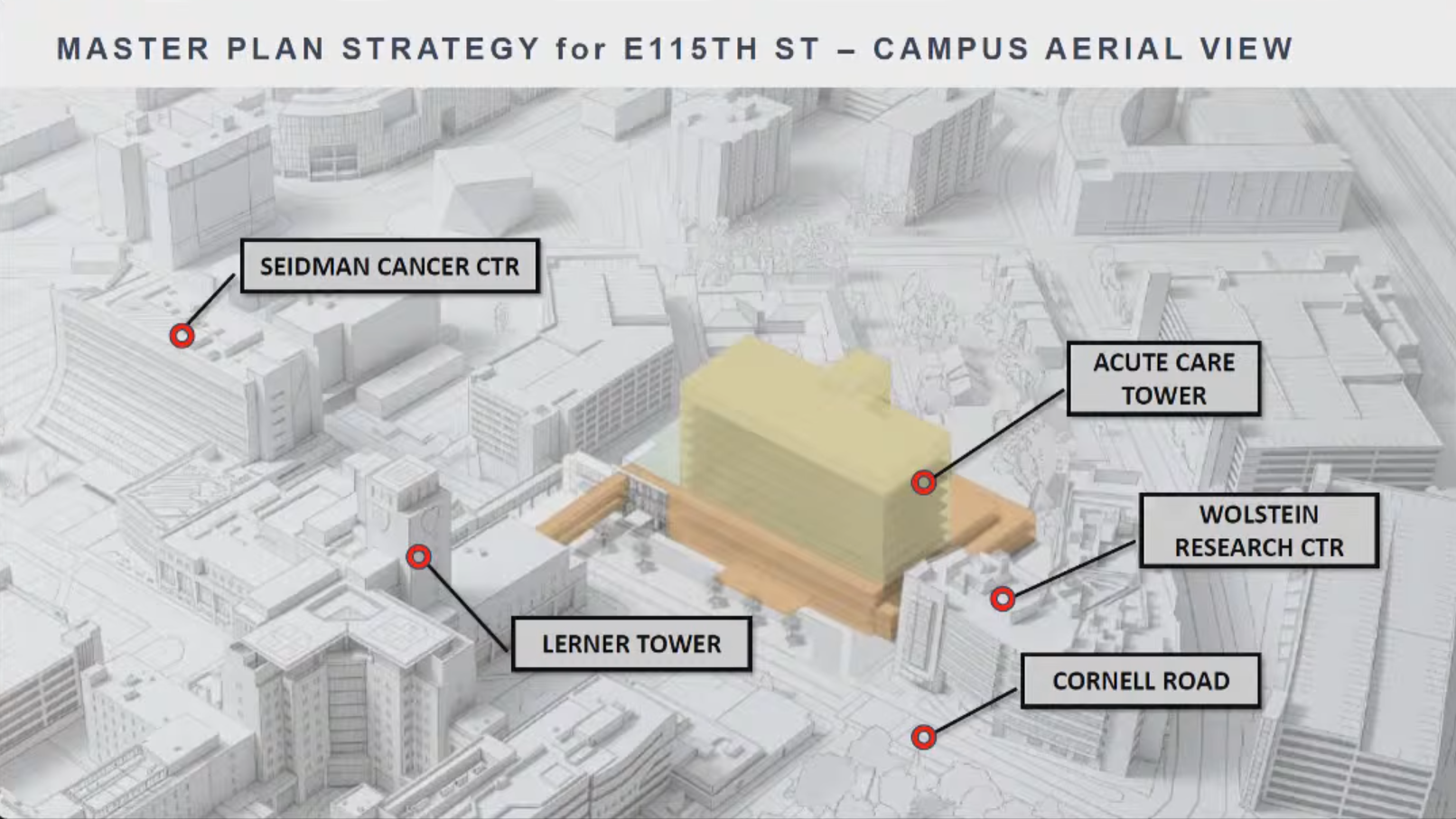
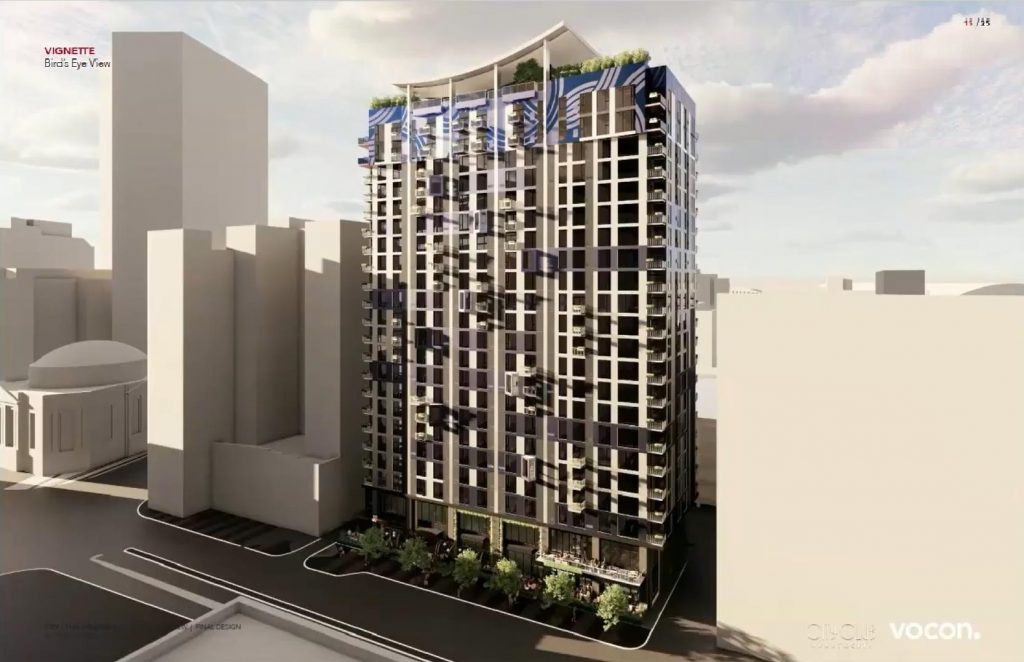
While UH sought conceptual approval at Friday’s meeting, they hinted at a new acute care tower proposed as part of the permanent use for the demolition site (University Hospitals, LevelHEADS).
The current pedestrian path is not highly visible and sandwiched between the demolition properties and the Wolstein Research Center. Hospital representatives also plan to completely rebuild East 115th to mitigate what they say are deteriorating sidewalk and pedestrian facilities.
In a potential phase two, UH will return to the commission for approval to demolish the Fayne and Foley Buildings on Cornell Road as part of the final condition. First revealed in Friday’s presentation were plans for either a new acute care tower or another parking garage to replace the temporary parking.
City planning staff felt that their future plans for the temporary lots were sufficient for final approval, “just understanding the circumstances that have taken place on East 115th.” The commission approved the demolitions unanimously with the condition that UH return to the local design review committee on landscaping plans.
“I think the fact that you are trying to save and salvage some of the homes to sort of create a more solid anchor next to the Cozad Bates is commended. Your thoughtfulness about how pedestrians come and go to your facility… I think you’ve demonstrated in my opinion a true honesty about how you want to approach this,” said Vice Chair Fluker.
END